Romans 11 and the parable of the olive tree

Romans 11 and the parable of the olive tree

In Romans 11, Paul finally answers the question he’s been dancing around since ch. 9: what is God’s plan for the people of Israel?

  • He’s defended God against false accusations (Rom 9:6-29).
  • He’s told us the nations have obtained righteousness from God, even though they didn’t pursue it. However, the people of Israel have come up empty. “But Israel, chasing after law as the means of righteousness, didn’t achieve that goal. Why not? Because they’re chasing righteousness not by means of faith, but as if by means of works,” (Rom 9:31-32; my translation).
  • Paul explained: “… because they don’t know the special righteousness which God offers and are trying to set up their own righteousness, they haven’t submitted themselves to this one-of-a-kind righteousness from God,” (Rom 10:3; my translation).[1]

So, in Romans 11, Paul at last answers the question. But we’re making a mistake if we reduce this to an academic question about “Israel.” The real question is: “how will God’s divine rescue plan come together?” Christians sometimes have incomplete ideas about this—they either ignore His promises to the people of Israel or maximize those promises and lose sight of the whole. So, how will God’s plan come together, and what will it look like when it’s finished?

1. God hasn’t rejected the people of Israel (vv. 11:1-6)

God has not rejected His people.[2] Perhaps a better translation is “repudiate,”[3] which gives the idea of to thrust or drive away[4]—to cast off, disown, to refuse to be associated with.[5] How could God have disowned His people if Paul himself is a native Israelite (Rom 11:1)? God has known the people of Israel for a long time[6]—He has a relationship with them (Rom 11:2). It is not over for them.

So, what’s happening, then? Why have the people of Israel not accepted Jesus as their Messiah? Does God intend to rescue (a) all the people of Israel, or (b) a group from within the larger number?

Paul explains that, for the moment, God is working through a remnant. Just as He reserved a small core of people for Himself during the prophet Elijah’s day, “[s]o too, at the present time there is a remnant chosen by grace,” (Rom 11:5). And, then and now, these are people God has reserved for Himself—salvation is ultimately the result of God’s specific grace(Rom 11:4).[7] Whatever God is up to, for right now He’s only rescuing a smaller group of Jewish people.

This rescue is by means of grace, not by means of works[8]—or else it wouldn’t be called “grace” (Rom 11:6). This is what the people of Israel had missed (Rom 9:30 – 10:4). If I owe you money, when I pay you it’s not an expression of love or friendship—it’s a business transaction. With God, His divine favor and love is a gift, not a business transaction.

2. Instead, God is punishing the people of Israel (vv. 11:7-10)

So, if God hasn’t repudiated the people of Israel, what is He doing with them?

The people of Israel had chased after righteousness but missed the boat. The chosen ones among them had made it, “but the others were hardened,” (Rom 11:7). The idea here is a divine blinding, a veil of sorts, a darkening of the mind—a mental block that makes them “not get it.”[9]

This is a punishment which follows the failed chase—“God permits them to become entangled in their own No.”[10] If God is God, then He has the power to act upon our hearts and minds so that we make real, voluntary decisions, but in the manner He wants (cp. Jn 12:39-40). God channels our desires towards the goal He’s determined. This is not a new thing:

  • When Moses preached to the people of Israel on the eastern banks of the Jordan River, he recounted Israel’s long and sad tale of disobedience. Paul quotes Moses here in support: “God gave them a spirit of stupor, eyes that could not see and ears that could not hear, to this very day,” (Rom 11:8; quoting Deut 29:4).
  • King David called out to God in misery and asked for judgment on his enemies: “May the table set before them become a snare; may it become retribution and a trap. May their eyes be darkened so they cannot see, and their backs be bent forever,” (Rom 11:9-10; quoting Ps 69:22-23).

Paul says the same thing has happened to the people of Israel. God hasn’t repudiated or disowned them—He’s punishing them.

3. What’s the point of God’s punishment? (vv. 11:11-32)

Paul writes:

So, I’m asking: “they didn’t stumble and ruin themselves, did they?” May it never be! Instead, because of their false step, the divine rescue [goes] to the nations, so that it will make the people of Israel jealous.[11]

Romans 11:11; my translation

There you have it. Israel’s “false step” or “trespass—their rejection of Christ as the long-promised prophet, rescuer, and king—triggers God’s pivot to the nations. God is making the people of Israel jealous, envious (cp. Rom 10:19). Interestingly, Paul’s focus is not the nations per se. Instead, he frames the people of Israel as the hinge upon which God’s whole rescue plan turns.[12] The idea is that the people of Israel will see God showing love + grace to the nations, become jealous, re-evaluate, then choose divine rescue through Jesus.

This obviously hasn’t yet happened. Right now, the people of Israel either (a) don’t care, or (b) reject Christ. The people of Israel will never become jealous unless they first agree that Jesus is their Messiah. For example, one kid won’t be jealous of the other’s cookie unless they both agree the cookie is worth having! I’m not jealous if my wife eats plain Lays potato chips, because I don’t like plain Lay’s potato chips.

So, when will God change their minds and make the people of Israel jealous, so they’ll want Jesus as their king, too? During the Millennium (see Zech 12:10ff). But Paul ignores this question—he homes in on “the nations” who will read his letter. He deploys a sort of parable to explain God’s divine rescue plan.

3.1. The parable of the olive tree (vv. 11:13-24)

Paul is the apostle to the nations. But, along the way, he hopes to “somehow arouse my own people to envy and save some of them,” (Rom 11:14). Remember that, for the moment, God is saving a remnant of the people of Israel and Paul aims to scoop some of them up as he goes along. He declares “if the root is holy, so are the branches” (Rom 11:16). That is, if the people of Israel are the channel for all the covenants, the patriarchs, the promises (Rom 9:3-5)—i.e., “the root” of the Christian family—then surely the “branches” downstream of the patriarchs (the people of Israel alive in this present age) have a future, too.[13] Their restoration will be like a resurrection from the dead (Rom 11:16)!

Paul now segues into the olive tree parable:

If some of the branches have been broken off, and you, though a wild olive shoot, have been grafted in among the others and now share in the nourishing sap from the olive root, do not consider yourself to be superior to those other branches.

Romans 11:17-18

God has broken some of these downstream Israelite “branches” off, and grafted non-native “olive shoots” into the tree. They “now share in the nourishing sap from the olive root.” This is not a substitution or a replacement—it is an unexpected addition. Both (a) the native branches which remain, and (b) the non-native branches which God has added to the tree, partake of the same nutrients from the same root. “The Gentiles nourish themselves on the rich root of the patriarchal promise”[14] because, as the apostle writes elsewhere, “if you belong to Christ, then you are Abraham’s seed, and heirs according to the promise,” (Gal 3:29).

Because these new “olive shoots” are non-native, they mustn’t become arrogant. “You will say then, ‘Branches were broken off so that I could be grafted in,’” (Rom 11:19). This is true, but the people of Israel were “hardened” or “blinded” (i.e., branches cut off from the tree) because of their unbelief. In contrast, the nations (i.e., the non-native olive shoots) only remain “in” this tree and stand firm because of faith. Faith is the determining factor, so “[d]o not be arrogant, but tremble,” (Rom 11:20).

If you ever get to the point that you think your relationship with God is because of who you are, what you’ve done, what you bring to the table—that it’s about something other than faith + trust in Jesus (Rom 11:20)—then you’ll be cut out of the tree just as surely as the people of Israel have been (Rom 11:22).

The players in the parable are now clear:

One olive tree → One family of God

Two types of branches on this tree → Two different people groups within God’s family

There is (a) one family of God, (b) from two different places, (c) drawing on the same Lord, the same faith, the same baptism (Eph 4:5; i.e., the same sap). There is one flock, governed by the same shepherd and king. There is the same divine rescue, the same love, the same grace, the same forgiveness. This is the secret or mystery which has now been revealed by the Holy Spirit to God’s apostles and prophets: “the secret is that, through the Good News, the nations are fellow-heirs, and united in one family, and sharers together in God’s promise in relationship with Christ Jesus,” (Eph 3:6, my translation).

  • Jesus spoke of “other sheep” that were not native to His flock: “I must bring them also. They too will listen to my voice, and there shall be one flock, and one shepherd,” (Jn 10:16).
  • John wrote that the high priest Caiphas spoke better than he knew when he suggested it would be for the greater good if they killed the troublesome Jesus: “[H]e prophesied that Jesus would die for the Jewish nation, and not only for that nation but also for the scattered children of God, to bring them together and make them one,” (Jn 10:51-52). This refers to the nations.
  • The prophet Isaiah records the words of the mysterious “suffering servant” as he recalls Yahweh’s instructions. It wasn’t enough for the Servant to just rescue the people of Israel: “I will also make you a light for the Gentiles, that my salvation may reach to the ends of the earth,” (Isa 49:6).

This means Paul’s olive tree parable is a restatement of an old promise in new clothes. And to be sure, it’s not over for the people of Israel (cp. Rom 11:11)—“if they do not persist in unbelief, they will be grafted in, for God is able to graft them in again,” (Rom 11:23).

3.2. This parable means the people of Israel have a future (vv. 11:25-32)

Paul is using the parable of the olive tree to explain God’s rescue plan—how does the tree come to its finished form? It will be a three-step process:

I do not want you to be ignorant of this mystery, brothers and sisters, so that you may not be conceited: Israel has experienced a hardening in part until the full number of the Gentiles has come in, and in this way all Israel will be saved.[15]

Romans 11:25-26

It’s never been a secret that God plans to rescue His people. What has been a secret is the specific way this rescue plan happens. Paul doesn’t want the nations to be in the dark any longer, else they might become arrogant and think themselves wiser than they are. Here, Paul writes, is the mystery:

  • First, the most people of Israel do not believe God’s good news of righteousness as a gift, by means of faith. Instead, they choose to pursue it by means of “resume-ism.” So, this majority of Israelites are the branches whom God has “broken off” and to whom He’s temporarily sent “blindness” and “hardness of heart”—a dullness of spirit.
  • So, second, God has now pivoted to the nations and to the Jewish remnant—the “wild olive shoots” are being grafted into the tree. This present stage of God’s rescue plan will last “until the full number of the nations have entered in” and joined God’s kingdom family, at which time God lifts the divine “blindness” and rescue operations will proceed for the people of Israel.
  • And so, third, this is how “all Israel will be rescued.”

The “all Israel” refers to the ethnic Jewish people who are alive at the time God moves to the third stage, after the full number of the nations have entered the family.[16]

  • It cannot mean “every Jewish person who ever lived.” God isn’t a universalist (even at the sub-category level), and it would be absurd to suppose Caiphas will be walking the streets of glory.
  • Paul isn’t referring to a re-defined “Israel” consisting of all true believers (cp. Gal 3, 6:16; Rom 4). His focus here in Romans 9-11 is ethnic Jewish people.
  • He isn’t referring to all “true” ethnic Jewish people from all time, because Paul’s burden in Romans 9-11 is to explain what’s happening to the people of Israel right now in relation to His divine timetable.

But, through it all, it’s still the same Jesus, the same king, the same divine rescue mission. Two people groups merged into the same family, the same tree, partaking of the same “sap.” God has not pushed away the people of Israel—there is (a) the remnant which can meanwhile choose to pursue God by means of faith, and (b) the entire number of Jewish people who will embrace Jesus as Messiah after the full number of the nations have come in. The people of Israel “are loved on account of the patriarchs, for God’s gifts and his call are irrevocable,” (Rom 11:28-29).

This three-stage rescue plan, culminating in God rescuing all the ethnic people of Israel then alive when Christ returns, is just what scripture foretold (“as it is written,” Rom 11:26). The prophet Isaiah tells us that one day the Lord looked about and saw the human situation was hopeless—that He Himself must enter the arena to set things right. “So his own arm achieved salvation for him, and his own righteousness sustained him,” (Isa 59:16). And so the Redeemer would one day come to Zion—“to those in Jacob who repent of their sins” (Isa 59:20). The covenant Yahweh swore to make with His people would take away their sins, because “My Spirit, who is on you, will not depart from you,” (Isa 59:21). The apostle quotes the former citation and paraphrases the latter as support for a future for the people of Israel (Rom 11:26b-27).

4. One God and father of all

Paul never again probed so far behind the divine curtain. The see-saw of God’s rescue plan—Israel, then the nations, then Israel again (Rom 11:12, 30-32)—overwhelms him. “How unsearchable his judgments, and his paths beyond tracing out!” (Rom 11:33).

Commentators have spilt gallons of ink and gigabytes of megapixels on interpreting this passage—especially Romans 11:25-26. What is clear is that the people of Israel have a future. It’s not a “blank cheque” future which encourages a laissez-faire life of spiritual fakery. Nor is it a “I’ll never get tickets to the show!” kind of defeatism that one has when trying to purchase Taylor Swift concert tickets. There will be more than a “lucky few” Israelites grafted back into God’s olive tree! It is a real future—(a) the remnant chosen by grace now, followed by (b) “all Israel” present here when Christ returns later.

Yes, God has unfinished business with Israel during the Millennium, but that is merely the last stop before journey’s end. The “Israel maximizers” make a mistake if they hop off the train here,[17] because there is yet one more stop to go. The train decommissions in Revelation 22, when there will be one family, one tree, “one God and Father of all, who is over all and through all and in all,” (Eph 4:6). God will restore Eden, and the tree of life will be available to all “for the healing of the nations” (Rev 22:1-5).

Of course, Paul doesn’t discuss that here. But the people of Israel will be there … along with all the other nations who are blessed through Abraham (Gal 3:8) and have become His offspring.


[1] Gk: ἀγνοοῦντες (adverbial, causal) γὰρ (explanatory) τὴν (monadic) τοῦ θεοῦ (gen. source) δικαιοσύνην καὶ τὴν ἰδίαν (δικαιοσύνην) ζητοῦντες (adverbial, causal—paired with ἀγνοοῦντες) στῆσαι (BDAG, s.v., sense 3; anarthrous, complementary), τῇ δικαιοσύνῃ (monadic) τοῦ θεοῦ (gen. source) οὐχ ὑπετάγησαν (passive w/middle sense, constative).

[2] The fact that the people of Israel are “his people” (τὸν λαὸν αὐτοῦ; Rom 11:1) is significant.

[3] BDAG, s.v. “ἀπωθέω,” sense 2; p. 126.

[4] LSJ, s.v. “ἀπωθέω,” senses 1, 2; p. 232.

[5] OED, s.v. “repudiate,” senses 1a, 2a.

[6] It goes too far to plead that “foreknow” here (προέγνω) means something like “to choose beforehand.” The word can bear that meaning (e.g. 1 Pet 1:20), but the more common use is just “to know beforehand or in advance” (BDAG, s.v., sense 1, p. 966) or to “foreknow” (LSJ, s.v., sense 3). Reformed exegetes who wish to carry water for unconditional single election will find fertile ground elsewhere in scripture, but Romans 11:2 is not the place to plant that flag.

[7] The 1833 New Hampshire Confession explains: “… regeneration consists in giving a holy disposition to the mind; that it is effected in a manner above our comprehension by the power of the Holy Spirit, in connection with divine truth, so as to secure our voluntary obedience to the gospel,” (Article VII).

[8] Gk: εἰ δὲ χάριτι (dative of means), οὐκέτι ἐξ (means) ἔργων.

[9] See BDAG, s.v. “πωρόω,” and LSJ, s.v., sense 3.

[10] Emil Brunner, The Epistle to the Romans, trans. H.A. Kennedy (Philadelphia: Westminster, 1959), p. 94.

[11] Λέγω οὖν, μὴ ἔπταισαν (fig. for “sin”) ἵνα πέσωσιν (result clause; BDAG, s.v., sense 2b); μὴ γένοιτο· ἀλλὰ τῷ αὐτῶν (dir. obj) παραπτώματι (dat. reason) ἡ σωτηρία (monadic article) τοῖς ἔθνεσιν (implied verb of “going,” dir. obj.) εἰς τὸ παραζηλῶσαι (purpose clause) αὐτούς (dir. obj. of infinitive—refers to people of Israel).

[12] John Murray, The Epistle to the Romans, vol. 2 (Grand Rapids: Eerdmans, 1965), p. 76.

[13] Leon Morris, The Epistle to the Romans (Grand Rapids: Eerdmans, 1988), pp. 411-412.

[14] Brunner, Romans, p. 96.

[15] Gk: Οὐ γὰρ θέλω ὑμᾶς ἀγνοεῖν, ἀδελφοί, τὸ μυστήριον τοῦτο (dir. obj.), ἵνα μὴ ἦτε (purpose clause) παρʼ ἑαυτοῖς φρόνιμοι. ὅτι (appositional—explains the mystery) πώρωσις ἀπὸ μέρους (paired to τῷ Ἰσραὴλ) τῷ Ἰσραὴλ (dative of reference) γέγονεν ἄχρι οὗ τὸ πλήρωμα τῶν ἐθνῶν (partitive) εἰσέλθῃ 26 καὶ (conclusion) οὕτως (adverb of manner) πᾶς Ἰσραὴλ σωθήσεται, καθὼς γέγραπται.

“Now, I don’t want you all to be in the dark about this secret, brothers and sisters, so that you won’t think you’re wiser than you are. The secret is that a dullness of spirit has come upon some of the people of Israel until the full number of the nations have entered in. And so, that is how all Israel will be rescued …”

[16] “… Paul speaks of a future salvation of ethnic Israel near or at the return of Jesus Christ,” (Tom Schreiner, Romans, in BECNT, 2nd ed. (Grand Rapids: Baker, 2018), pp. 598ff). See also Douglas Moo, The Epistle to the Romans, in NICNT (Grand Rapids: Eerdmans, 1996), p. 723.

[17] Tom Schreiner rightly warns: “The purpose of this revelation is not to titillate the interest of the church or to satisfy their curiosity about future events. The mystery is disclosed so that the gentiles will not fall prey to pride …” (Romans, p. 595).


The Bible–Puzzle or Telescope?

The Bible–Puzzle or Telescope?

We need to read our bibles. God wants us to read our bibles—it is the story of Him revealing hidden things to us we would otherwise never know! Fair enough. But I first want to ask an important question—what is the best way to think of the Scriptures?

Different Christians answer in different ways; most often as the result of the different emphases of their theological traditions mediated from seminaries to pastors. How you answer the question above will determine what you think happens when you read your bibles. Only one of these answers is the best answer—which one is it?

We will first take a look at a passage from Psalm 119, then look at two possible frameworks for reading Scripture (a puzzle or a telescope?), then wrap up with what I feel is the best approach.

Words Which Give Light

Psalm 119 is a beautiful love song to God’s revelation. Today, on this side of the Cross, we often assume the psalmist is simply talking about the Bible (e.g. “I have hidden your word in my heart,” Psalm 119:11). But he was probably talking about revelation in a general sense.

“Revelation” is when God personally unveils Himself to His people to communicate things we would otherwise never know.[1] God revealed Himself in many ways—through visions, prophecies, individual guidance, dreams, divine appearances, angels, direct speech, most definitively in Jesus Christ (God’s “Word” (Jn 1:1, et al), His revelation, message, and literal speech embodied in the incarnation) … but also in written records. Strictly speaking, the bible is more an inspired and truthful record of God’s revelations than “the” revelation all by itself.[2] My point is that, while my comments here will focus on the Scriptures, all references in Psalm 119 to “the word” are probably about more than “the bible.”

Think about what the psalmist says in Psalm 119:129-136. He says God’s statutes are wonderful, and this loveliness drives him to loving obedience (Ps 119:129). This is not the rote obedience of a legalist, but the joyful response of a good child. He declares “the unfolding of your words gives light; it gives understanding to the simple,” (Ps 119:130). As God communicates to us (however He does it—“words” here means “speech”), His light shines into us, bringing understanding even to the most ordinary among us. God’s speech, His message, unspools and casts light into our hearts, minds, and souls—into our very being. 

So, the psalmist wants more and more—“longing for your commands,” (Ps 119:131). He wants more light, more understanding, more relationship. He wants to be a better child. He knows relationship with God is not about rote doctrine. “[R]evelation is primarily a spiritual transaction rather than mere illumination of the intellect … [i]t is easy to see how far removed this is from the bare communication of truth to the mind.”[3] It is “those who love your name” (Ps 119:132) who receive mercy, not “those who follow the checklist.”

So, when the psalmist asks God to “direct my footsteps according to your word” (Ps 119:133), he is asking for more than “help me not do that bad thing again.” There is that, but the reason why he asks “let no sin rule over me” is because he loves God and wants to be an obedient child (cp. Deut 6:4; Mk 12:28-32; Mt 9:13 (cf. Hos 6:6)). He even asks to be rescued from those who hinder him from obeying God’s precepts (Ps 119:134).

When he asks “make your face shine on your servant” (Ps 119:135), he is playing on God’s personal revelation as a luminescent cloud. Just as Moses came down from the mountain with his face all aglow from actual contact with Yahweh, so the psalmist figuratively asks for God to turn to him with blessing, with favor, with divine help—“teach me your decrees.” His love for God flows so deep that “streams of tears flow from my eyes, for your law is not obeyed,” (Ps 119:136). This is not the fuming rage of a legalist (cf. Jn 9:19-34), but the sorrow of a child brokenhearted about externalism in the congregation.

As we consider the psalmist’s attitude about God’s revelation, His “word” (in any format), let us return to the question I asked at the beginning—what is the best way to think about the Scriptures?

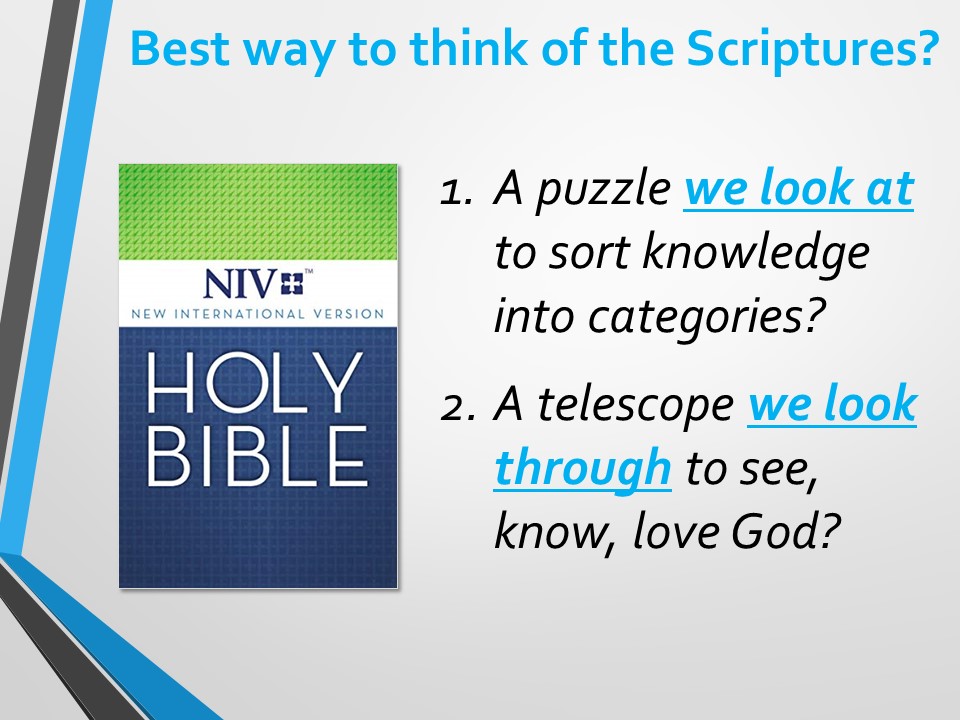
  1. a puzzle piece we look at to categorize knowledge, or
  2. a telescope we look through to see, know, experience, and love God?

Which model does our passage best suggest? To answer this question, we will consider each model in turn.

Bible as a Puzzle

When you believe the bible is one big puzzle to be sorted into categories, with various passages filed under this heading or that (“the proper task of theology is to exposit and elucidate the content of Scripture in an orderly way”),[4] then you may tend to read in a cold, analytical, and sterile fashion. It does not mean you will have this attitude—it just means you may lean in that direction, to greater or lesser extent.

  1. Faith can unwittingly become about intellectual knowledge. Do you believe Jesus is the Son of God? Do you believe in the virgin birth? Do you believe Jesus died on the Cross? Do you believe in the resurrection? And so it goes—intellect can unconsciously supplant trust, love, and commitment.
  2. And so, bible study can unconsciously degenerate into an autopsy—cold, dispassionate, clinical.
  3. We end up reading the bible for doctrine, for knowledge—not for love (notwithstanding the honest caveats).

This is often more an attitude or ethos than a conscious decision. Let me share one example from one very influential evangelical theologian from yesteryear. He is discussing the definition of “revelation.”

I have learned a lot from Carl Henry. I like Carl Henry. But, where is the love? Henry saw the Scriptures as a puzzle to be sorted, filed, indexed. A theologian was like a lawyer preparing a brief—“logical consistency is a negative test of truth and coherence a subordinate test.”[5] He looked at Scripture to find truth. This mindset may produce something like the following, which is largely a precis of some of Henry’s system:

  1. God reveals Himself through the bible—all knowledge (even revelation about Christ[6]) flows from the Scriptures. It is the “basic epistemological axiom.”[7]
  2. God does not reveal Himself as personal presence. That would open the door to a subjective mysticism. Instead, He reveals Himself via propositions—“a rational declaration capable of being either believed, doubted, or denied.” Revelation must be cognitive, which means it must be propositional, which means the Scriptures are the ballgame,[8] and the implication is the bible is a storehouse of data.
  3. Therefore, the Spirit’s job in this context is to help us interpret this data that is the bible. He has no meaningful role apart from this.[9] Henry saw danger when the Spirit was “severed from the Word,” and by “Word” Henry meant the Scriptures, not Jesus.[10] Representing this perspective downstream from Henry, John MacArthur did not misspeak when he wrote that the bible “is the only book that can totally transform someone from the inside out.”[11] It is telling that MacArthur did not credit Jesus with granting life, but rather the bible (energized with “Spirit-generated power”).[12]
  4. So, the most important thing we can do is study the bible. “Only the Bible can effect that kind of change in people’s lives, because only the Bible is empowered by the Spirit of God.”[13] The inevitable corollary is a strong defense of Scripture’s integrity, which explains the emphasis from these quarters on Scripture’s inerrancy.
  5. And so, our focus may subtly shift from relationship with the Messiah to whom the bible points, to “the bible” itself—to doctrine, knowledge, cold logic. Henry did not think rationalism was an error, so long as it was based on valid premises.[14]
  6. The bible becomes, de facto, the only channel for relationship with God. This is why many Christians who trend towards “knowledge” as their relationship paradigm for God are very uncomfortable with the “Jesus reveals Himself to Muslims via dreams” issue—because the bible is not in the driver’s seat. In a similar way, these Christians often speak about the Spirit to say what He does not do—it is frequently negative. I suspect these Christians are wary of something non-rational, something supernatural, something they cannot understand with the intellect.[15]

Here is an example. Sometime in years past, I was with a group of pastors, and we were discussing the “problem of evil.” One pastor brought up an example of someone who “walked away from the faith” after suffering sexual abuse as a teen. The woman told her pastor that, if her abuser ever became a Christian, “I could never share heaven with him!” 

A man in the group stabbed the air with a forefinger. “Her attitude is that ‘I’m more righteous than God, and so I’m more qualified to make a decision about that person’s fate!’”

There was a moment of silence. I suggested, “Maybe she’s just really hurting? Maybe that’s all that was behind that comment.”

You see, to him, there is not a person here with feelings—there is only icy logic, a remorseless conclusion based on theology. He did not see people who hurt—he saw problems to be categorized into doctrinal cubbyholes, to be sorted, filed, tagged. In practical terms, he unwittingly acted as if the Bible were a cadaver, and the question at hand was an excuse to grab a scalpel, slice it open, and pick at it. This man read the bible for knowledge. It was cold. Clinical. There was no love.

Of course, not everyone is like that pastor. But, some pastors (and some ordinary Christians) are not too far downstream from this. There is a better way!

Bible as a Telescope

At the back of all this is this question—what is a relationship with God about? There is a continuum, with “love” and “knowledge” at opposite poles. A ditch lies at either end—God is either Jello or an iceman. Both poles are important (it is kind of important to know about God, after all!), but you will likely tend towards one over the other—Carl Henry certainly did.

So, let me declare this—love must be the foundation for your relationship with God. Moses said it. Jesus affirmed it. I think that is pretty definitive! On this continuum, trend towards love.

If you think faith is about love and trust in Jesus, you will look through the bible to connect to God. But, if you think faith is about information about Jesus, then you may look at the bible as an end in and of itself. This last approach misses the point.[16]

Let me give you a few examples:

  1. You love espresso. You have an expensive espresso machine. Which is more important—the machine or the espresso it produces? The espresso, of course! Suppose someone objects, “Well, without the machine, we wouldn’t have espresso!” This is missing the point—the goal is to drink espresso! The machine is only valuable insofar as it makes the coffee.
  2. You have a telescope. It is a great telescope—the best! You set it up in your backyard, ready to go. Someone keeps gushing about the telescope; its the features and its general awesomeness. “Isn’t it great?” he asks. It might be a wonderful telescope, but the goal is to look through the scope to see the heavens! The telescope is not the point—it is simply a means to a greater end. It is a tool. To obsess over the telescope is to miss the point.

What I am suggesting is that the bible is a telescope. It lets us see, know, and experience God. It channels God, by the power of the Spirit. It does not exist for its own sake—its only job is to provide a scope to look through to see God and experience Him. We do not look at a telescope—we look through it to see the heavens. In the same way, you look through the Scriptures to see God—you do not look at it!

We saw from our text that as God’s revelation unfolds to us, it brings “light” to our eyes, giving understanding to the simple (Ps 119:130). The Scriptures (God’s truthful record of His revelation) are a telescope which bring God into focus, make Him present, confront us with Him for teaching, rebuking, correction, for training in righteousness (2 Tim 3:16)—“direct my footsteps according to your word” (Ps 119:133).

In another place, the psalmist says, “Your word is a lamp for my feet, a light on my path,” (Ps 119:105). God’s revelation lights our path so we can find our way to Him, so Jesus—the true light (Jn 1:9)—can shine upon we who are in darkness and guide our feet into the way of peace (Lk 1:79). Elsewhere, Solomon says our spirit is “the lamp of the Lord, that sheds light on one’s inmost being,” (Prov 20:27). We are lamps waiting to be lit by Yahweh—“light and life to all He brings!” (cp. Jn 1:4). His revelation—ultimately Jesus as the light of the world—illuminates us from the inside out. The Scriptures are a witness to that revelation (Jn 5:46)—they connect us to Jesus.

Read the Scriptures with Love!

This is what I’m saying, in the end:

  1. Read the bible to know God, not to know about God. This is not a call to toss doctrine to the winds—it is not a “we don’t need no theology in this here church!” attitude. It is a plea to keep warmth, love, and personal encounter with Christ via the Spirit at the forefront. Carl Henry was right to acknowledge that personal faith is a gift of the Spirit,[17] but I fear some who follow in his theological train unwittingly make the same acknowledgments in a pro forma manner.  
  2. Read the bible to love God, not to love facts about God. The demons know true doctrine and it does them no good (Jas 2:19)! “The purpose of theology [and bible reading!] is to clarify the propositions involved in faith, but we must never mistake belief in propositions for the faith.”[18]
  3. Read the bible to grow closer to Him in relationship, not to pick at Scriptures with tweezers.

I have one more example to give. Many years ago, I spoke to an individual who did not believe spiritual illumination helped us understand the bible. Instead, she said the Spirit “allows me to receive the text as it is.” I asked her to explain. She said the Spirit never helped people agree on what a text means. She said she had people in her church who were more spiritual than she, but worse bible interpreters—thus a person’s spirituality was irrelevant. The matter would always be settled by grammar, syntax, rules of interpretation.

I interrupted and asked her flat out, “Are you saying you never pray and ask to understand the bible?” She grimaced, then stammered a bit. “I don’t want to say the word ‘understand’ …” She then rallied, and repeated that interpretation was always settled by grammar and interpretative rules, and that the Spirit simply “enables me to accept the text as it is.”

Basically, she followed Carl Henry. She looked at the Scriptures to discover truth from the ink on the page or the pixels on the screen—she did not look through them to see, know, experience, and love God. If we are not careful, our faith may grow cold and rational. Emil Brunner remarked that “[t]his confusion, this replacing of personal understanding of faith by the intellectual, is probably the most fatal occurrence within the entire history of the church.”[19]

We need to read our bibles, but in the right way! 

  1. I like my espresso machine, but only because through it I see my espresso—the machine is a means to an end.
  2. We love our bibles, but only because it is a telescope we look through to see, know, and love God.
  3. The bible in your hand is God’s divine means to an end, and that end is a relationship with Him.
  4. It is not a puzzle we look at—it is a telescope we look through.

So, when you read your bibles, read them with an attitude of love—not the attitude of a mortician—so that through the Scriptures you can see, experience, and love God. Read for formation, not simply for information.[20]


[1] See Edgar Mullins, The Christian Religion in its Doctrinal Expression (Philadelphia: Roger Williams Press, 1917), p. 141. 

[2] This need not be categorized as a neo-orthodox statement. Long before Barth or Brunner put pen to paper, Edgar Mullins repeatedly called the Scripture “the record of God’s revelation,” (Christian Religion, pp. 137, 140, 142), as did Alvah Hovey before him (Manual of Christian Theology (New York: Silver, Burdett and Company, 1900), pp. 42, 85.   

[3] Mullins, Christian Religion, p. 141. 

[4] Carl F.H. Henry, God, Revelation, and Authority, vol. 1 (Waco: Word, 1976), p. 238. See especially ch(s). 13-14.

[5] Henry, God, Revelation, and Authority, p. 1:232. 

[6] To Henry, the Scripture is the reservoir or conduit of divine truth (Thesis No. 11, God, Revelation, and Authority, vol. 4(Waco: Word, 1979), p.7). It is the end of the line. The Spirit’s role in this context is to illuminate the Scripture (see Thesis No. 12, God, Revelation, and Authority, p.4:129) by enlivening it so we understand what it says. He only helps us interpret but imparts no new information (God, Revelation, and Authority, pp. 4:273, 275)—this is illumination, according to Henry. The Christian looks at the Bible as an end in and of itself.

[7] Henry, God, Revelation, and Authority, pp. 1:218f. 

[8] See Henry, God, Revelation, and Authority, pp. 3:455-459. 

[9] To Henry, the Scriptures are the vehicle and the Spirit simply shines a light upon them. “God intends that Scripture should function in our lives as his Spirit-illumined Word. It is the Spirit who opens man’s being to a keen personal awareness of God’s revelation. The Spirit empowers us to receive and appropriate the Scriptures, and promotes in us a normative theological comprehension for a transformed life. The Spirit gives a vital current focus to historical revelation and makes it powerfully real,” (God, Revelation, and Authority, p. 4:273).   

[10] Henry, God, Revelation, and Authority, pp. 3:482f. “The Bible supplies no basis for the theory that the logos of God must be something other than an intelligible spoken or written word.”

[11] John MacArthur (ed.), The Inerrant Word: Biblical, Historical, Theological, and Pastoral Perspectives (Wheaton: Crossway, 2016), p. 19.

[12] This relentless focus on the Scriptures to the exclusion of anything else led Emil Brunner to intemperately accuse such adherents of idolatry. “The habit of regarding the written word, the Bible, as the ‘Word of God’ exclusively—as is the case in the traditional equation of the ‘word’ of the Bible with the ‘Word of God’—an error which is constantly on the verge of being repeated—is actually a breach of the Second Commandment: it is the deification of a creature, bibliolatry,” (Revelation and Reason: The Christian Doctrine of Faith and Knowledge, trans. Olive Wyon (Philadelphia: Westminster, 1946), p. 120). 

[13] MacArthur, Inerrant Word, p. 20. 

[14] “The Christian protest against rationalism in its eighteenth-century deistic emphasis on the sufficiency of human speculation unenlightened by divine revelation is legitimate enough. What is objectionable about rationalism is not reason, however, but human reasoning deployed into the service of premises that flow from arbitrary and mistaken postulations about reality and truth. Christian theology unreservedly champions reason as an instrument for organizing data and drawing inferences from it, and as a logical discriminating faculty competent to test religious claims,” (God, Revelation, and Authority, p. 1:226). Emphasis added.

[15] Carl Henry wrote, “There is but one system of truth, and that system involves the right axiom and its theorems and premises derived with complete logical consistency,” (God, Revelation, and Authority, p. 1:227). 

[16] For the position I am advocating, see especially (1) Emil Brunner, Revelation and Reason, pp. 3-57, 118-136, and (2) William Hordern, A New Reformation Theology (Philadelphia: Westminster, 1959), pp. 31-76.  My telescope analogy is from Hordern (p. 70). For a helpful cautionary note hitting the brakes on Brunner (et al) while disagreeing with Henry’s more rationalistic perspective, see Millard Erickson, Christian Theology, 3rd ed. (Grand Rapids: Baker, 2013), pp. 157-163. See also James L. Garrett, Systematic Theology, vol. 1 (Grand Rapids: Eerdmans, 1990), pp. 168-182 for a solid, helpful discussion on the bible and authority in Christianity.   

[17] Henry, God, Revelation, and Authority, p. 1:228.

[18] Hordern, New Reformation Theology, p. 72.  

[19] Emil Brunner, Truth as Encounter: A New Edition, Much Enlarged, of ‘The Divine-Human Encounter’ (London: SCM Press, 1964), p. 165.   

[20] Justo Gonzalez, Knowing Our Faith: A Guide for Believers, Seekers, and Christian Communities (Grand Rapids: Eerdmans, 2019), p. 27. “… our main purpose in reading the Bible must not be information, but rather formation. When we read, for instance, the story of Abraham, what is important is not that we learn by heart the entire route of his pilgrimage, but rather that somehow we come to share that faith which guided him throughout his journey.”

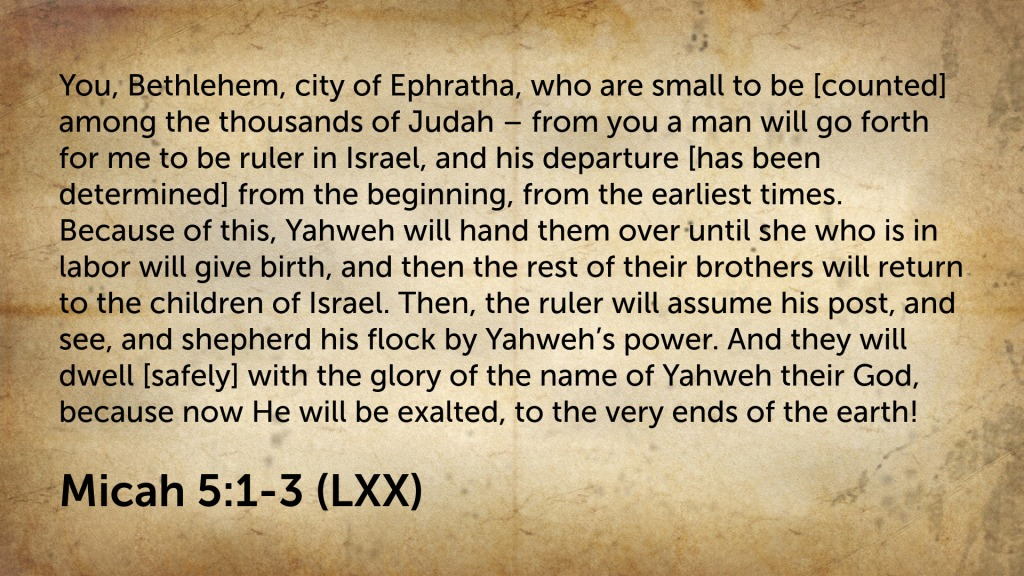
My Translation of Micah 5:1-3

The prophet Micah wrote a wonderful prophesy about Jesus Christ, the One who would come forth for God to be the ruler par excellence in Israel. I’ve spent some time translating the passage from the Septuagint; the Greek translation of the Hebrew Scriptures which Jesus and the early Christian used. I plan to write a bit about this passage soon. For now, I’ll just leave you with the translation.

There are some differences from the English translation in your Bibles, because they’re translated from Hebrew, not Greek. The verse numbers from the Septuagint are also different, sometimes. This is one of those times. In your English Bibles, this passage will be Micah 5:2-4. Here, it’s Micah 5:1-3:

Micah 5(1-3)You can find more of my pitiful translations from the New Testament, the Septuagint and an ancient creed or two here.

Is Inerrancy a Necessary Doctrine?

inerrancyIn the book, Five Views on Biblical Inerrancy, Kevin Vanhoozer (responding to Michael Bird’s essay), wrote:

Why should the rest of the world care about North American evangelicalism’s doctrinal obsession with inerrancy? First, it may be only a matter of time, given globalization and patterns of higher education, until the rest of the world is faced with similar challenges to biblical authority posed by biblical criticism, naturalistic scientism, and skeptical historicism. If you can find McDonald’s or Starbucks in Taiwan and Timbuktu, can Richard Dawkins or Bart Ehrman be far behind?

Indeed!

James Merrick and Stephen Garrett (ed.), Five Views on Biblical Inerrancy (Grand Rapids, MI: Zondervan, 2013; Kindle ed.), KL 3189-3192).

Ehud is . . . Jason Bourne

bourneThe people are downtrodden and oppressed. An evil, pagan king rules over them with an iron fist. Year by year, he demands tribute from his vassals. The people cry out, desperate for somebody to rescue them. There was only one man for the job. A man so cunning, he makes Ethan Hunt look like a child. A man so dangerous, he makes 007 look like a pitiful kitten. A man so deadly, nobody can stop him. That man is . . . Ehud, the original Jason Bourne.

And the people of Israel again did what was evil in the sight of the LORD; and the LORD strengthened Eglon the king of Moab against Israel, because they had done what was evil in the sight of the LORD. He gathered to himself the Ammonites and the Amalekites, and went and defeated Israel; and they took possession of the city of palms. And the people of Israel served Eglon the king of Moab eighteen years.

But when the people of Israel cried to the LORD, the LORD raised up for them a deliverer, Ehud, the son of Gera, the Benjaminite, a left-handed man. The people of Israel sent tribute by him to Eglon the king of Moab.

And Ehud made for himself a sword with two edges, a cubit in length; and he girded it on his right thigh under his clothes. And he presented the tribute to Eglon king of Moab. Now Eglon was a very fat man. And when Ehud had finished presenting the tribute, he sent away the people that carried the tribute.

But he himself turned back at the sculptured stones near Gilgal, and said, “I have a secret message for you, O king.”

And he commanded, “Silence.” And all his attendants went out from his presence.

And Ehud came to him, as he was sitting alone in his cool roof chamber. And Ehud said, “I have a message from God for you.”

And he arose from his seat. And Ehud reached with his left hand, took the sword from his right thigh, and thrust it into his belly; and the hilt also went in after the blade, and the fat closed over the blade, for he did not draw the sword out of his belly; and the dirt came out. Then Ehud went out into the vestibule, and closed the doors of the roof chamber upon him, and locked them.

When he had gone, the servants came; and when they saw that the doors of the roof chamber were locked, they thought, “He is only relieving himself in the closet of the cool chamber.” And they waited till they were utterly at a loss; but when he still did not open the doors of the roof chamber, they took the key and opened them; and there lay their lord dead on the floor.

Ehud escaped while they delayed, and passed beyond the sculptured stones, and escaped to Se-irah. When he arrived, he sounded the trumpet in the hill country of Ephraim; and the people of Israel went down with him from the hill country, having him at their head. And he said to them, “Follow after me; for the LORD has given your enemies the Moabites into your hand.” So they went down after him, and seized the fords of the Jordan against the Moabites, and allowed not a man to pass over. And they killed at that time about ten thousand of the Moabites, all strong, able-bodied men; not a man escaped.

So Moab was subdued that day under the hand of Israel. And the land had rest for eighty years.

Judges 3:12-30


Delighting in God’s Law

33 Teach me, O Lord, the way of thy statutes;
    and I will keep it to the end.
34 Give me understanding, that I may keep thy law
    and observe it with my whole heart.
35 Lead me in the path of thy commandments,
    for I delight in it.
36 Incline my heart to thy testimonies,
    and not to gain!
37 Turn my eyes from looking at vanities;
    and give me life in thy ways.
38 Confirm to thy servant thy promise,
    which is for those who fear thee.
39 Turn away the reproach which I dread;
    for thy ordinances are good.
40 Behold, I long for thy precepts;
    in thy righteousness give me life!

Psalm 119:33-40 (RSV)

Good Book

bookIf you’ve traveled in Baptist fundamentalist circles, then you’ve likely encountered various flavors of King James Only-ism. This is a movement which, to a greater or lesser extent, promotes the King James Bible as the only English translation of the Scriptures for Christians to use.

I do not agree with this movement. I cannot support any movement which elevates a translation above the original Greek and Hebrew text.

If you prefer the Textus Receptus for the New Testament, that is lovely. Good men, like Kent Brandenburg, have written helpful books promoting this printed Greek text, which underlies the KJV, NKJV and the newer Modern English Version. If you prefer the Byzantine Text, fine. If you prefer the eclectic text, such as the UBS-5 or the NA-28, even better!

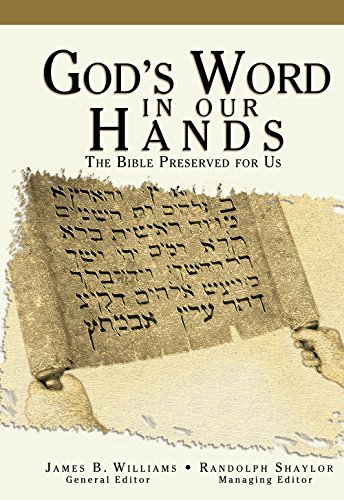
I wanted to recommend a good book about the preservation of Scripture to folks who may want some resources on this issue. What makes this volume unique is that is was written by fundamentalists for people in fundamentalist churches. Here is a synopsis:

The solid facts of the process by which the Bible has come to its present form are explained in detail. The book includes textual criticism of the existing manuscripts and autographs, including the Textus Receptus, the Majority, Eclectic, and Minority texts, and the Masoretic Text. It also provides needed answers to the arguments of those who adhere to extreme or exclusive positions. This book is excellent for pastors, teachers, and laypersons alike. It will prove that all conservative versions are, without a doubt, translations of the plenary verbally inspired Word of God.

The book is entitled God’s Word in Our Hands: The Bible Preserved for Us, and it costs 99 entire cents on Kindle. It’s written in an easy-going, conversational style. You can understand it. Buy it. Read it. Understand it. Use multiple English Bible versions to compare during your devotional reading. Grow in the Lord. 

Goodbye.                                                                   

Are You Blessed?

How blessed is the one whose rebellious acts are forgiven, whose sin is pardoned!

How blessed is the one whose wrongdoing the Lord does not punish, in whose spirit there is no deceit.

When I refused to confess my sin, my whole body wasted away, while I groaned in pain all day long. For day and night you tormented me; you tried to destroy me in the intense heat of summer.

Then I confessed my sin; I no longer covered up my wrongdoing. I said, “I will confess my rebellious acts to the Lord.” And then you forgave my sins.

For this reason every one of your faithful followers should pray to you while there is a window of opportunity. Certainly when the surging water rises, it will not reach them.

You are my hiding place; you protect me from distress. You surround me with shouts of joy from those celebrating deliverance.

I will instruct and teach you about how you should live. I will advise you as I look you in the eye. Do not be like an unintelligent horse or mule, which will not obey you unless they are controlled by a bridle and bit.

An evil person suffers much pain, but the Lord’s faithfulness overwhelms the one who trusts in him.

Rejoice in the Lord and be happy, you who are godly! Shout for joy, all you who are morally upright!

  • Psalm 32 (NET)

Help from the Lord!

mountain

I look up toward the hills. From where does my help come? My help comes from the LORD, the Creator of heaven and earth! May he not allow your foot to slip! May your protector not sleep! Look! Israel’s protector does not sleep or slumber! The LORD is your protector; the LORD is the shade at your right hand. The sun will not harm you by day, or the moon by night. The LORD will protect you from all harm; he will protect your life. The LORD will protect you in all you do, now and forevermore.

  • Psalm 121 (NET)

Why Trust the Four Gospels?

Very good, short (20:00 min) lecture on some reasons why we can trust the Gospels over and against the false, gnostic gospels. If you have a few minutes, this will be time well spent. The man lecturing is Peter J. Williams, Warden of Tyndale House, Cambridge, UK: