In this passage (1 Peter 4:1-6), the Apostle Peter urges Christians to arm themselves with the same selfless mindset that Christ had; “for Christ also died for sins once for all, the righteous for the unrighteous, that he might bring us to God, being put to death in the flesh but made alive in the spirit,” (1 Pet 3:18).
In particular, Peter says the one who suffers in the body (just like Jesus did) is “through with sin,” (1 Pet 4:1). This mindset, attitude and determination is the foundation and bedrock that makes it possible for Christians to have the same mindset Jesus had. In this passage, we’ll look at this passage and what it means for our practical lives, in the real world.
My bible study notes for this passage are here. The first two lessons on this passage are below. As always, the entire teaching series, complete with my teaching notes and audio from the lessons, is here:
You haven’t read the Book of Leviticus lately … have you? Don’t be shy; I understand! This is a confusing and mysterious book to many Christians, but it doesn’t have to be. The book is about the moral, ceremonial and civil laws that God’s people had to follow under the Old Covenant. It’s full of lots of details, and lots and lots of blood.
Lots of blood.
It may not be a spell-binding page-turner of a book, but it’s one of best resources God gave us for understanding who His Son is. When we compare the elaborate sacrificial rituals from the Book of Leviticus to what Christ did for sinners once for all, we see a beautiful object lesson. That’s what the sacrificial system is; God’s object lesson to prepare His people to understand and accept the need for a final, perfect atonement for sin and rebellion.
That’s what I preached about this past Sunday morning; how “Christ also died for sins once for all, the righteous for the unrighteous, that he might bring us to God,” (1 Pet 3:18).
Here’s the sermon (below):
For reference, here’s the graphic I referenced throughout the sermon, which depicts the Old Covenant tabernacle, as described in the Book of Exodus:
The sermon audio is below. Actually, this is a Sunday School lesson. But, the title has been published, so I can’t change it now!
The Book of Zechariah is a neglected book. At 14 chapters, it’s the longest of the so-called Minor Prophets. It’s an obscure book, tucked away in an even more obscure part of the Christian Bible – that wasteland after the Book of Daniel, before the New Testament.
And yet …
This book has perhaps more direct prophesies per column inch about the coming Messiah than any other book in the Bible. It promises a glorious future for the distressed Israelites, a new and better leader who’ll rule over the world in peace and righteousness, promises a new and better covenant, a new and better High Priest, and vows that Israel will be ashamed for betraying and rejecting her Savior. It’s a thrilling book, and a close reading (with a good commentary even closer at hand) will encourage even the most cynical Christian.
This is also the book which prophesies how the Messiah will reveal Himself to the world as King. That prophesy is found in Zechariah 9:9-11 (and following), and it’s what I taught about this morning. It’s a prophesy which bookmarks the start of God’s fulfillment of everything He’s promised to His people, ever since the Garden of Eden.
Why should Christians want to ask for God’s favor, instead of returning evil for evil, or insult for insult? What is the end-goal? Why should we be prepared to give an account of the hope that’s within us? I covered some of this in Sunday School, as we examined this passage (1 Peter 3:13-17; what follows is my translation):
So, who’ll harm you, if you’re zealous for what’s right? But, even if you do suffer because you’re doing what’s right, God will bless you. So, don’t be afraid of their threats or be intimidated. Instead, reverence the Messiah as Lord in your hearts.
Always be ready to give a defense to every man who’s asking you for an account of the hope inside each of you. But, do this with gentleness and reverence in order to have a good conscience, so that when they keep slandering your good way of life because you belong to Christ, they might be ashamed. Because it’s better to suffer because you’re doing what’s good (if that’s God’s will), than because you’re doing what’s evil.
The audio is below, and the translation notes are here.
What should a Christian wife do, if she’s married to an unbeliever? Generally, I think there are two possible responses. The first is to be tempted to break the marriage covenant:
Maybe she hit the road, and dump the guy?
Perhaps she should preach to him incessantly, and heckle him to “get saved” and become a Christian?
Should she take a judgmental, self-righteous attitude?
The second response is to be tempted to mix your Christian faith into secular culture, in an attempt to curb any possible offense it might cause in your family, and in society – go along to get along, as they say:
Maybe she should go with her husband to worship the gods and goddesses at the pagan temple?
Maybe she should burn incense in homage to the Emperor?
Maybe she should internalize her faith, and make it a totally private affair. In other words, become a “secret” Christian?
In this passage (1 Peter 3:1-7), the Apostle Peter talks about this problem. His advice is very, very simple – be submissive to your unbelieving husband, because he might be won over to the Gospel by your Christlike way of life.
Listen to the first discussion about this passage, and read the teaching notes, too. As always, the audio and teaching notes for the entire book of 1 Peter are here.Ciao!
Today, I managed to finish my Sunday School march through 1 Peter 2:18-25. Why on earth would Peter tell his readers, “this is favor with God – if, when you’re doing right and suffering, you endure it. This is why you slaves were called to salvation!” The Apostle answered that question by drawing a parallel to Christ, our Savior.
Christ lived, suffered bled and died on behalf of all people, many of whom couldn’t care less. In the same way, Christian slaves (and, by extension – all Christians) have been called to salvation to do right (i.e. be faithful Christians who live holy lives), and (if necessary) endure hardship. And, we’re supposed to do it all for the sake of the people we have influence with – some of whom couldn’t care less, either.
Christ is our example.
Along the way, I made some brief comments about how this vision of the Christian life (i.e. we’re slaves for God, and He called us to salvation so we can be witnesses for Him) is extraordinarily counter-cultural. Christian pop-culture in America is largely consumed with narcissism, and the Gospel is so often framed as a tool to give you success. God is the Cosmic Butler, and is Jesus the Divine Therapist.
Real life is hard. Peter knows that; it’s why he wrote his letter. Today, in Sunday School, we continued looking at 1 Peter 2:18-25, and considering what it means:
We reviewed a bit about what slavery was like (and what is wasn’t like) in Peter’s world
Why does God want Christian slaves to submit themselves to their masters, even if they’re cruel masters?
What attitude should Christian slaves have, while they do this?
Why is God pleased if a Christian slave endures sorrows while suffering unjustly? What on earth does this even mean?
We tackle some of these issues, and more, every Sunday. Here is the archive of lessons from 1 Peter, so far. Listen along to this week’s lesson:
Here, in Micah 5:2-4, the prophet gave us probably the best-known passage in his book, and one of the most precious promises of the coming Christ. It’s a beautiful prophesy, and full of hope. Many Christians quote it this time of year, but fewer consider the real context of this prophesy.
If you picture God sitting before a crackling fire, passing around hot apple cider and chocolate truffles, telling the Israelites the wonderful story of the Coming King with a twinkle in his eye, tears of tender love flowing down His cheeks and a warm, fuzzy feeling in his heart … then you’re wrong!
In reality, God is promising all this to them even though (by and large) they’re complete religious hypocrites who hate God and hate His law. Let me say this plainly, because it’s the same message God sent Micah to preach to these Israelites, and it’s the same context in which he preached this prophesy of the Messiah:
If you don’t repent and believe, then this prophesy of the King from Bethlehem isn’t Good News for you – it’s bad news. Listen below for more. The sermon notes are here.
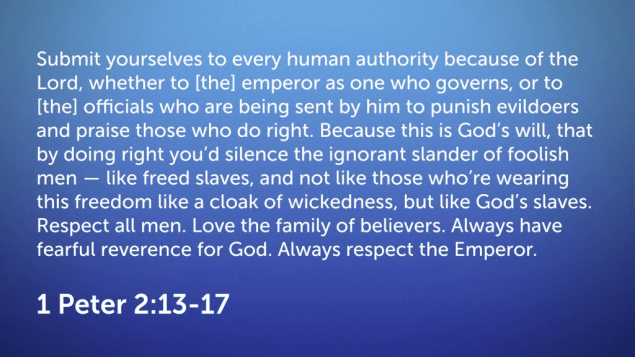
What do you think of your political leaders? To be honest, many Christians would have to admit they don’t think much of politicians!
What do you think of the government? What do you think about the institutions, the agencies and bureaucracies at the local, state and federal level? Many people wish some of them would go away. In the recent election, “drain the swamp!” was one of now-President Trump’s rallying cries.
The concept is timeless; the political class is corrupt, underhanded and looking out for itself. There is an implicit assumption that all bureaucrats, at all levels of government, are inept and incompetent at best, and nefarious at worst. Even in the Apostle Peter’s day, one pagan writer referred to Rome as the city “where all things hideous and shameful from every part of the world meet and become popular.”[1]
It’s almost expected that we should despise politicians, government and those who work for “the state.” In America, we need only look to this recent political season to see the hateful rhetoric and vitriol we often show to politicians from “the other side.” Too often, Christians let their secular political passions get the best of them, and join in on this feeding frenzy of scorn and ridicule. That is wrong.
The Apostle Peter wrote his first letter in a very different context. Christians were under pressure from a pagan society to conform, or at least round some of the “rough edges” off their faith. Former pagans had been ostracized from their communities, cut off from all the support structure they had. Former Jews, who believed Jesus was the fulfillment of their Scriptures, likely had it even worse. The storm clouds of persecution had not yet broken open upon the Christians, but they were about to.
In Jerusalem, James the Just had recently been killed by a Jewish mob, thrown from the top of a building in the temple complex, stoned as he lay injured and crippled, then his head had been beaten in by a club [2]. In Rome, the Emperor Nero would soon conveniently blame Christians for starting a massive fire which had destroyed a good portion of the city. He would use this marginalized “Jewish sect” as a scapegoat, and kill many believers in awful ways. [3]
When Peter commanded Christians to “submit yourselves to every human authority because of the Lord,” he didn’t have our quaint American context in mind. He wrote for a darker time, for a more serious context. In the West, we are blessed beyond all imagination. When we Christians consider “persecution” here, we talk about losing our 501(c)(3) status and cry about bakers being forced to make cakes. In Peter’s day, people died horribly for their faith.
Yet, Peter still wrote those words, and God wanted him to write them. You see, God isn’t concerned with our comfort in the here and now; this is what Peter warned us about elsewhere (1 Peter 1:1-6; 4:12-19). The early Christians rejoiced in persecution, because they knew they were a testimony for Christ (see Acts 4; especially 4:23-31). Instead, we’re commanded to make our entire way of life holy, so we might have opportunity to help draw people to Christ by our own example in the midst of terrible trials. One of those contexts was in dealing with the government.
So to return to modern politics, it’s clear there’s a lot for Christians to disagree with. But, the Apostle Peter tells us we should always submit ourselves to every human authority, anyway. Of course, the Bible qualifies this blanket statement elsewhere (see, for example Acts 4-5). But, in general terms, we should respect human authority “because of the Lord.”
But, we often don’t do that, do we? This isn’t the way our culture operates today; our culture encourages people to act petulant, childish, angry and crazed when they do not like a politician or agree with his politics or policies.
Last week, we spent some time in Sunday School talking about this. How we speak and think about government institutions and officials, at all levels (local, state and federal) is important. The Christian message is offensive enough; we shouldn’t compound this by crazed activism, un-Christlike rhetoric or insurrection.
Take a listen to the audio (below), and let’s see what Peter has to say about all this. It will take us several weeks to discuss this passage, and some of its implications. The teaching notes for the passage are here. All audio and teaching notes for the 1 & 2 Peter series so far are here. Feel free to contact me with any questions, or to comment below.
Notes
[1] From Tacitus, “Annals 15.44.2-8.” This excerpt is from J. Stevenson (ed.), A New Eusebius, revised by. W.H.C. Frend (London, UK: SPCK, 1987), 2-3.
[2] I follow Eusebius’ account, who quotes from a near-contemporary source (Ecclesiastical History, 2.23). Josephus makes no mention of James being clubbed to death (Antiquities, 20.9.1).
[3] From Tacitus, “Annals 15.44.2-8.” This excerpt is from J. Stevenson (ed.), A New Eusebius, revised by. W.H.C. Frend (London, UK: SPCK, 1987), 2-3.
It’s easy to lose your perspective. We live in a very self-absorbed, historically ignorant culture. We know, intellectually at least, that we can learn from people who have come before us. We get it. But, functionally, we don’t get it. We often act as though what’s happening right now is momentous, unprecedented, and unparalleled. That’s often not the case at all.
We live in a very politically charged atmosphere. Old mores are being toppled, the “shackles” of a Puritan-esque Christian ethic (though, to be sure, our society left Puritanism behind a long time ago, but never mind the facts) and are being cast off with glee. Our society has formerly transformed from a false “Christian Americana,” to outright secularism. To be sure, America has been secular for quite a while, but now she feels free to revel in it, without the rusty, embarrassing remnants of a Christian ethical compass to hold her back.
The historian George Marsden wrote about this bygone age in American culture, which he believes was at its height in the later quarter of the 19th century. He described it well; very well. Those who grew up in the old “Bible Belt” will understand exactly what Marsden was getting at. He wrote:
A veneer of evangelical Sunday-school piety covered almost everything in the culture, but no longer did the rhetoric of idealism and virtue seem to touch the core of the materialism of the political and business interests. It was a dime store millennium.[1]
This dimestore millennium endured for a while. I believe we saw its last gasp this past decade. Now, it’s gone. Russell Moore, a Southern Baptist leader and minister a generation older than me, wrote this about his Boy Scout troop and the cultural Christianity of his childhood in the South:
The “God and Country” badge wasn’t really about conforming us to the gospel, or to the Bible, to any confessional Christian tradition, or even, for that matter, to the “mere Christianity” of the ancient creeds and councils. This project didn’t want to immerse us (or even sprinkle us) into the strange world of the Bible, with its fiery spirits and burning bushes and empty tombs. We were here for the right kind of Christianity, the sort that was a means to an end. We were to have enough Christianity to fight the Communists and save the Republic, as long as we didn’t take it all too seriously.[2]
That version of America is gone, and it’ll never come back.
So, Christians in America are in a quandary. How should we live, work and minister in a culture which is so adamantly pagan and secular? The Apostle Peter tells us how. And (to return to my point about perspective), Peter is a guy who wrote and ministered in a much more secular time than we live in today, in the West.
Not long after Peter died for his faith (likely on the orders of the Roman Emperor, Nero), Christians were periodically ordered to declare their allegiance to the Emperor by offering incense to him, and worshipping him. Now, that’s a quandary. Do you think our political climate is unprecedented? Peter faced Nero. You face MSNBC. Children, please . . .
Our text for next few week is very practical; it speaks to real life, in the real world, and how Christians should think about and deal with the government (really, all people in authority).
Who are you supposed to submit yourself to?
What does it mean to “submit yourself?”
How should this inform how you interact with government officials, or refer to them in private conversations, public conversations, and your posts on social media?
Take a listen to the audio (below), and let’s see what Peter has to say about all this. It will take us several weeks to discuss this passage, and some of its implications. The teaching notes for the passage are here. All audio and teaching notes for the 1 & 2 Peter series so far are here. Feel free to contact me with any questions, or to comment below.
Notes
[1] George Marsden, Understanding Fundamentalism and Evangelicalism (Grand Rapids, MI: Eerdmans, 1991), 10.
[2] Russell D. Moore, Onward: Engaging the Culture without Losing the Gospel (Nashville, TN: B&H, 2015), 11-12.
 In this passage (1 Peter 4:1-6), the Apostle Peter urges Christians to arm themselves with the same selfless mindset that Christ had; “for Christ also died for sins once for all, the righteous for the unrighteous, that he might bring us to God, being put to death in the flesh but made alive in the spirit,” (1 Pet 3:18).


 The sermon audio is below. Actually, this is a Sunday School lesson. But, the title has been published, so I can’t change it now!
 Why should Christians want to ask for God’s favor, instead of returning evil for evil, or insult for insult? What is the end-goal? Why should we be prepared to give an account of the hope that’s within us? I covered some of this in Sunday School, as we examined this passage (1 Peter 3:13-17; what follows is my translation):
 What should a Christian wife do, if she’s married to an unbeliever? Generally, I think there are two possible responses. The first is to be tempted to break the marriage covenant:
 Today, I managed to finish my Sunday School march through 1 Peter 2:18-25. Why on earth would Peter tell his readers, “this is favor with God – if, when you’re doing right and suffering, you endure it. This is why you slaves were called to salvation!” The Apostle answered that question by drawing a parallel to Christ, our Savior.
 Real life is hard. Peter knows that; it’s why he wrote his letter. Today, in Sunday School, we continued looking at 1 Peter 2:18-25, and considering what it means:
 Here, in Micah 5:2-4, the prophet gave us probably the best-known passage in his book, and one of the most precious promises of the coming Christ. It’s a beautiful prophesy, and full of hope. Many Christians quote it this time of year, but fewer consider the real context of this prophesy.
 What do you think of your political leaders? To be honest, many Christians would have to admit they don’t think much of politicians!


 The Eccentric Fundamentalist