Every Pastor grows depressed when he reads books about “how to be a better Pastor.” I believe that, if you took five popular “how to be a Pastor” books by conservative authors, and compiled a list of everything these books said, you’d be one depressed guy. Of course, not all of these lists are credible.
For example, one well-known Christian leader posted, just today, that one “warning sign” of a bad pastor is that has a “poor social media witness.” No, I’m not joking. Somehow, I must have missed that requirement in the Bible. Yes, now that I think on it … I’m almost certain the Apostle Paul mentioned a weekly quota for FaceBook, Twitter and Instgram posts.
Competence, not brilliance
But, that madness aside, these lists can be depressing. No doubt about it. But, I want to offer a small ray of sunshine. When it comes to pastoral requirements, I don’t believe God requires a guy to be perfect at everything. He asks for competence, not brilliance; along with a willingness to get better and learn over time.
Let me use a sports analogy. In baseball, the “ideal” athlete is known as a “five-tool player.” This means a guy who can (1) hit for power, (2) hit for a good average, (3) has good base-running skills and speed, (4) can throw, and (5) can field. Most guys aren’t “five-tool players.” Most baseball players can do one or more of these things very well, and are competent at the rest. A superstar is generally someone who can do all five (e.g. Ken Griffey, Jr.).
Some Pastors are “five-tool” guys. They can do everything very, very well. Most guys can’t do that. And, I don’t think God asks for brilliance. But, I think He does expect competence.
Unfortunately, many congregations don’t even ask for that much. Christians are generally very, very good at spiritualizing incompetence, because we want to be “loving” and “nice.” A man might not be able to teach his way out of a wet paper bag, might not know Augustine from Anselm, might have a spine as stiff as a soggy spaghetti noodle, but if he’s a nice guy who loves the Lord, some congregations are willing to make him their Pastor. That is a terrible mistake.
The list …
I believe the Bible teaches a Pastor must meet certain qualifications. I also believe that God gives every believer certain talents, gifts and abilities, and molds and shapes all His children into the people He wants them to be. We can look at the Bible to find these Pastoral qualifications. Most Christians instinctively turn to 1 Timothy 3, or Titus 1, to find these. But, those largely moral requirements. What about performance requirements? What about the skill sets, the competences that allow a Pastor to actually do his job?
I think the book of 2 Timothy has something for us, on that score. At my church, as we prepare the congregation to consider a new Pastoral candidate, I’m walking through 2 Timothy 1-2 and picking out some “marks of a good Pastor.” Here is the list I’m working from:
He must be a leader, not a coward
He must be committed to the Bible
He must be educated, competent and capable – so he can guard the faith
He must train new leaders
He must be totally committed to the Gospel ministry
He must not preach a cheap Gospel, and encourage self-examination
He must be theologically balanced and mature
He must be spiritually and emotionally mature
He must be able to teach
I could have found more, but this is enough. Remember, God asks for competence, not brilliance. We can’t all be superstars. But, we can all be competent. If a guy can’t meet these core competencies, then he isn’t qualified to lead a congregation.
End of story.
In the rest of this series, I’ll briefly elaborate on each of these “marks of a good Pastor.”
What should a congregation look for when considering a Pastor? What are the requirements? What are the marks of a good and faithful Pastor?
Nice hair? A hip personality? Someone who’s “cool” and “relevant?” A guy who’s 50, but dresses like a confused teenager? Someone who ditches a pulpit for a bistro table, and looks like he’s wearing his wife’s jeans? The truth is much more serious than that.
Many Christians instinctively turn to 1 Timothy 3, and Titus 1 to answer this question. That’s nice, but I’m not gonna go there. Instead, I’m going to work my way through 2 Timothy 1-2, and look for some answers. Here’s what I have so far:
A Pastor must to be a leader, not a coward
A Pastor must be committed to the Bible
A Pastor must be educated, capable and competent
The sermon notes are here, and the sermon audio is below. There’ll be more in next week’s sermon …
Every Christian agrees that, when an unbeliever hears the Gospel, and repents and believes the Good News and becomes a Christian, God gets the glory. Salvation is from Him. All praise goes to Him. Got it.
Yet, Christians have argued about the mechanics of how salvation works for a very long time. I like to explain it like this – imagine you’re attending a play in a theater …
Out on stage, in front of the curtain, everybody sees what’s going on. This is salvation viewed from the outside. An unbeliever hears the Gospel, repents and believes, and becomes a Christian. God gets the glory. But, backstage behind the curtain, all sorts of things are happening to produce the scene out front. Props are brought in and moved out. Costumes are changed. Backdrops are arranged. Backdrops are moved. And so it goes. Christians disagree about what’s going on behind the scenes, in the heart and mind of an unbeliever, to produce repentance and faith.
Generally, people tend towards either:
A more “God alone” understanding of what happens behind the curtain, or
A more cooperative scheme, where man and Yahweh work together, in some form or fashion, to produce salvation
There are great, wide, terrible and heretical ditches on both sides of this divide, to be sure. These are complicated waters, and unwary Christians can read a whole lot of irresponsible garbage by folks on both sides of this unending theological war. Few of the folks you’ll read on the internet know what they’re talking about. Even some who do know write very irresponsibly, at times.
This is why it warms my heart to see a responsible theologian bring some balance to this difficult topic. How can a Christian reconcile God’s obvious control and sovereignty over everything in creation, and man’s clear responsibility to repent and believe the Gospel? Well, I have a book you might like to consider …
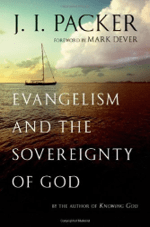
Way back when, in a galaxy far, far away, a theologian named J.I. Packer wrote a little book entitled Evangelism and the Sovereignty of God. Here’s how he introduced this topic …[1]
There is a long-standing controversy in the Church as to whether God is really Lord in relation to human conduct and saving faith or not. What has been said shows us how we should regard this controversy. The situation is not what it seems to be. For it is not true that some Christians believe in divine sovereignty while others hold an opposite view. What is true is that all Christians believe in divine sovereignty, but some are not aware that they do, and mistakenly imagine and insist that they reject it.
What causes this odd state of affairs? The root cause is the same as in most cases of error in the Church – the intruding of rationalistic speculations, the passion for systematic consistency, a reluctance to recognize the existence of mystery and to let God be wiser than men, and a consequent subjecting of Scripture to the supposed demands of human logic.
People see that the Bible teaches man’s responsibility for his actions; they do not see (man, indeed, cannot see) how this is consistent with the sovereign Lordship of God over these actions. They are not content to let the two truths live side by side, as they do in the Scriptures, but jump to the conclusion that, in order to uphold the biblical truth of human responsibility, they are bound to reject the equally biblical and equally true doctrine of divine sovereignty, and to explain away the great number of texts that teach it.
The desire to over-simplify the Bible by cutting out the mysteries is natural to our perverse minds, and it is not surprising that even good men should fall victim to it. Hence this persistent and troublesome dispute. The irony of the situation, however, is that when we ask how the two sides pray, it becomes apparent that those who profess to deny God’s sovereignty really believe in it just as strongly as those who affirm it.
How, then, do you pray? Do you ask God for your daily bread? Do you thank for your conversion? Do you pray for the conversion of others? If the answer is “no,” I can only say that I do not think you are yet born again. But if the answer is “yes” – well, that proves that, whatever side you may have taken on this question in the past, in your heart you believe in the sovereignty of God no less firmly than anyone else. On our feet we may have arguments about it, but on our knees we are all agreed.
I think Packer does an excellent job presenting this issue from a pastoral perspective. He sounds like a nice grandfather, discussing theology over hot chocolate on a cold winter’s morning …
If you’re a Christian who has paid attention, you’ve probably heard strong opinions from Pastors or other Christians about various English Bible translations. Maybe you’ve heard the NIV is a “liberal translation,” because it’s “gender-neutral.” Perhaps you’ve heard the NLT is a paraphrase. And so it goes.
There’s nothing wrong with the major English Bible translations. I don’t care which one you read and use; KJV, ASV, RSV, NIV, NRSV, NEB, REB, NASB, MEV, LEB NET, Phillips. Take your pick. In the end, most disagreements come down to what you believe about (1) translation philosophy and (2) which printed, Greek New Testament text is the best. I wrote a long article about bible translations a while back to briefly address some of these concerns.
Today, I want to talk about translation philosophy. If you ask an informed Christian, she’ll probably tell you there are two camps:
Formal equivalence, or “word for word” translations. This approach tries, as much as possible, to retain the original word order in Greek and Hebrew.
Dynamic equivalence, or “thought for thought” translations. This philosophy seeks to convey the meaning of the word or phrase, and isn’t as tied to the original word order.
This is all wrong. Wrong. Not right. Wrong.
Most Christians in America aren’t fluent in a second language, and haven’t studied languages. I understand, and I’m not blaming anybody. But, the result is that Christians who say these things are usually repeating what others have told them. They often really don’t know what they’re talking about. This kind of argument works best as an abstraction, as a pie in the sky philosophy. When you put the fancy ideas away, and actually try to translate a Bible passage yourself, life gets tough.
Here’s a simple example …
What does “bless” mean?
The Apostle Peter is wrapping up his discussion of the so-called “household” or “station codes,” and he wrote this to sum up every Christian’s responsibility to live in a holy way in a pagan world (1 Peter 3:8-12). Here’s one excerpt from that section:
Finally, all of you, have unity of spirit, sympathy, love of the brethren, a tender heart and a humble mind. Do not return evil for evil or reviling for reviling; but on the contrary bless, for to this you have been called, that you may obtain a blessing (1 Peter 3:8-9, RSV).
Tell me, what on earth does “bless” mean, in this context? I want you to explain it to me. I want you to consider the context, consider why the phrase repeats in the same sentence, and tell me what “bless” and “blessing” mean. I’m waiting …
Still waiting.
Well, I’ll go first. Here’s one thing you should always remember:
There is no such thing as a “literal meaning.” Literally (heh)!
Every word and every sentence depends on context for clarity. Words have tons of different meanings, but the context tells you which meaning is right. You already know this, instinctively. You don’t even realize you know it, but you do.
Think about the word “tons” (which I conveniently put in bold so you’d see it). What is the “literal meaning” of that word? You don’t know, do you? You’re thinking on it now, and you’re realizing it all depends on how the word is used, aren’t you? Merriam-Webster’s dictionary says:
The word could refer to a metric unit of weight, or
It could mean a large quantity of something, or
Various quantities of storage capacity for maritime shipping
So, there is no literal meaning for a word or phrase – context is everything. Now, when you look at a dictionary, you get what linguistic nerds call a gloss. This is a generic definition that covers a lot of ground, but doesn’t even begin to explain the word well. For example, you could say the gloss for the word ball is “a rounded mass or shape.” But, that really doesn’t tell you much. There are tons of ways (see what I just did!?) to use the word ball in the English language.
“George and I went to the ball last night! He looked so handsome in his tuxedo!”
“We left the kids at home last night, and went out on a date. We had a ball!”
“Hey, Jeff, wanna play some ball with the guys this Saturday?”
“For the last time, Sherri – you’ve got to keep your eye on the ball! What’s wrong with you, lately?”
When you come to the Greek participle εὐλογοῦντες, the normal gloss means bless. Yay. How wonderful. What on earth does this mean? Well, when you consider how the word is used in the New Testament and contemporary Greek writing, you have two basic options:
It can mean something like “be kind.”
It could also mean “to invoke God’s blessing upon.”
Which one is it, here? Because Peter goes on to say Christians were called to inherit blessing (i.e. “divine favor”) from God, it makes sense to understand the participle to have the same sense, here.[1] That is, it seems Peter is using the term “bless” in the same way both time he uses it, in 1 Peter 3:9.
Once again, here is Peter’s argument – consider which usage best fits the context:
Do not return evil for evil or reviling for reviling; but on the contrary ——–, for to this you have been called, that you may obtain a ——–.
Is Peter telling them to be nice to hostile unbelievers? Or, is he telling them to invoke God’s favor upon these hostile outsiders? Christians have been called to do this, whatever it is. As a result of God’s calling, Christians will obtain … whatever this is. It seems obvious the second option is the one we want; to invoke God’s divine favor.
But, how should we translate it? Should we render it as bless?
The rendering “bless” is standard Biblish in our Christian vocabulary. It’s meaningless. You’re used to seeing it, because it’s comforting and familiar. But, does the word bless here actually communicate anything at all? What does it mean?
We’ve just found out that, in this context, it means a Christian shouldn’t return insult for insult, or evil for evil. Instead, the Christian should ask for God’s favor on the offender. So, perhaps we should just translate it that way! This is what my translation looks like:
You must not make it a habit to repay evil for evil, or insult for insult. But, instead, you must always repay by asking for God’s favor on the person, because you were called to all this, [and] as a result you’ll obtain God’s favor!
We shouldn’t be captive to glosses that don’t explain what the word actually means. Deliberate ambiguity isn’t a virtue when the context is rather straightforward.
Some critics would say my translation philosophy here is dynamic equivalency. I reply – I love you, but you really don’t know what you’re talking about.[2] A dynamic equivalency translation would actually go one step further, and ask the question, “what does it mean to ask for God’s favor on the person?” The answer, I believe, is to pray for the person’s salvation. So, a true dynamic equivalent translation would render this something like, “you must always repay the person by praying for his salvation …” So, there.
In this context, the participle εὐλογοῦντες means “to invoke God’s blessing upon” someone. This isn’t a tenuous interpretation; it’s pretty straightforward and I can make a very, very good case for it. Shouldn’t a translation seek to bring this across?
May I encourage you not to be deceived by this idea of choosing an English Bible so that you can see the underlying Greek structure. You will be led astray on every verse. If you want to get that close to the Greek, I know of a couple Greek textbooks that will help you get there (grin). If not, then understand that all translations have to smooth out the Greek to make it understandable English, and read it with that in mind.
Keepin’ it real
I could say a whole lot more, nuance my position a bit, and offer up all the appropriate caveats about translation philosophy. But, I won’t bother here. I’ve said enough to make my point, and any theologians reading this already know what those caveats are anyway.
Let’s recap:
Don’t take a simplistic stance on a Bible translation philosophy – it’s complicated.
Most Pastors or leaders you listen to either never learned Greek, or have allowed themselves to forget most of it. Even if they use it, many of them don’t do much beyond word studies. It’s very rare to have a Pastor who actually does translation himself, and can interact with exegetical commentaries and argue syntax in meaningful fashion. So, the chances are the person who’s giving you information about bible translation philosophies is well-meaning, but really doesn’t know what he’s talking about.
There is no such thing as a “literal meaning” of a word. I mean that literally. Get it?
A bible translation shouldn’t be afraid to ignore a gloss and render the clear meaning of a word or phase, if the context is clear and straightforward.
So, don’t be afraid of the NLT. Don’t be afraid of the NIV. Don’t be afraid of the KJV or the RSV. They’re good translations.
Notes
[1] Actually, there is real disagreement about how to translate the last bit of 1 Peter 3:9, but I won’t bother to go into that here!
At a time when the daily news trumpets the latest political scandal, our Facebook walls vomit forth more madness, our Twitter feeds grow ever darker, and the comment boxes on our favored websites grow more vile by the moment, a Christian ought to pause to consider the end-game. Christ will return, and there will be true peace on earth for all those with whom He’s favored. Then, on that day, there will be no more “fake news,” no more victimized gymnasts, no more predatory medical doctors – no more sin at all.
Christ declared to the Apostle John, “Behold, I make all things new!” (Rev 21:5). This passage of Scripture (Psalm 47) gives us a brief glimpse of what this day of rejoicing will look like.
Clap your hands, all peoples!
Shout to God with loud songs of joy (Psalm 47:1)
This is clearly a psalm celebrating a momentous event. All the people are commanded to clap, and shout to God with riotous joy. Is the psalmist referring to the Israelites in the congregation, or to “all peoples” who belong to Yahweh, including Gentiles? This is interesting, but we’ll have to wait for more context before making a decision. For now, just consider – why should the people shout for joy, and clap with such glee?
For the LORD, the Most High, is terrible
a great king over all the earth (Psalm 47:2)
It’s a celebration about who Yahweh is. He’s the Most High, He’s terrible (i.e. “fearful,” [NEB]; “to be feared” [NASB]; “awesome” [NLT; LEB]; “awe-inspiring” [NET]. He’s a great king over all the earth!
Yahweh is the King now, even as He allows Satan to be the “prince of the power of the air, the spirit that is now at work in the sons of disobedience,” (Eph 2:2). You can’t read the story of Job, for example, without seeing God in complete control over His creation (Job 1:6-12; 2:1-6). Satan operates only because God permits it. This means people who reject Yahweh and His promise of salvation through the coming Messiah are criminals in God’s universe. He’s already the King; He just hasn’t come back quite yet.
Some readers might quibble, and suppose this psalm is only describing some future event. Perhaps so, but this psalm was sung by faithful Israelites as they worshipped. It had meaning then, too. Yahweh was their king then and, in this New Covenant era, He’s our king, also. It’s a present reality, with a still future fulfillment.
He subdued peoples under us,
and nations under our feet.
He chose our heritage for us,
the pride of Jacob whom he loves (Psalm 47:3-4)
The congregation praises Yahweh for what He’s done. Through His blessing, this small nation “dispossess[ed] nations greater and mightier than yourselves,” (Deut 9:1). This only happened because He chose the Israelites from among the pagans, made them His own, and blessed them abundantly. It was a corporate election to salvation and service, and it was all of grace (Deut 7:7-8; 9:4-5). This is why they clap and shout with such joy in their hearts and souls. God is good, and He’s full of mercy, grace, love and kindness.
God has gone up with a shout,
the LORD with the sound of a trumpet.
Sing praises to God, sing praises!
Sing praises to our King, sing praises!
For God is the king of all the earth;
sing praises with a psalm (Psalm 47:5-7)
Again, God is the king of all the earth. It’s a present reality that all people are commanded to acknowledge and respect. They do this by confessing their sins, believing in Yahweh’s promise of a future Deliverer, Messiah and Savior, and then proving their love by following His law in sincerity and truth. God’s people will love Him, and want to praise Him for who He is, and what He’s done. This kind of universal joy and praise to Yahweh will only come when all creation bows in submission to Him. As another psalmist wrote, “The LORD sends forth from Zion your mighty scepter. Rule in the midst of your foes!” (Ps 110:2).
The scene here almost reads like a coronation, as if the King has just assumed His throne, been crowned as “Lord of Lords,” and is accepting the rapturous praise of His servants. The psalmist is viewing the event as if it’s just happened, and he’s recording it all in his trusty notebook. This song may have been sung at coronations for Israelite kings at some point, or it could be purely prophetic – the Israelite people looking forward to that glorious day when Messiah would come and assume David’s throne. Some people assume the Old Covenant saints were largely ignorant about the details of the Messianic prophesies. Perhaps they were, but David certainly wasn’t (compare Ps 16:8-11; Acts 2:25; 13:32-36).
God reigns over the nations;
God sits on his holy throne (Psalm 47:8)
Yahweh will reign on earth one day. The Book of Revelation tells us this will be an entirely new earth, situated in an entirely new creation. And, in a new holy city, Yahweh will sit on His throne with His eternal Son, and they’ll reign together over the nations (Rev 21:22-27).
The princes of the peoples gather
as the people of the God of Abraham.
For the shields of the earth belong to God;
he is highly exalted (Psalm 47:9)
What a wonderful picture! This is so different from the Jewish attitude in Jesus’ day; an attitude which was racist, prejudiced, and characterized by a sneering nationalism borne out of centuries of the most rabid and insatiable persecution. God told the Israelites they would “be to me a kingdom of priests and a holy nation,” (Ex 19:6). Their task was to represent Yahweh to the pagan world around them, loving Him with everything they had (cf. Deut 6:4-5), as they modeled His kingdom by living according to His laws. They came closest during Solomon’s reign (1 Kgs 10), but even that wasn’t very close at all
The exile changed everything, and the Israelites gradually began to emphasize orthopraxy instead of orthodoxy; right behavior over against right belief. This subtle shift had enormous implications, which compounded themselves as the years went by. The Book of 1 Maccabees, for example, speaks of “the Gentiles” over and over again (e.g. 3:25-26; 3:52; 3:58-60, etc.). It doesn’t matter who Judas and Jonathan’s enemies were, they were always “the Gentiles.” The Maccabees weren’t concerned with a “circumcision of the heart” at all. Theirs was a religion of law, of right behavior, of cultic ritual. There is no mention of devotional piety; only external conformity. Judas sallied forth and “hunted and tracked down the lawless” (3:6), and “destroyed the godless” (3:8). He forcibly circumcised young Israelite boys (2:46), and “thus they saved the law from the Gentiles and their kings …” (2:48). On his deathbed, Judas’ father Matthias exhorted his sons to “draw your courage and strength from the law, for by it you will win great victory,” (2:64).
By Jesus’ day, He encountered an externalism that boasted an elaborate, blasphemous theology of ritual defilement from contact with Gentiles. It was this perversion that prompted His condemnation of their ceremonial washing rituals (Mk 7:1-13); “you leave the commandment of God, and hold fast the tradition of men!” (Mk 7:8). Peter had enormous trouble getting rid of this baggage (Acts 10:34-48; Gal 2:11-13). The Jerusalem church likewise struggled mightily with the very idea that Gentiles could be joint-heirs of living grace. They criticized Peter (Acts 11:1-2), were wary of the Antioch congregation’s Hellenistic makeup (Acts 11:22-23), and had repeated issues with some of their own members advocating a perverted, works-righteousness salvation (Acts 15:1-2). Even the Apostle James treaded lightly around these men (Acts 21:17-26).
And yet … this psalm knows nothing of this prejudicial attitude. Instead, the author catapults over this madness and lands squarely in the New Jerusalem. The princes of the people (i.e. the Gentiles) have gathered together as (some translations render this “with”) the people of the God of Abraham. The Gentiles are joint-heirs with the Israelites. This is the glorious future for all who believe. The Gentiles and the Israelites will serve Yahweh together, worshipping Him in spirit and in truth. There, in the true celestial city on a new and perfect earth, all God’s people from every nation will come to the tree of life to eat freely. After all, “the leaves of the tree were for the healing of the nations,” (Rev 22:2).
Yahweh is the King of all who believe. This psalm paints a glorious future. The King will reign. The people, Jew and Gentile alike, will clap, shout and “rejoice with joy unspeakable and full of glory,” (1 Pet 1:8). Oh, the half has never yet been told!
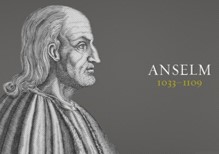
Anselm was a brilliant guy. A genius. This past year, I read his book Why God Became Man. He published it in 1097, so you could say it’s a bit of a antique. Anselm’s book is really about why Christ had to take on a human nature and be conceived of and born to a virgin. But, along the way, he tackled the reason for Christ’s death and thus popularized the “satisfaction theory” of atonement, which envisioned God as an overlord of sorts who was owed “satisfaction” or payment by his subjects for crimes committed, in order to set things right.
This theory is very intriguing, and it’s not too far from the penal substitution theory most conservative Christians are taught. I’m confident in saying this, because I doubt many Christians (even those in academia who ought to know better) have actually read Anselm’s book. I have.
Here, I want to provide an extended excerpt, and some brief commentary. Anselm’s book is fascinating for two reasons; (1) he structures it as a dialogue between himself and a bright student named Boso, and (2) he’s remorselessly logical. Anselm would have been a swell lawyer.
As you read this, remember two things:
There really were Christians in the Medieval period
Christians in 1097 really were smart
Here we go …
What it is to sin and to give recompense for sin
Anselm: What we have to investigate, therefore, is the question: ‘By what rationale does God forgive the sins of men?’ And, so that we may do this more clearly, let us first see what it is to sin and what it is to give satisfaction for sin.
Boso: It is for you to demonstrate and for me to pay attention.
Anselm: If an angel or a man were always to render to God what he owes, he would never sin.
Boso: I cannot contradict this.
Anselm: Then, to sin is nothing other than not to give God what is owed to him.
Boso: What is the debt which we owe to God?
Anselm: All the will of a rational creature ought to be subject to the will of God.
Boso: Perfectly true.
This is pretty brief, but it’s good enough for me. God made us, so our duty is to be completely subject to God’s will in our lives. That’s an umbrella definition, but it’s more than big enough to cover the bases. So far, so good.
Anselm: This is the debt which an angel, and likewise a man, owes to God. No one sins through paying it, and everyone who does not pay it, sins. This is righteousness or uprightness of the will. It makes individuals righteous or upright in their heart, that is, their will. This is the sole honour, the complete honour, which we owe to God and which God demands from us. For only such a will, when it can act, performs actions which are pleasing to God. Even when it cannot act, it is pleasing in itself, because no work without it is pleasing. Someone who does not render to God this honour due to him is taking away from God what is his, and dishonouring God, and this is what it is to sin.
God demands your entire will be subject to Him. You exist to serve Him. If you fail to do this, you commit sin and dishonor God, who is your Creator. This is fine. Excellent stuff.
As long as he does not repay what he has taken away, he remains in a state of guilt. And it is not sufficient merely to repay what has been taken away: rather, he ought to pay back more than he took, in proportion to the insult which he has inflicted.
For just as, in the case of someone who injures the health of another, it is not sufficient for him to restore that person’s health, if he does not pay some compensation for the painful injury which has been inflicted, similarly it is not sufficient for someone who violates someone else’s honour, to restore that person’s honour, if he does not, in consequence of the harmful act of dishonour, give, as restitution to the person whom he has dishonoured, something pleasing to that person.
This makes sense, doesn’t it? You can’t just repay God by doing what you should have done. No, you have to do more than that in order to set things right. Isn’t that what Leviticus says? If you steal from a guy, you have to pay him back more than what you stole (Lev 6:1-5). That’s why Jesus knew Zaccheaus was actually sorry (Lk 19:1-10).
One should also observe that when someone repays what he has unlawfully stolen, what he is under an obligation to give is not the same as what it would be possible to demand from him, were it not that he had seized the other person’s property. Therefore, everyone who sins is under an obligation to repay to God the honour which he has violently taken from him, and this is the satisfaction which every sinner is obliged to give to God.
Things won’t be right between you and God unless and until you repay the honor you stole from Him by your crimes. You have to “satisfy” God in order to set things right. This is not far at all from the penal, substitutionary theory. The two theories are very, very close cousins. Perhaps even step-siblings.
Boso: With regard to all these matters, seeing we have undertaken to adopt a logical approach, I have nothing to say in contradiction, though you frighten me a little.
Who says Medieval guys don’t have a sense of humor!?
Whether it is fitting for God to forgive a sin out of mercy alone, without any restitution of what is owed to him
Anselm: Let us now return to the main argument and see whether it is fitting for God to forgive a sin out of mercy alone, without any restitution of the honour taken away from him.
Boso: I do not see why this should not be fitting.
Isn’t this still a question, today? Why doesn’t God just forgive and forget? Why doesn’t He just be “loving” and forgive sin, without demanding satisfaction? Isn’t that what real love is, to forgive unconditionally?
Anselm: To forgive a sin in this way is nothing other than to refrain from inflicting punishment. And if no satisfaction is given, the way to regulate sin correctly is none other than to punish it. If, therefore, it is not punished, it is forgiven without its having been regulated.
Boso: What you say is logical.
If you don’t punish a criminal, then you’re left with unregulated lawlessness. We instinctively understand this in society, with the criminal justice system. This is why it’s “not fitting” if a municipality unconditionally “forgives” a serial killer, and lets him go without punishment. Why can’t we understand this when it comes to God’s criminal justice system, too?
Anselm: But it is not fitting for God to allow anything in his kingdom to slip by unregulated.
Boso: I am in fear of sinning, if I want to disagree.
Indeed.
Anselm: Therefore, it is not fitting for God to forgive a sin without punishment.
Boso: That follows.
Yes, it does.
Anselm: There is another thing which also follows, if a sin is forgiven without punishment: that the position of sinner and non-sinner before God will be similar— and this does not befit God.
Boso: I cannot deny it.
Why obey the law, if the law-breaker faces no penalty? Why shouldn’t we all just do whatever we want, if there’s no incentive for holy behavior? We’ll all be forgiven in the end, right? So, why not party?
Anselm: Consider this too. Everyone knows that the righteousness of mankind is subject to a law whereby it is rewarded by God with a recompense proportional to its magnitude.
Boso: This is our belief.
Anselm: If, however, sin is neither paid for nor punished, it is subject to no law.
Boso: I cannot interpret the matter in any other way.
Nor can I …
Anselm: Therefore, sinfulness is in a position of greater freedom, if it is forgiven through mercy alone, than righteousness— and this seems extremely unfitting. And the incongruity extends even further: it makes sinfulness resemble God. For, just as God is subject to no law, the same is the case with sinfulness.
Boso: I cannot object to your reasoning. But, when God teaches us to forgive those who sin against us, he seems to be being contradictory— in teaching us to do something which it is not fitting for him to do himself.
Exactly! God wants us to forgive, but He won’t do the same without first demanding “satisfaction?” Why on earth? What a good question!
Anselm: There is no contradiction in this, because God is giving us this teaching in order that we should not presume to do something which belongs to God alone. For it belongs to no one to take vengeance, except to him who is Lord of all. I should explain that when earthly powers take action in this way in accordance with right, it is the Lord himself, by whom they have been appointed for the task, who is acting.
Interesting answer. God can demand satisfaction, because He is Creator, and vengeance belongs to Him (Deut 32:35).
Boso: You have removed what I thought to be an inherent contradiction. But there is another matter about which I want your answer. For, since God is so free that he is subject to no law and no judgement, and is so benevolent that nothing can be conceived of more benevolent than he, and since there is nothing right or proper except what he wishes, it does seem surprising that we should be saying that he is in no way willing to forgive an injury to himself, or that it is not permissible for him to do so, whereas we are in the habit of seeking forgiveness from him even for things we do to other people.
Boso wants to know why God is intent on demanding satisfaction when He Himself can set (or abolish) the very principles by which he demands this satisfaction! In other words:
God made this standard,
which means He’s not bound by it (i.e. it’s not an external compulsion forced upon Him),
which means He could abolish the requirement for satisfaction if He wanted to.
Anselm: What you say about God’s freedom, his will and his benevolence is true, but we ought, in our reasoning, to understand these concepts in such a way as not to impugn his dignity. For the term ‘freedom’ relates only to the freedom to perform what is advantageous or fitting, and one should not give the name of ‘benevolence’ to something which brings about a result unfitting for God. A statement that, ‘What God wills is just and what he does not will is unjust’, is not to be understood as meaning that, ‘If God wishes anything whatsoever that is unfitting, it is just, since it is he who wills it’.
Ok, fair enough. God will not will something that is against His own character. To suggest He would do so impugns His dignity. Got it.
For the argument that, ‘If it is God’s will to tell a lie, it is just to tell a lie’, is a non sequitur. Rather, the liar is not God. For a will cannot wish to tell a lie, if it is not one in which the truth has been corrupted, or, more accurately, one which has been corrupted by the fact of deserting the truth. When, therefore, one says, ‘If it is God’s will to tell a lie’, this is no different from saying, ‘If God is a being such as to wish to tell a lie’. It does not follow, then, that telling a lie is just.
Unless, that is, we adopt an interpretation of the kind used when we say with reference to two impossibles, ‘If this thing is so, then that thing is so’, when neither ‘this’ nor ‘that’ is the case; for instance, if one were to say, ‘If water is dry, then fire is wet’, given that neither is true. It is therefore only true to make the statement, ‘If it is God’s will, then it is just’, about things which it is not unfitting for God to wish. For if it is God’s will that it should rain, then it is a just thing that it should rain; and if it is his will that some man should be killed, then it is just that he should be killed.
In consequence of this reasoning, if it is not fitting for God to do anything in an unjust and unregulated manner, it does not belong to his freedom or benevolence or will to release unpunished a sinner who has not repaid to God what he has taken away from him.
Boso: You are removing all the objections which I thought could be raised against you.
Hopefully, this little excerpt is having the same impact on you as it did on poor Boso! Why don’t you buy Anselm’s major works, and read this little book for yourself?
This article is a short summary of the oral arguments in Masterpiece Cakeshop, Ltd. v. Colorado Civil Rights Commission, which was argued before the U.S. Supreme Court on December 5, 2017. For those who’ve been following the news, this is the “Christian cake baker case.” Oral arguments are an opportunity for both sides to defend their legal positions in person, and answer any questions the Justices have. The Supreme Court will rule on this case sometime in 2018.
In the article, I provide a few bits of commentary. But, this is primarily a summary.[1] Hopefully, it can spur each of on to consider the issue of soul liberty in the public square in these troubled times.
Philipps’ objection is not with the people who want the cake, his attorney argued. Instead, the objection is the message it communicates. “The First Amendment prohibits the government from forcing people to express messages that their violate religious convictions,” (4:12-19). The back and forth centered on this point. What is “speech?” How do you separate the identity of the customer from the message the product communicates?
Ginsburg opened by asking about off the shelf products; would Philipps provide these to a same-sex couple (4:21-5:4; 10:9-19)? Absolutely, Waggoner said, a pre-made item wasn’t compelled speech (5:5-8). The crux of the issue is intent. When Phillips puts a pre-made product on display “in the stream of commerce in a public accommodation setting, his speech has been completed,” (6:1-4). However, when you consider custom designed cakes, it’s a whole new ballgame (6:7-10). Thus it is with Phillips; “we are drawing the line prior to the compulsion — there can be no compulsion of speech,” (6:4-6). And, this is about more than putting “words and symbols” onto the cake – it’s the act of custom making the product itself (8:8-19).
So, where is the line? Who can claim an artistic exemption on the basis of compelled speech? The justices hammered away on this line. Can a florist (11:9-13)? Yes, Wagonner said (11:14-17). What about a wedding invitation designer (11:18-21)? Of course (11:22). What about hair stylists (12:8) or makeup artists (12:17)?
“Absolutely not,” Waggoner says (12:9).
Justice Kagan is aghast; “Why is there no speech in — in creating a wonderful hairdo,” (12:12-13)?
Waggoner provided a legal answer, but not a particularly logical one. A tailor, a chef, a hairstylist and a makeup artist don’t produce “speech” because they (1) aren’t communicating a message with their product, and (2) their product isn’t analogous to other forms of protected speech (12:9-11; 12:23-13:5; 14:16-21).
This prompted Justice Sotomayor to ask how the Court could protect Phillips’ cake as a medium for public expression, when its primary purpose is to be eaten (15:21-25)!? Simple, Waggoner replied.
“[I]in the wedding context, Mr. Phillips is painting on a blank canvas. He is creating a painting on that canvas that expresses messages, and including words and symbols in those messages,” (16:9-14).
Well, what about sandwich artists (16:24-17:3)? The difference, Waggoner says, is the message being conveyed:
… when we have someone that is sketching and sculpting and hand designing something, that is creating a temporary sculpture that serves as the centerpiece of what they believe to be a religious wedding celebration, that cake expresses a message (17:4-10).
This distinction is the heart of the issue, according to Waggoner. If the very nature of the product is communicative, then you have “speech,” and this speech cannot be compelled. For example, this is why architecture is not “speech,” because “buildings are functional, not communicative,” (17:20-23).
Justice Breyer weighed in:
So, in other words, Mies or Michelangelo or someone is not protected when he creates the Laurentian steps, but this cake baker is protected when he creates the cake without any message on it for a wedding? Now, that — that really does baffle me, I have to say (18:4-10).
So, where on earth is the line (19:1-11)? What should we do? The answer, Waggoner says, is simple: “Is the individual who’s being compelled to speak objecting to the message that’s contained in that speech or the person? And that’s usually a very obvious inquiry,” (20:7-11). This is why Waggoner believes the issue of public accommodation laws related to race are completely different; “we know that that objection would be based to who the person is, rather than what the message is,” (23:3-6).
Here is the dividing line, and it isn’t something a secular Court can decide. Is sexual identity a legitimate category at all, from a Christian perspective? You can’t set theology aside here, because it informs how you answer the question. Everybody has a foundation for his worldview, and the Christian worldview (based on the Scriptures) proclaims that all sexual thoughts, intents and actions outside a monogamous, male and female sexual relationship in the context of a marriage covenant is deviant. To the Christian, “sexual identity” is not a legitimate category, because it isn’t part of the original, “good” created order. Race is, sexual identity is not.[2]
Waggoner, of course, didn’t go there. She simply continued to push the distinction between the racial public accommodation laws (which were about who the person is) and the Phillips case which, she insisted, is about the message, not the people. It’s unclear whether she (and her client) actually believe this, or if it’s merely a convenient legal peg to hang their case on.
How can the State fairly decide whether this message vs. identity distinction isn’t just a smokescreen? This was Justice Gorsuch’s question (24:18-21), and he didn’t receive a satisfactory answer.
Solicitor General’s Response on Behalf of Baker (from Noel Francisco)
Francisco insisted there must be “breathing space” for free speech protections for business owners, so they aren’t compelled to engage in “speech” for an event they disagree with (26:1-8). Dignity interests cut both ways, he argued (28:1-8).
What about a situation in a rural context, where only very limited services are available (28:10-29:11)? Leave that to the individual states, Francisco said (29:12-17).
Where is “the line?” You figure that out, he answered, by applying a two-fold test:
can the “art” in question be analogized to traditional art in a legitimate way, and
“is it predominantly art or predominantly utilitarian,” (41:1-3)?
In Phillips’ case, Francisco observed, “people pay very high prices for these highly sculpted cakes, not because they taste good, but because of their artistic qualities,” (41:3-6).
The goal is the intent of the purchaser. Is it merely a cake to be eaten? Why not go to Safeway? No, they clearly sought out Phillips so he could create, sculpt and fashion a special cake which is analogous to a traditional sculpture “except for the medium used,” (40:18-20). Is the creation’s purpose and effect intended to be (1) artistic, or (2) utilitarian? That is the key to answering the question (42:2-24).
In Phillips’ case, they sought him out for artistic purposes, to create an artistic and aesthetic effect on the wedding guests. Thus, they asked him to “speak” through the medium of the cake, and his “speech” must be protected. Francisco closed with a “slippery-slope” argument:
… if you were to disagree with our basic principle, putting aside the line about whether a cake falls on speech or non-speech side of the line, you really are envisioning a situation in which you could force, for example, a gay opera singer to perform at the Westboro Baptist Church just because that opera singer would be willing to perform at the National Cathedral (46:13-21).
State of Colorado (from Frederick Yarger)
Colorado’s position is simple (47:12-22):
if you are a retail establishment, then
you’re subject to anti-discrimination laws, and
“you cannot turn away from your storefront if you’re a retail store,” (65:21-23).
It really is that simple and, if you’re a retail establishment, the State can require you to serve a customer (50:11-19).
What about, say, a same-sex couple who went to Catholic Legal Services and demanded to be given legal service related to their marriage? Would Colorado force them to provide service (50:21-51:23)? Yes, Yarger says, if Catholic Legal Services were operating in a retail context, “then Colorado would have the ability to regulate them,” (52:3).
Justice Kennedy brought up an interesting point. Colorado’s opinion read, in part, that “freedom of religion used to justify discrimination is a despicable piece of rhetoric,” (52:14-16). Why shouldn’t the Court assume Colorado is prejudiced against religion, and act accordingly? Kennedy asked Yarger three times if he disavowed the statement, and Yarger tap-danced mightily to avoid answering (52:17-53:15). If there were a bias on Colorado’s part, he claimed, of course there would be the problem (54:12-16). But, such was not the case (55:15-23).
Colorado’s issue, Yarger said, is that Philipps’ actions were based on the identity of the customer. Phillips may claim the message is the problem but, Yarger argued, the message here is linked with the customer’s identity, so the argument lacks merit. “[T]he message in this case, Your Honor, depended entirely on the identity of the customer who was ordering the cake,” (62:15-18). So, if the baker chooses to refuse service, he is being discriminatory (63:16-21).
Justice Kennedy, once again, chimed in with some stern words (64:3-8):
Counselor, tolerance is essential in a free society. And tolerance is most meaningful when it’s mutual. It seems to me that the state in its position here has been neither tolerant nor respectful of Mr. Phillips’s religious beliefs.
Yarger disagreed, and his position hinges on granting the idea that “sexual identity” is a valid category, on par with race and sex (64:14-65:3). They’re protected by public accommodation laws, so “sexual identity” must be, too.
Attorney for Homosexual Couple (from David Cole)
Cole traveled over much of the same ground Yarger did. Beware the slippery slope; “to accept his argument leads to unacceptable consequences,” (74:20-21). Sexual identity is a valid category, along with race and sex (75:9-16).
Cole dismissed Francisco’s “artistic purpose and effect” argument. If a mom buys a cake for a child’s birthday party, “no one thinks that the baker is wishing happy birthday to the four-year-old. It’s the mom,” (78:1-3). The issue isn’t some alleged “message,” it’s the identity of the homosexual couple. “Because in this case, again, the only thing the baker knew about these customers was that they were gay. And, as a result, he refused to sell them any wedding cake,” (79:4-8).
For Colorado, if you’re in retail, your private beliefs do not allow you to discriminate against a protected class (92:6-10), and sexual identity is a protected class (87:13-19; 89:7-10). Justice Kennedy retorted, “your identity thing is just too facile,” (89:23-24).
Conclusion
The legal arguments hinge on whether the act of making a cake is “speech,” and whether that “speech” can be compelled by the State. Both sides presented valid “slippery-slope” arguments in support of their own positions. On balance, it is doubtful whether you can logically separate the identity of a homosexual couple from the message their wedding cake is meant to convey.
Aside from the legal arguments, there is a more profound question for the Christian – where is the dividing line between one’s right to soul liberty, and the opportunity to share the Gospel in all sorts of negative contexts? Could Philipps have baked the cake, and still made a positive opportunity out of this? Have his actions served to “maintain good conduct among the Gentiles, so that in case they speak against you as wrongdoers, they may see your good deeds and glorify God on the day of visitation,” (1 Pet 2:12)?
Should we allow everyone do what they want, according to their own consciences? Is this the best solution? Os Guinness wrote a book advocating a sophisticated version of this approach, and remarked,
Soul freedom for all was once attacked as naive and utopian, and it is still resisted as subversive. Yet it is not only a shining ideal but a dire necessity today and an eminently practical solution to the predicaments of our time. Truly it is the golden key to a troublesome situation in which the darker angels must not be allowed to dominate.”[3]
But, when it gets down to brass tacks, how do we actually do this? This case is about that question. How do you allow people to express their sincere beliefs, yet crack down on genuine bigotry and hatred? How do you carve out these exceptions, and where does it end?
Guinness remarked that, in the end, soul freedom depends on people thinking and acting like adults, and taking their civic responsibilities seriously. “Reciprocity, mutuality and universality are the key principles of this vision of a civil public square. In this sense a civil public square is the political embodiment of the Golden Rule.”[4] In this day and age, these are not virtues that totalitarians (on either side) are anxious to model. Instead, activists seek to force their views on the public by force of law, not by persuasion and discussion in the public square:
“The constant pursuit of rights through law alone rather than the habits of the heart has caught Americans in the toils of ever-spreading law. On the one hand, it has led to a strengthening of the law at the expense of the habits of the heart, of litigation at the expense of both civic education and the role of parents and schools, and of the lawyers and the lawyer class at the expense of other public servants.[5]
This case is the fruit of this particularly poisonous tree. The Court has been made the arbitrator of morality. How can the Court fulfill this mission? How can it draw the line this homosexual couple wants it to draw? In a moment of candor, Justice Breyer admitted, “I can’t think of a way to do it,” (59:11-12).
Notes
[1] I make no attempt to summarize or even reference the various briefs filed by the Petitioners or Respondents. Here is the question before the Supreme Court. If you’re interested, you can find them. Throughout this article, I’m referencing the official transcript of oral arguments. The citation format in the article is page number : line number.
[2] Of course, in the end, the only category distinctions which have eternal significance are (1) believer or (2) non-believer. Or, as the Didache puts it, “there are two ways, one of life and one of death, and there is a great difference between the two ways,” (Didache 1:1).
[3] Os Guinness, The Global Public Square: Religious Freedom and the Making of a World Safe for Diversity (Downer’s Grove, IL: IVP, 2013), 14.
What should a Christian wife do, if she’s married to an unbeliever? Generally, I think there are two possible responses. The first is to be tempted to break the marriage covenant:
Maybe she hit the road, and dump the guy?
Perhaps she should preach to him incessantly, and heckle him to “get saved” and become a Christian?
Should she take a judgmental, self-righteous attitude?
The second response is to be tempted to mix your Christian faith into secular culture, in an attempt to curb any possible offense it might cause in your family, and in society – go along to get along, as they say:
Maybe she should go with her husband to worship the gods and goddesses at the pagan temple?
Maybe she should burn incense in homage to the Emperor?
Maybe she should internalize her faith, and make it a totally private affair. In other words, become a “secret” Christian?
In this passage (1 Peter 3:1-7), the Apostle Peter talks about this problem. His advice is very, very simple – be submissive to your unbelieving husband, because he might be won over to the Gospel by your Christlike way of life.
Listen to the first discussion about this passage, and read the teaching notes, too. As always, the audio and teaching notes for the entire book of 1 Peter are here.Ciao!
I read your last email with joy in my heart! You say your Christian is going through a difficult time; that his wife has left him and run off with her “personal trainer” from the gym. This is excellent news, my boy! You must strike when his defenses are at their weakest – never lose an opportunity to help him doubt the Enemy’s goodness, kindness, mercy and grace.
Make the enemy a tyrant
Don’t tempt him to doubt the Enemy’s providence; his governance over everything that happens. No, Frederick – we want him to keep believing that God (in the words of one of the Enemy Forces’ wretched creeds), “leads and governs them according to his holy will, in such a way that nothing happens in this world without his orderly arrangement.”
You see, we don’t want him to doubt that God governs His creation. He certainly does! What we want, Frederick, is for this young man to doubt God’s goodness. You must do everything you can to make the Enemy seem cold, distant, uncaring and unmerciful. Make the man despise God for allowing this to happen. Poison his mind with bitterness! Instead of recognizing that God governs and controls everything, but people are still morally responsible for their own actions – lead him to believe that God is a cruel despot, a wicked kitten playing with a spider.
He’s the poor spider, Frederick – and God is the kitten who tears off a leg here, smashes his body there and finally (when he grows tired of this play), eats him whole and leaves a few stray bits and pieces on the floor to rot.
Keep the scriptures abstract
You wrote that the young man is trying to find comfort in the Scriptures. You specifically mentioned the book of 1 Peter, where the cursed apostle warned believers that “this is favor with God – if, when you’re doing right and suffering, you endure it. This is why you slaves were called to salvation!” And, when he wrote, “Therefore let those who suffer according to God’s will do right and entrust their souls to a faithful Creator.”
Don’t wait for a moment, Frederick! This is a critical moment for the young man; a turning point. The Enemy teaches that He calls men from slavery to us, sets them free, and calls them to live a life in devoted service to Him. He calls them to worship His Son as their King and Lord. He tells them to trust in His good providence, and to always realize that everything He does is for a good, holy and just reason. No, no, no!
We can’t allow this mindset to last, my boy. The good news is that this mindset is extraordinarily counter-cultural. It goes against every instinct in his body, and your object is to keep this at an intellectual level. Make this a sterile, cold and abstract kind of doctrine. The very word doctrine conjures up images of ivory-towers, thick books, and dreary lecture-halls.
Keep it there. Keep it far away from so-called “real life.” Keep the scriptures academic; don’t let them become practical. Encourage your young man to think he’s special, unique – that the pain he’s feeling is one of a kind, and the scriptures don’t speak to his situation.
Encourage him to keep the old habits
At heart, Frederick, people are narcissists. They’re in love with themselves, and it takes tremendous effort to make them love God more. This process only begins with the so-called “new birth,” when the Enemy gives his new subjects a new heart, soul and mind. He awakens them spiritually (that’s when we lose them, Frederick), and gives them the ability to love him and his son. But the good news is these habits have to be learned. Many of the Enemy Forces don’t bother to cultivate this behavior, so they’re easy prey for us when disaster strikes.
But, always remember – “disaster” for the Enemy is sweet music to our ears!
Farewell, for now …
I must dash. I’ll send you another email in a few weeks. Remember this, and you’ll do well:
Keep him away from the scriptures
Push the doctrine of God’s providence, but crush any thoughts that He’s good and kind. Make God a tyrant, not a loving King.
If he does read the scriptures for help during his suffering, keep everything he reads abstract, cold and distant. Emphasize the dryness of doctrine, and the pain of his personal experience.
Cultivate his bitterness, feed his pain, bury his thoughts of God’s goodness, crush his theological notions of God’s kind providence, and maximize every thought about divine injustice.
Make the young man hate God for doing this to him.
I can’t wait to write again, Frederick. I’m anxious to see what you do with what I’ve taught you! Our Father Below greets you. May the Cursed One be blasphemed forever.
Your loving uncle,
Legion
Notes
[1] Some readers will recognize this letter is inspired by C.S. Lewis’ masterpiece The Screwtape Letters, which is a fictional set of letters between a high-ranking demon (Screwtape) and his young nephew, Wormwood. In these letters, Screwtape offers young Wormwood some practical advice about how to ruin the life of an ordinary young man who has recently become a Christian.
Lewis was a Christian, and this work functions as sort of a mirror into one’s own soul. It’s one of the most brilliant pieces of literature written, I believe. I can’t hope to match Lewis’ style and content, but I can at least give it a shot.
Today, I managed to finish my Sunday School march through 1 Peter 2:18-25. Why on earth would Peter tell his readers, “this is favor with God – if, when you’re doing right and suffering, you endure it. This is why you slaves were called to salvation!” The Apostle answered that question by drawing a parallel to Christ, our Savior.
Christ lived, suffered bled and died on behalf of all people, many of whom couldn’t care less. In the same way, Christian slaves (and, by extension – all Christians) have been called to salvation to do right (i.e. be faithful Christians who live holy lives), and (if necessary) endure hardship. And, we’re supposed to do it all for the sake of the people we have influence with – some of whom couldn’t care less, either.
Christ is our example.
Along the way, I made some brief comments about how this vision of the Christian life (i.e. we’re slaves for God, and He called us to salvation so we can be witnesses for Him) is extraordinarily counter-cultural. Christian pop-culture in America is largely consumed with narcissism, and the Gospel is so often framed as a tool to give you success. God is the Cosmic Butler, and is Jesus the Divine Therapist.
 Every Pastor grows depressed when he reads books about “how to be a better Pastor.” I believe that, if you took five popular “how to be a Pastor” books by conservative authors, and compiled a list of everything these books said, you’d be one depressed guy. Of course, not all of these lists are credible.
 What should a congregation look for when considering a Pastor? What are the requirements? What are the marks of a good and faithful Pastor?
 Every Christian agrees that, when an unbeliever hears the Gospel, and repents and believes the Good News and becomes a Christian, God gets the glory. Salvation is from Him. All praise goes to Him. Got it.
 If you’re a Christian who has paid attention, you’ve probably heard strong opinions from Pastors or other Christians about various English Bible translations. Maybe you’ve heard the NIV is a “liberal translation,” because it’s “gender-neutral.” Perhaps you’ve heard the NLT is a paraphrase. And so it goes.
 At a time when the daily news trumpets the latest political scandal, our Facebook walls vomit forth more madness, our Twitter feeds grow ever darker, and the comment boxes on our favored websites grow more vile by the moment, a Christian ought to pause to consider the end-game. Christ will return, and there will be true peace on earth for all those with whom He’s favored. Then, on that day, there will be no more “fake news,” no more victimized gymnasts, no more predatory medical doctors – no more sin at all.
 Anselm was a brilliant guy. A genius. This past year, I read his book Why God Became Man. He published it in 1097, so you could say it’s a bit of a antique. Anselm’s book is really about why Christ had to take on a human nature and be conceived of and born to a virgin. But, along the way, he tackled the reason for Christ’s death and thus popularized the “satisfaction theory” of atonement, which envisioned God as an overlord of sorts who was owed “satisfaction” or payment by his subjects for crimes committed, in order to set things right.


 What should a Christian wife do, if she’s married to an unbeliever? Generally, I think there are two possible responses. The first is to be tempted to break the marriage covenant:
 My dear Frederick:
 Today, I managed to finish my Sunday School march through 1 Peter 2:18-25. Why on earth would Peter tell his readers, “this is favor with God – if, when you’re doing right and suffering, you endure it. This is why you slaves were called to salvation!” The Apostle answered that question by drawing a parallel to Christ, our Savior.
 The Eccentric Fundamentalist