Obergefell v. Hodges – An Analysis of the “Gay Marriage” Supreme Court Decision

courtOn Friday, June 26, 2015, the Supreme Court of the United States issued a landmark ruling about same-sex marriage. Here is what it determined:

The Fourteenth Amendment requires a State to license a marriage between two people of the same sex and to recognize a marriage between two people of the same sex when their marriage was lawfully licensed and performed out-of-State.[1]

What does the 14th Amendment to the U.S. Constitution state? Here is Section 1, which is the portion relevant to this discussion:

All persons born or naturalized in the United States, and subject to the jurisdiction thereof, are citizens of the United States and of the State wherein they reside. No State shall make or enforce any law which shall abridge the privileges or immunities of citizens of the United States; nor shall any State deprive any person of life, liberty, or property, without due process of law; nor deny to any person within its jurisdiction the equal protection of the laws.[2]

What exactly did this Supreme Court decision determine? What were the legal arguments both for and against the point at issue? This article will introduce these issues and present the legal arguments, from both sides, strictly from the court decision itself.

What was this case about?

This case was an amalgamation of several individual cases from Michigan, Kentucky, Ohio, and Tennessee – all States which define marriage as a union between one man and one woman. The petitioners were 14 same-sex couples and two men whose same-sex partners are deceased. The respondents were officials from the States in question. The petitioners claim the respondents (i.e. the respective States) violated the 14th Amendment by denying them the right to marry or by not recognizing their same-sex marriages which had been lawfully performed in another State.[3]

The petitioners argued they were being denied the right to “life, liberty, or property, without due process of law,” and that they were being denied the “equal protection of the laws,” specifically with regard to the legal benefits traditional married couples enjoyed.

What questions did the court rule on?

Each District Court in each State denied the petitioner’s claims, and dismissed the cases. Each petitioner then appealed to the United States Court of Appeals for the Sixth Circuit, which promptly reversed the District Courts and consolidated all the cases together. The individual States appealed this decision, and the Supreme Court agreed to hear arguments related to two critical questions. These questions are what the Supreme Court decided, and they are:[4]

  1. Does the 14th Amendment require a State to license a marriage between two people of the same sex?
  2. Does the 14th Amendment require a State to recognize a same-sex marriage licensed and performed in a State which does grant that right?

The Supreme Court answered “Yes!” to both questions – a moral evolution so profound that President Obama remarked that it was “justice that arrive[d] like a thunderbolt!”[5] Each State in this country is now (1) required to license same-sex marriages, and (2) required to recognize same-sex marriages from other States.

The court on traditional marriage

There is a worldview issue here which cannot be ignored. Is there an objective definition of marriage to turn to, or are we left with social mores? The Christian turns to God’s revealed word. The secularist turns to the shifting winds of culture. In the majority opinion, Justice Kennedy revealed he has no concrete definition of marriage.[6] He acknowledges that supporters of traditional marriage will be horrified at the Court’s decision, but assures us that the respondents do not seek to demean the institution at all – indeed, they seek to honor it:

To the contrary, it is the enduring importance of marriage that underlies the petitioners’ contentions. This, they say, is their whole point. Far from seeking to devalue marriage, the petitioners seek it for themselves because of their respect—and need—for its privileges and responsibilities. And their immutable nature dictates that same-sex marriage is their only real path to this profound commitment.[7]

Kennedy went on to state that “new dimensions of freedom become apparent to new generations.”[8] It is obvious Kennedy views the widespread secular acceptance of same-sex marriage with satisfaction, a righteous reversal from a bygone era when homosexuals were not allowed to have “dignity in their own distinct identity” and “a truthful declaration by same-sex couples of what was in their hearts had to remain unspoken.”[9]

In his dissent, Chief Justice Roberts cut right to the heart of the matter; “The real question in these cases is what constitutes ‘marriage,’ or—more precisely—who decides what constitutes ‘marriage’”?[10] Roberts believed that it is certainly “no historical coincidence”[11] that human society, across millennia and across cultures, has always recognized marriage as being a union between one man and one woman. He appears genuinely befuddled by this moral revolution, observing “the premises supporting [the traditional] concept of marriage are so fundamental that they rarely require articulation.”[12] He tied marriage to procreation, and observed that it is a basic fact that:

  1. humans must procreate to survive,
  2. this procreation occurs when a male and female have sexual intercourse,
  3. children’s prospects are immeasurably strengthened when the parents form a lasting bond, and
  4. society has recognized that bond as “marriage.”[13]

Individual states, Roberts reminded us, always defined marriage in the traditional, biological way until about a dozen years ago.[14] He fired back at Kennedy’s statement that marriage is an institution of both “continuity and change” by observing that not one Court decision related to marriage in this country’s history has ever redefined the “core meaning” of the institution itself – until now.[15]

The court on its role in society

Is it the Supreme Court’s role to interpret the law as it currently is, or to determine what it ought to be? This was the basic question Chief Justice Roberts asked,[16] and it is really the crux of the matter between the two parties on the Court. What is the role of the Court? The democratic process has been thwarted, he warns: “Five lawyers have closed the debate and enacted their own vision of marriage as a matter of constitutional law.”[17] He believes the Court is confused about its role, and sees no legal grounds for the majority decision. The Court is not a legislative body which enacts policy.[18]

Roberts believes the Court dangerously overreached on this decision, and most of his ire is directed at this point. Indeed, his entire dissent is not about the validity of same-sex marriage per se; it is about what he believes is a very dangerous overreach of authority by the Court:

Understand well what this dissent is about: It is not about whether, in my judgment, the institution of marriage should be changed to include same-sex couples. It is instead about whether, in our democratic republic, that decision should rest with the people acting through their elected representatives, or with five lawyers who happen to hold commissions authorizing them to resolve legal disputes according to law. The Constitution leaves no doubt about the answer.[19]

The Court’s rationale for this “overreach” is chilling. Justice Kennedy acknowledged that “democracy is the appropriate process for change.”[20] However, “when the rights of persons are violated, ‘the Constitution requires redress by the courts,’ notwithstanding the more general value of democratic decision-making.”[21] It is the Court’s job, Kennedy believes, to take the fundamental issue of human dignity and rights out of the capricious hands of legislatures, elected officials and majorities, away from the “vicissitudes of political controversy” and establish them as legal precedent.[22] In effect, Kennedy believes in an activist Court. Apparently, so does the majority of the U.S. Supreme Court.

This decision makes it clear the Court is deeply divided not only over issues of morality, but over its basic role in American society.

Roberts’ arguments are both laudable and depressing. They’re laudable in the sense that he points out the absurdity of this wholesale re-definition of a sacred institution:

[T]he Court invalidates the marriage laws of more than half the States and orders the transformation of a social institution that has formed the basis of human society for millennia, for the Kalahari Bushmen and the Han Chinese, the Carthaginians and the Aztecs. Just who do we think we are?[23]

Yet, Roberts’ dissent is also depressing because it betrays the bankruptcy of secular morality, even “traditional” morality. His entire argument is from history, from the “way things have always been.” He has no positive argument to make beyond the issue of procreation. Like Kennedy, Roberts has no objective standard to turn to. Socially-constructed mores function by inertia; they may endure for a long time, but when the brakes are removed nothing can stop it from moving. It may teeter and wobble a bit in its original position for a time, but it will topple sooner or later.

In this country, the God-given definition of marriage has toppled, and conservatives like Roberts who have no objective foundation for morality are left befuddled, frustrated and speechless. Ultimately, Roberts has no answers. All he has is a secular, allegedly “outdated” cultural construct of morality that America in 2015 has left behind.

The court’s legal justification for this ruling

The Court justified its ruling requiring States to both license and recognize same-sex unions on four pillars. They are:[24]

  1. individual autonomy
  2. a two-person union is important to individuals
  3. it safeguards children and families
  4. it safeguards social order

These arguments, and the dissenting opinion, are analyzed below.

Pillar #1 – individual autonomy and liberty

Justice Kennedy’s argument on this point is remarkable because it is not a legal argument at all; he simply made blanket statements as though they were brute facts. “The right to personal choice regarding marriage is inherent in the concept of individual autonomy.”[25] His entire argument here, which quite literally consists of three short paragraphs, is that people must be allowed to do what makes them happy. He makes it a point to use the word “freedom,” possibly to establish a subtle link to the concept of “liberty” from the text of the 14th Amendment:

The nature of marriage is that, through its enduring bond, two persons together can find other freedoms, such as expression, intimacy, and spirituality. This is true for all persons, whatever their sexual orientation.[26]

The question is – who gets to determine whether a given construct of “happiness” is socially acceptable? Kennedy anticipates this objection and has no answer. He merely states, “There is dignity in the bond between two men or two women who seek to marry and in their autonomy to make such profound choices.”[27] The Court has decreed that homosexual relationships are dignified, therefore they are. Kennedy does not explain why this is a dignified pursuit and provides no legal rationale for supposing it is one. As Chief Justice Roberts observed, the Court’s decision is a more of a policy statement than a legal document.

Roberts tore into this “freewheeling notion of individual autonomy.”[28] The Court’s position on this is smoke and mirrors, a rhetorical gloss with no legal substance. The Court’s decision is nothing more than a statement of moral philosophy, a naked quest for policy preferences. He marveled that “nobody could rightly accuse the majority of taking a careful approach.”[29]

The truth is that today’s decision rests on nothing more than the majority’s own conviction that same-sex couples should be allowed to marry because they want to.[30]

Roberts’ issue is that no legal argument was actually presented for the redefinition of marriage. No “right to marry” case ever heard before the Court, whether it concerned inter-racial couples, individuals with child-support debts, or incarcerated prisoners,[31] has ever re-defined the institution itself. Every “right to marry” case presupposed the traditional definition of marriage. To Roberts, this is the death blow to the Court’s majority opinion. “None of the laws at issue in those cases purported to change the core definition of marriage as the union of a man and a woman.”[32]

Thus, there is simply no legal precedent for the sweeping claim to personal autonomy championed by the Court. The personal accounts of the homosexual petitioners were “compelling,” Roberts admitted. “As a matter of constitutional law, however, the sincerity of petitioners’ wishes is not relevant.”[33] There is simply no legal basis for a constitutional right to redefine the entire institution of marriage in the name of individual autonomy. “None exists, and that is enough to foreclose their claim.”[34]

 Pillar #2 – a two-person union is “important” to people

Kennedy continues his quest for individual autonomy; “this Court’s jurisprudence is that the right to marry is fundamental because it supports a two-person union unlike any other in its importance to the committed individuals.”[35] In essence, Kennedy’s argument here is as follows:

  1. Homosexual marriage is important to the petitioners,
  2. to deny what is important to the petitioners infringes upon liberty and autonomy,
  3. to infringe upon personal liberty and autonomy violates the “due-process” clause of the 14th Amendment,
  4. therefore homosexual marriage must be sanctioned

Couples wish to define themselves by their commitment to each other, and homosexual couples are entitled to the “right to marry” because this is how they define reality.

Marriage responds to the universal fear that a lonely person might call out only to find no one there. It offers the hope of companionship and understanding and assurance that while both still live there will be someone to care for the other.[36]

It is not enough to merely de-criminalize homosexual acts, as the Court did in the case of Lawrence v. Texas; Kennedy believes homosexual couples are entitled to the “full promise of liberty.”[37] That full promise means legally sanctioned marriage, because it’s what makes them happy.

Pillar #3 – it safeguards children and families

This is the pillar which will probably surprise Christians. What basis does the Court have to rule that legalizing same-sex marriages actually safeguards children and families? Kennedy offers a handful of reasons:

  1. By granting official recognition and legal standing to homosexual parents, their children can now “understand the integrity and closeness” of their family.[38]
  2. This recognition offers “permanency and stability important to children’s best interests.”[39]
  3. If their homosexual “parents” are not allowed to marry, “their children suffer the stigma of knowing their families are somehow lesser.”[40]
  4. Likewise, such children will suffer “significant material costs” because of a “difficult and uncertain family life.”[41]

Kennedy hangs his hat on a quote from Zablocki v. Redhail , which stated, “[T]he right to ‘marry, establish a home and bring up children’ is a central part of the liberty protected by the Due Process Clause.”[42] Kennedy chose a particularly flimsy hook to hang his judicial hat on. Here is the argument:[43]

  1. Homosexual couples exist
  2. They already establish homes
  3. They already adopt and raise children
  4. Because the right to marry, establish a home, and bring up children have each been considered as a “unified whole,”[44] the Court therefore has precedent to extend the “right to marry” to homosexual couples.

This weak and vacuous argument goes far beyond special pleading. Kennedy betrays a pitiful willingness to grasp at any straw, any legal precedent – not matter how tenuous the link is. The Court actually advanced the argument that (1) because homosexual couples already establish homes, and (2) already adopt and raise children, that (3) they should be granted the “right to marry” because these three privileges have been interpreted as being part of a “unified whole” in previous “right to marry” court decisions! The Court missed Roberts’ entire point – no “right to marry” case has ever sought to re-define the institution itself!

Again, the reader is left with the impression that this is not a legal document; it is a poor man’s attempt at moral philosophy. In that light, Roberts’ warnings about judicial overreach are particularly relevant:

Stripped of its shiny rhetorical gloss, the majority’s argument is that the Due Process Clause gives same-sex couples a fundamental right to marry because it will be good for them and for society. If I were a legislator, I would certainly consider that view as a matter of social policy. But as a judge, I find the majority’s position indefensible as a matter of constitutional law.[45]

Pillar #4 – marriage maintains social order

If a society does not pledge to both protect and support married couples, then a critical “building block of our national community”[46] is threatened. If American society withholds formal legal status from same-sex couples, they are “denied the constellation of benefits that the States have linked to marriage.”[47] Basically, society harms homosexual couples by withholding that right from them. By harming them, society thereby damages itself.

Same-sex couples are consigned to an instability many opposite-sex couples would deem intolerable in their own lives. As the State itself makes marriage all the more precious by the significance it attaches to it, exclusion from that status has the effect of teaching that gays and lesbians are unequal in important respects. It demeans gays and lesbians for the State to lock them out of a central institution of the Nation’s society. Same-sex couples, too, may aspire to the transcendent purposes of marriage and seek fulfillment in its highest meaning.[48]

The Court is well aware of Roberts’ objection – no previous “right to marry” case ever sought to re-define the meaning of the institution itself. That, Kennedy argued, is missing the point. The question is not, “Do they have the right to marry?” The question is, “Why don’t they have the right to marry?”[49] This brings us full circle to the historical argument for traditional marriage, which Kennedy brushes aside with breath-taking arrogance. Definitions change, society changes, and “rights come not from ancient sources alone. They rise, too, from a better informed understanding of how constitutional imperatives define a liberty that remains urgent in our own era.”[50]

In the end, Kennedy is a good secularist who believes that morality is a shifting target. He personally feels homosexual couples are being denied a fundamental right and “it would disparage their choices and diminish their personhood to deny them this right.”[51] On that note, Chief Justice Roberts warns us, “allowing unelected federal judges to select which un enumerated rights rank as ‘fundamental’—and to strike down state laws on the basis of that determination—raises obvious concerns about the judicial role.”[52]

These four pillars are the sum of the Court’s legal opinion. Kennedy summarized as follows:

It is now clear that the challenged laws burden the liberty of same-sex couples, and it must be further acknowledged that they abridge central precepts of equality . . . The imposition of this disability on gays and lesbians serves to disrespect and subordinate them. And the Equal Protection Clause, like the Due Process Clause, prohibits this unjustified infringement of the fundamental right to marry.[53]

Conclusion – moral revolution?

The Court’s decision on 26JUN15 has only raised more questions.

An activist court

There is no doubt that the Court has bought into a purely secular view of morality, which fueled its activist stance in this case. The Court acted out of what it perceived to be a moral duty, one that could not afford to wait for the democratic process. Chief Justice Roberts was horrified at the Court’s activist stance in this case, especially the cavalier way it simply brushed aside the definition of marriage a millennia in the making. While Kennedy points to referenda, legislative debates, grassroots campaigns, studies, papers, books, and “more than 100 amici[54] as proof that this issue has been debated long enough, Roberts couldn’t disagree more about the Court’s “extravagant conception of judicial supremacy.”[55]

The fact is that five lawyers on the Court personally believed that homosexual marriage is a fundamental right, and ruled accordingly. It was their duty to rule the way they did – justice demanded it. “Of course, the Constitution contemplates that democracy is the appropriate process for change, so long as that process does not abridge fundamental rights.”[56]

What other activist decision can the American people expect, on the basis of some perceived “moral imperative” from a few lawyers in Washington D.C.? As Roberts observed, “there is indeed a process due the people on issues of this sort—the democratic process.”[57]

The legal “slippery slope”

Many observers have warned about the “slippery-slope” the Court’s decision has opened up. What about plural marriages? What about polyamory? The Court has slipped badly here, jettisoning all vestiges of tradition and history, “preferring to live only in the heady days of the here and now.”[58] Chief Justice Roberts recognized this, and warned:

If the majority is willing to take the big leap, it is hard to see how it can say no to the shorter one . . . It is striking how much of the majority’s reasoning would apply with equal force to the claim of a fundamental right to plural marriage.[59]

The petitioner’s counsel betrayed his own moral bankruptcy when he was asked, during oral arguments, whether his position opened the door to plural marriages. Counsel dismissed the idea out of hand by stating that no State had such an institution. Roberts then observed that this was precisely his point – no State at issue in this case had an institution of same sex marriage either, and yet the Petitioner was arguing to force them to adopt one![60]

Tax-exempt status for churches and para-church organizations

Chief Justice Roberts wrote, “Unfortunately, people of faith can take no comfort in the treatment they receive from the majority today.”[61] This is quite true, and it is rather horrifying to see how little thought or care the Solicitor General had given to this potential landmine at the time of oral arguments. I will let the following exchange from the oral arguments speak for itself:[62]

JUSTICE ALITO: “Well, in the Bob Jones case, the Court held that a college was not entitled tax-exempt status if it opposed interracial marriage or interracial dating.  So would the same apply to a university or a college if it opposed same­sex marriage?”

GENERAL VERRILLI: “You know, I ­­ I don’t think I can answer that question without knowing more specifics, but it’s certainly going to be an issue. I ­­… I don’t deny that.  I don’t deny that, Justice Alito.  It is … ­ it is going to be an issue.”

Going forward, the Court’s ruling has created an atmosphere of immense uncertainty among Bible-believing Christians in the United States. It will take the next several years, and likely decades, to appreciate the full impact of this decision. It also brings to mind the old arguments over what the local church’s role is in political life. Is it legitimate to attempt to “impose” Christian values on a secular state? Should Christians continue to try to have a voice in the political arena, or should local churches simply preach the Bible, keep their heads down and “mind their own business”?

None of these questions are new, but the Court’s decision has given them a new impetus. All these questions will be debated now, and for years to come because of this decision.

Notes

[1] “Syllabus,” in Obergefell et al v. Hodges. Supreme Court of the United States. Retrieved from http://goo.gl/urIhon. 26JUN15. Pg. 1.

[2] “Constitution of the United States – Amendments 11-27,” from archives.gov. Retrieved from http://goo.gl/BST2fT. 27JUN15.

[3] “Opinion of the Court,” in Obergefell et al v. Hodges, 2.

[4] “Opinion of the Court,” 2-3.

[5] The White House, “Remarks by the President on the Supreme Court Decision on Marriage Equality.” Retrieved from https://goo.gl/K6CDO0. 27JUN15.

[6] “The history of marriage is one of both continuity and change. That institution—even as confined to opposite-sex relations—has evolved over time,” (“Opinion of the Court,” 6).

[7] “Opinion of the Court,” 4.

[8] “Opinion of the Court,” 7.

[9] “Opinion of the Court,” 7.

[10] “Dissenting Opinion,” in Obergefell et al v. Hodges, 4.

[11] “Dissenting Opinion,” 4.

[12] “Dissenting Opinion,” 5.

[13] “Dissenting Opinion,” 5.

[14] “Dissenting Opinion,” 6.

[15] “Dissenting Opinion,” 8.

[16] “But this Court is not a legislature. Whether same-sex marriage is a good idea should be of no concern to us. Under the Constitution, judges have power to say what the law is, not what it should be,” (“Dissenting Opinion,” 2).

[17] “Dissenting Opinion,” 2.

[18] “Although the policy arguments for extending marriage to same-sex couples may be compelling, the legal arguments for requiring such an extension are not,” (“Dissenting Opinion,” 2).

[19] “Dissenting Opinion,” 3.

[20] “Opinion of the Court,” 24.

[21] “Opinion of the Court,” 24.

[22]  “The Nation’s courts are open to injured individuals who come to them to vindicate their own direct, personal stake in our basic charter. An individual can invoke a right to constitutional protection when he or she is harmed, even if the broader public disagrees and even if the legislature refuses to act,” (“Opinion of the Court,” 24).

[23] “Dissenting Opinion,” 3.

[24] “Opinion of the Court,” 12-17.

[25] “Opinion of the Court,” 12.

[26] “Opinion of the Court,” 13.

[27] “Opinion of the Court,” 13.

[28] “Dissenting Opinion,” 19.

[29] “Dissenting Opinion,” 19.

[30] “Dissenting Opinion,” 19.

[31] These cases are, respectively, Loving v. Virginia, Zablocki v. Redhail and Turner v. Safley.

[32] “Dissenting Opinion,” 16.

[33] “Dissenting Opinion,” 15.

[34] “Dissenting Opinion,” 17.

[35] “Opinion of the Court,” 13.

[36] “Opinion of the Court,” 14.

[37] “Opinion of the Court,” 14.

[38] “Opinion of the Court,” 15.

[39] “Opinion of the Court,” 15.

[40] “Opinion of the Court,” 15.

[41] “Opinion of the Court,” 15.

[42] “Opinion of the Court,” 14.

[43] It’s worth noting that Kennedy’s legal argument is so vague and badly written that he never actually defends it. He simply states it in an off-hand way in one single sentence before waxing eloquent about the harm being done to children of same-sex couples. His entire legal argument for this pillar is here: “A third basis for protecting the right to marry is that it safeguards children and families and thus draws meaning from related rights of childrearing, procreation, and education. See Pierce v. Society of Sisters, 268 U. S. 510 (1925); Meyer, 262 U. S., at 399. The Court has recognized these connections by describing the varied rights as a unified whole: “[T]he right to ‘marry, establish a home and bring up children’ is a central part of the liberty protected by the Due Process Clause,” (“Opinion of the Court, 14).

[44] “Opinion of the Court,” 14.

[45] “Dissenting Opinion,” 10.

[46] “Opinion of the Court,” 16. “For that reason, just as a couple vows to support each other, so does society pledge to support the couple, offering symbolic recognition and material benefits to protect and nourish the union.”

[47] “Opinion of the Court,” 17.

[48] “Opinion of the Court,” 17.

[49] “Rather, each case inquired about the right to marry in its comprehensive sense, asking if there was a sufficient justification for excluding the relevant class from the right,” (“Opinion of the Court,” 18).

[50] “Opinion of the Court,” 18-19.

[51] “Opinion of the Court,” 19.

[52] “Dissenting Opinion,” 11.

[53] “Opinion of the Court,” 27.

[54] “Opinion of the Court,” 23.

[55] “Dissenting Opinion,” 25.

[56] “Opinion of the Court,” 24.

[57] “Dissenting Opinion, 22.

[58] “Dissenting Opinion,” 22.

[59] “Dissenting Opinion,” 20.

[60] “Dissenting Opinion,” 21.

[61] “Dissenting Opinion,” 28.

[62] Oral Transcript of 14-556, Question #1, pg. 38. Supreme Court of the United States. Retrieved from http://goo.gl/PPtV1U. 27JUN15.

Sinking Sand – Living in a World Without Objective Morality

flowerThe Western world is in a curious position. In centuries past, countries in the West generally relied on a set of shared Judeo-Christian moral values to underpin criminal laws, and enforce public decency and freedom of conscience. You see, everybody has a moral foundation, whether we admit it or not.
Why is it bad to kill somebody, beat up old ladies, or listen to Brittany Spears? Why does virtually every society, in any corner of the world, agree on these three issues (and more)? Does it have something to do with evolution? Are these just generally agreed-upon values, with no objective moral weight? Is there no concrete standard to appeal to?

The law written on our hearts

Christians have always believed men and women are made in the image of God. Among other things, this means God designed, created and fashioned us to be in relationship with Him. This means we’re hard-wired with an innate sense of right and wrong. To be sure, as a result of Adam and Eve’s willful rebellion, we’ve all been ruined by sin, and this isn’t the perfect world God created way back when, in the beginning. But, we all have some residual glimmerings which betray our true Creator, Maker and Sustainer.

This law, which the Bible tells us has been written on our hearts (Romans 2:15), tells each one of us what is right and wrong. This is why everybody knows it’s wrong to cheat on your wife, molest little children, or “like” Michael Bolton on your Pandora app.

The problem

So, who cares? Well, in our new “enlightened” age, it’s not “appropriate” to acknowledge our debt to this God-given law. We must pretend it doesn’t exist because, as you know, God and His law have no rightful place in the global public square anymore.

How do courts make laws, when they don’t have an objective moral standard to appeal to, any longer? How do legislatures legislate, when they can’t appeal to any concrete foundation as the basis for the moral principles which undergird laws? Without an objective standard, all you’re left with are the shifting winds of cultural subjectivism. And we how that turns out …

In short, Western society is like a cut flower. We’ve cut ourselves off from the only real moral standard and benchmark there is, and we have no meaningful ability to legislate or interpret laws in a sane matter any longer. We saw this in the recent U.S. Supreme Court case involving homosexual marriage, Obergefell v. Hodges. And, as I’ll discuss later this week, we’ll likely see in another case before the Supreme Court; Masterpiece Cakeshop, Ltd. v. Colorado Civil Rights Commission.

Os Guinness, in his book The Global Public Square: Religious Freedom and the Making of a World Safe for Diversity, made some profound remarks along this line:

The willful neglect of this foundational freedom is a serious problem, and unless it is addressed, it will prove consequential to the future of free and open societies. But it has been compounded by an even deeper problem. The Western world, which has been the pioneer and champion of the human rights revolution, is experiencing a grand moral and philosophical confusion over how human rights are to be grounded and justified at all.

At first glance it would seem that human rights need no grounding. Cited on all sides and on a thousand occasions, they are today’s self-evident truths to many people—as obvious and logical as two plus two makes four, as powerful as belief in God in the great ages of faith, and the instinctive resort of all who face injustice or feel hard done by. Indeed, the human rights revolution has become for many a religion in itself. But that blind belief is naive.

Human rights can no more be taken for granted today than belief in God in a senior common room in a modern university. Take the three core notions that many modern people still consider self-evident and unassailable: human dignity, liberty and equality. Along with a whole range of beliefs in the modern world, there is confusion as to how they are to be understood and a yawning chasm as to how they are to be grounded.

Originally pioneered in the West and grounded in Jewish and Christian beliefs, human dignity, liberty and equality are now often left hanging without agreement over their definition and their foundation. There is a cold logic to the present quandary. If the original Jewish and Christian foundations of human dignity, liberty and equality are to be rejected, the ideas themselves need to be transposed to a new key or eventually they will wither. The Western world now stands as a cut-flower civilization, and such once-vital convictions have a seriously shortened life (pg. 65).

Indeed. 

The Son Who Reveals the Father

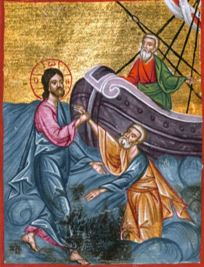
peter walksThe interesting thing about the Gospel of Mark is that Jesus doesn’t tell us (over and over again) He’s the Messiah; He proves it by His actions.[1] This passage (Mk 6:45-52) is full of trinitarian implications. It follows right on the heels of the feeding of the 5000 (“for they did not understand about the loaves,” Mk 6:52), and it can’t be rightly understood without that connection.

Jesus’ prayer

Alarmed at the crowd’s blasphemous intentions to make Him a dime-store King (Jn 6:15), Jesus “immediately made his disciples get into the boat and go before him to the other side,” (Mk 6:45).

Commentators are divided about why He “went into the hills to pray,” (Mk 6:46). Some suspect He prayed that the disciples wouldn’t be seduced by these wrong Messianic ideas;[2] a notion some scholars reject.[3] Others think He prayed the disciples would have a safe voyage.[4] If that was His intent, then God surely didn’t listen! Some think Jesus prayed for Himself, that He wouldn’t yield to the temptation to take a shortcut to His Kingdom and bypass Calvary.[5] Options one and three are the most likely.

But, for our purposes the content of His prayer is less important than the fact of it – who did Jesus pray to? Oneness Pentecostal theologians would have us believe Jesus’ human will is praying to His divine will for strength;[6] a rather extreme form of Nestorianism. In light of the evidence we’ve seen for a distinction between Divine Persons,[7] this is a desperate dodge. Jesus, as our divine substitute, truly prayed to the Father for strength to avoid this temptation[8] as part of His lifelong active obedience to the law for our sake.

Walking on the waves

Several hours later, as the disciples made their way across the lake, Jesus “saw that they were distressed in rowing, for the wind was against them,” (Mk 6:48). In recent weeks, Jesus has:

  • Called and commissioned the twelve, “gave them authority over the unclean spirits,” the ability to miraculously heal the sick, and sent them out to preach the Good News of the Kingdom (Mk 6:7-13). In short, Jesus commissioned them to duplicate His message and the signs which accompanied it (cf. Lk 7:22-23; Isa 35:5-6).
  • He’s fulfilled the role as Israel’s true leader and shepherd, preaching the Kingdom of God to a massive crowd and healing their sick (Mk 6:34).
  • Like Moses before Him, Christ fed the Israelites in the wilderness by miraculous provision. He did it as a teaching lesson; e.g. “Look what I’m doing here – what does this say about who I am?”
  • But, where Moses prayed to God for food and waited, Jesus simply produced it Himself – because He is Moreover, He allowed the people to gorge themselves on the food (“they all ate and were satisfied,” Mk 6:42); a rare treat for people who did not have much.

What follows is a deliberate display of divine power, to show these disciples who He really is. Before, during an earlier storm, they’d asked, “Who then is this, that even wind and sea obey him?” (Mk 4:41). As if they didn’t have enough evidence, Jesus will show them one more proof and answer that question. This story is not an allegory about how Jesus helps His people in difficult times; that is a terrible misreading of the context.[9] Rather, this miracle acts as a crescendo, an epic finale of self-disclosure to men haven’t quite grasped the truth yet.[10]

Mark tells us that, somewhere between 0300 – 0600:

… he came to them, walking on the sea. He meant to pass by them, but when they saw him walking on the sea they thought it was a ghost, and cried out; for they all saw him, and were terrified. But immediately he spoke to them and said, ‘Take heart, it is I; have no fear,’ (Mk 6:48-50).

Some commentators try to explain away this miracle, as if Christ were merely splashing through the shallows along the shore, or perhaps this account was a later invention. Others worry this story presents a docetic Jesus; a phantasm who is less than human (“they thought it was a ghost,” Mk 6:49).[11] This assumption relies on the idea that Jesus somehow renounced His divine attributes or the use of them and, thus, cannot use them without compromising His humanity. This is incorrect; Jesus continued to exercise all His divine attributes, while assuming a human nature in such a way that He now “lives and acts in both natures forever.”[12] As God the Son Incarnate, He lived His life (including the exercise of divine and human attributes) in accordance with the Father’s will[13] – and it was evidently His will for the Son to reveal Himself in this unique way.

What, then, should we make of Jesus “walking on the sea?” The contrast is between the Old Covenant revelation of Yahweh as distant and frightful, and Jesus’ New Covenant revelation of Yahweh as personal, intimate and close. The Book of Job tells us God “alone stretched out the heavens, and trampled the waves of the sea … Lo, he passes by me, and I see him not; he moves on, but I do not perceive him,” (Job 9:8, 11). There are two points to notice; Yahweh shields Himself from His people, and He has awesome power:

  • Job knows Yahweh as the One who is invisible, indistinct and unapproachable. “If he should pass over me, I would not notice, and if he should pass by me, likewise I would not perceive,” (Job 9:11; Lexham LXX).[14]
  • Likewise, His power is so great, He “walks about upon the sea as upon a floor,” (Job 9:8b, Lexham LXX).

This is precisely what Jesus does in our passage; “he came to them, walking on the sea,” (the NT phrase is nearly identical LXX text).[15] But, where Yahweh hides His divine presence from His people (“you cannot see my face; for man shall not see me and live,” Ex 33:20), Jesus, “the only Son, who is in the bosom of the Father, he has made him known,” (Jn 1:18). Jesus is equal with the Father, and is Yahweh, God with them, showing Himself to His chosen disciples. Like Yahweh, He, too, was “walking on the sea.” He would have passed them by. Instead, unlike Yahweh in the Old Covenant, He stops and joins them.[16]

I AM

Jesus says, “Take heart, it is I; have no fear,” (Mk 6:50). This phrase ἐγώ εἰμι could mean “it is I.” Or, it may be a deliberate reference to the Divine Name. Commentators are divided,[17] and context is key. Here, in the midst of a culminating series of miracles and expressions of divine identity to the disciples, it’s hard to see this as an innocent, “Hey, its me!” greeting.[18] Even if that’s all it is, the greeting has no meaning without a context for who Jesus is. Also, even if the disciples didn’t understand Jesus to be saying, “I AM Yahweh!” at the time, the Lord may have wanted us to understand this when He moved Mark to write these words.[19]

It’s best to see this as Jesus’ deliberate identification with Yahweh. This is more than simple oneness with the Father; Jesus is explicitly claiming to be Yahweh. In a truly delightful way, Father, Son and Spirit work in a correlative way, so the seeming actions of one are actually performed by all three as a single unit.[20]

Having revealed Himself as the true shepherd, teacher and leader of Israel who preached God’s Kingdom (Mk 6:34), miraculously provided for the people in the wilderness as Moses’ preeminent and divine successor (Mk 6:35-44), having then come to the disciples as Yahweh Himself (Mk 6:48), walking “about upon the sea as upon a floor” (Job 9:8; Lexham LXX), then told the disciples to be calm because He is Yahweh Himself in the flesh (“I am!” Mk 6:50), Jesus caps this crescendo by stopping the storm (Mk 6:51).[21]

After all this, why are the disciples “utterly astounded,” (Mk 6:51)? Mark tells us they still didn’t understand who Jesus is; “for they did not understand about the loaves, but their hearts were hardened,” (Mk 6:52). This series of divine unveilings was intended be a bright mirror, showing who this Messiah is.[22] Yet, it didn’t work here.

Today, as we reflect back on the passages like this one (and so many others), I hope Christians are committed to progressing beyond these disciples to actually know who Yahweh, our triune God, is.[23]

David Bernard, a Oneness Pentecostal theologian, has well said:

Many church members do not really understand the doctrine of trinitarianism and, as a practical matter, are closer to Oneness belief … Most Catholics and Protestants do not have a well-developed concept of the trinity, do not know in detail what trinitarianism teaches, and cannot explain Bible passages in trinitarian terms.[24]

I’m afraid he is correct. It is a shame the very identity of our great God and Savior is such a neglected doctrinal subject. Carl Trueman has observed:[25]

Ask yourself this: if my church put on a conference about how to have a great Christian marriage and fulfilled sex life, would more or fewer people attend than if we did one on the importance of the incarnation or the Trinity?

The answer to that question allows an interesting comparison between the priorities of the church today and that of the fourth and fifth centuries. It is not that the people in your church do not believe that, say, Christ rose from the dead and the tomb was empty; rather it is that such belief has no real usefulness to them other than as it provides them with what they are looking to obtain in the here and now.

In such a context, orthodoxy as expressed in the great creeds and confessions is not rejected; it is simply sidelined as irrelevant and essentially useless.

The Trinity is all over Scripture; it’s certainly all over the Gospel of Mark. Jesus shows us who He is, and He shows us the Father and the Spirit, too – our One God, who eternally exists in three co-equal, co-eternal Persons. If we seek to love God with all our heart, soul and might (Deut 6:5), then we ought to want to know who He really is – in all His triune glory.

Notes

[1] James R. Edwards, The Gospel According to Mark, in PNTC (Grand Rapids, MI: Eerdmans, 2002), 199.

[2] See Edwards (Mark, 196-197) and William L. Lane, The Gospel of Mark, in NICNT (Grand Rapids, MI: Eerdmans, 1974), 235.

[3] “The feeding miracle certainly has messianic overtones (cf. Isa 25: 6– 8), but Mark presents it as an act of compassionate shepherding and nothing about the crowd’s behavior indicates messianic ambitions or expectations,” (Mark Strauss, Mark, in ZECNT [Grand Rapids, MI: Zondervan, 2014], 284).

[4] William Hendriksen, The Gospel of Mark, in NTC (Grand Rapids, MI: 1975), 258-259.

[5] This is the view advocated by many theologians, such as James A. Brooks (Mark, vol. 23, in NAC [Nashville: B&H, 1991], 111); R.C.H. Lenski (The Interpretation of St. Mark’s Gospel [Columbus, OH: Wartburg, 1946], 271; and Albert Barnes (Notes on the New Testament, vol. 9 [Grand Rapids, MI: Baker, 1998], 155-156).

[6] “We do not say Jesus prayed to Himself, for this would incorrectly imply that the man was the same as the Spirit. Rather, we say that the man prayed to the Spirit of God, while also recognizing that the Spirit dwelt in the man,” (David K. Bernard, Oneness of God [Hazelwood, MO: Word Aflame Press, 2000; Kindle ed.], KL 1737-1738).

[7] Mk 1:1-3, 8, 10-12, 14, 24, 35; 2:10, 12, 28; 3:11, 28-30, 31-32; 5:7; 6:41.

[8] Jesus, in the incarnation, was made in a state in innocence and holiness, just like Adam. His temptations did not come from a wicked disposition from within, but from without – just like Adam and Eve.

[9] “As with the stilling of the storm, this miracle has been interpreted from patristic times as an allegory of the Church, subjected to hardship and persecution, and wondering if the Lord would ever return: the story is then understood as a message of hope in a dark hour—a promise that Christ will indeed come. This interpretation was natural enough for those in that situation, but Mark himself gives no indication that he understands the story in that way; rather his concern here, as elsewhere, seems to be with the question ‘Who is Jesus?’ The answer is clear to those who grasp the significance of the story,” (Morna D. Hooker, The Gospel according to Saint Mark, in BNTC [London: Continuum, 1991], 169).

[10] “Jesus’ walking on the water to his disciples is a revelation of the glory that he shares with the Father and the compassion that he extends to his followers. It is a divine epiphany in answer to their earlier bafflement when he calmed the storm, ‘Who is this?’ (4:41). In this respect Mark’s Christology is no less sublime than is John’s, although John has Jesus declaring that he is the Son of God (John 10:36), whereas Mark has him showing that he is the Son of God,” (Edwards, Mark, 199).

[11] See Hooker (Mark, 168-169). She doesn’t agree with this perspective, but she discusses it briefly.

[12] Stephen J. Wellum, God the Son Incarnate: The Doctrine of Christ, in Foundations of Evangelical Theology, ed. John Feinberg (Wheaton, IL: Crossway, 2016), 435. Wellum explains, “From the moment of the virgin conception, the eternal Son ‘took into his own divine person a complete set of human characteristics and components – including everything that pertains to humanity – so that from then on he is said to possess a human nature as well.’ The direction of metaphysical movement is crucial. The Son did not come to an existing human being or even human nature to form an artificial or ad hoc union. Rather, through the virgin conception, God created a new human nature for the Son, who assumed that nature as part of his subsistent existence,” (435).

[13] “The best way to account or the asymmetrical relationship in Christ is in terms of the Trinitarian relations worked out in redemptive history for the sake of the Son’s incarnational mission. The Son lives out his divine and human lives in relation to the Father and Spirit as our Redeemer. Against all forms of kenoticism, the Son does not renounce his divine attributes or even the use of them. Instead, the Son’s entire life is best viewed through the lens of his filal dependence on the Father in the Spirit. The Son does nothing except what he knows that Father wills him to do,” (Wellum, God the Son, 441).

[14] Rick Brannan et al., eds., The Lexham English Septuagint (Bellingham, WA: Lexham Press, 2012).

[15] The Lexham LXX reads: καὶ περιπατῶν ὡς ἐπ᾽ ἐδάφους ἐπὶ θαλάσσης. The Gospel of Mark reads: περιπατῶν ἐπὶ τῆς θαλάσσης. Mark left out the editorial flourish, “like on a floor/ground.” The sense is the same.

[16] Matthew 14:28-33 includes an additional element to the account, which I won’t deal with here.

[17] For example, Lane (Mark, 237) and John Grassmick (Mark, in BKC, vol. 2 [Wheaton, IL: Victor, 1983], 132) believe this is a theophany. Walter Wessel (Mark, in EBC, vol. 8 [Grand Rapids, MI: Zondervan, 1984], 676) and Strauss (Mark, 286-287) disagree.

“The phrase ‘I am [he]’ (ἐγώ εἰμι) is a normal way of self-identification in Greek and so would not by necessity recall these OT allusions. In the present context, Jesus’ purpose is to assure the disciples that it is he and not a ghost. Furthermore, an explicit divine claim would be unusual in Mark’s gospel, where Jesus reveals his divine authority through his actions, but never directly through his words (but cf. 14: 62, where the same phrase is used). It seems unlikely, therefore, that Mark understands Jesus to be saying emphatically, ‘I am Yahweh!’ Whether Mark’s readers in the post-resurrection church would have picked up such an allusion is a more difficult question,” (Strauss, Mark, 286-287).

[18] “God cannot be fully seen, but Jesus can. The one who comes to them on the sea is not simply a successor to Moses, who fills baskets with bread in the desert. Only God can walk on the sea, and Jesus’ greeting is not simply a cheery hello to assuage the disciples’ fears. He greets them with the divine formula of self-revelation, ‘I am,’” (David E. Garland, Mark, in NIVAC [Grand Rapids, MI: Zondervan, 1996], 264).

[19] “It is not clear that Mark interpreted the words in this way, but others may well have soon done so (cf. John 18:5f.),” (Hooker, Mark, 170).

[20] Carl Beckwith observed, “If the essential attributes, like the external acts of the Trinity, belong equally and indivisibly to Father, Son, and Holy Spirit, as the church rightly confesses, why do Scripture and our creeds sometime assign them more particularly to one person? The explanation given by the Fathers and reformers has been that the external acts and essential attributes of God may be appropriated or attributed more particularly to one person in order to more fully disclose the persons of the Trinity to our creaturely ways of thinking. This doctrine of appropriation assists us conceptually and aims to focus our prayers and worship on the divine persons,” (The Holy Trinity, vol. 3, in Confessional Lutheran Dogmatics [Fort Wayne, IN: Luther Academy, 2016; Kindle ed.], KL 9443-9448).

[21] Lane doesn’t believe this was a miraculous act (Mark, 239).

[22] “But the principal charge brought against them is blindness, in allowing so recent an exhibition to fade from their memory, or rather in not directing their mind to the contemplation of Christ’s divinity, of which the multiplication of the loaves was a sufficiently bright mirror,” (John Calvin and William Pringle, Commentary on a Harmony of the Evangelists Matthew, Mark, and Luke, vol. 2 [Bellingham, WA: Logos Bible Software, 2010], 239).

[23] “Within the one Being that is God, there exists eternally three co-equal and co-eternal persons, namely, the Father, the Son and the Holy Spirit,” (James White, The Forgotten Trinity [Minneapolis, MN: Bethany House, 1998], 26).

[24] Bernard (Oneness of God, KL 2963 – 2964; 2971 – 2972).

[25] Carl R. Trueman, The Creedal Imperative (Wheaton, IL: Crossway, 2012; Kindle ed.), KL 532-538.

Some Advice for Younger Fundamentalists

Slide1
Jim is having a deep discussion with Carl about predestination

Baptist fundamentalism is a very particular sub-culture in the evangelical Christian world. I’m a member of this small sub-culture. It’s a movement with a rich and worthy legacy. What on earth is fundamentalism? Here is my brief definition:

Fundamentalism is a philosophy of ministry characterized by a militant apologetic defense and passionate, unashamed proclamation of the Christian faith from the Scriptures in the face of pagan unbelief, theological revisionism and compromise.

The “movement” was a largely American reaction against apostate theological revisionism in the later 19th century. Depending on who you ask, and where they come from, fundamentalism developed along different lines, in different denominations. The general idea was that the “rule of faith,” the core doctrines which make Christianity what it is, are worth fighting for.

During the first decades of the 20th century, these individual movements lost ground in their various ecclesiastical orbits and bureaucracies. Gradually, these men realized they’d better pull out of these apostate bureaucracies, and form their own organizations. So, pastors and their churches across our fair land did just that.

The problem

But, over the decades, this movement has ossified in some quarters. It’s inevitable, I suppose:

  • The first generation goes forth on its own, to conquer new ground and blaze a glorious trail for reformation.
  • The second generation takes the helm, anxious to continue in the proud and honorable tradition of their fathers.
  • The third generation is focused more on perpetuating the organization, and less on the theological issues which actually created the movement in the first place.

It can become this way in any organization. The original ideals are still spoken of with respect, and the right phrases are trotted out at just the right times. And yet … there’s something wrong. The focus is now on the organization, not the original issues. This is why, for example, Al Sharpton is such a joke when you compare him to Booker T. Washington.

In the fundamentalist sub-culture over the past decade, we have seen an identity crisis. Some younger fundamentalists have fled the movement, shrieking in terror (oh, the humanity!) for parts unknown. Others have left for the confessional, Reformed world. Some are just … different. Still others have remained, anxious to reform a movement worth saving. And, some have mounted a desperate rear-guard action, anxious to fight against any notion of reform. These are (for lack of a better term) the Company Men.  However, unlike the heroic defenders at Rorke’s Drift, they shall not prevail.

The Company Men control some outlets in the fundamentalist world. Their influence is slowly waning, and their numbers are steadily shrinking. I believe a major reason for is because some have lost their sense of mission. In short, they have ossified.

The great parallel

Let me frame this in a way that might be helpful. Some readers have been, or are, leaders in local churches. This may help folks to understand where I’m coming from:

  • Some fundamentalist para-church organizations are like dying churches.

Here is what I mean:

  • A dying church lives in the past, idolizes it, and generally neglects its most basic functions of robust discipleship and active evangelism. Instead, dying churches tread water and gradually die out. As the end draws nearer, some church members often react with extreme defensiveness, and pine away for the “good old days” of the Nixon era, when they ran 500+ and had multiple bus routes.
  • In these churches, there always are some younger, reform-minded folks who see the problem, but are rarely given free reign to actually tackle these issues. Eventually, some of them get fed up, and leave. The younger exodus begins, and you’re left with a small congregation of (sometimes) embittered older saints who dig their heads into the sand, and convince themselves they’re suffering for righteousness’ sake.
  • Indeed, some of those who remain take to slandering the younger men as inexperienced, inept, “new-fangled,” and immature. This is generally (but not always) pride and arrogance talking – borne out of defensiveness.

This is a remarkable parallel to what has been happening in some fundamentalist para-church organizations for some time:

  • They’re dying.
  • They live in the past, idolize it, and generally neglect their most basic functions of fighting to defend the faith against theological revisionism and outright apostasy, at an intellectual and popular level. Instead, some of these dying organizations tread water and will gradually die out. As the end draws near, some fundamentalists often react with with extreme defensiveness, and pine away for the “good old days” of the Nixon era, when they had meaningful influence in the larger Christian sub-culture.
  • In these organizations, there always are some younger, reform-minded folks who see the problem, but are rarely given free reign to actually tackle these issues. Eventually, some of them get fed up, and leave. The younger exodus begins, and you’re left with a small organization of (sometimes) embittered older saints who dig their heads into the sand, and convince themselves they’re suffering for righteousness’ sake.
  • Indeed, some of those who remain take to slandering the younger men as inexperienced, inept, “new-fangled,” and immature. This is generally (but not always) pride and arrogance talking – borne out of defensiveness.

Do you see the parallels? Many of the godly saints in these para-church organizations can correctly diagnose these problems in local churches. Can they do it in their own organization? Will they do it? We’ll see.

This great divide, this great ossification, is tearing Baptist fundamentalism apart at the seams. Many younger men refuse to be formally identified with the movement out of disgust at what it’s become in certain quarters. Some older men are only too happy to see them go. Clearly, the thrill is gone …

The advice

This kind of talk can make a fella feel downright sad. So, I reckon I’ll share a few tidbits of advice for younger fundamentalists. I may add more to this list, as time goes by. But, for now, I think this is some pretty good advice. It’ll help put things into perspective. This advice is deliberately blunt, so flee now if you must.

So, here’s some advice when it comes to fundamentalist identity politics:

  1. Write about fundamentalism, if you wish – just don’t ever discuss it online. It will destroy your soul and you will accomplish nothing. I’ve verified this over years of careful testing. (Note – I actually added this last bit of “advice” after the fact, after extensive interaction in an online forum about this very article).
  2. If you usually blindly support a particular flavor of Baptist fundamentalism, without any introspection or constructive thought, that means you’re a Company Man. It also means you’re a “Yes Man.” Don’t be a “Yes Man.”
  3. Don’t be a Company Man. Think for yourself, even if that means disagreeing with the godly folks who trained you. You have a brain, so use it. If your congregation wants artificial intelligence, it can turn to Alexa or Siri.
  4. It’s ok to disagree. If you blindly tow the line on everything your ecclesiastical sub-culture’s powerbrokers say, you’re foolish and shouldn’t be a leader. Step down and make room for someone else.
  5. Your fundamentalist heroes could be wrong about something. Yes, it’s true. But, then again, you could be wrong, too …
  6. Nobody cares about fundamentalist politics but other pastors. That means it’s not important.
  7. Most members of your church don’t care about the FBFI, IFCA or the GARBC. They care about Christ, the Gospel, and living holy lives. That means fundamentalism isn’t very important.
  8. If “the movement” is more important to you than the original philosophy and impetus which inspired the movement in the first place (i.e. militant defense and offense against apostasy), then you’re unbalanced and unstable. Go buy yourself a life on Amazon and get some perspective.
  9. Fundamentalism isn’t a confessional, pseudo-denomination. Anybody who acts like he, or his organization, is the enforcer for a narrow and very particular flavor of “fundamentalist orthodoxy” is a Company Man.
  10. Think of historic fundamentalism as a philosophy of ministry, not a traditional movement. You’ll be happier.
  11. Read the Bible, and love the people in your church. Don’t love fundamentalism. It won’t love you back.
  12. If it’s an explicit or clearly implicit teaching of Scripture, it’s worth fighting over. If it’s a personal preference, get a life and deal with it. But, before you either launch polemical broadsides or plan an ecumenical lovefest, make sure you’ve done the exegetical and systematic work to figure out the difference between a clear teaching and personal preference.
  13. Don’t be afraid of other pastors, and what they might think.
  14. Before you disagree with somebody, honestly try to understand their position. This means you have to actually think critically, and be introspective (see #2, above).

Real Christian Life … and Slavery (Part 3)

big-beautiful-stack-of-books-231x300Real life is hard. Peter knows that; it’s why he wrote his letter. Today, in Sunday School, we continued looking at 1 Peter 2:18-25, and considering what it means:

  • We reviewed a bit about what slavery was like (and what is wasn’t like) in Peter’s world
  • Why does God want Christian slaves to submit themselves to their masters, even if they’re cruel masters?
  • What attitude should Christian slaves have, while they do this?
  • Why is God pleased if a Christian slave endures sorrows while suffering unjustly? What on earth does this even mean?

We tackle some of these issues, and more, every Sunday. Here is the archive of lessons from 1 Peter, so far. Listen along to this week’s lesson:

The Two Ways to Live

forkA few days ago, I shared some … unique allegorical insights from an early 2nd century Christian work, entitled The Epistle of Barnabas. Today, I wanted to share something positive and uplifting from that old letter. In the decades immediately following the death of the apostles, it was apparently common to frame the issue of salvation and allegiance to Christ as “the two ways to live.”

One very early Christian text, which may have been in circulation before the Apostle John even wrote the Book of Revelation, discusses these “two ways,” and remarks, “There are two ways, one of life and one of death, and there is a great difference between the two ways,” (Didache 1.1). In The Epistle of Barnabas, the author went into great detail and contrasted the way of salvation and the way of continued rebellion and allegiance to Satan. It’s excellent stuff, and it’ll still preach today …

The way of light

Here is what the letter reads (Barnabas 19). The author describes what a faithful, believing life in submission and allegiance to Christ as Lord actually looks like:

Therefore, the way of light is this: if anyone desires to travel along the way to the appointed place, let him be diligent in his works. Therefore the knowledge which was given to us to walk in it is as follows.

You shall love the one who made you, fear the one who created you, and glorify the one who redeemed you from death. You shall be sincere in heart and rich in spirit. You shall not be joined with those who walk in the way of death. You shall hate everyone who is not pleasing to God. You shall hate all hypocrisy. You shall never forsake the commandments of the Lord.

You shall not exalt yourself, but shall be humble in all things. You shall not take glory upon yourself. You shall not plot an evil plan against your neighbor. You shall not permit arrogance in your soul.

You shall not commit sexual immorality, you shall not commit adultery, you shall not corrupt children. The word of God shall not go out from you with anyone impure. You shall not show favoritism. when correcting someone concerning sin. You shall be gentle. You shall be quiet. You shall tremble at the words which you have heard. You shall not bear a grudge against your brother.

Do not be double minded, whether it will happen or not. Do not take the name of the Lord in vain. You shall love your neighbor more than your own life. You shall not murder a child by abortion, and again, you shall not kill the just-born one. Do not withhold your hand from your son or from your daughter, but you shall teach them from youth the fear of God.

You shall not yearn after the things of your neighbor. You shall not be greedy, you shall not be joined by your soul with the haughty, but be associated with the humble and righteous. The activity that happens to you accept it as good, knowing that nothing takes place without God.

You will be neither double-minded nor glib of tongue. You will be subject to your master as a copy of God, in modesty and fear. Do not command your male slave or female slave in bitterness, who are hoping in the same God, lest they cease to fear the God over you both, because he does not come to call with partiality, but to whom the Spirit prepares.

You shall share in all things with your neighbor and you shall not say it is your own. For if you are sharers in the incorruptible, how much more in the corruptible? You shall not be quick to speak, for the mouth is a snare of death. To the degree that you are able, you shall be pure for the sake of your soul.

Do not reach out your hand first to receive, only to pull back from giving. You shall love as the apple of your eye everyone who speaks the word of the Lord to you. You shall remember the day of judgment night and day, and you shall seek out every day the presence of the saints, either by laboring in word and going out to encourage and striving to save a soul by the word, or with your hands doing work as a ransom for your sins.

You shall not hesitate to give nor grumble while giving, but you will come to know who is the good paymaster of the reward. You shall guard what you have received, neither adding to nor taking away from. You shall utterly detest the evil one. You shall judge justly.

You shall not cause division, but make peace by bringing together those who fight. You shall make confession for your sins. You shall not come to prayer with an evil conscience. This is the way of light.

The way of darkness

But, what about the other path? The letter continues (Barnabas 20):

But the way of the Black One is crooked and filled with cursing, for it is the way of eternal death with punishment, in which are the things which destroy their soul: idolatry, arrogance, arrogance in an influential position, hypocrisy, acts of duplicity, adultery, murder, robbery, pride, transgression, deceit, malice, stubbornness, use of potions, magic, greediness, lack of fear of God; persecutors of the good, hating the truth, loving the lie, not knowing the reward of righteousness, not joining the good, not judging righteously, not being concerned about the widow and orphan, not caring in the fear of God but for what is evil, from whom gentleness and endurance are inseparably removed, loving what is worthless, pursuing reward, not having mercy on the poor, not toiling for the downtrodden, prone to slander, not knowing the one who made them, murderers of children, corrupters of the creatures of God, rejectors of the needy ones, oppressors of the afflicted, defenders of the rich, lawless judges of the poor, people steeped in sin.

This is good stuff. It’s still convicting today. Some things never change.

Notes

Both excerpts were quoted from The Apostolic Fathers in English, translated Rick Brannan (Bellingham, WA: Lexham Press, 2012).


Contending for the Faith

fools talkIn his wonderful book, Fools Talk: Recovering the Art of Christian PersuasionOs Guinness spends some time discussing the challenges that thinking Christians face today. One of the most dire, he believes, is from the fraudulent, revisionist perversion of true Christianity within churches:

Many revisionists in the Protestant liberal churches, followed by the extremes of Catholic progressivism and emergent evangelicalism, have reached the point where their thinkers preach “a different gospel,” some of their leaders are hardly recognizable as Christian, and some have joked that they recite the Apostles’ Creed with their fingers crossed …

Some of today’s deadliest challenges to the Christian faith come from within the church itself, yet in many parts of the church Christian apologetics is weak, poorly understood and openly dismissed as an unworthy and a wrong-headed enterprise.

Without faithful and courageous apologists, men and women who are prepared to count the cost, the church is vulnerable to the challenges it faces internally as well as externally. Can there be any question that today’s “grand age of secular apologetics,” which is both post-Christian and pluralistic, is no time for Christians to be voiceless and lacking in persuasion?

If ever there was a time when it was vital for all Christians to be bold and winsome advocates on behalf of their faith, it is now. No one can fail to see the blizzard of challenges sweeping down on the Christian faith today and calling for a clear response.

From questions about the origins of the universe (Leibniz’s “Why is there not nothing?”) to the challenges of scientism, to attacks on the existence of God and the person of Jesus, to the exposure of the sins and hypocrisies of the church, to recurring questions about evil and suffering raised by natural disasters, to the validity and importance of truth, to the contested place of religion in public life, to the purported irrationality and menace of religion of any kind, to the relationship of the Christian faith to other religions and the response of Christians to new technologies and alternative lifestyles—the church faces an unprecedented barrage of questions, challenges and attacks on its core message, its view of the world and its way of life.

Not surprisingly, such grave assaults from the outside have led to serious erosions on the inside too, and all this at a speed and on a scale that is without precedent in Christian history (210-211).

In today’s environment, many “Christians” are moving rapidly towards the exits, anxious to leave the hard truths of the “rule of faith” behind. As soon as it begins to cost something to identify as a Christian, we’ll see the pretenders stop pretending and seek to “revise” the faith. Indeed, Guinness makes the point that the term “revisionist” is much more accurate than “liberal,” (222-223).

He then turned to one important task for Christians today:

Christian advocates, then, must be ready to focus their attention on those inside the church as well as those outside—resisting modern revisionism just as St. Paul resisted ancient Gnosticism and St. Athanasius stood fast against Arianism and the world of his day.

Are today’s evangelists and apologists prepared to count the cost and pick up their crosses again and truly be contra mundum—even to the point of scorn, shame, and perhaps imprisonment and death?

Let there be no misunderstanding: the greatest crisis now facing the church in the West today is the crisis of authority caused by the church’s capitulation to the pressures of the sexual revolution, and in particular to the bullying agenda of the Lesbian-Gay-Bisexual-Transgender-Queer coalition.

It will not do for evangelists and apologists to keep silent for fear of losing opportunities to present the gospel. As Luther made plain in his day, to fight the battle at any point other than where the battle is being fought in one’s day is to lose the battle (226).


Guinness’ book isn’t about fighting the culture wars. It’s an encouraging, thought-provoking and profoundly moving book about recovering the lost art of persuasion as a tool for engaging the our friends, neighbors, co-workers and communities with the Gospel. It’s probably the most helpful apologetics book I’ve ever read, but it’s much more than that. I’ll write a full review on it soon.

A Dose of Reality About The New Testament Canon

st-barnabasMany Christians are confused about how the individual books which make up the New Testament “got into” the New Testament in the first place. They often assume the books were chosen by somebody. Perhaps you picture a conference room, with various books spread out over the table, an eager assistant fiddling with a PowerPoint presentation, and ballots being passed around. Not so much …

Why is a book canonical?

Michael Kruger has written a wonderful book on this subject, entitled Canon Revisited: Establishing the Origins and Authority of the New Testament Books. In this tome, he made the case for a “self-authenticating” model of canonicity.[1] This model is built around three criteria:

  1. The book has godly, divine qualities
  2. The book has apostolic origins. This doesn’t mean it was written by an apostle, but that it was written during the time the apostles were alive
  3. The book was corporately recognized and received by the church catholic

There’s a whole lot to unpack here, and I won’t bother to do it. If you’re interested, you can buy the book. Or, you can read some of the short articles Kruger has written on his website. My point is that, when it comes to the individual books which make up the New Testament canon, “[b]ooks are not canonical because they are recognized; they are recognized because they are already canonical.”[2] If God inspired a man to write the book, He made sure His sheep heard and recognized His voice in the book – which led His church, collectively, to accept it as sacred Scripture.

Barnabas’ letter

In this little article, I want to explain how that works in very practical terms. I believe Christians can read Scripture and immediately, intuitively understand its divine qualities (point #1, above). Likewise, a Christian can read something written by a Christian, and tell it isn’t divine. It may be helpful and really neat, but it isn’t divine, inspired, or inerrant.

I want to show you an excerpt from an ancient work entitled The Epistle of Barnabas. It was a very popular book in its day, but it isn’t “Scripture.” The book was likely not written by Baranbas himself. It was common in those days to attribute a work to a dead person who had “street cred,” in order to boost the work’s popularity. The book was written sometime after the destruction of Jerusalem in 70 A.D. and before Emperor Hadrian rebuilt Jerusalem in 132 – 135 A.D.[3] Most scholars date it sometime in the first quarter of the second century. The book is note-worthy because it is extraordinarily anti-Jewish, and takes an allegorical approach to interpreting the OT Scriptures.

Why isn’t this book “Scripture?” Why isn’t it in your New Testament right now? Well, one reason is that it clearly doesn’t have “divine qualities.” Here is an excerpt from the book (Barnabas 10:1-8).[4]

What do you think of it?

And that Moses said, “You will not eat pig or eagle or hawk or crow or any fish which does not have scales on itself,” he included three doctrines in his understanding. ⌊Moreover⌋, he says to them in Deuteronomy, “And I will make a covenant of my regulations with this people.” Therefore, as a result the commandment of God is not ⌊to refrain from eating⌋, but Moses spoke in the spirit (Barnabas 10:1-2).

So, Moses “spoke in the spirit,” did he? What does this mean? Heh. Get ready …

Therefore, he mentioned the pig for this reason: you will not be joined, he says, with people such as these, who are like pigs. That is, when they live luxuriously they forget the Lord, but when they have need, they acknowledge the Lord, as also the pig when it eats it does not know its owner, but when it is hungry it cries out, and after receiving food, it is silent again.

I … see. This is allegorical interpretation. According to Barnabas, the dietary laws aren’t really about food at all. Did you think they were? Silly you! Moses wasn’t talking about literal pigs. He was referring to people who are moral pigs. It gets worse.

“And you shall not eat the eagle or the hawk or the kite or the crow.” He means you must not join with or ⌊resemble⌋ people such as these, who do not know how, by toil and sweat, to provide food for themselves, but they plunder what belongs to another in their lawlessness, and they lie in wait, as if conducting themselves in purity, and they look around to see who they may plunder through their greediness, as also these birds alone do not provide food for themselves, but sitting idle, seeks out how it may devour the flesh of another, having become a public nuisance in its wickedness.

Ah, of course. How could I have been so blind for so long? The eagle sits up high, watching and waiting for prey so it can strike like a silent ninja. Just so, we must not imitate this wickedness. It’s all clear to me, now.

And “You shall not eat,” he says, “the sea eel or the octopus or the cuttle-fish.” He means you shall not become like such animals, joining with people such as these, who are ungodly to the end and who are condemned already to death, as also these cursed little fish swim alone in the deep water, not swimming as the rest, but they dwell in the mud beneath the deep water.

This is profound.

But also you shall not eat the rabbit. For what reason? You shall not become, he means, a child molester, or even seem like such as these, because the rabbit multiplies its anus each year, for as many years as it lives, so many holes it has.

Words fail me.

But, “You shall not eat the hyena.” He means do not become an adulterer or a corrupter, and do not even seem like such as these. For what reason? Because this animal changes its nature each year, and it becomes ⌊one year male⌋, ⌊the next year female⌋.

Of course they do. Doesn’t everybody know that?

But he also hated the weasel rightly. Do not become, he means, such as this, of the sort we hear committing transgression with the mouth through impurity, and do not be joined with the unclean women, those who commit transgression with the mouth, for this animal conceives with the mouth.

Enough!

Barnabas has some interesting insights (it’s not all this weird, honest), but it clearly isn’t Scripture. It doesn’t have the divine qualities. Jesus and the apostles didn’t interpret the Old Testament allegorically. This author does. This book was written in a different time, in a different context, and from a different worldview than the New Testament. It’s clear.

If you disagree, I’m willing to hear your exegesis of the rabbit passage, above. I’ll be standing by.

Notes

[1] Michael Kruger, Canon Revisited (Wheaton, IL: Crossway, 2012), 88-122.

[2] Ibid, 108.

[3] See the short introduction in Michael Holmes (ed.), The Apostolic Fathers, 2nd ed. (Grand Rapids, MI: Baker, 1989), 160.

[4] This excerpt is from The Apostolic Fathers in English, translated Rick Brannan (Bellingham, WA: Lexham Press, 2012).

God Loves Frauds, Too …

starHere, in Micah 5:2-4, the prophet gave us probably the best-known passage in his book, and one of the most precious promises of the coming Christ. It’s a beautiful prophesy, and full of hope. Many Christians quote it this time of year, but fewer consider the real context of this prophesy.

If you picture God sitting before a crackling fire, passing around hot apple cider and chocolate truffles, telling the Israelites the wonderful story of the Coming King with a twinkle in his eye, tears of tender love flowing down His cheeks and a warm, fuzzy feeling in his heart … then you’re wrong!

In reality, God is promising all this to them even though (by and large) they’re complete religious hypocrites who hate God and hate His law. Let me say this plainly, because it’s the same message God sent Micah to preach to these Israelites, and it’s the same context in which he preached this prophesy of the Messiah:

If you don’t repent and believe, then this prophesy of the King from Bethlehem isn’t Good News for you – it’s bad news. Listen below for more. The sermon notes are here.

How a Church Ought to do Evangelism

I don’t intend to really answer the question here, but I do want to suggest a tentative way a congregation ought to structure its efforts for evangelism. Here it is; the picture says a thousand words . . .

Organization for Church Evangelism

A few points:

  • I emphasize deliberate corporate evangelism, because these efforts should be about intentionally giving the Good News to people. I don’t believe touchy-feely events, where you try to “friend” people into God’s coming Kingdom, are the best way to go. This is best reserved for interpersonal relationships on a personal level. This isn’t a tactic a church should use for corporate evangelism.
  • I also focus on deliberate personal evangelism, because your goal should be to get to actually telling the person the Gospel. You shouldn’t be somebody’s friend for 20 years, and hope “one day” to have an open door. Deliberately plan to work the Gospel into conversation, as appropriate. Don’t be like this.

Ciao.