On “Vision Casting” and Other Stupid Clichés

visionThere are certain phrases, buzzwords and slogans that make the rounds every now and then. I remember, long ago in a galaxy far, far away, when “the bomb” was a common way to express how interesting or amazing something was. Of course, nobody in his right mind would use that term now. Its too passé . . .

No one is immune to these fads. We’re prisoners of our culture and social context. Christians are no different. There are certain phrases that percolate in the pastoral sub-culture, each more mindless and idiotic than the next. One is “vision casting.”

Theoretically, this is a process whereby a dynamic and really spiritual “leader” conceives a vision, a path forward, a roadmap to bring his congregation from where it is, to where it simply must go. Eager and enthusiastic, this hip pastor “casts the vision” to the congregation. Of course, they see it, get it, and sign on for this “vision.”

If you’re a young pastor, you gotta “vision cast.” It’s, like, the cool thing to do.

Pardon me while I retch. In the real world, this is otherwise known as leadership. But, I understand. Leadership doesn’t sound cool. It lacks that sense of deliberate ambiguity, of abstract mushiness, that “vision casting” has.

There is no need to “vision cast,” because the Bible already gave us our mission. We just need to follow it. In this teaching lesson from 1 Peter 2:4-10 (our second one from this passage), the apostle tells us what congregations ought to be focused on. He tells you what you ought to be focused on.

  1. What is a church’s purpose? Its mission?
  2. If you’re a Christian, what is your most basic purpose in life? Why did God save you?
  3. If you’re a Christian, what role do you play in your church’s mission? Where do you fit in?
  4. What are the implications for you? For your work? For all the relationships and circumstances which comprise “your life?”

You see, there’s no need to “vision cast.” Pastors don’t need to catch visions, or cast them to church members. Peter tells us all about our mission, and its clear as day. What are the answers to these questions? How do you find your place and purpose in life, as God intended it to be?

Read 1 Peter 1:1 – 2:10, and think for a little while. Or, do that and listen in as we talk about all this. Drop me a line, or leave a comment if you’d like to chat.

The PDF notes for this week’s lesson are here. As always, all audio and PDF notes from the entire 1 & 2 Peter teaching series are here.


They’re Watching . . .

Dear friends:

I’m begging you – because you’re foreigners and temporary residents here, keep far away from the worldly lusts which are doing battle against the soul.

Always keep your whole way of life pure among the unbelieving nations, so that as they speak evil about you as though you’re criminals, because of your good deeds (which they’re watching) they might give honor to God on that day when He returns to judge the world.

Submit yourselves to every human authority for the Lord’s sake, whether to [the] emperor as one who governs, or to [the] officials who are being sent by him to punish evildoers and praise those who do right.

Because this is God’s will, that by doing right you’d silence the ignorant slander of foolish men — like freed slaves, and not like those who’re wearing this freedom like a cloak of wickedness, but like God’s slaves.

Respect all men. Love the family of believers. Always have fearful reverence for God. Always respect the Emperor.

  • 1 Peter 2:11-17 (my translation)

All About Bible Translations

stack-of-BiblesI think the best way to do figure out what a confusing passage means is to compare English bible versions. We have lots of them, and they’re usually good. Some have different goals, and they’re translated with these goals in mind.

In this post, I want to provide a brief overview of some common English bible translations that I think are helpful for Christians. Along the way, I’ll give some brief answers to common questions about bible translation. Here goes . . .

Why so many English versions?

There are many reasons. First, Christian translators and scholars are eager to always improve English translations; to fashion a new and better translation that speaks to the “common man,” and all sorts of other spiritual stuff. That’s good.

Also, Christian publishers want to market their own materials using their own proprietary translation. Who can blame them? It’s easier for Crossway, for example, to have its own translation, rather than potentially having to pay to use somebody else’s translation in the books it publishes. So, while the translators and scholars have noble goals, what’s even more true is that these scholars wouldn’t ever get the chance to fashion their new “ultimate” English versions unless a publisher thought it’d be worthwhile to sell the finished product.

Each major Christian publisher has commissioned and produced its own translation.

  • Zondervan has the NIV.
  • Crossway has the ESV.
  • Broadman & Holman have the CSB (formerly known as the HCSB).
  • HarperCollins has the NKJV; Thomas Nelson actually produced the thing, but it was bought by HarperCollins.
  • Tyndale House owns the NLT.

I could go on, but you get the point. But, the providential end result is that we have a lot of English bible versions. They’re usually all good. You should make use of them.

What are the differences between translations?

Generally, there are two issues readers should be aware of; NT textual basis and translation philosophy.

New Testament textual basis

There are basically three options for bible translators and scholars to use when it comes to the New Testament; (1) the Textus Receptus, (2) a Byzantine text, or (3) an eclectic text.

The Textus Receptus is a compiled, printed Greek text which began life in 1518 as an edited, printed compilation of perhaps a half-dozen Greek manuscripts containing the New Testament. The earliest of these dated from the 10th century. This printed edition was revised several times, but it continued to be based on very few Greek manuscripts. This is the first printed Greek New Testament, and its dominance lasted nearly 400 years. You can still buy a copy of one version of the Textus Receptus today, from the Trinitarian Bible Society. The KJV, NKJV and Modern English Version (MEV) are based on the Textus Receptus.

The Byzantine text platform is an edited, compiled, printed Greek text based on the vast majority of Greek manuscripts. However, most of these Greek manuscripts date from the Middle Ages, which means they aren’t very early at all. There are at least three printed, compiled Greek New Testaments based on the Byzantine text, all of them published within the past 40 years. There has never been a major English bible translation done from the Byzantine text, so don’t bother looking for one.

The eclectic (or critical) text is an edited compiled, printed Greek text based on a whole host of factors, from early manuscripts and later ones, too. It doesn’t strictly favor earlier Greek manuscripts or later ones, but in practice the earlier manuscript copies are often given more weight. It evaluates differences in Greek manuscripts on their own internal and external merits, and chooses the reading which makes the best sense. Different editions of this critical text have been published for over 100 years. Every major English bible translation (except the KJV, NKJV and MEV) is based on this eclectic text.

Some Christians passionately believe in the Textus Receptus, and the KJV whose New Testament comes from that Greek text. They may tell you all other Bibles are perversions. They’re wrong.

What are the differences between these different Greek New Testaments?

There are lots of spelling variations of different words, which are usually meaningless. There are lots of other meaningless odds and ends. The most striking differences are in (1) the longer ending of Mark, (2) the section from 1 John 5:6-8 which reads “and these three are one,” and (3) the story of the woman caught in adultery.

The Textus Receptus has all three of these. The printed Byzantine texts usually don’t count the “and these three are one” bit from 1 John 5:6-8 as being original, but have the other two. The eclectic printed texts don’t include any of these, because they aren’t in the earliest Greek manuscripts.

These are very complicated issues, and there are other less significant differences, but these are the most noteworthy. In fact, if you pay attention, I guarantee you’ll see notes in the margins of your Bible in the New Testament which read something like “other, later manuscripts include . . .” This isn’t a secret.

For some excellent information about this entire subject (which scholars call “textual criticism”), see these wonderful short lectures by Dan Wallace; look under the “textual criticism” heading.

Translation philosophy

It’ll be very challenging to write about this in a few paragraphs, but I’ll give it a shot. Modern English translations ran a whole gamut, from very literal to very free with their translation philosophy. This chart should make things clearer:
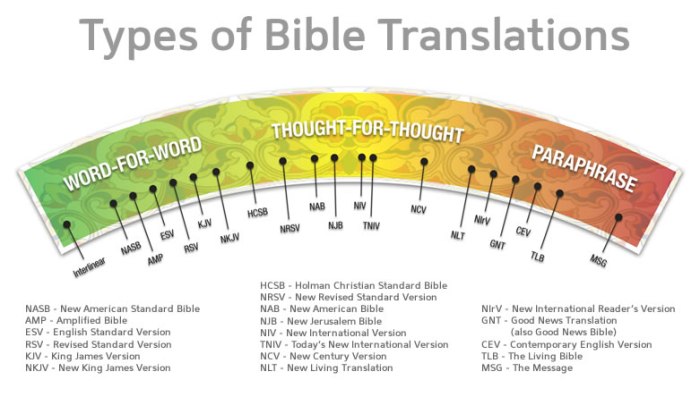
types-of-bible-translations

You may have been told that more “literal” translations are more accurate. You may have even been told that “thought-for-thought” translations are “liberal.” No. No. No. No.

Some translations seek to render the Greek word order as closely as humanly possible, believing this is the best way to translate. The NASB is the best example. This translation is so faithful to the original word order, and is so fearful of making any interpretive decisions, that it reads a bit like cardboard. In some places, it is very difficult to understand.

Other translations seek to make things clear. They’re willing to sacrifice a nearly word-for-word equivalence in order to make the idea crystal clear. The NLT is the best example. A child can read this translation with no problem. I know adults with low reading levels who benefit greatly from this translation.

Which one is best? All of the above. Let me give you an example; look at these samples from a wide variety of translations. They march in order from more “word for word” to “thought for thought.” Pay particular attention to the portions I highlight and underline, and watch how the sense changes between translations, from rigid English to freer, looser and clearer English:

  • NASB: “Keep your behavior excellent among the Gentiles, so that in the thing in which they slander you as evildoers, they may because of your good deeds, as they observe them, glorify God in the day of visitation,” (1 Pet 2:12).
  • ESV: “Keep your conduct among the Gentiles honorable, so that when they speak against you as evildoers, they may see your good deeds and glorify God on the day of visitation,” (1 Pet 2:12).
  • RSV: “Maintain good conduct among the Gentiles, so that in case they speak against you as wrongdoers, they may see your good deeds and glorify God on the day of visitation,” (1 Pet 2:12).
  • Mine: “Always keep your whole way of life pure among the unbelievers, so that as they speak evil about your pure way of life as though you’re criminals, because of your good deeds (which they’re watching) they might give honor to God when He arrives,” (1 Pet 2:12).
  • NIV: “Live such good lives among the pagans that, though they accuse you of doing wrong, they may see your good deeds and glorify God on the day he visits us,” (1 Pet 2:12).
  • NLT: “Be careful to live properly among your unbelieving neighbors. Then even if they accuse you of doing wrong, they will see your honorable behavior, and they will give honor to God when he judges the world,” (1 Pet 2:12).

I focused on three aspects of this sentence; (1) “Gentiles,” (2) “speaking evil about you,” and (3) “the day of His visitation.”

Gentiles

This word could mean “Gentiles,” or it could mean “nations” (i.e. pagan nations). How should it be translated? If you believe Peter wrote his letters to primarily Jewish Christian congregations, perhaps you’d keep “Gentiles” or “nations.” The terms have a particularly Jewish flavor to them, especially in light of the OT. A Jew would get it.

But, if you don’t believe Peter wrote to majority Jewish Christian congregations, how should you render it? Does “Gentiles” really do the trick? Is that what Peter was literally getting at? They could live like demons among Jews, but if a Gentile comes along – be good? Doubt it. Peter seems to be referring to “unbelievers.”

Should it be translated it as “unbelievers?” The NLT went with “unbelieving neighbors.” The NIV and NEB chose “pagans.” The NET went with “non-Christians.” Phillips chose “surrounding peoples in your different countries,” which is clearly an attempt to retain the “nations” sense of the Greek. Lattimore chose “the heathen.” Most other English translations, which are often more essentially literal than these, went with “Gentiles.” Which one is better? Which one is clearer?

I think we need to make a distinction between meaning and clarity. The rendering “Gentiles” or “nations” is more technically accurate. But, the translation “unbelievers” is (I believe) much more clear. If something is clearer, is it not, in reality, more accurate?

Note that, in the list of translations (above), the reference to “Gentiles” drops after the first few entries. That’s because translations that trend (more or less) towards “thought for thought” realize that “Gentiles” is meaningless to the uninitiated; thus you have options like “unbelievers,” “non-Christians” and “pagans.” They realize that Peter seems to mean “unbelievers.” Which one is best? Both of them!

Speaking evil

The Greek syntax is tricky here. The NASB renders it faithfully (“so that in the thing in which they slander you as evildoers”), but let’s be honest – that’s a really hard sentence to understand. What on earth does this even mean? I’d rather read an inter-office memo about break-room etiquette than this.

The NASB is deliberately not trying to smooth things out; they want to stick to a woodenly literal translation. In my own translation, it’s obvious I think Peter is saying these unbelievers are slandering Christians because of their holy life, so I translated it that way (“so that as they speak evil about your pure way of life as though you’re criminals“). I have grammatical reasons for doing this, and they aren’t important now.

The point is that, as you go down the list, you see a change from wooden literalness to a drive for clarity. You might not agree with the NLT here (“even if they accuse you of doing wrong“), but at least you know exactly what they think it means. The NASB leaves it to you to figure it out, which isn’t a bad thing.

The day of His visitation

What does that even mean? In the list (above) you see the different translation philosophies very clearly. The NASB rendered it faithfully from Greek, but didn’t try to make it clear. The NLT, on the other hand, went all in for one particular meaning (“give honor to God when he judges the world“), but that isn’t literally what the Greek says. It’s probably what it means, but it isn’t what it says. Which is best? Both.

Hopefully, this crash course in translation philosophy has been helpful to you. The point is that translations are different, and you can learn a lot by comparing a few good ones.

Which translations should you compare?

Here is the short list of the ones I use. You could use others, but I’ve found these to be very helpful. You can find most of them at biblegateway.com.

  1. NASB. Extraordinarily literal. This is the most literal version in English today. It’s a favorite for preachers who prefer very close exposition and study. This means it’s not a pretty translation, but it is accurate.
  2. KJV. More literal translation. Old-fashioned, beautiful. May be hard to understand.
  3. RSV. More literal translation. Revision of the old ASV, which in turn was a revision of the KJV. The old standard for mainline Protestant denominations in the middle of last century. It retains “thee/thou” when bible characters address God. It’s normal English, but has an indescribable air of elegance. It’s beautiful. This is the translation I use.
  4. ESV. More literal translation. A revision of the RSV. Elegant, modern English. Very solid choice.
  5. NKJV. More literal translation. A 35-40 year-old revision of the KJV. Modern English. Clear. Solid choice.
  6. CSB (Christian Standard Bible, formerly HCSB). Literal translation. This is a completely original translation, commissioned by the Southern Baptists. It’s a good choice. It was completely revised and the update launched last year.
  7. NIV. Trends towards thought-for-thought. About 40 years old. Probably the best-selling English Bible of the last few decades. If you want clarity, combined with a commitment to stick close to the Greek text, this is it.
  8. NET (New English Translation). Thought for thought. This is not a well-known version. Produced by a team of scholars largely concentrated at Dallas Theological Seminary. It was produced for free distribution on the internet. This is an extraordinary translation, and any Christin who reads it will find it beautiful, accurate and enriching. I love this translation.
  9. NEB (New English Bible). Thought for thought. This is a mid-century British translation. It isn’t well known today. It’s a very nice translation, and their choices are often bold and striking. I like it.
  10. Phillips. Thought for thought. John Phillips was an Anglican preacher who started his own translation of the New Testament in the London underground, during the Blitz in World War 2. He later completed the entire New Testament by the mid-1950s. His translation is excellent, thought-provoking, and rewarding. He aims for clarity for the reader.
  11. NIrV. (New International Reader’s Version). Thought for thought. This is a sub-set of the NIV, designed specifically for children. My 7-yr old son uses it. It is a very good, very simple and very accurate translation. My son reads his bible aloud during our family devotions, and I am always impressed with how the translators got the meaning across in simple prose, in a way that is faithful to the Greek text. This is a very good translation.
  12. NLT. Very thought for thought. This is probably as far as you can go without falling off the cliff into paraphrase. This is a very free bible version, which makes extraordinarily bold translation choices. You may not agree with the NLT, but you’ll always know what the translators thought the phrase meant. They aimed for clarity, and they achieved it.

Should you use a paraphrase, like The Message?

No. Paraphrases are completely unnecessary, and are very nice incubators for heresy and foolishness. There are plenty of thought-for-thought translations on the market (e.g. NLT, NrIV) that are very, very, very easy to understand.

A translation actually considers the original language, the grammar, the syntax, and renders it faithfully. A paraphrase is one guy’s restatement of a passage in a deliberately simplistic manner. It’s not anchored to the actual words of Scripture, so it’s very dangerous to count on a paraphrase.

For example, this is how The Message renders 1 Peter 2:12:

Live an exemplary life among the natives so that your actions will refute their prejudices. Then they’ll be won over to God’s side and be there to join in the celebration when he arrives.

Pardon me while I retch. Unbelievers are not “natives.” Peter said these unbelievers are slandering Christians, making them out to be criminals and evildoers. That is completely gone. Poof. They don’t have sin; they have prejudices. There is no mention that these unbelievers are watching the way you live your life. God is reduced to the guy at the party who made a pizza run, and will be cheered when he returns (“Dude! Where’s the pepperoni!?”).  Eternity, coupled with God’s righteous and wrathful judgment on Satan and all who refuse the Gospel, is reduced to “the celebration.” Eternity is now a frat-party.

This is foolish, unnecessary, and cheap. You don’t need a paraphrase, and you don’t need The Message.

Wrapping Up

So, what’s the point? If you read something in your bible, and you’re confused, I want you to reach for a different bible translation. Don’t ask Pastor Google or Pastor Bing, or even (heaven forbid) . . . Pastor Yahoo. Just look at another bible translation. Have a short list of go-to comparison translations, with a whole spectrum of translation philosophies. Keep a NLT, ESV and NIV handy, for example.

For some more on all this, see this wonderful article by Mark Ward, entitled “Which Bible Translation Is Best? All the Good Ones.”

You don’t need to know Greek or Hebrew. You have a whole host of good resources in English bible translations. They’re each different. They each have different translation philosophies. But, they’re all good. Use them, use your brain, think about the text, and it’ll become clear.

Happy studying. Ciao.
Living Stones in God’s House

Peter has a lot of practical advice for Christians. His original audience were believers who faced “unofficial” hostility from society. The storm cloud of official, state-sanctioned persecution had not yet broken, but it didn’t a meteorology degree to see it was coming soon. These new Christians faced all sorts of pressures from evil-intentioned and well meaning people, alike.

Some were Jews who embraced Jesus as the long-promised Messiah, and had been abandoned by their family, their synagogue, their community – effectively, they were non-persons. Cast adrift, they had no family and no social support structure besides other members of their Christian congregation.

Other believers were former pagans, who had renounced everything their society and culture stood for. They found themselves to be an unexpected minority, likewise cut off from a world they used to move quite easily and freely in.

Whether Jew or Gentile, the temptation to soften the shaper edges of the Christian message were the same. If they could only see their way clear to reinterpret some of the more “objectionable” things (like, say Jesus’ deity, His miraculous resurrection, His exclusive claim to be the only conduit for salvation and eternal life), then perhaps life would be easier.

One of the reasons Peter wrote his letter was to tell them to not give in to this self-delusion. Over and over again, he emphasized that Christians have been called to suffer for Christ’s sake. He stressed the idea of Christians in community with one another; fellow exiles trying to make our way in this wicked world together, serving the Lord and waiting for Him to return to fix everything.

This passage today, 1 Peter 2:4-10, is all about mission and purpose. What on earth are Christians here to do? What is our mission? Peter tells us all about that today.

  • How should you think of a church? What is its mission?
  • How should you visualize the people who make up a church?
  • If you’re a Christian, why did God save you? For what purpose?
  • What does God think of you as?
  • What implications does all this have for your life, for your job, for the way you should view yourself?
  • What implications does this have for the way you should think about your position or station in life?

All this, and more, is what Peter’s message here is all about. Take a listen, and consider what all this means for your congregation, and your personal and unique role in the life of your church. More than that, consider what it means for who you are, and why God made you the person you are today.

The PDF notes for today’s lesson are here. As always, all audio files and PDF notes for all lessons are here. Unless I note otherwise, you can assume the translation from 1 Peter is mine.

Generic Parchment Reference (ES)

Jealousy, Slander and the Christian Life

fighting smileyHave you ever been a member of a church where all people did was fight and hate each other? Have you ever seen two factions wage ecclesiastical war against each other, while peacemakers in the middle hunker down, eager to avoid stray rounds and just escape with their lives?

No? Good for you.

The reality is, this is what some churches are like. Things usually get this bad for two reasons:

First, Christians often don’t really love each other.

This means they don’t confront one another when someone goes off the reservation into spiteful wickedness, cunning trickery, hypocrisy, jealousy or slander.

If they loved each other, they’d look out for each other. This is a symptom of a cheap, commitment-free view of covenant church membership. See, for example, this wonderful parody of the consumer approach to church membership which plagues the Western world.

Second, church leaders are sometimes not leaders at all.

Sometimes, they’re timid, afraid of conflict, cowardly and desperately hopeful that “things will just work out.” They often spiritualize their cowardice and timidity with a pious gloss of meaningless Christian-ese (e.g. “we’ll leave this to God to sort out;” “we’ll give the Spirit time to work,” “we can’t judge”). This attitude betrays not only their own immaturity as spiritual leaders (or, worse, their absolute unfitness for pastoral ministry), but their own confusion on what forgiveness actually is. Hint – it isn’t “forgive and forget. (I wrote about this in more detail in my article “Forgive and Forget? No!”).

Robert Gates, a former Secretary of Defense under both President Bush and President Obama, recently wrote a book on leadership. He cautioned, “If you don’t have the guts as the leader to make tough and timely decisions, for God’s sake, don’t take the job,” (pg. 94).

Yes, indeed. To pastors and aspiring pastors – if you don’t have the guts to make tough decisions, do something else. Anything else. For God’s sake; literally. Your indecisiveness and weakness may destroy your church. It will likely harm some of the people within your church.

Today, in Sunday School, we finished our look at 1 Peter 1:22 – 2:3. We looked at the sins of jealousy and slander, and talked about what we ought to be craving instead – Christ Himself! Rather than gorge ourselves on internal strife and malicious pettiness, we ought to be always craving the genuine, pure milk that is the eternal Son of God. He’ll grow us until He returns to deliver us. Have you actually tasted that the Lord is good (1 Peter 2:3; cf. Psalm 34:8)? Then you should want to examine your own life, and be ridding yourself of these wicked sins.

This is a powerful passage, with far-reaching implications for how to love God, how to love each other, and what a congregation is supposed to be marked by. I took four sessions to cover this passage, and particularly enjoyed the discussion this morning. I hope you’re blessed by it, too.

The complete PDF notes for this passage (1 Peter 1:22 – 2:3) are here. As always, all PDF notes and audio for the entire 1 & 2 Peter teaching series are here.

How to Study the Bible (Part 3)

books2Read the series so far.

I’m continuing my little series on Bible study, and I have something truly profound for you this evening. Yes, it’s true. I have something so unique, so original, so earth-shattering and so awesome that your mind may literally explode. Stop reading now, if you’re not 100% certain you’re ready . . .

I am going to tell you the true secret to Bible study. This is the most important step, but most people don’t touch it. They know about it, but they ignore it. They’d rather rely on work from other people, like pastors, theologians or Christian media personalities who generally know nothing.

What is this secret? I’ll tell you. Get ready . . .

Collect Information About the Subject You’re Studying

Yes. Amazing, isn’t it? If you want to know what the Bible really teaches about a particular topic, you collect all the information about that topic.

Say you want to learn all about what, exactly, a congregation ought to be doing. What constitutes a “church?” What building blocks need to be there for a church to actually be a church? I wrote about this briefly, in an introduction to my own study on this very topic. How do you even begin to study this?

You Start Small

The entire Bible is a bit daunting. So, start with a single author. Figure out, for example, what Luke had to say about a church. That’s much more manageable. Get a notepad, a pen, and your Bible. Start reading. Note every passage that speaks to your topic. Finish reading Luke. Rejoice.

Expand Your Scope

You finished Luke. Yay. You win a cookie.

After you finish the cookie, see what Peter had to say about a church. Then John. Then James. Then Jude. Then Paul.

At the end of the day, you have a whole mountain of data to work with. I’ll talk about how to do that in the next installment. For now, let me emphasize this – you’ll never be able to really study the Bible unless you collect and analyze the data yourself.

Don’t Assume Anything

We all have theological assumptions; a particular grid we interpret the Bible through. It’s very easy to ignore, overlook or misinterpret evidence that doesn’t fit neatly into our favored “system.”

I’m a dispensationalist. I don’t agree with a lot of the system, but I agree with the bare essentials of it. But, suppose I come across something that goes against dispensationalism. What should I do? Ignore it, because dispensationalism is always right? Or, make a note of it, because I (and the folks who taught me) could have got it wrong?

I hope you made the second choice.

Don’t be a mindless robot, blindly accepting a pre-packaged set of beliefs and interpretive grids. Most of the time, those grids are biblical, helpful and useful. But, in the finer points, there is always room for improvement and better understanding. There are different perspectives. You can be a mindless robot and ignore competing ideas, or you can keep an open mind and always be willing to let the text of Scripture correct your preconceived notions.

Do you want to believe something because you were told it’s true? Or, would you rather believe it because you looked at all the evidence yourself, and are actually convinced it’s true?

When a Biblical Author Talks About Your Topic, Pay Close Attention

Don’t build a mountain out of a passing comment or phrase that has nothing to do with the subject under discussion. In 1 John 2:2, the Apostle John mentioned that Jesus “is the expiation for our sins, and not for ours only but also for the sins of the whole world.”

Nice. That speaks to the extent of Christ’s atonement. Cool. Is that John’s point, in this book, though? Nope. It was a passing comment, a quick reference. Make a note of it, but give priority to passages that directly teach the subject you’re studying.

Which passage speaks about the church more directly; John 13:34-35 or 1 Peter 1:22 – 2:10? Yes, they both have insight about the topic, but which one speaks directly to the topic? That’s the one you should give more weight to.

What Does This Look Like?

Here is an example of some information I’ve gathered about the topic “what is a church.” I took all this from the Book of Acts, following the exact method I just explained to you. Here it is:

marks

This is just a sample; I have a LOT more information. But, you get the idea. This isn’t hard; but it takes time. It takes determination. It takes constructive thought.

Most people will never do this work. I’m not naïve. But, you can do this work. You have time. You need a pad of paper, your Bible, a pen, a few minutes a day, and some prayer. You can do this. It took me several weeks to gather all my data. It might take you less time, or more. It’ll be worth it.


How to NOT Love Fellow Christians . . .

People can be mean. Christians can be mean, nasty, evil, hypocritical, petty, and rude. Yes, I know this is a great shock. No doubt, your own experience with Christians has always been positive, Christ-like, and glorifying to our great God and Savior. We all know Christians are sweet, gentle and nice people – all of ’em, right!?. This must be a rude awakening to you. I understand. Take a moment to compose yourself . . .

All better? Good.

As I was saying, Christians can be nasty. Peter understood that – it’s why he wrote us (1 Peter 2:1) and told us how not to love the brethren in our churches. You want to know how to love fellow Christians in your church like the brothers and sisters in Christ they are? Don’t do this list of things.

Of course, there’s more to it than this. Peter also told us how we should love them. But, for today, I only managed to get through a bit of 1 Peter 2:1. I’m disappointed. I wanted to get through the whole passage (1 Peter 2:1-3), because I don’t like talking about this kind of stuff. I’ve seen Christians hate one another, and watched it tear them and a church apart. I don’t like remembering it. But, alas, I didn’t get through all the material.

I hope this discussion is a blessing to you. I pray it will make you consider yourselves, your lives, your motives and thoughts. Does the shoe fit? Then, solve the problem and do something about it. Put these things away.

The updated PDF notes are here. As always, the entire teaching series on 1 & 2 Peter is available here.

1 peter 2


Nasty Sinners, Little Babies and Mystery Milk – Peter on the Christian Life

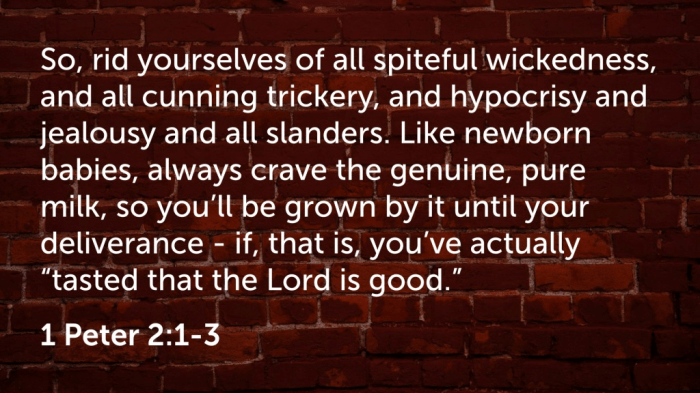
Here, in the picture below, is tomorrow’s passage for Sunday School! Some real food for thought about how Christians are supposed to interact with each other in a church. So many questions to answer:

  • What, exactly, do these sins look like? What are they?
  • Why do they happen so often?
  • What can we, as Christians, do about these problems in our personal lives, and in our corporate lives as members of a church?
  • What is this “genuine, pure milk?” Why does the KJV add ” . . . of the word” to the end of that phrase, even though it’s not there in Greek?
  • How do you “taste” that the Lord is good?

What are the answers? Well, you’ll just have to WAIT, won’t you . . . !?

1 peter 2

Holy Priests, Lego Bricks & Jenga


legos

Christians are individual building blocks, little Lego bricks. We’re each being called by God, and placed into the corporate spiritual temple or household that is God’s kingdom, His family, and His church. We’re each essential, and we’re each important. Don’t believe me? Pay Jenga sometime, and then you’ll get the analogy.

In 1 Peter 2:4-10, the apostle gives us a wonderful passage about what a local church is, and what we ought to think about it. People ought to think about it. The word “church” can also be translated “congregation,” and I think we should start using that term. The “church” isn’t the building; it’s the people. The people in a congregation are your spiritual brothers and sisters, united in Christ by repentance and faith in His Good News.

More on this in a week or so. For now, read the passage and think on these things.

My Translation of 1 Peter 2:4-10

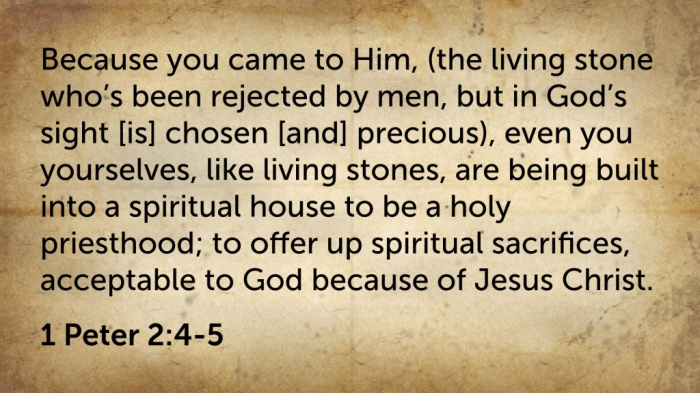
Because you came to Him, (the living stone who’s been rejected by men, but in God’s sight [is] chosen [and] precious), even you yourselves, like living stones, are being built into a spiritual house to be a holy priesthood; to offer up spiritual sacrifices, acceptable to God, through Jesus Christ. This is why God says in Scripture,

Look! I have placed in Zion a stone, a cornerstone; chosen [and] precious – the one who believes in Him will never, ever be ashamed of it.

This means the honor is yours, you who believe! But to those who don’t believe, He’s “the stone the builders rejected that’s become the head cornerstone,” and “a stone to stumble on and a rock that offends them.” These builders are stumbling because they’re rejecting the message. Actually, they were destined for this.

But you believers are a chosen nation, a royal priesthood, a holy nation – God’s own people. The purpose of all this is so you’d announce the wonderful things God did, who called you out of the darkness [and] into His amazing light. You used to not be a people, but now you’re the people of God! You weren’t given any mercy, but now you’ve received mercy!

Learning from Smart, Dead Guys

Ikone_Athanasius_von_AlexandriaWe really don’t know everything. I know – it’s crazy. Christians stand on the shoulders of dedicated, intelligent and devout brothers and sisters from days gone by. Our very vocabulary, the categories and structures of our theology have been shaped by the controversies and issues of bygone days.

This is why creeds and confessions are such valuable tools in a Christian’s arsenal. See, for example:

  1. The 1833 New Hampshire Confession of Faith
  2. The 1689 London Baptist Confession of Faith
  3. The Belgic Confession

So, because Christians before us have already puzzled and thought until their puzzlers were sore, I’ve decided to take some time to read about Christology from some 4th century Christians. Last year, I translated the Nicene-Constantinople Creed (381 AD). I plan to write a short introduction and commentary on it, and basically use it as a vehicle to teach 4th century Christology.

In order to really understand what was going on in the 4th century, I need to do two things:

  1. I need to read some good history books, and
  2. I need to read what Christians from the 4th century actually wrote about Christ, and see how they responded to the Arian heresies and the controversy about the Holy Spirit.

That’s where Athanasius of Alexandria comes in. He was a key figure in the Christological controversies of the 4th century; perhaps the key player. I don’t have time to read everything he wrote (that would take a while!), but I am taking time to read some of it.

That brings me to the point. The man was a genius. It’s always humbling to learn something from really smart, dead guys. And, to top it off, Athanasius didn’t even have wireless internet!

In this short excerpt from his work On the Incarnation of the Word, Athanasius tackled the objection that Jesus’ death was humiliating and unfitting for the Son of God. Read what he has to say, and think about it:

For perhaps a man might say even as follows: If it was necessary for His death to take place before all, and with witnesses, that the story of His Resurrection also might be believed, it would have been better at any rate for Him to have devised for Himself a glorious death, if only to escape the ignominy of the Cross.

But had He done even this, He would give ground for suspicion against Himself, that He was not powerful against every death, but only against the death devised for Him; and so again there would have been a pretext for disbelief about the Resurrection all the same. So death came to His body, not from Himself, but from hostile counsels, in order that whatever death they offered to the Saviour, this He might utterly do away.

And just as a noble wrestler, great in skill and courage, does not pick out his antagonists for himself, lest he should raise a suspicion of his being afraid of some of them, but puts it in the choice of the onlookers, and especially so if they happen to be his enemies, so that against whomsoever they match him, him he may throw, and be believed superior to them all; so also the Life of all, our Lord and Saviour, even Christ, did not devise a death for His own body, so as not to appear to be fearing some other death; but He accepted on the Cross, and endured, a death inflicted by others, and above all by His enemies, which they thought dreadful and ignominious and not to be faced; so that this also being destroyed, both He Himself might be believed to be the Life, and the power of death be brought utterly to nought.

So something surprising and startling has happened; for the death, which they thought to inflict as a disgrace, was actually a monument of victory against death itself. Whence neither did He suffer the death of John, his head being severed, nor, as Esaias, was He sawn in sunder; in order that even in death He might still keep His body undivided and in perfect soundness, and no pretext be afforded to those that would divide the Church.[1]

You’d be surprised how much you read in Christian books is really just a regurgitation of stuff somebody else said a long time ago. I’m learning a lot from Athanasius. I can also see where our understanding of theology has, in some instances, advanced beyond him – particularly in the 5th century, leading up to the Chalcedonian Creed. But, what an explanation he provided here!

You can learn a lot from smart, dead guys . . .

Notes:

[1] Athanasius of Alexandria, “On the Incarnation of the Word,” in NPNF2, ed. Philip Schaff and Henry Wace, trans. Archibald T. Robertson (New York, NY: Christian Literature Company, 1892), 4:49.