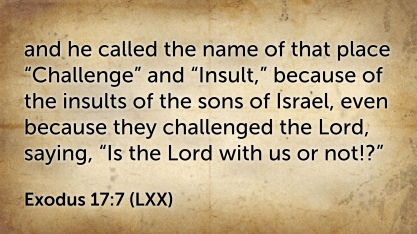
What Have You Done for Me Lately!? (Exodus 17:7)

josh17(7).pngOn their journey towards Mt. Sinai from Egypt, the Israelites became angry. Actually, they became angry a lot, but this time they said something particularly foolish:

Exodus 17:7 (KJV): And he called the name of the place Massah, and Meribah, because of the chiding of the children of Israel, and because they tempted the LORD, saying, Is the LORD among us, or not?

I spent some time pondering why on earth they would ask this question. It’s a pretty stupid question, really. Is the Lord with them? Well, let’s quickly re-cap everything He had done for them in a few short months since Moses returned to Egypt:

  1. They saw Moses’ staff miraculously transformed into a serpent (Ex 4:29-31), which was meant as a token miracle to convince the Israelites that Moses really was a man sent from God to rescue them from captivity, just as He had promised their fathers (cf. Gen 15:6, Ex 6:6-8).
  2. They saw Moses turn the Nile River into blood (Ex 7:14-25).
  3. They saw the plague of frogs strike Egypt (Ex 8:7).
  4. They saw God miraculously kill all the frogs dead at once (Ex 8:8-15).
  5. They witnessed the plague of lice, and the pagan magicians themselves even acknowledged that “this is the finger of God!” (Ex 8:16-19).
  6. They beheld the plague of flies, and the way the Lord miraculously kept all flies out of the delta of Goshen where the Israelites were! (Exodus 8:20-24).
  7. They saw the Lord do yet another miracle, removing the plague of flies once Pharaoh promised to release the Israelites (Ex 8:25-32).
  8. The Israelites saw the plague which struck all the cattle in Egypt on a set date, a plague which did not touch the area of Goshen where they themselves lived (Ex 9:1-7).
  9. They witnessed the plague of boils (Ex 9:8-12).
  10. They saw the plague of fire and hail, “such as there was none like it in all the land of Egypt since it became a nation.” Once again, this plague did not touch the Israelites (Ex 9:13-26).
  11. They saw the Lord miraculously stop this plague upon command (Ex 9:27-35).
  12. They witnessed the awful and devastating plague of locusts (Ex 10:1-20).
  13. They beheld the plague of darkness, “even darkness which may be felt,” over the entire land of Egypt (Ex 10:21-29). Bizarrely, this darkness did not effect their own homes. Can you even begin to imagine how awe-inspiring this must have been to the Israelites, and how terrifying it must have been to the pagan Egyptians!?
  14. They witnesses the last plague, which killed all the firstborn sons in Egypt (Ex 12) – a plague which even stuck the cattle (what little were left!). More than that, they each personally experienced the Lord’s blessing and protection when they applied the blood of the passover lamb to their doorposts, so that “the Lord will pass over the door, and will not suffer the destroyer to come in unto your houses to smite you,” (Ex 12:23).
  15. The Lord allowed the Israelites to leave Egypt well-provisioned and enriched with goods from the Egyptians (Ex 12:36).
  16. They saw the Lord, every single day, lead them in a pillar of cloud by day, and a pillar of fire by night (Ex 13:21-22).
  17. God miraculously split the waters of the Red Sea in the dead of night. The Lord showed Himself as a cloud which came between the pursuing Egyptians, laying a thick blanket of darkness before the enemy, but lighting the way for the Israelites to make the crossing onto the Sinai Peninsula by the roaring fire of His glorious presence (Ex 14:19-22).
  18. They saw God drown the entire Egyptian army in the river (Ex 14:27-28).
  19. The Lord miraculously provided heavenly food for them in the barren wilderness (Ex 16).

In light of all this, why in the world would God’s people even ask such a foolish question? They asked it because they were ungrateful, selfish, self-centered, and inherently wicked. I’m just the same, and so are you. We’re ungrateful for God’s blessings and provisions. You’re selfish and materialistic, ignoring God’s grace and petulantly demanding still more. Like the noted philosopher Janet Jackson asked, “what have you done for me lately?”

These people had lots of reasons to trust God to provide for them and take care of them. He’d rescued and cared for them every step of the way. More than that, He was visibly revealing Himself every single moment of every single day, by cloud or by fire. If you’re a Christian by repentance and faith in Jesus Christ and His perfect, finished work, then think about the Israelites the next time you’re tempted to complain and ask anything stupid. If you’re a Christian, the Lord is always fully with you, in the Person of the indwelling Holy Spirit (cf. John 14:23).

For those who are interested, here is my own translation of this verse from the Greek Septuagint.

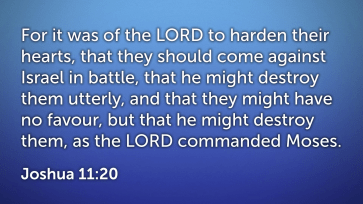
God Destroys His Enemies (Joshua 11:20)

josh 11(20).pngThe Bible says that God deliberately hardens evil men’s hearts so that they’ll be destroyed. He wants them to be destroyed. He decided to destroy them. He destroys them. Simple.

Here is one passage from the Book of Joshua, which chronicles the Israelite’s campaign to conquer the Promised Land which had been sworn to them so many years ago. This excerpt concerns Joshua and the Israel’s campaign in the south:

Joshua conquered the whole land, including the hill country, all the Negev, all the land of Goshen, the lowlands, the Arabah, the hill country of Israel and its lowlands, from Mount Halak on up to Seir, as far as Baal Gad in the Lebanon Valley below Mount Hermon. He captured all their kings and executed them. Joshua campaigned against these kings for quite some time. No city made peace with the Israelites (except the Hivites living in Gibeon); they had to conquer all of them, for the LORD determined to make them obstinate so they would attack Israel. He wanted Israel to annihilate them without mercy, as he had instructed Moses (Joshua 11:16-20, NET).

That last bit is very self-explanatory. Why did none of those cities make peace with the Israelites? Why did they not sense their own inevitable destruction, and opt for discretion and survival? As they saw the Israelite juggernaut coming their way, why didn’t they make an alliance and be done with it? Why did they fight and seal their own fate? The Bible tells us; “for the LORD determined to make them obstinate so they would attack Israel. He wanted Israel to annihilate them without mercy, as he had instructed Moses,” (Joshua 11:20).

God deliberately hardened their wicked hearts, ensuring they would stand and fight, so that they’d be defeated and utterly destroyed. He wanted them gone. He deliberately hardened their hearts. They fought and lost. They were destroyed. They were gone. The. End.

Of course, this issue often results in all sorts of hand-wringing in the pews and in the academic Bible commentaries. People worry this means men and women have no free will. They worry this makes us all into mindless puppets who dance to God’s capricious tune. They worry it makes God mean, wicked and evil. None of this is true, of course.

Men and women do indeed have free will. However, in a manner beyond our comprehension, God’s sovereign will operates through and above our own will and consciousness to achieve His perfect end. Joseph’s brothers were not forced to sell their brother into slavery; they wanted to. And yet, Joseph later told them, “As for you, you meant to harm me, but God intended it for a good purpose, so he could preserve the lives of many people, as you can see this day,” (Genesis 50:20). The Roman soldiers, Jewish leaders and Roman politicians were not forced to have Jesus arrested, tortured and executed like a common criminal; they each acted according to their own sinful and selfish motives. And yet, the Apostle Paul wrote, “Him, being delivered by the determinate counsel and foreknowledge of God, ye have taken, and by wicked hands have crucified and slain,” (Acts 2:23).

Men and women have free will, and often God channels and directs the innate wicked, evil and selfish motives, lusts and ambitions of sinful men to His own holy ends, for his own righteous and appropriate purposes. To return to our text in Joshua, God did not put evil in these people’s hearts. He did not make them hate the Israelites. He did not make them hate Him. They were already evil. They already despised the Israelites. They already hated Him and all the holiness, righteousness and justice He stands for.

God took sovereign hold of their inherent wickedness and channeled it for His own purpose. They wanted to kill the Israelites. They hated God. They met their earthly judgment on the field of battle, and were ushered into their just and appropriate eternal damnation immediately afterward.

It is disappointing to see commentaries tap-dance around the plain truth of the Scripture here. There is no need to tap-dance. There is no need to be apologetic. There is only a need to preach what the text says. It says they did not make peace, because the Lord hardened their hearts so they would be annihilated without mercy. That’s it.

These texts are horrifying to many Christians because we so often unconsciously downplay God’s holiness and our own sinfulness. We often have an un-Biblical, soft, cuddly and fuzzy version of God in our minds which simply doesn’t reflect reality. More dedicated  reading of the Torah, the revelation of God’s heavenly throne room from Revelation 4-6, and the beautiful description of the new earth and the New Jerusalem in Revelation 21-22 would go a long way toward curing this problem. Then, these texts won’t seem frightening at all.

The Heavenly Chorus (Revelation 5:9-10)

Revelation 59 [widescreen].pngThe Book of Revelation gives God’s people some very precious glimpses into His heavenly throne room. The Book of Hebrews tells us all the rituals, furniture and setup for the holy place in the tabernacle in the wilderness and, later, King Solomon’s temple was just a figure, a representation of the real throne room (ἀντίτυπα τῶν ἀληθινῶν) in heaven (Hebrews 9:24; cf. Exodus 25:40, 26:30, 27:8, etc.). Throughout Revelation 4-5, God gave us a look at His real throne room.

The scene opens on the Apostle John being granted a vision of supreme importance; a vision so vital that God chose to have Him write it all down in a book which is preserved in your Bibles even today. John saw a scroll in God’s hand. The scroll had writing on both sides, and was sealed with seven seals. A mighty angel proclaims with a loud voice,

 . . . who is worthy to open the book, and to loose the seals thereof? And no man in heaven, nor in earth, neither under the earth, was able to open the book, neither to look thereon. And I wept much, because no man was found worthy to open and to read the book, neither to look thereon (Revelation 5:2b-4).

But, all was not lost. A man enters the throne room. One of the 24 elders motions to John and says,

Weep not: behold, the Lion of the tribe of Juda, the Root of David, hath prevailed to open the book, and to loose the seven seals thereof (Revelation 5:5).

These allusions probably seem strange and bizarre to a non-believer, or to a Christian who ignores the Old Covenant books. These are deliberate allusions, freighted with all sorts of Messianic and triumphant implications. The man is Christ Jesus. He is the “lion” who sprang from the Jewish tribe of Judah (Genesis 49:9ff). He is the “root” descended from King David’s father, Jesse (Isaiah 11:1ff). This is the risen Christ who has been continually interceding for His people since He returned to His Father’s house in the days after his resurrection (Acts 1:9ff). This is the Savior of whom John the Baptist declared, “Behold the Lamb of God, which taketh away the sin of the world!” (John 1:29).

This is the crucified, resurrected, co-equal and co-eternal Son of God who came to give His life a ransom for many (cf. Mk 10:45). John the Baptist continued, “This is he of whom I said, ‘After me cometh a man which is preferred before me: for he was before me,'” (John 1:30). Jesus is greater than John, because he existed before John. And yet, John the Baptist is several months older than his cousin, Jesus! How can John be younger, then? It is because Jesus is the co-equal, co-eternal Son of God . . .

whom he hath appointed heir of all things, by whom also he made the worlds; Who being the brightness of his glory, and the express image of his person, and upholding all things by the word of his power, when he had by himself purged our sins, sat down on the right hand of the Majesty on high (Hebrews 1:2b-3).

This is who has strode into God’s throne room. This is why the Apostle John need not dispair. Someone worthy has been found to open the seven-sealed scroll and unleash the terrible but righteous judgments of God upon a rebellious and wicked world (cf. Gen 6:5).

But, why is Jesus Christ so particularly worthy? The 24 elders are angelic beings and are perfectly holy – why can’t they open the scroll? What about the four living beings who are also before God’s throne? Are they tainted in some way? Our passage tells us why only Jesus is worthy:

Then he came and took the scroll from the right hand of the one who was seated on the throne, and when he had taken the scroll, the four living creatures and the twenty-four elders threw themselves to the ground before the Lamb. Each of them had a harp and golden bowls full of incense (which are the prayers of the saints) (Revelation 5:7-8).

Pay attention to what these angelic beings say, to what they sing in praise and worship to Jesus Christ. Here it is, in my own translation (detailed translation notes are available here):

and they were singing a new song, saying, ‘You are worthy to take the scroll and to open its seals, because you were slaughtered, and by your own blood you bought for God [people] from every tribe, language, people and nation, and you have made them a kingdom and priests for our God, and they will rule on the earth’ (Revelation 5:9-10).

First, they make a simple statement – “You are worthy to take the scroll and to open its seals.” Only Messiah, the Anointed and Chosen Son of God, can perform this task. Why? How is He uniquely qualified? There are several reasons:

1. because you were slaughtered

He was murdered, slain and slaughtered like a sacrificial animal. He died to take away the sins of the world. More than that, He did it willingly and voluntarily. He wasn’t checkmated into it. He wasn’t cornered and out-manauvered. He didn’t struggle valiently and die fighting. He deliberately, passively and meekly allowed His enemies to destroy Him (cf. John 14:28-31). He let Himself be slaughtered. What do you think about that?

2. and by your own blood

We observe the Lord’s Supper because of Jesus’ shed blood, which is a synonym for His death. It is through His death, by means of that death, that Jesus Christ perfectly saves men, women, boys and girls on this earth from slavery to the kingdom of darkness and transfers them to His own kingdom (Colossians 1:13). His death is the instrument which accomplishes this miracle.

3. you bought for God [people] from every tribe, language, people and nation

Jesus’ death has purchased people for God from everywhere on earth. This purchasing was done in the past, when He died. It happened in the past. From God’s perspective, all His chosen people from all over the world already are saved. It’s so certain and sure that He regards it as a done deal. The angelic beings in God’s heavenly throne room sing about it as an accomplished fact. Jesus is not buying; He bought. Jesus did not die intending to save every single person in the world. Everybody is born hating God (Romans 3:18). Everybody is born inherently worthless to Him (Romans 3:12). Many people continue to hate Him until their dying day, or cloak their hatred in a noxious shroud of good works intended to bribe the Lord and “earn” His favor, as if such a thing were even possible (cf. Galatians 2:21). Jesus died to save His chosen people, and those chosen people are from every tribe, language, people-group and nation in the entire world. The Gospel isn’t restricted by racial divide, the highest mountainpeaks, the lowest valleys, the most treacherous waters or the most bigoted, sinful and hateful prejudices of sinful men. It is intended for all people, and among all people, Christ has already purchased His own for God!

4. and you have made them a kingdom and priests for our God

God’s people want to serve Him. Christ is building His kingdom, which is not here yet. His people are priests in the sense that they have direct and personal access to Him which outsiders do not have. If you do not have salvation through repentance and faith in Jesus Christ, then you do not have God (1 John 2:23). You have no access to Him. He is actively angry with you. You reject Him and His Son. You hate Him. You are a criminal in His world. His people, however, make God known to those who hate Him. They tell others about God and His dear Son, Jesus Christ. They mediate the Lord to a pagan world. They don’t offer up literal sacrifices, they offer up their own selves as spiritual sacrificies to Him for His work (Romans 12:1f, 1 Peter 2:5). They regard themselves as slaves for His sovereign, holy and appropriate use. And, again, this is presented as an accomplished fact, a done deal, a past event with ongoing results.

5. and they will rule on the earth.

God’s people will rule with Him in eternity. God’s enemies will suffer for all eternity.

Jesus Christ is worthy because of what He did. He died to save sinners. When this scene takes place, the world has definitively rejected Him and the Good News He suffered and bled and died to bring to people. The world deserves judgment. He and His Father are the Ones the world is rejecting. It is only fitting that the “Lamb of God which taketh away the sins of the world” be the One who unleashes His Father’s righteous judgment on the very world which rejected Him and has “no cloak for their sin,” (John 15:22).

Empty Suits and Unholy Rage – ISIS vs. the Secular West (Part 1)

I originally published this short series on SharperIron.org, and it is reprinted here with permission.

chairThe Problem

Recently, a French political scientist was interviewed on National Public Radio. The terrorist attack in Nice had just taken place. France had been on heightened security alert since November 2015, when 130 people were slaughtered in a series of coordinated attacks involving suicide bombers, assault weapons and hostage taking. Now, just this month, a Tunisian madman who had lived in France for 11 years deliberately ran a 19-ton cargo truck into a crowd along the Nice waterfront on Bastille Day. 84 people died. The 31-yr old terrorist, a man who by all accounts was a drug addict, alcoholic, and all-around petty villain, was surrounded by police and shot dead in the cab of his truck. The media was engaged in the usual post-mortem analysis. What can be done? What should be done? What isn’t working? What would drive somebody to do such a thing? This was the context for Myriam Benraad’s interview with NPR. What should France be doing differently? Her answer was remarkable:

In France, I think there’s a real malaise. There’s a crisis of our political and social model for a number of reasons which I cannot enumerate fully during this interview. But we need to re-enchant our model, whether we’re speaking about the social contract that we’re supposed to embody, the openness and the tolerance and all of these things that have been really helped, I believe, in the last decade.[1]

How do you persuade angry young men, many of them immigrants from abroad, some even EU citizens, that it isn’t a good idea to butcher many people in the name of Allah? What must be done to counteract this propaganda? Benraad recognizes that there is a problem. She also realizes that France (and its coalition partners) have not yet found the solution. She is not alone.

The Empty Secular Solution

On September 29, 2015, an article appeared in The New York Times which stated, “President Obama called upon a conclave of world leaders on Tuesday to fight violent extremism not just with weapons but with ideas, jobs and good governance, a strategy he has long advocated. There are few signs that it is succeeding.”[2] President Obama announced this was an ideological war, not a strictly military conflict. “Ideologies are not defeated with guns,” he exclaimed. “They are defeated by better ideas — a more attractive and compelling vision.”[3]

What is this “compelling vision” the Western world offers angry young men that ISIS cannot? What “better ideas” was President Obama referring to? This strategy was probably driving the now-infamous statement by State Department spokeswoman Marie Harf that ISIS could be defeated if only their fighters had access to jobs. “We can work with countries around the world to help improve their governance. We can help them build their economies so they can have job opportunities for these people.”[4]

The State Department has admitted “the coalition does not communicate well.”[5] An official lamented that the West was always reacting to ISIS online propaganda, instead of advancing its own narrative. The counter-propaganda effort was a failure, a disaster. The Western world was being defeated in social media by the junior varsity team.[6] ISIS was “expanding like Starbucks franchises.”[7] Something must be done. A solution was nigh at hand – a “full-time coalition communications hub.”[8]

Thus, we now have something called the “Global Engagement Center.” The director of the center explained that his counter-propaganda mission was to expose the awful truth that ISIS “is indeed a vicious awful organization that is rife with hypocrisy and everything else . . . it’s about revealing their true nature so people understand they aren’t what they say they are,’ he said. ‘They’re not paying their fighters what they claim to be paying them, and nor is the quality of life what they’re advocating.”[9] So, for example, the GEC’s Twitter account has graphics of people standing in line for food, with the text, “Under Daesh, the lines of the hungry grow longer.” Another post shows a laptop computer illuminated by the miserable, flickering glow of a tea light candle. “Daesh can’t provide basic services for its people,” the picture warns solemnly.

This is the same approach which Myriam Benraad advocated. Young immigrant men in France are disenchanted. They’re cynical and soured on the life they’ve found in the West. This is why she suggested, “we need to re-enchant our model, whether we’re speaking about the social contract that we’re supposed to embody, the openness and the tolerance and all of these things that have been really helped, I believe, in the last decade.”

Her comments are not remarkable because of their insight. They are remarkable because they betray how shallow and impotent a secular approach to this conflict is. The same could be said about the entire counter-propaganda message being pushed by the Obama administration and its various coalition partners. As Albert Mohler, President of the Southern Baptist Theological Seminary, has observed, “What we are looking at here is a vast collision of worldviews, and one that secular leaders in Europe and in the United States, starting in the White House, seem to be incapable of understanding. At its base, we’re talking about a worldview conflict between Islam and Modernity.”[10] Mohler later remarked that France, because of its unashamed commitment to secularism, is “almost singularly incompetent to know how to respond. There is amongst the French intellectuals now a virtual inability to understand anyone who might operate in terms of worldview from any kind of theological motivation and basic structure.”[11]


Notes

[1] National Public Radio. “French Men Attracted To ‘Anti-System Utopia’ In Drive To Join ISIS,” on All Things Considered. 19JUL16. Retrieved from http://goo.gl/Vr37KO.

[2] Gardiner Harris and Eric Schmitt, “Obama’s Call at U.N. to Fight ISIS With Ideas Is Largely Seen as Futile,” in The New York Times. 29SEP15. Retrieved from http://goo.gl/Ru4yKS.

[3] Ibid.

[4] T. Beckett Adams, “State Department spokeswoman claims jobs are key to defeating ISIS,” in Washington Examiner. 17FEB15. Retrieved from http://goo.gl/3WXpDk.

[5] The New York Times. “State Department Memo on the Islamic State Group.” 12JUN15. Retrieved from http://goo.gl/ipNTiK.

[6] See the discussion by Glenn Kessler, “Spinning Obama’s reference to Islamic State as a ‘JV’ team,” in The Washington Post. 03SEP14. Retrieved from https://goo.gl/yw2eRg.

[7] New York Times. “State Department Memo,” 2.

[8] New York Times. “State Department Memo,” 2.

[9] Kristina Wong, “How the US is working to defeat ISIS online,” in The Hill. 25JUN16. Retrieved from http://goo.gl/bWktxW.

[10] Albert Mohler. The Briefing. 12-7-15. Retrieved from http://www.albertmohler.com/2015/12/07/the-briefing-12-07-15/.

[11] Albert Mohler. The Briefing. 8-1-16. Retrieved from http://www.albertmohler.com/2016/08/01/briefing-08-01-16/.

What Color is the Horse!? (Revelation 6:8)

horseAlmost every Christian of a certain age is used to the KJV’s wording in Rev 6:8:

And I looked, and behold a pale horse: and his name that sat on him was Death, and Hell followed with him. And power was given unto them over the fourth part of the earth, to kill with sword, and with hunger, and with death, and with the beasts of the earth (Revelation 6:8).

But, is the horse actually pale? William Tyndale, the genius Greek and Hebrew scholar from the 16th century, the man who gave us the first English translation of the New Testament from the original Koine Greek, rendered it as, “And I looked and behold a green horse.”

Green isn’t pale! What on earth is happening? Alas, the plot thickens even more:

  • NKJV: pale horse
  • NASB: ashen horse
  • ESV: pale horse
  • NET: pale green horse
  • ISV: pale green horse
  • RSV: pale horse
  • LEB: pale green horse
  • NRSV: pale green horse

What saith the Greek? Here it is: καὶ εἶδον, καὶ ἰδοὺ ἵππος χλωρός. This is not a textual issue; the Textus Receptus, Robinson & Pierpont’s Byzantine Text, and the UBS-5 all have the same text here. This is a translation issue. It’s also not a simple matter of right and wrong; translation is not that simple here. My translation is, “and I looked, and along came a pale green horse!” The key word here is χλωρός. Most of the standard Greek lexicons agree this word means something like “pale green.” The issue is whether the word should be taken literally or figuratively:

  • BDAG defines it as pale, greenish gray (s.v. “7938 χλωρός,” 2).
  • Friberg goes for green, pale green, yellowish green. He classifies the use here as figurative, so he opts for a sickly sense and gives the gloss “pale,” (s.v. “28653 χλωρός”).
  • Gingrich also opts for the figurative sense, and prefers “pale,” to convey the picture of a sickly person (s.v. “6893 χλωρός,” 2).
  • Louw-Nida keep the sense of pale, greenish grey, “evidently regarded as typical of a corpse,” (79.35 χλωρός).

As you already saw, the English translations are evenly split. How is the word used elsewhere in the New Testament? Here, it’s pretty clear that the color of light, pale green is the idea. For example, Jesus had the crowd sit in groups upon the green grass (Mk 6:39). The Book of Revelation speaks of the grass being burnt up (Rev 8:7).

What does the context say? Here is the story of the fourth seal:

Then when the Lamb opened the fourth seal I heard the voice of the fourth living creature saying, “Come!” So I looked and here came a pale green horse! The name of the one who rode it was Death, and Hades followed right behind. They were given authority over a fourth of the earth, to kill its population with the sword, famine, and disease, and by the wild animals of the earth (Revelation 6:7-8).

The fourth horseman was named Death, and the Grave followed after him. Together, God will give them power to kill 25% of the world’s population during the coming Great Tribulation (Jeremiah 30:7; Mt 24:21-22) by way of war, famine, disease and wild animals. This is bad news. The overriding sense is that this fourth horseman represents death and the cold grave which awaits the wicked.

By this point, it seems clear that the pale green sense is conveying the idea of a decaying, bloated and rotting corpse. The colors of these horsemen of the seven seals mean something. The horseman is not merely pale and sickly. He’s pale green to represent the rotting corpses of the wicked who will experience God’s terrifying judgment, wrought at the hands of unwitting and fiendish men.

The horse is pale green.

Joshua 11:20 in the Septuagint

josh11(20)This isn’t the best title to entice a tired reader, but it’s the best I could do! In my devotions the other day, I ran across Joshua 11:20. Here it is, with the immediate context:

So Joshua took all that land, the hills, and all the south country, and all the land of Goshen, and the valley, and the plain, and the mountain of Israel, and the valley of the same; Even from the mount Halak, that goeth up to Seir, even unto Baalgad in the valley of Lebanon under mount Hermon: and all their kings he took, and smote them, and slew them. Joshua made war a long time with all those kings. There was not a city that made peace with the children of Israel, save the Hivites the inhabitants of Gibeon: all other they took in battle. For it was of the LORD to harden their hearts, that they should come against Israel in battle, that he might destroy them utterly, and that they might have no favour, but that he might destroy them, as the LORD commanded Moses (Joshua 11:16-20, KJV).

This verse means what it reads. You cannot escape it. You cannot wish it away. You cannot “contextualize” it and change the meaning of the words. Look at all the English translation you like (e.g. ESV, NLT, NIV, NASB, NET, ISV, LEB, KJV, NKJV, Tyndale, NRSV, RSV), and you won’t find an escape hatch. But, more on that later. For now, I wanted to post my own translation of this verse from the Septuagint.

The LXX, or Septuagint, is the Greek translation of the Old Testament Hebrew which dates from perhaps 200 B.C. and was the Bible the early church, including Jesus Christ, used and quoted from.

Here is my own translation of Joshua 11:20 from the Greek Septuagint (the PDF is available here):

Greek Text:

ὅτι διὰ κυρίου ἐγένετο κατισχῦσαι αὐτῶν τὴν καρδίαν συναντᾶν εἰς πόλεμον πρὸς Ισραηλ ἵνα ἐξολεθρευθῶσιν ὅπως μὴ δοθῇ αὐτοῖς ἔλεος ἀλλ᾽ ἵνα ἐξολεθρευθῶσιν ὃν τρόπον εἶπεν κύριος πρὸς Μωυσῆν

English Translation:

Joshua 11:20 (LXX): “for because of the Lord it came to pass that their heart was strengthened in order to meet Israel in battle so that they would be annihilated. That is, so that mercy would not be granted to them – even so that they would be totally destroyed, just as the Lord said to Moses!”

Detailed Translation:

josh11(20)aa

ὅτι: (1) Classification – the conjunction is expressing the intentional cause, the grounds, of the preceding statement (Josh 11:19)

διὰ: (1) Classification – the preposition is expressing reason

κυρίου: (1) Case – in the genitive case because it is the object of the preposition διὰ

ἐγένετο: (1) Translation – this construction is common in narrative literature, and its general sense is to move the events along. The normal gloss is “it came to pass,” or something of that nature (cf. BDAG, s.v. “1646 γίνομαι,” 4.f.).

κατισχῦσαι: (1) Classification – an anarthrous, simple infinitive which complements and completes the thought of the verb ἐγένετο. (2) Voice – a simple active, indicating the subject (the heart of Israel’s enemies) is performing the action of the infinitive. Of course, it was “because of the Lord” (διὰ κυρίου) that their heart did this in the first place! (3) Tense – context suggests a constative aorist, describing a simple historical event in the past.

αὐτῶν: (1) Case – the personal pronoun is possessive, indicating the heart in question belong to Israel’s enemies

τὴν καρδίαν: (1) Case – an accusative subject of the infinitive κατισχῦσαι

συναντᾶν: (1) Classification – an anarthrous, simple infinitive which complements the prepositional phrase

εἰς: (1) Classification – the preposition is expressing purpose. Why was their enemies’ heart strengthened? So that they would sally forth into battle against Israel and be destroyed!

πόλεμον: (1) Case – in the accusative case because it is the object of the preposition εἰς

josh11(20)b

πρὸς: (1) Classification – the preposition is either expressing association (“battle with Israel”) or opposition (“battle against Israel”). (2) Translation – I opted to leave this completely untranslated, because it’s basically superfluous.

Ισραηλ: (1) Case – in the accusative case because it is the object of the preposition πρὸς

ἵνα ἐξολεθρευθῶσιν: (1) Classification – this is a standard purpose clause. (2) Voice – a simple passive, which indicates the subject (Israel’s enemies) receive the action of the verb.

ὅπως: (1) Classification – the conjunction is expressing purpose. I believe it’s acting in apposition to the preceding purpose clause, further explaining God’s intentions here – therefore I translated it with “that is . . .”

μὴ: This is a simple negation

δοθῇ: (1) Voice – a simple passive, which indicates that mercy is something being dispensed (or in this case, not being dispensed!) to Israel’s enemies

αὐτοῖς: (1) Case – a dative of direct object, signifying Israel’s enemies are receiving the action of the verb

ἔλεος: (1) Case – the subject nominative of the sentence

ἀλλ᾽: (1) Classification – the conjunction is expressing emphasis. It makes no contextual sense to translate this to express contrast (“but”), because the preceding subjunctive purpose clause is already negative. I think it serves to just heighten the sense of God’s divine condemnation, so I translated it as “even.”

ἵνα ἐξολεθρευθῶσιν: (1) Classification – this is a standard purpose clause. (2) Voice – a simple passive, which indicates the subject (Israel’s enemies) receive the action of the verb.

Josh11(20)c

ὃν τρόπον: (1) Translation – this construction is usually expressed in English with the gloss “just as . . .” (Friberg, s.v. “27075 τρόπος,” 1).

εἶπεν: (1) Voice – a simple active, indicating the Lord performed the action of the verb. (2) Tense – context suggests a constative aorist, describing a simple historical event in the past. (3) Mood – a declarative indicative.

κύριος: (1) Case – the subject nominative

πρὸς: (1) Classification – the preposition is expressing association

Μωυσῆν: (1) Case – in the accusative case because it is the object of the preposition πρὸς

Seeing God in Creation

hubble1
Carina Nebula (Courtesy of NASA)

We live in a created world. You can look at this world and see that it was planned, designed, created and is being sustained by an intelligent being. That Being has revealed Himself to us in the pages of the Old and New Testaments. He spoke to us by the prophets of old, like Moses, Isaiah, Jeremiah, Zechariah, David and Noah. In these last days, He has spoken to us through His Son, Jesus Christ (Hebrews 1:1).

That phrase, “Jesus Christ,” is both a name and a title. “Jesus” is the Greek rendering for the the Hebrew name translated as “Joshua,” which means “God is salvation.” That is His name – Jesus, Joshua, God is salvation. What a fitting name for the Son of God! The word “Christ” is a title, not a last name. It means “Messiah” or “Anointed One.” It means Jesus is the promised descendant from Eve who will crush Satan once and for all (Gen 3:15). He is the Suffering Servant whom Isaiah prophesied about (Isaiah 52:13-53:12). He is the true and great High Priest, clothed in fine garments (Zechariah 3). He is the Israelite prophet like Moses, whom all people are obligated to listen to (Deuteronomy 18:15ff). He is the One who King David prophesied about, whom the Lord will never allow to remain in the grave and see corruption (Psalm 16:10; Acts 2:27-31, 13:35-38). He is the one who is righteous and just, who came on the scene in a meek and lowly manner bearing the glorious message of salvation, reconciliation, forgiveness and adoption for all those who repent and believe His Good News (Zechariah 9:9).

This is who Jesus Christ is; the Anointed and Chosen One sent by God, who is God, who is salvation, who bears the message of salvation, who offers the refreshing and life-giving waters of eternal life (John 4:14) to sinners who are dead in their own trespasses and sins (Ephesians 2:1). He is the One who is co-equal and co-eternal with God the Father, who voluntarily and willingly left the Father’s throne room in heaven and came here to live a perfect and sinless life, and to die a sacrificial and substitutionary death for men, women, boys and girls from every tribe, language, people and nation on earth (cf. Revelation 5:9).

If you’re a Christian, it is He “who has qualified you to share in the saints’ inheritance in the light. He delivered us from the power of darkness and transferred us to the kingdom of the Son he loves, in whom we have redemption, the forgiveness of sins,” (Colossians 1:12b-14). If you’re not a Christian, then you have no cloak or pathetic pretense (cf. John 15:22ff) for your continued rebellion and insurgency against Him. The Apostle Peter said,

He commanded us to preach to the people and to warn them that he is the one appointed by God as judge of the living and the dead. About him all the prophets testify, that everyone who believes in him receives forgiveness of sins through his name (Acts 10:42-43).

Peter also warned,

But the things God foretold long ago through all the prophets – that his Christ would suffer – he has fulfilled in this way. Therefore repent and turn back so that your sins may be wiped out, so that times of refreshing may come from the presence of the Lord, and so that he may send the Messiah appointed for you – that is, Jesus. This one heaven must receive until the time all things are restored, which God declared from times long ago through his holy prophets.

Moses said, ‘The Lord your God will raise up for you a prophet like me from among your brothers. You must obey him in everything he tells you. Every person who does not obey that prophet will be destroyed and thus removed from the people.’

And all the prophets, from Samuel and those who followed him, have spoken about and announced these days. You are the sons of the prophets and of the covenant that God made with your ancestors, saying to Abraham, ‘And in your descendants all the nations of the earth will be blessed.’ God raised up his servant and sent him first to you, to bless you by turning each one of you from your iniquities (Acts 3:18-26).

You’re reading these words from a device which was deliberately engineered and designed by professionals to work just like it’s working right now. It is the same with this world we’re living in. The obvious intelligent design of the world around us tells us that God exists.

The heavens declare the glory of God; the sky displays his handiwork. Day after day it speaks out; night after night it reveals his greatness. There is no actual speech or word, nor is its voice literally heard. Yet its voice echoes throughout the earth; its words carry to the distant horizon. In the sky he has pitched a tent for the sun. Like a bridegroom it emerges from its chamber; like a strong man it enjoys running its course. It emerges from the distant horizon, and goes from one end of the sky to the other; nothing can escape its heat (Psalm 19:1-6)

Yet, all too often, we ignore the plain evidence of God in creation. We pass by the world around us without a second glance.

Bright, however, as is the manifestation which God gives both of himself and his immortal kingdom in the mirror of his works, so great is our stupidity, so dull are we in regard to these bright manifestations, that we derive no benefit from them. For in regard to the fabric and admirable arrangement of the universe, how few of us are there who, in lifting our eyes to the heavens, or looking abroad on the various regions of the earth, ever think of the Creator? Do we not rather overlook Him, and sluggishly content ourselves with a view of his works? And then in regard to supernatural events, though these are occurring every day, how few are there who ascribe them to the ruling providence of God—how many who imagine that they are casual results produced by the blind evolutions of the wheel of chance? Even when, under the guidance and direction of these events, we are in a manner forced to the contemplation of God, (a circumstance which all must occasionally experience,) and are thus led to form some impressions of Deity, we immediately fly off to carnal dreams and depraved fictions, and so by our vanity corrupt heavenly truth (John Calvin, Institutes of the Christian Religion, trans. Henry Beveridge [reprint; Peabody, MA: Hendrickson, 2008], 1.5.12).

This knowledge is meant to drive us to know more about God, and it is His dear Son, Jesus Christ, who reveals the Father to us, tells us who we are, where we stand with God, and what we must do to be reconciled, redeemed, forgiven, adopted into God’s family. It drives us to the Messiah, to the Christ, who in turn drives us to the Gospel.

Moses on Divorce

jailWhat does the Pentateuch say about divorce? Not a whole lot, really; but what it does say is particularly relevant for Jesus Christ’s own discussion from the New Testament. He quoted this passage. That tells us He believes the Old Testament is authoritative and binding. It also gives us some important insight into God’s own view of marriage. But, that is a topic for some other post. Today, we’ll simply look at what Moses wrote on the subject. Here it is:

When a man hath taken a wife, and married her, and it come to pass that she find no favour in his eyes, because he hath found some uncleanness in her: then let him write her a bill of divorcement, and give it in her hand, and send her out of his house. And when she is departed out of his house, she may go and be another man’s wife. And if the latter husband hate her, and write her a bill of divorcement, and giveth it in her hand, and sendeth her out of his house; or if the latter husband die, which took her to be his wife; Her former husband, which sent her away, may not take her again to be his wife, after that she is defiled; for that is abomination before the LORD: and thou shalt not cause the land to sin, which the LORD thy God giveth thee for an inheritance (Deut 24:1-4)

Because I really like bullet-point lists, I’ll outline the passage thus:

  • A man has married a woman
  • She does not find or obtain favor in her husband’s eyes, because of some indecency or uncleanness
  • He may write her a bill of divorce and legally terminate the marriage
  • She will then be expelled from his household
  • She is then free to marry once again
  • If either . . .
    • her new husband despises her and divorces her, or
    • he dies while they’re still married,
      • she may not re-marry the first husband
  • The overarching point seems to be that re-marriage to the original husband is not permissible under any circumstances

The real puzzle here is what on earth this “uncleanness” is that makes a divorce permissible! Now, we certainly aren’t the first people to mull this very question over in our heads. The Jewish Pharisees asked Jesus Christ this question, attempting to back Him into a corner:

The Pharisees also came unto him, tempting him, and saying unto him, Is it lawful for a man to put away his wife for every cause? (Matthew 19:3)

There were two dominant schools of thought on what, exactly, this “uncleanness” in a wife meant. One group of people believed it referred to gross sexual immorality and indecency, but falling short of adultery. The other group believed this was a broad category for all sorts of real and imagined offenses, such as cooking a meal incorrectly! What does the term mean?

William Tyndale went with uncleanness, with the sense of impurity and unholiness. The KJV imported Tyndale right in, and it also has uncleanness. The NKJV, unsurprisingly, kept uncleanness also. The NASB, however, rendered it indecency. So did the ESV. The NET used something offensive in her. The ISV chose objectionable, as did the LEB. Interestingly, the LEB includes a footnote which further explains the sense is something shameful or repulsive.

The LXX reads ὅτι εὗρεν ἐν αὐτῇ ἄσχημον πρᾶγμα. The key word here is the adjective ἄσχημον, which means something shameful, unpresentable, indecent, or unmentionable. For example, when Shechem sexually assaulted Jacob’s daughter, the Bible says he had “done a disgraceful thing,” (Gen 34:8, NASB). It sometimes has specific reference to genitalia, the unmentionable and indecent part of one’s body (cf. 1 Cor 12:23; BDAG, s.v. “1235 ἀσχήμων”).

So, what does all this mean? The sense seems to be that a divorce was permitted under Mosaic Law if the wife had done something sexually immoral and indecent. This sexual indecency probably does not rise to the level of outright adultery, because the Law proscribed the death penalty for this act. So, the sexual immorality was something less than adultery, but it was plainly unseemly, outrageous, and beyond the pale of holiness and moral purity.

Messiah Himself gave credence to this viewpoint when He responded to the Pharisees:

They say unto him, Why did Moses then command to give a writing of divorcement, and to put her away? He saith unto them, Moses because of the hardness of your hearts suffered you to put away your wives: but from the beginning it was not so. And I say unto you, Whosoever shall put away his wife, except it be for fornication, and shall marry another, committeth adultery: and whoso marrieth her which is put away doth commit adultery (Matthew 19:7-9)

So, we can tentatively conclude that the Mosaic Law only allowed divorce if the wife was engaged in sexual inappropriate, indecent, morally impure and unholy behavior. Of course, this was never intended to be a blank check or a “Get Out of Jail Free!” card to escape from a bad marriage. But, a good understanding of these four verses will ground Christians to better grasp Jesus’ own teaching in the New Testament.

A Bit from Calvin . . .

calvin“Mingled vanity and pride appear in this, that when miserable men do seek after God, instead of ascending higher than themselves as they ought to do, they measure him by their own carnal stupidity, and neglecting solid inquiry, fly off to indulge their curiosity in vain speculation. Hence, they do not conceive of him in the character in which he is manifested, but imagine him to be whatever their own rashness has devised. This abyss standing open, they cannot move one footstep without rushing headlong to destruction. With such an idea of God, nothing which they may attempt to offer in the way of worship or obedience can have any value in his sight, because it is not him they worship, but, instead of him, the dream and figment of their own heart.”

  • John Calvin, Institutes of the Christian Religion, trans. Henry Beveridge (reprint; Peabody, MA: Hendrickson, 2008), 1.4.1.

The Slayer and the Avenger

terrified-smiley
Cities of refuge were a safe haven for someone who killed another accidentally

Christians need to pay more attention to the Old Testament. There is something particularly wicked about ignoring 75% of God’s inspired, sacred and preserved Word. My brethren, these things ought not so to be! To that end, I will be posting a few occasional observations from the Pentateuch for the foreseeable future; a topic which I’m certain will not generate a great deal of excitement! I’ll begin with some brief comments on the “cities of refuge.”

When the LORD thy God hath cut off the nations, whose land the LORD thy God giveth thee, and thou succeedest them, and dwellest in their cities, and in their houses; Thou shalt separate three cities for thee in the midst of thy land, which the LORD thy God giveth thee to possess it. Thou shalt prepare thee a way, and divide the coasts of thy land, which the LORD thy God giveth thee to inherit, into three parts, that every slayer may flee thither (Deuteronomy 19:1-3)

These are the infamous “cities of refuge,” which God commanded His people to establish once they crossed the Jordan River and completed their conquest of Canaan.

You can see that Moses commanded these cities be places where “every slayer may flee thither.” In this quaint phrase, we have the genesis of the modern category of “manslaughter.” When you compare different English translations, you get a good sense of how people have tried to communicate the nuance. William Tyndale, the ingenious linguist and father of English Bible translations, went with “murder.” The KJV, obviously, chose “slayer,” which is essentially the very same thing. NKJV, NASB and ESV each go with “manslayer.” The NET rendered it “one who kills another person.” The LXX[1] has the word φονευτῇ, which means killer or murderer.

At first bluish, it seems this passage (along with Numbers 35:6-14) establishes a divinely sanctioned projection zone for murderers! This doesn’t sound very appropriate; why would God do such a thing? Moses tells us . . .

And this is the case of the slayer, which shall flee thither, that he may live: Whoso killeth his neighbour ignorantly, whom he hated not in time past (Deuteronomy 19:4)

Who, exactly, is a “slayer?” The Bible is quite clear that a “slayer” is somebody who kills a fellow covenant brother or sister[2] The key word here is “ignorantly,” which was imported straight from Tyndale. Other translations render this as unintentionally (NKJV, ESV, NASB, LEB), unwittingly (ISV) or, perhaps better, accidently (NET). The sense is that this killing was not premeditated; the victim cannot be somebody “whom he hated in time past.”

The human imagination has been dark and cruel since the fall, and surely Moses (and God!) could imagine a scenario where a bitter feud might turn deadly. God also knows full well that accidents happen in this cursed world; and that is the distinction in this passage. A man should not be put to death for accidently killing somebody else. This is precisely what is behind the modern legal distinctions between murder and involuntary manslaughter. Moses goes on to give a simple example to help the Israelites get the point:

As when a man goeth into the wood with his neighbour to hew wood, and his hand fetcheth a stroke with the axe to cut down the tree, and the head slippeth from the helve, and lighteth upon his neighbour, that he die; he shall flee unto one of those cities, and live: Lest the avenger of the blood pursue the slayer, while his heart is hot, and overtake him, because the way is long, and slay him; whereas he was not worthy of death, inasmuch as he hated him not in time past (Deuteronomy 19:5-6)

You can easily imagine just this kind of scenario taking place. A man chops wood. His hand is sweaty, his grip slack, his mind and body dulled with fatigue. He’s not being careful. He raises the ax to smite an offending tree trunk, loses his grip, and the ax head buries itself in his companion’s skull. The man dies. This is the kind of scenario God has in mind.

Naturally, the victim’s family will be out for blood. If necessary, the man can flee to one of these cities of refuge for sanctuary. If he does not, he may well be killed by a relative out for revenge. Why are these cities of refuge even necessary? Because the man does not deserve to die; “he was not worthy of death.” He did not conceive, plan and execute a cold-blooded murder. He did not hate his fellow and want him dead. It was an accident.

This is an excellent example of how God instituted common-sense and practical laws which would allow His people to govern themselves as best they could in this “present, evil world” (Galatians 1:4) while serving the Lord (cf. Deut 6:4-5). This basic distinction is a key component of our modern legal system.


[1] The LXX, or Septuagint, is the Greek translation of the Old Testament Hebrew which dates from perhaps 200 B.C. and was the Bible the early church, including Jesus Christ, used and quoted from.

[2] See Numbers 35:15. This command covers more than just ethnic Israelites; it encompassed all covenant members of the Israelite nation. This means (a) Israelites, (b) foreign-born proselytes, and (c) a sojourner, a resident alien, or what the New Testament calls “god-fearers.” It is important to realize that the Mosaic Law and the Sinai Covenant which ratified it was never intended for simply ethnic Israelites. It was intended for all covenant people who came to saving faith in God and the promise of His coming Messiah, Jesus Christ. Incidentally, Moses just prophesied about Messiah in the previous chapter in this very book (Deut 18:5ff)!