The Heavenly Chorus (Revelation 5:9-10)

Revelation 59 [widescreen].pngThe Book of Revelation gives God’s people some very precious glimpses into His heavenly throne room. The Book of Hebrews tells us all the rituals, furniture and setup for the holy place in the tabernacle in the wilderness and, later, King Solomon’s temple was just a figure, a representation of the real throne room (ἀντίτυπα τῶν ἀληθινῶν) in heaven (Hebrews 9:24; cf. Exodus 25:40, 26:30, 27:8, etc.). Throughout Revelation 4-5, God gave us a look at His real throne room.

The scene opens on the Apostle John being granted a vision of supreme importance; a vision so vital that God chose to have Him write it all down in a book which is preserved in your Bibles even today. John saw a scroll in God’s hand. The scroll had writing on both sides, and was sealed with seven seals. A mighty angel proclaims with a loud voice,

 . . . who is worthy to open the book, and to loose the seals thereof? And no man in heaven, nor in earth, neither under the earth, was able to open the book, neither to look thereon. And I wept much, because no man was found worthy to open and to read the book, neither to look thereon (Revelation 5:2b-4).

But, all was not lost. A man enters the throne room. One of the 24 elders motions to John and says,

Weep not: behold, the Lion of the tribe of Juda, the Root of David, hath prevailed to open the book, and to loose the seven seals thereof (Revelation 5:5).

These allusions probably seem strange and bizarre to a non-believer, or to a Christian who ignores the Old Covenant books. These are deliberate allusions, freighted with all sorts of Messianic and triumphant implications. The man is Christ Jesus. He is the “lion” who sprang from the Jewish tribe of Judah (Genesis 49:9ff). He is the “root” descended from King David’s father, Jesse (Isaiah 11:1ff). This is the risen Christ who has been continually interceding for His people since He returned to His Father’s house in the days after his resurrection (Acts 1:9ff). This is the Savior of whom John the Baptist declared, “Behold the Lamb of God, which taketh away the sin of the world!” (John 1:29).

This is the crucified, resurrected, co-equal and co-eternal Son of God who came to give His life a ransom for many (cf. Mk 10:45). John the Baptist continued, “This is he of whom I said, ‘After me cometh a man which is preferred before me: for he was before me,'” (John 1:30). Jesus is greater than John, because he existed before John. And yet, John the Baptist is several months older than his cousin, Jesus! How can John be younger, then? It is because Jesus is the co-equal, co-eternal Son of God . . .

whom he hath appointed heir of all things, by whom also he made the worlds; Who being the brightness of his glory, and the express image of his person, and upholding all things by the word of his power, when he had by himself purged our sins, sat down on the right hand of the Majesty on high (Hebrews 1:2b-3).

This is who has strode into God’s throne room. This is why the Apostle John need not dispair. Someone worthy has been found to open the seven-sealed scroll and unleash the terrible but righteous judgments of God upon a rebellious and wicked world (cf. Gen 6:5).

But, why is Jesus Christ so particularly worthy? The 24 elders are angelic beings and are perfectly holy – why can’t they open the scroll? What about the four living beings who are also before God’s throne? Are they tainted in some way? Our passage tells us why only Jesus is worthy:

Then he came and took the scroll from the right hand of the one who was seated on the throne, and when he had taken the scroll, the four living creatures and the twenty-four elders threw themselves to the ground before the Lamb. Each of them had a harp and golden bowls full of incense (which are the prayers of the saints) (Revelation 5:7-8).

Pay attention to what these angelic beings say, to what they sing in praise and worship to Jesus Christ. Here it is, in my own translation (detailed translation notes are available here):

and they were singing a new song, saying, ‘You are worthy to take the scroll and to open its seals, because you were slaughtered, and by your own blood you bought for God [people] from every tribe, language, people and nation, and you have made them a kingdom and priests for our God, and they will rule on the earth’ (Revelation 5:9-10).

First, they make a simple statement – “You are worthy to take the scroll and to open its seals.” Only Messiah, the Anointed and Chosen Son of God, can perform this task. Why? How is He uniquely qualified? There are several reasons:

1. because you were slaughtered

He was murdered, slain and slaughtered like a sacrificial animal. He died to take away the sins of the world. More than that, He did it willingly and voluntarily. He wasn’t checkmated into it. He wasn’t cornered and out-manauvered. He didn’t struggle valiently and die fighting. He deliberately, passively and meekly allowed His enemies to destroy Him (cf. John 14:28-31). He let Himself be slaughtered. What do you think about that?

2. and by your own blood

We observe the Lord’s Supper because of Jesus’ shed blood, which is a synonym for His death. It is through His death, by means of that death, that Jesus Christ perfectly saves men, women, boys and girls on this earth from slavery to the kingdom of darkness and transfers them to His own kingdom (Colossians 1:13). His death is the instrument which accomplishes this miracle.

3. you bought for God [people] from every tribe, language, people and nation

Jesus’ death has purchased people for God from everywhere on earth. This purchasing was done in the past, when He died. It happened in the past. From God’s perspective, all His chosen people from all over the world already are saved. It’s so certain and sure that He regards it as a done deal. The angelic beings in God’s heavenly throne room sing about it as an accomplished fact. Jesus is not buying; He bought. Jesus did not die intending to save every single person in the world. Everybody is born hating God (Romans 3:18). Everybody is born inherently worthless to Him (Romans 3:12). Many people continue to hate Him until their dying day, or cloak their hatred in a noxious shroud of good works intended to bribe the Lord and “earn” His favor, as if such a thing were even possible (cf. Galatians 2:21). Jesus died to save His chosen people, and those chosen people are from every tribe, language, people-group and nation in the entire world. The Gospel isn’t restricted by racial divide, the highest mountainpeaks, the lowest valleys, the most treacherous waters or the most bigoted, sinful and hateful prejudices of sinful men. It is intended for all people, and among all people, Christ has already purchased His own for God!

4. and you have made them a kingdom and priests for our God

God’s people want to serve Him. Christ is building His kingdom, which is not here yet. His people are priests in the sense that they have direct and personal access to Him which outsiders do not have. If you do not have salvation through repentance and faith in Jesus Christ, then you do not have God (1 John 2:23). You have no access to Him. He is actively angry with you. You reject Him and His Son. You hate Him. You are a criminal in His world. His people, however, make God known to those who hate Him. They tell others about God and His dear Son, Jesus Christ. They mediate the Lord to a pagan world. They don’t offer up literal sacrifices, they offer up their own selves as spiritual sacrificies to Him for His work (Romans 12:1f, 1 Peter 2:5). They regard themselves as slaves for His sovereign, holy and appropriate use. And, again, this is presented as an accomplished fact, a done deal, a past event with ongoing results.

5. and they will rule on the earth.

God’s people will rule with Him in eternity. God’s enemies will suffer for all eternity.

Jesus Christ is worthy because of what He did. He died to save sinners. When this scene takes place, the world has definitively rejected Him and the Good News He suffered and bled and died to bring to people. The world deserves judgment. He and His Father are the Ones the world is rejecting. It is only fitting that the “Lamb of God which taketh away the sins of the world” be the One who unleashes His Father’s righteous judgment on the very world which rejected Him and has “no cloak for their sin,” (John 15:22).

Jonah . . . the Missionary?

This is the beginning of a short little series on the Book of Jonah. Enjoy!

—————————————————–

All people know about Jonah is that he was swallowed by a giant fish! That’s all most Christians remember about this wonderful little book. The truth is the Book of Jonah isn’t a Sunday School lesson, but a real account of a real event that has real meaning for your life

 JONAH RUNS (1:1-3):


1 Now the word of the LORD came unto Jonah the son of Amittai, saying,
2 Arise, go to Nineveh, that great city, and cry against it; for their wickedness is come up before me.


Jonah is commanded to go and preach to the people in Nineveh because of their wickedness. God hasn’t just found out about their wickedness. It’s just gotten so bad that He’s decided to take some drastic action. Nineveh is in Assyria, and if you know the Old Testament, you know that the northern kingdom of Israel isn’t exactly friends with Assyria!

God gives an immediate command, “Arise, go to Nineveh!” In other words, “Go, right now!” It’s also a pretty big undertaking – over 500 miles overland! This is more than a car-trip!

Jonah 1 (1-3)
See the distance Jonah had to travel, from Israel all the way overland to Nineveh?


Before we move on, I want you to think about how strange of a command this is in the Old Testament. We see calls for repentance all the time in the prophets – for Israel, though. Where else do we see a prophet sent directly to a pagan nation to preach to them about their wickedness in particular? Nowhere else! So, this raises the question – what kind of missions work was done in the Old Testament?

 Missions Work in the Old Testament:

Here are some good questions to ponder, and if these questions have never occurred to you, then do some thinking on it now:

  • Why don’t we see a “great commission” in the OT?
  • Why weren’t the Israelites told to go make disciples of all nations, and bring them to Jerusalem to worship the One true God?
  • Why don’t we have maps telling about Old Testament missionary journeys in the back of our Bibles?
  • Did God have no message of salvation for the rest of the world?

I want to start by reminding you that God has worked with mankind in different ways, at different times. Before God chose Israel, He worked with all of mankind individually. After God chose Israel, He worked with all of mankind through Israel

Now the LORD had said unto Abram, Get thee out of thy country, and from thy kindred, and from thy father’s house, unto a land that I will shew thee: And I will make of thee a great nation, and I will bless thee, and make thy name great; and thou shalt be a blessing: And I will bless them that bless thee, and curse him that curseth thee: and in thee shall all families of the earth be blessed (Genesis 12:1-3).

God makes a whole lot of promises, but one of them is that the vehicle of blessing for all the other nations will be Israel:

“In the third month, when the children of Israel were gone forth out of the land of Egypt, the same day came they into the wilderness of Sinai. For they were departed from Rephidim, and were come to the desert of Sinai, and had pitched in the wilderness; and there Israel camped before the mount. And Moses went up unto God, and the LORD called unto him out of the mountain, saying, Thus shalt thou say to the house of Jacob, and tell the children of Israel; Ye have seen what I did unto the Egyptians, and how I bare you on eagles’ wings, and brought you unto myself. Now therefore, if ye will obey my voice indeed, and keep my covenant, then ye shall be a peculiar treasure unto me above all people: for all the earth is mine: And ye shall be unto me a kingdom of priests, and an holy nation. These are the words which thou shalt speak unto the children of Israel” (Exodus 19:1-6).

What in the world was God talking about here? What does it mean to be a kingdom of priests? What does a priest do? A priest represents God to the rest of the people – He’s a go-between. So, to go back to the missions question – what were the Israelites supposed to do to fulfill this responsibility of being a kingdom of priests, or a corporate go-between for God and the pagan nations?[1]

  • Option #1: Go out, preach the Gospel, and make disciples!
  • Option #2: Live holy lives, follow God’s law with a true heart and let unbelievers gradually flow to them, slowly but surely?

Don’t worry about what scholars say, or what your study Bible notes say – what do you think? I take option #2. If Israel had lived as a holy people, God would have continued what began under Solomon. After all, some great things happened under Solomon. Israel came closer than ever before to realizing the covenant blessings that God had promised for obedience. The temple was built and God did dwell inside it. Solomon was a godly king who only asked for the wisdom to rule right (see 1 Kings 10:1-9).

And there came of all people to hear the wisdom of Solomon, from all kings of the earth, which had heard of his wisdom (1 Kings 4:34).

And king Solomon passed all the kings of the earth in riches and wisdom. And all the kings of the earth sought the presence of Solomon, to hear his wisdom, that God had put in his heart (2 Chronicles 9:22-23).

This sounds like a good start, doesn’t it? So, what happened to this seemingly unstoppable roller-coaster ride to greatness and God’s blessing? The Bible tells us:

But king Solomon loved many strange women, together with the daughter of Pharaoh, women of the Moabites, Ammonites, Edomites, Zidonians, and Hittites; Of the nations concerning which the LORD said unto the children of Israel, Ye shall not go in to them, neither shall they come in unto you: for surely they will turn away your heart after their gods: Solomon clave unto these in love. And he had seven hundred wives, princesses, and three hundred concubines: and his wives turned away his heart (1 Kings 11:1-3).

Sin is what happened. That’s why we need Christ –  the perfect King who will succeed where even good men like Solomon failed.


3 But Jonah rose up to flee unto Tarshish from the presence of the LORD, and went down to Joppa; and he found a ship going to Tarshish: so he paid the fare thereof, and went down into it, to go with them unto Tarshish from the presence of the LORD.


So far, so good – Jonah is commanded to go preach to the heathen Assyrians in Nineveh. But, he doesn’t like that idea, so he heads off to Joppa and books passage[2] on a ship bound for Tarshish. Nobody is quite sure where Tarshish was – but the smart money says the southwest coast of Spain[3].

 Why is Jonah Running?

So, why is Jonah fleeing? What in the world does he hope to accomplish?

  • Option #1 – Jonah thinks he can hide from God, and God won’t be able to find him[4]
  • Option #2 – Jonah just wants to get away, wash his hands of the whole business and have God find someone else for the job[5]

I go with option #2. Jonah hates the Assyrians and doesn’t want anything to do with them. He’s so sick at heart and outraged that God’s mercy and forgiveness is being offered to them, that he’s willing to run from God!

Think about how drastic of a move this is! He’s dropping everything, leaving his home, family, friends, possessions – everything! He books last-minute passage on a ship bound for the ends of the earth (not literally, but you know what I mean!) – this must have cost a whole lot of money! He has no baggage, probably not much money and no plans.

He used a ship; today we’d use a plane. If I were in Jonah’s position today, and wanted to run far, far away, long-distance destinations available from O’Hare airport today are Beijing, Berlin, Tokyo and Zurich. I’d personally choose Zurich. There’s a flight leaving on tomorrow, for only $1,000! I could pay for the flight, and survive for a few weeks on just the credit card, but I’d have to figure something out very quickly:

  • Where would I live?
  • How would I earn money?
  • Where will I buy clothes?
  • How will I afford food

Jonah is doing something very drastic – and his situation would be more dire than mine! He’s so opposed to the very idea of the Gospel[6] going to the Assyrians that He’d willing to do all this!

Why Didn’t Jonah Want To Go?

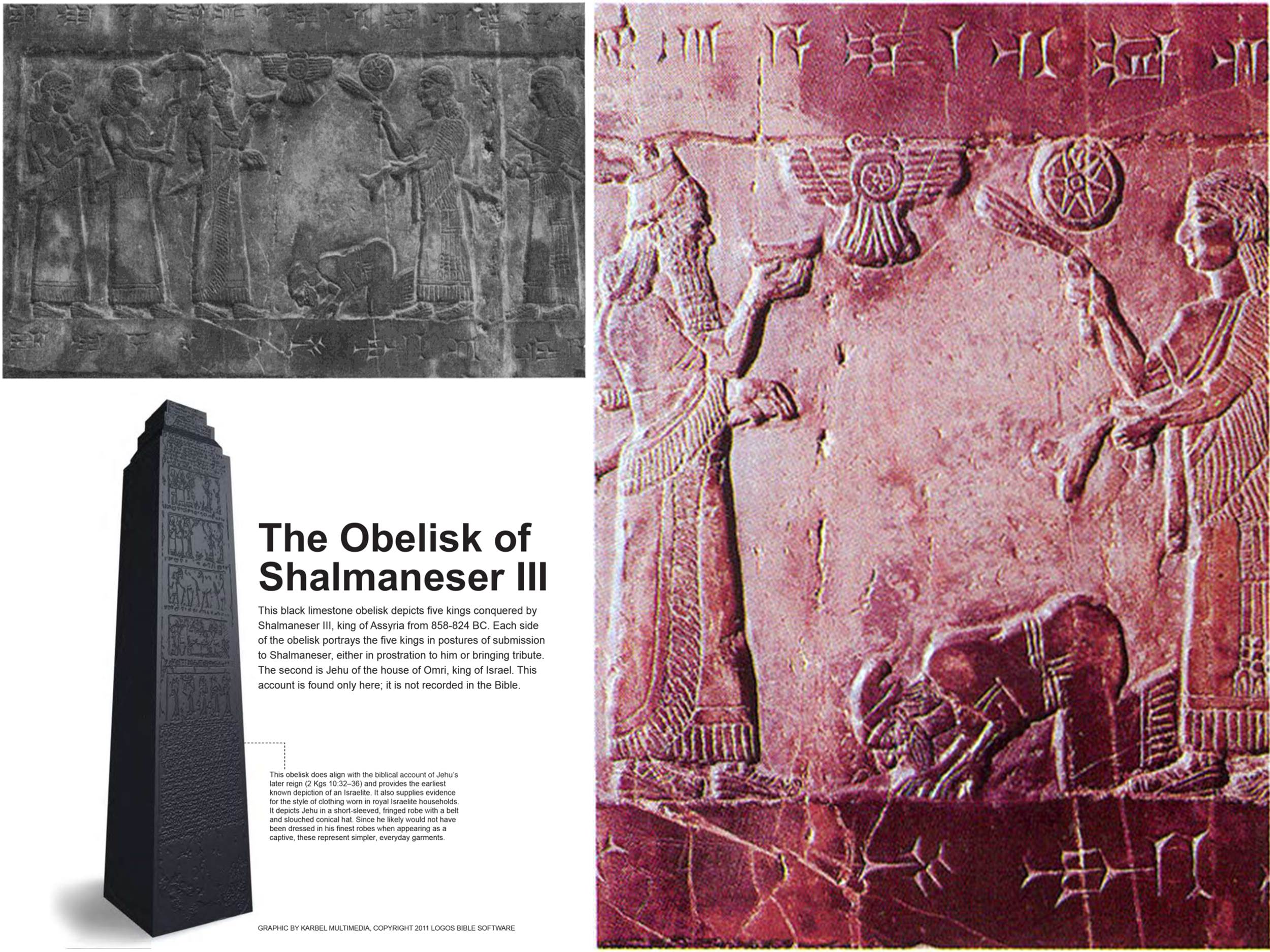
He didn’t want to go because the Assyrians were not nice people! They were the dominant empire in the entire Middle East – Babylon would come next. Archeologists and historians have discovered evidence of several massive military battles in Israel from 853 – 845 B.C. During that period, Israel, Judah and a bunch of other countries apparently joined together to defend themselves against the Assyrians[7]. The Judean King, Jehu, is shown cowering down and kissing the Assyrian King’s feet in this picture, below:

jonah

In Jonah’s day, Assyria is in the middle of a roughly 75 year (823-744 B.C.)[8] slump. They’re not doing so well anymore and are fighting amongst themselves. Meanwhile in Israel, Jeroboam II has come to power. Israel is expanding northwards and gaining territory. The economy is booming. Jonah and Hosea are from the same approximate generation.

But, Assyria is still out there, still dangerous and still a threat to Israel. They’re a serious danger to Israel – that means they’re a serious danger to Jonah. I want you to picture the absolute last kind of foreigner you’d want to share the Gospel with as an American – who would it be?

  • The five Taliban members who were just released in trade for SSG Bowe Bergdahl?
  • The 9/11 hijackers?
  • Osama bin Laden?
  • ISIS?

How would you like to leave behind your family, friends and your home to preach the Gospel to these folks? Not many Christians would be too eager to sign up for that trip? Yet, that’s what Jonah was told to do; and he didn’t like it!

There is a new book out about a Lutheran chaplain during World War II named Harry Gerecke. He served two years in England and then in Europe with the Army. He was preparing to ship back home in the summer of 1945, but was asked to stay and be a Chaplain to the German war-criminals during the Nuremberg Trials. He had watched soldiers blown up, shot and killed by Germans for two years. Now, he was being asked to delay his return home and preach the Gospel to the captured Nazi leaders, many of whom had committed horrible atrocities!

What would he do? What would you do? He stayed 1.5 years extra and reported that four men were saved![9] Put yourself in Jonah’s position, and don’t condemn him too easily. What he did was wrong, of course – but what would you do if God told you to travel to Syria and preach the Gospel to ISIS militants?

WHY DID GOD SEND JONAH TO NINEVEH?

I won’t answer that question until we reach the end of the book! But, what can we learn about God from the very beginning of this little book? God saves people from every tribe, tongue and nation.

The Gospel isn’t an American thing and it wasn’t an Israelite thing – God’s vision has always encompassed more than that. Israel wasn’t supposed to sit still and look pretty because she was chosen (“elect”) by God to be His holy people – she was supposed to:

  1. live the right way
  2. follow His law out of a pure heart, and
  3. draw other nations to Him by her own example!

The Gospel gets shared with everybody, even if we don’t like them.

—————————————————-

[1] This is indeed the crux of the issue! Perhaps the most accessible advocate for the idea that Israelites were supposed to be active missionaries to the pagan world is Walter J. Kaiser. He asks, “[i]t is at this point that the thesis of this book participates in issues that are hotly debated today: Did this ‘kingdom of priests’ serve Israel alone or the entire world? Were they to be active or merely passive witnesses,” (Mission in the Old Testament: Israel as a Light to the Nations, 2nd ed. [Grand Rapids, MI: Baker, 2012], xiii). Kaiser goes on to insist, “[t]he fact remains that the goal of the Old Testament was to see both Jews and Gentiles come to a saving knowledge of the Messiah who was to come. Anything less than this goal was a misunderstanding and an attenuation of the plan of God. God’s eternal plan was to provide salvation for all peoples; it was never intended to be reserved for one special group, such as the Jews, even as an initial offer!” (Ibid, xiv). Kaiser states the issue well, but his opponents do not suggest that Israel was supposed to be an elitist, snobbish society. Nor do they suggest that Israel did not fail in her adherence to the Mosaic Covenant. They merely disagree over the nature of her missions mandate – was it passive or active?

Over against Kaiser’s model is the idea that Israel’s “missions mandate,” such as it was, was basically passive. This position believes that the great ingathering of Gentiles is an eschatological one, for the latter days. This position is well represented by Andreas J. Kostenberger and Peter T. O’Brien, Salvation to the Ends of the Earth: A Biblical Theology of Mission (Downer’s Grove, IL : IVP, 2001), 25-53. At this point, one’s theological stripes will be revealed – will this ingathering take place when Jesus rules and reigns from a literal Jerusalem over a literally restored Israel (dispensationalist), or is this ingathering taking place right now as the spiritual kingdom of Christ reigns in the hearts of the elect (covenantalist)?

I hold to the second option, advocated by Kostenberger and O’Brien, that Israel’s missions mandate was very real, but basically very passive (Jonah being an obvious exception). I am a dispensationalist, so I believe the great eschatological ingathering of Gentiles will take place when Israel is restored, and Christ rules and reigns as her King in Jerusalem in the Millennium (see, for example, Isa 61).

[2] There is some debate about whether Jonah chartered the entire vessel, or whether he merely booked passage as a passenger to Tarshish, where the ship had already been headed. The Scripture itself provides the answer; v.5 tells us that the frightened sailors tossed the wares they were carrying overboard. Evidently the ship was engaged in trade and already bound for Tarshish; Jonah merely slipped on-board after negotiating the fare. If Jonah had chartered the entire vessel outright, they wouldn’t have gone through the trouble of loading wares for later sale in Tarshish. If they had tried to, there would no doubt have been a considerable delay and Jonah would have sought passage on another vessel.

[3] “Although alternatives have been suggested, south-west Spain remains the most likely location for Tarshish,” (T. Desmond Alexander, “Jonah,” in Obadiah, Jonah and Micah, vol. 26, Tyndale Old Testament Commentaries [Downers Grove, IL: InterVarsity Press, 1988], 110). John Walton suggests Tarshish need not be taken as a literal destination, but as a reference to great distance, e.g “I’m headed for Timbuktu!” doesn’t necessarily mean one is going to Mali, Africa. It could mean one just wants to get far, far away (Jonah, The Expositor’s Bible Commentary, vol. 8, revised ed. [Grand Rapids, MI: Zondervan, 2008], 469).

[4] No Bible believer would really believe one can literally hide from God. This is not a legitimate option!

[5] “Jonah wished to escape, not beyond the power of God, but away from the stage on which God was working out His purposes and judgments. The Christian worker anxious to avoid the full impact of modern problems should have no difficulty in understanding Jonah’s action,” (H. L. Ellison, Jonah, The Expositor’s Bible Commentary, vol. 7 [Grand Rapids, MI: Zondervan, 1985], 369). See also Ellison’s remarks on the silliness of the first interpretive option (369). Walton remarks, “Jonah does not necessarily think that distance will put him out of range of the Lord’s reach; he may have thought his flight will simply result in the Lord’s finding someone else for the job,” (Jonah, 469).

[6] Many commentators discount the idea that Jonah was a “missionary” in the NT sense, and certainly don’t agree that Jonah preached the Gospel (according to the revelation Jonah had at the time, the Gospel entailed saving faith in God alone for justification [e.g. Gen 15:6] and loving adherence to the Mosaic Covenant as proselytes). John Walton (Jonah, 457-458, 477-485) and H.L. Ellison (Jonah, 363, 383-384) are particularly insistent on this point. The particulars will wait until we reach Jonah 3, but as for a hint of my own position, Jesus’ own words in Mt 12:41 are rather decisive on this point! But for the sake of brevity I’ll simply refer to Jonah as a “missionary” and his message as “the Gospel” and save the details for later!

[7] See A. K. Grayson, “Assyria, Assyrians” in Dictionary of the Old Testament: Historical Books, ed. Bill T. Arnold and H.T.M. Williamson (Downer’s Grove, IL: IVP, 2005), 100-102

[8] Ibid.

[9] This information is from Lyle Dorsett, “Would You Share the Gospel with Hitler’s Worst Henchmen?” ChristianityToday.com. 23MAY14. Retrieved from http://goo.gl/Ll6mmr.

How Well Do You Know the Trinity?

How well do you know the doctrine of the Trinity? Could you explain, from the Scriptures, that Jesus was God? Could you explain how the Christian understanding of Christ as God doesn’t make us tri-thiests, or people who believe in three Gods?

Watch the video below, a short five minute clip from a Unitarian who believes Jesus was a created being, and not a person of the Godhead. This video is heresy! Could you answer his argument? After the video, see a short explanation on the historical development of the orthodox doctrine of the Trinity!


What you just watched was heresy. Now, I’ll give a short account of how the orthodox Trinitarian doctrine developed:

How the Doctrine of the Trinity Developed

When you consider “how the teaching of the Trinity developed,” it is important to understand that we are not talking about how men made up this doctrine. We’re talking about the struggle to precisely put into words the body of faith received from Christ and His disciples. This oral tradition, or body of faith, had acted as a conduit for correct doctrine and had eventually been set down in writing at the prompting of the Holy Spirit (1 Pet 1:21). So, we’re not discussing how men made this doctrine up, but how they struggled to precisely synthesize and define a doctrine clearly taught in the Scriptures.

There are five basic phases in the historical development of the Triune God, each often overlapping with one another; the economic concept, dynamic monarchism, modalism, Arianism and orthodoxy.[1] The very early church in general did not concern itself with deep theological reflection; therefore these various heretical doctrines generally emerged in conflict with orthodoxy in the mid to late 2nd century and early 3rd century. The church was chiefly concerned with basic survival amidst intense periods of persecution. “The process of organizing itself and propagating the faith and even the struggle for survival in a hostile world precluded much serious doctrinal reflection.”[2]

Economic Concept

This economic development dealt with the roles of the specific persons of the Godhead rather than the ontological development and its implications. Early church fathers who developed the economic concept include Hippolytus, Tertullian and Justin Martyr. Their conclusion was that God consists of one identical substance which is extended into three distinct manifestations.[3]

Justin Martyr, writing in the mid 2nd century likened this to one fire kindled from another; “which is not lessened when it has kindled [another], but remains the same; and that which has been kindled by it likewise appears to exist by itself, not diminishing that from which it was kindled.”[4]

Tertullian, writing sometime between 197-217 A.D., characterized this as a unity of substance and remarked,

Even when the ray is shot from the sun, it is still part of the parent mass; the sun will still be in the ray, because it is a ray of the sun—there is no division of substance, but merely an extension.[5]

Tertullian went on, “the material matrix remains entire and unimpaired, though you derive from it any number of shoots possessed of its qualities.”[6]

Tertullian actually formulated the concept of later orthodoxy, “one essence in three persons” in his attack on modalism. In his polemic on Praxeas, written no earlier than 208 A.D., he wrote again of a unity of substance which was distributed into a Trinity;

placing in their order the three Persons—the Father, the Son, and the Holy Ghost: three, however, not in condition, but in degree; not in substance, but in form; not in power, but in aspect; yet of one substance, and of one condition, and of one power, inasmuch as He is one God, from whom these degrees and forms and [l3] aspects are reckoned, under the name of the Father, and of the Son, and of the Holy Ghost.[7]

This economic concept of the Trinity is orthodox but incomplete. Erickson lamented about a “certain vagueness” in the economic concept of the Trinity. “Any effort to come up with a more exact understanding of just what it means will prove disappointing.” [8]

Dynamic Monarchism

This concept was an attempt by the early church to actually define the relationship between Christ and God. The main proponent of monarchism was Theodotus, who brought the doctrine to Rome about 190 A.D. He sought to preserve the supremacy of God the Father at the expense of God the Son.[9] Jesus was not really God; God was simply working through Him.

Theodotus “did not deny Christ’s birth from a virgin . . . but he did deny his divinity, teaching that he was a mere man upon whom the Holy Spirit descended at the time of his baptism, in consequence of which he became the Christ, received power to fulfill his special mission and by his righteousness was raised above all other men. The descent of the Holy Spirit, however, although raising him to a very exalted position, did not make him divine.”[10]

The concept was that Christ was elevated to an exalted position, a sort of “moral oneness” with God.[11]

A key proof-text for this concept was 1 Cor 5:19,[12] where Paul wrote “in Christ God was reconcilingthe world to himself.” Christ was not divine; God was simply using Christ as the means to achieve His ends. This view was condemned by the Christian community. Dionysius, the Bishop of Rome from approximately 259-263 A.D., held monarchist views. Eusebius recorded that Dionysius held, “contrary to the teaching of the Church, low and degraded views of Christ, namely, that in his nature he was a common man.” The catholic church (in the original sense of the term) moved energetically to combat this heresy, summoning Dionysius to a council to explain himself. Eusebius contemptuously referred to him as “a despoiler of the flock of Christ.”[13] Monarchism was never a widespread movement and was a relatively isolated phenomenon.[14]

Modalism

Erickson wrote that modalism was “a genuinely unique, original and creative conception . . . a brilliant breakthrough.”[15] It advocated the view that God was really just one person with three different names, roles or activities. Father, Son and the Holy Spirit are identical, successive revelations of the same person.[16] Like a skilled thespian, God simply plays different roles at different times.

Tertullian, writing his treatise against Praxeas sometime after 208 A.D., observed dryly, “Praxeas did a twofold service for the devil at Rome: he drove away prophecy, and he brought in heresy.”[17] Tertullian boldly claimed that Satan himself was working through Praxeas in his modalistic interpretation of the Trinity. “Out of this doctrine of the unity he may fabricate a heresy. He says that the Father Himself came down into the Virgin, was Himself born of her, Himself suffered, indeed was Himself Jesus Christ.”[18] He went on to state,

So it is either the Father or the Son, and the day is not the same as the night; nor is the Father the same as the Son, in such a way that Both of them should be One, and One or the Other should be Both.[19]

Employing a legal tactic of positing and answering modalistic objections, Tertullian continued,

Well, but “with God nothing is impossible.” True enough; who can be ignorant of it? Who also can be unaware that “the things which are impossible with men are possible with God?” The foolish things also of the world hath God chosen to confound the things which are wise.” We have read it all. Therefore, they argue, it was not difficult for God to make Himself both a Father and a Son, contrary to the condition of things among men. For a barren woman to have a child against nature was no difficulty with God; nor was it for a virgin to conceive. Of course nothing is “too hard for the Lord.

But if we choose to apply this principle so extravagantly and harshly in our capricious imaginations, we may then make out God to have done anything we please, on the ground that it was not impossible for Him to do it. We must not, however, because He is able to do all things suppose that He has actually done what He has not done.[20]

The modalistic conception of the Trinity was indeed novel. It solved any number of problems; both the unity of the Godhead and the full deity of all three persons are perfectly preserved by it. Ultimately, however, Scripture condemned this heresy to the flames. Too many texts spoke far too explicitly of the Trinity as distinct persons for the church to accept; such as Christ’s baptism, Christ speaking of the coming of the Spirit and His prayers that were specifically addressed to the Father.[21]

Arianism

The Arians, like the modern day Jehovah’s Witnesses, went a different route. Christ, they asserted, was not equal with God or even God at all – He was a creature brought into being by God. They felt that elevating Christ to the level of God the Father was, in effect, abandoning monotheism. They went further than the monarchists by emphatically declaring Christ was no more than a mere creature. However, from the beginning the church had worshipped Christ as God! The stage was set for a divisive battle. Athanasius considered Arianism to be a “harbinger of the Antichrist” and the daughter of Satan.[22] Summarizing their teaching, he wrote,

God was not always a Father; but once God was alone, and not yet a Father, but afterwards He became a Father. The Son was not always; for, whereas all things were made out of nothing, and all existing creatures and works were made, so the Word of God Himself was made out of nothing, and once He was not, and He was not before His origination, but He as others had an origin of creation.[23]

The church was quite rightly concerned with condoning the worship of a mere man. Athanasius wrote against the Arian heresy with great enthusiasm, judging it to be a theology which had been “vomited forth” and was at odds with Scripture and “alien to the divine oracle.”[24] Arians took Proverbs 8:22-23 as one of their primary proof-texts; “The Lord possessed me at the beginning of his work, the first of his acts of old. Ages ago I was set up, at the first, before the beginning of the earth.” The Arians examined texts such as this and others[25] and concluded it may be appropriate to call Christ a god, but he was certainly not the same as God the Father.[26] Arias himself explained,

God himself is inexpressible to all beings. He alone has none equal to him or like him, none of like glory. We call him unbegotten on account of the one who by nature is begotten; we sing his praises as without beginning because of the one who has a beginning. We worship him as eternal because of him who was born in the order of time. The one without beginning established the Son as the beginning of all creatures.[27]

Therefore, according to Arians, Christ Himself could not even fathom God’s essence. He was a mere creature; an exalted creature, to be sure – but a creature nonetheless. Church historian Justo Gonzalez summarized by observing, “if asked to draw a line between God and creation, Arians would draw that line so as to include the Word in creation.”[28]

Orthodoxy

The Arian heresy prompted the Council of Nicea in 325 A.D., the first ever ecumenical council of the early church. Prior to Nicea, church disputes had been settled over time with long debate culminating with an eventual consensus. After the conversion of Constantine, for the first time the authority of the state was invoked to settle a theological issue. Advocates of particular viewpoints could, for the very first time, forsake lengthy explanations of their positions in favor of simply convincing imperial authority. “Eventually, theological debate was eclipsed by political intrigue.”[29]

Arianism began as a local conflict in Alexandria, Egypt. The Bishop of Alexandria, Alexander, was in vehement disagreement with Arias, who was one of the most famous presbyters of the city. Alexander eventually condemned Arias and removed him from all official positions in Alexandrian church. Arias, refusing to meekly fade from the scene, appealed to the common people of Alexandria and other Bishops from throughout the East for support. Arias was quite successful; people marched in the streets chanting Arian dogma and various Bishops wrote letters in support. The Eastern church was in turmoil.

Constantine, who had recently established Christianity as the state religion, resolved that he must act. He decided to call a council of Bishops from the entire empire to settle this matter, among others. Arias, not being a Bishop himself, was forbidden to attend. He counted on Eusebius of Nocomedia to present his views. Eusebius (not to be confused with the historian) resolved to simply explain the matter, certain that all opposition would fade away in light of the remorseless logic of Arianism. Eusebius’ oration did not go well.

The assertion that the Word or Son was no more than a creature, no matter how high a creature, provoked angry reactions from many of the bishops: ‘You lie!’ ‘Blasphemy!’ ‘Heresy!’ Eusebius was shouted down, and we are told his speech was snatched from his hand, torn to shreds, and trampled underfoot.[30]

The result of this controversy, the Nicene Creed, is emphatically anti-Arian and takes great pains to emphasize the deity of Christ;[31]

I believe in one God, the Father Almighty, Maker of heaven and earth, and of all things visible and invisible.

And in one Lord Jesus Christ, the only-begotten Son of God, begotten of the Father before all worlds; God of God, Light of Light, very God of very God; begotten, not made, being of one substance with the Father, by whom all things were made.

Who, for us men for our salvation, came down from heaven, and was incarnate by the Holy Spirit of the virgin Mary, and was made man; and was crucified also for us under Pontius Pilate; He suffered and was buried; and the third day He rose again, according to the Scriptures; and ascended into heaven, and sits on the right hand of the Father; and He shall come again, with glory, to judge the quick and the dead; whose kingdom shall have no end.

And I believe in the Holy Ghost, the Lord and Giver of Life; who proceeds from the Father and the Son; who with the Father and the Son together is worshipped and glorified; who spoke by the prophets.

And I believe one holy catholic and apostolic Church. I acknowledge one baptism for the remission of sins; and I look for the resurrection of the dead.

In the Nicene Creed the early church provided a clear and unambiguous affirmation of the full deity of all three persons of the Godhead, while at the same time maintaining their distinct roles in the economic Trinity.

The doctrine received further refinement at the Council of Constantinople in 381 A.D. where the common phrase “three in one” was coined;[32] the very essence of the orthodox concept of the triunity of God. He is not triple, but three in one.


[1] Millard J. Erickson, Christian Theology, 2nd ed. (Grand Rapids, MI: Baker, 1998), 358-360. Erickson omits a discussion of Arianism.

[2] Ibid, 353.

[3] Ibid, 358.

[4] Justin Myrtyr, Dialogue with Trypho 61, ANF 1:607

[5] Tertullian, Apology 21, ANF 3:34. Emphasis mine.

[6] Ibid.

[7] Tertullian, Against Praxeas 2, ANF 3:59. Emphasis mine.

[8] Erickson, Theology, 358.

[9] Millard J. Erickson, Making Sense of the Trinity: Three Crucial Questions (Grand Rapids, MI: Kregel, 2000), 48.

[10] Eusebius, Ecclesiastical History 5.28, NPNF2 1:597

[11] Erickson, Making Sense, 48.

[12] Ibid.

[13] Eusebius, Ecclesiastical History 7.28.2, NPNF2 1:807.

[14] Erickson, Theology, 359.

[15] Ibid, 360.

[16] Ibid, 360.

[17] Tertullian, Against Praxeas 2, ANF 3:598.

[18] Ibid. Emphasis mine.

[19] Tertullian, Against Praxeas 10, ANF 3:604

[20] Ibid.

[21] Baptism (Mt 3:13-17; Mk 1:9-11; Lk 3:21-22; Jn 1:29-34), Christ speaks explicitly to the Father (Jn 17) and of the Spirit (Jn 16:5-11).

[22] Athanasius, Discourse Against the Arians 1.1.1., NPNF2, 4:306.

[23] Athanasius, Discourse Against the Arians 1.2.5, NPNF2, 4:309.

[24] Athanasius, Discourse Against the Arians 1.3.10., NPNF2, 4:312.

[25] Jn 14:28; Mk 10:18 and Lk 18:19; Mk 13:32; Lk 2:52

[26] Erickson, Making Sense, 51.

[27] Graham Keith, “Our Knowledge of God: Insights from the Fourth-Century Trinitarian Controversies,” Reformation and Revival 12:1 (Winter 2003), 86.

[28] Justo Gonzalez, The Story of Christianity, 2 vols., combined ed. (Peabody, MS: Prince Press, 2007), 1:161.

[29] Ibid, 159.

[30] Ibid, 164.

[31] Rick Brannan, ed., Historic Creeds and Confessions (Grand Rapids, MI: CCEL, n.d.).

[32] Erickson, Theology, 361.

Sufficiency of the Scriptures (Part #5)

sciptura

This is the final article on my series of the scriptures being the sole, infallible authority for Christian faith and practice. The entire series is attached as a PDF here. 

Summary

The question is whether the Scriptures are sufficient. Are they the sole, infallible authority for Christian faith and life, or is something more needed?

First, it has been shown the Scriptures themselves are very clear that neither Christ nor His apostles tolerated or sanctioned the use of tradition for religious faith and life.

Second, Matthew, Luke, Paul, Peter and Jude relied on Scripture alone for their theology. As Armitage stated, “Christ and his Apostles always appeal directly to the Law, the Prophets, and the Psalms, and to their co-relative sentiments, facts and precedents, where they are applicable; and where they are not applicable, a new revelation was granted.”[1]

Third, an exposition of several critical Scripture passages demonstrate that (1) Christ condemned the use of tradition, even if derived from Scripture, (2) Scripture is divinely inspired by God and profitable to make the man of God complete, (3) Scripture is the very product of the Spirit of God.

Fourth, the New Testament alone is the only source of authority for church polity

Fifth, in summary, “it is clear that Jesus, his disciples, and the Jewish people in general presupposed Scripture to be not only the infallible record of God’s revelatory acts, but the authoritative, objective link between the prophetic nature of revelation and its fulfillment.”[2]


[1] Thomas Armitage, A History of the Baptists (Roger Williams Heritage Archives, 1886), 116.

[2] King, “Holy Scripture,” 42.

Sufficiency of the Scriptures (Part #3b)

10reasons

This is Part #3b on my series about the absolute sufficiency of the Scriptures as the sole, infallible authority for Christian faith and life. Part #1 set the stage. Parts #2a and #2b examined what several books in the New Testament had to say on the subject. Part #3a, along with this post, examine several critical passages which teach the doctrine of sola scriptura.

2 Peter 1:16-21

In this passage, Peter shows great concern that Christians “confirm their calling and election,” (2 Pet 1:10). He listed several traits (2 Pet 1:5-7) which should be the practical outworking of a fruitful life in Christ (2 Pet 1:8). Peter endeavored to constantly remind Christians of these points (2 Pet 1:12-15), and then set out to demonstrate the validity of the truth he preached.

Peter made it very clear that he and the other apostles “did not follow cleverly devised myths” when they preached of the second coming of Christ, and reminded his readers he was an eyewitness of His majesty! (2 Pet 1:16). Once again, deviation from a concrete, propositional truth is a negative thing to the NT evangelists. Peter is stressing the legitimacy of the doctrine he preached, and he did so by affirming that it was truthful and in accordance with actual events. Peter recounted what he saw on the Mount of Transfiguration, when he saw the glorified Christ and heard the voice of God the Father issuing His seal of approval on His Son’s ministry. His Second Coming will happen. Peter assures his audience he knows this to be true because he witnessed God’s approval on His Son (2 Pet 1:18).

Implicitly, then, the whole of the Gospel message is also true and correct. Peter makes this very connection when he remarks, “and we have the prophetic word more fully confirmed,” (2 Pet 1:19a). Peter’s eyewitness testimony confirms the validity, accuracy and above all the sufficiency of the OT Scriptures – the transfiguration confirms the eventual fulfillment of the prophesies.[1] Peter uses the authority of the OT Scriptures alone to confirm the new mystery of the church age and the Gospel of Christ. This is progressive revelation once again; the new revelation in perfect accord with the old.

Meanwhile, as Christians wait for that blessed day (Titus 2:13), Peter calls his readers back to the sacred Scriptures, encompassing both the Hebrew Scriptures and the new revelation of the apostles. He tells them to “pay attention” to them, “as to a lamp shining in a dark place, until the day dawns and the morning star arises in your hearts,” (2 Pet 1:19b). “As a light, God’s word has validity and authority.”[2]

It is significant that Peter directs his readers only to God’s unshakable word for comfort and guidance in Christian life. Calvin remarked,

His object only was to teach us that the whole course of our life ought to be guided by God’s word; for otherwise we must be involved on every side in the darkness of ignorance; and the Lord does not shine on us, except when we take his word as our light.[3]

Peter continued onward and emphasized the source of Scripture; “no prophesy of Scripture comes from someone’s own interpretation,” (2 Pet 1:20). Again, it is not a cunningly devised fable. It is divinely inspired. It is propositional truth. No true prophesy “was ever produced by the will of man, but men spoke from God as they were carried along by the Holy Spirit,” (2 Pet 1:21). “To bear” or “to guide” translates the Greek word phero.[4] As Scripture authors penned their works, they were impelled, borne along and guided by the Spirit. “The metaphor here is of Prophets raising their sails, the Holy Spirit filling them and carrying their craft along in the direction He wished.”[5] This, along with 2 Tim 3:16-17, is clear testimony to the divine nature, authority and absolute sufficiency of the Scriptures.

The next post will establish that the New Testament is the sole, infallible authority for church polity. It comes from a distinctly Baptist perspective because, well . . . I’m a Baptist! 


[1] Edwin A. Blum, 2 Peter, vol. 12, The Expositor’s Bible Commentary, ed. Frank Gaebelein (Grand Rapids, MI: Zondervan, 1981), 274.

[2] Roger M. Raymer, 2 Peter, in The Bible Knowledge Commentary, ed. J.F. Walvoord and R. Zuck (Wheaton, IL: Victor, 1983), 868.

[3] John Calvin and John Owen, Commentaries on the Catholic Epistles (Bellingham, WA: Logos Bible Software, 2010), 388.

[4] The Lexham Analytical Lexicon to the Greek New Testament. Logos Bible Software, 2011.

[5] King, Holy Scripture, 95.

Discerning God’s Will for Our Lives

gdswl

This message is directly specifically at teenagers, but just for kicks, I’ll post it here anyway! It was preached for teen Sunday School at my church this morning. 

There are three basic, looming decisions facing any Christian teenager as their high school days come to a close and they face the prospect of escaping from home (at last!) and starting life on their own.

  • Am I a Christian? Do I live out my own faith or have I just been borrowing from my parents?
  • What career will I choose?
  • Who and when will I get married?

For a Christian teenager seeking to be true to God, each of these life-altering decisions are (hopefully) seen in the context of what God’s will for his life is. Questions such as these will naturally swirl through the mind:

  • What God want me to do?
  • Should I go to college? Which college?
  • Who does God have for me to marry?
  • Will I ever get married? 

We all probably remember wrestling with these issues in our own lives. In this lesson, I take a brief look at what a passage of Scripture has to say about (1) God’s universal will for every Christian and (2) discerning God’s will for our individual lives. The important takeaway is this:

  1. God’s specific will for our lives is predicated on His universal will for Christians. Basically, if we aren’t interested in fulfilling our most basic responsibility as Christians and walking worthy of God, then we’re wasting our time praying to God and asking for guidance and help on specific issues. First things first, after all!
  2. God does not reveal His specific will for our lives in a comprehensive, direct revelation. We frequently can only see God’s providential hand in our lives after the fact, years later, as we look back on life events. He does not provide us with a PDF instruction booklet outlining His specific plan for our lives! We have to make important decisions day by day as we (1) search the Scriptures, (2) pray earnestly for guidance, (3) weigh the counsel of other Christians we respect and finally (4) simply doing what we believe is best in light of all these factors. God will work through these situations to work things together for good.

We may not always appreciate or like what God has in store for us! However, if we can truly call ourselves children of God who have repented of our sins and trusted in Christ as Savior, we can trust God and live by faith as we await His glorious return!

I honestly wish I had much more time to flesh this out. Hopefully it was a blessing to our teens in church, and perhaps even to you. The Gospel of Mark continues next week.

Sermon notes

Sufficiency of the Scriptures (Part #3a)

bible alone

This is part 3a of my series on the sufficiency of the Scriptures as the sole infallible authority for Christian faith and life. Part #1 set the stage. Part #2a and #2b examined what several New Testament books had to say on the matter. This post and the next will take a look at several critical passages in the New Testament on the subject.

Mark 7:1-13

Pharisees and scribes from Jerusalem have come down to see Jesus once more (Mk 7:1; see also Mk 3:22-30). It is doubtful they were merely curious about Christ; they likely came specifically to investigate and condemn Him. “The scribes and Pharisees, who had come from Jerusalem, were doubtless sent as spies, to watch and to report in no friendly spirit the proceedings of the great Prophet of Nazareth.”[1]

They soon find something to take issue with; “they saw that some of his disciples ate with hands that were defiled, that is, unwashed,” (Mk 7:2). The Pharisees had developed the custom of ritualistic washing before meals, along with many other inventions (Mk 7:3-4). Mark takes pains to mark these customs as the “tradition of the elders.” In their zeal to preserve their Jewishness in a distinctly un-Jewish world, [2] the Pharisees had elevated ritualistic tradition to the same level as the OT law. [3] Edwards remarks that “by Jesus’ day, adherence to the unwritten oral tradition was as important for the Pharisees as was adherence to the Torah itself.”[4]

Here Christ issues His decree on the sufficiency of the Scriptures. Would He approve of the elevation of human tradition? The accusation from the Pharisees is not long in coming; “Why do your disciples not walk according to the tradition of the elders, but eat with defiled hands?” (Mk 7:5). Christ does not mince words; he calls them hypocrites and draws from a prophesy of Isaiah to accuse them of false worship!

Well did Isaiah prophesy of you hypocrites, as it is written, ‘This people honors me with their lips, but their heart is far from me; in vain do they worship me, teaching as doctrines the commandments of men,’ (Mk 7:6b-7).

Our Savior follows up this frank condemnation with a summary statement; “You leave the commandment of God and hold to the tradition of men,” (Mk 7:8). What follows is a sad and despicable example of how the custom of Corban had been twisted and turned into a prohibition from honoring one’s parents (Mk 7:9-13). Jesus’ concluding remark on the matter is particularly damning; “thus making void the word of God by your tradition that you have handed down. And many such things you do,” (Mk 7:13).

The word is God is made void by man-made traditions. Scripture is indeed sufficient, and Christ upheld them as the sole authority for faith and life. As David King observed, “if, in their day [Christ and the apostles], there existed alongside Scripture, a legitimate God-given, objective standard of authority such as extra-biblical revelation, it has failed to surface.”[5]

2 Timothy 3:10-17

Paul wrote to his young disciple, Timothy, encouraging him to persevere in the midst of trials and hardships. Paul related that, though false teachers will come and persecute the brethren, “they will not get very far, for their folly will be plain to all,” (2 Tim 3:9). Paul reminds Timothy that he is very aware of how Paul has suffered for Christ’s sake during the course of his ministry (2 Tim 3:10-11).

“Indeed, all who desire to live a godly life in Christ Jesus will be persecuted, while evil people and impostors will go on from bad to worse, deceiving and being deceived,” (2 Tim 3:12-13).

Now, Paul turns to practical application for his apprentice. In the midst of this admittedly dark letter, after reminding Timothy of own trials and tribulations, Paul observes that anybody (including young Timothy) who seeks to live for God will face troubles. What practical advice will Paul give Timothy?

He tells Timothy to “continue in what you have learned and firmly believed, knowing from whom you learned it,” (2 Tim 3:14). Timothy was schooled in the Scriptures from his grandmother and mother (2 Tim 1:5). He was also instructed at length by Paul (2 Tim 1:13-14) in the Christian faith, which augmented his Jewish upbringing. Paul likewise also instructed Titus in the same manner (Tit 1:9). Therefore, when Paul reminds Timothy to “continue in what you have learned,” he was speaking of his childhood and young adult instruction in the faith.[6] This is a progressive revelation; a devout Jewish upbringing rounded out by instruction from Paul concerning new revelation of the gospel of Jesus Christ (Gal 1:12; Eph 3:1-13).

Paul continues, and reminds Timothy that he has been acquainted with the “sacred writings” since childhood, which make one wise for salvation through faith in Christ (2 Tim 3:15). These “sacred writings” are the Hebrew Scriptures,[7] but the remark about these Scriptures leading to explicit faith in Christ demonstrate that Paul also had the gospel message in view here as a complete revelation.[8] Thus the complete, divine revelation of the Hebrew Bible and the Gospel of Jesus Christ are “sacred.” This accords very well with Paul’s command for those who preach another Gospel to be “accursed” (Gal 1:8-9). Scripture contains absolute, propositional truth which is sacred. Paul commends these Scriptures to Timothy as an anchor in turbulent times.

The Holy Spirit guided Paul to choose his words very deliberately. “All Scripture is breathed out by God,” (2 Tim 3:16). The original Greek of theopneustos means “divinely inspired.”[9] This simple passage describes not only the nature of the inspiration of Scripture, but its source.[10]

The context of Paul’s statement (2 Tim 3:14-15) clearly include more than simply the OT Scriptures.[11] “Since the early church viewed the words of Jesus as fully authoritative, it would not have been a large step for Christians to accept the writings of His apostles as equally authoritative with the OT.”[12] Precisely because the Scriptures are divinely inspired, it is profitable to make the man of God complete, equipped for every good work (2 Tim 3:16-17). What more authority can Scripture ever claim, but that it was literally inspired by God Himself?

The next post will continue our look at some important New Testament passages on the sufficiency of the Scriptures.


[1] H. D. M. Spence-Jones, gen ed., The Pulpit Commentary, 23 vols. (London; New York: Funk & Wagnalls Company, 1909). St. Mark Vol. I, 291. See also John D. Grassmick, “Mark,”  vol. 2, The Bible Knowledge Commentary: ed. J. F. Walvoord and R. B. Zuck (Wheaton, IL: Victor Books, 1985), 132. Grassmick is more charitable and merely stated they came to “investigate” Jesus.

[2] James R. Edwards, The Gospel According to Mark (Grand Rapids, MI: Kregel, 2002), 205. “Rituals concerning cleanness and uncleanness reflect rabbinic developments more than actual Torah prescriptions . . . As Judaism’s encounter with Gentile culture increased in the post-exilic period, however, the question of ritual cleanliness took on new significance as a way of maintaining Jewish purity over against Gentile culture.”

[3] Grassmick, “Mark,” 132-133. “These interpretations, designed to regulate every aspect of Jewish life, were considered as binding as the written Law and were passed on to each generation by faithful Law teachers (scribes).”

[4] Edwards, Mark, 208. See also Emil Shurer, A History of the Jewish People in the Time of Christ, 5 vols. (Peabody, MS: Hendrickson, 2012), 1:2.

“The predominance of Pharisaism is that which most distinctly characterized this period. The legalistic tendency inaugurated by Ezra had now assumed dimensions far beyond anything contemplated by its originator. No longer did it suffice to insist on obedience to the commandments of the Scripture Thora. These divine precepts were broken down into an innumerable series of minute and vexatious particulars, the observance of which was enforced as a sacred duty, and even made a condition of salvation. And this exaggeration even made a condition of salvation. And this exaggerated legalism had obtained such an absolute ascendency over the minds of the people, that all other tendencies were put entirely in the background.”

[5] King, Holy Scripture, 42.

[6] William Mounce, Pastoral Epistles, vol. 46, Word Biblical Commentary, ed. Bruce Metzger (Nashville, TN; Thomas Nelson, 2000), 562-563.

[7] Thomas D. Lea, 1, 2 Timothy, vol. 34, The New American Commentary, ed. David Dockery (Nashville, TN: B&H, 1992), 234.

[8] Mounce, Pastoral Epistles, 563-564. “It seems doubtful that Paul would say that the OT by itself could instruct Timothy in a salvation that was by faith in Christ Jesus; this would be anachronistic. . . It may be concluded that the expression ‘sacred writings’ is drawn solely from the vocabulary describing the Hebrew Scripture, but since Paul is thinking about the culmination of the scriptural hope realized through faith in Christ Jesus, he chooses the anarthrous plural construction to develop his argument in the direction of joining the Hebrew Scripture and the gospel.” Emphasis mine.

[9] James Swanson, Dictionary of Biblical Languages with Semantic Domains: Greek (New Testament). (Oak Harbor: WA, Logos Research Systems, Inc., 1997).

[10] Mounce, Pastoral Epistles, 566.

[11] Ibid, 567-568.

[12] Ibid, 568.

Sufficiency of the Scriptures (Part #2b)

sola_scriptura

Part 2b on my series on the sufficiency of the Scripture as the sole, infallible authority for Christian faith and life. Part #1 was an introduction to set the stage. Part #2a was the first part of what different books of the New Testament have to say on the matter.

Romans

Paul grounded the Gospel of Jesus Christ in the authority of the OT Scriptures. He tied the Gospel to that which God “promised beforehand through his prophets in the holy Scriptures,” (Rom 1:2). The Book of Romans is literally saturated with references to OT Scriptures to make theological points,[1] far more so than a brief biblical theology here can hope to demonstrate. Once again, Paul does not base his arguments on philosophy or tradition – he bases them on Scripture.

It is not the hearers of the law who are justified, but the doers (Rom 2:12-29). None are righteous (Rom 3:9-18); “there is no fear of God before their eyes,” (Rom 3:18). Knowledge of the OT law brings about conviction and knowledge of sin (Rom 3:19-20; 4:15; 7:7-25). The Law and Prophets bore witness to Christ (Rom 3:21-22). Abraham was justified by faith (Rom 4). We are dead in Adam but alive in Christ (Rom 5:12-21). God’s sovereignty in election is grounded in His corporate election of Israel and the individual, single election of individuals (Rom 9).

Israel refuses to respond to the present provision of salvation through Jesus Christ (Rom 10), and Paul bolstered his argument by citing examples of Israel’s previous rebellion (Rom 10:18-21). Gentiles have been grafted into the promises given to Abraham (Rom 11), “so as to make Israel jealous,” (Rom 11:11). Her rejection is not final and her restoration is assured. Paul’s appeal for Christians to present themselves as living sacrifices (Rom 12:1) is rooted in the OT concept of a sacrifice to God. Christ came to the Jews in the form of a servant “in order to confirm the promises given to the patriarchs,” (Rom 15:8-9).

Paul presents the new doctrine he received from Christ (Gal 1:12) as explicitly progressive revelation. This gospel and preaching of Jesus Christ, in complete accord with all which has come before it, is a “revelation of the mystery that was kept secret for long ages, but has now been disclosed and through the prophetic writings has been made known to all nations, according to the command of the eternal God,” (Rom 16:25-26).

1 Peter

Peter writes his epistle to Jewish Christians (1 Pet 1:1 – “elect exiles of the Dispersion”), demonstrating a clear connection in his mind between the OT and the Gospel of Jesus Christ. He stated that Christ fulfilled the OT prophesies.[2]

The prophets prophesized about the grace of God in salvation in Jesus Christ (1 Pet 1:10). These OT prophets sought to discern when the prophesy of Christ’s sufferings and subsequent glories would come to pass (1 Pet 1:11). It was revealed to these great men, presumably through the Spirit, that these prophesies were intended for a future time. Peter identified that time period as “now,” or the dispensation of grace in the church age.[3] The OT prophesies take on clearer, concrete and unmistakable meaning in light of the progressive revelation of the Gospel of Jesus Christ (1 Pet 1:12).

It was revealed to them that they were serving not themselves but you, in the things that have now been announced to you through those who preached the good news to you by the Holy Spirit sent from heaven, things into which angels long to look (1 Pet 1:12).

The context of 1 Pet 1 is that his readers could rejoice in their sufferings even though they could not see exactly how or when their present trials would end. Just as the OT prophets had limited understanding of their own prophesies, they trusted God to sovereignty work out all things according to good (Rom 8:28). God’s answer to Habakkuk’s plea for understanding of God’s ways was to live by faith (Hab 2:4). In the midst of suffering (1 Pet 1:6), it is very significant that Peter points his readers to Scriptures as the source of assurance. Several conclusions can be drawn:

  1. God has spoken propositionally to His people in a concrete fashion.
  2. Peter points to the Scriptures as the sole source of God’s revelation to men. He bases his subsequent call to be holy in a decidedly unholy world (1 Pet 1:13 – “therefore”) on the assurance of salvation and glorification in Christ, which was prophesied of in the OT and disclosed more completely by Peter and the other apostles.

Peter quotes the OT to make theological points, underscoring the authority of the OT.[4] He quoted from Isaiah 40:6, 8 (1 Pet 1:24-25) and stated “the word of the Lord remains forever.” He concluded by noting “and this word is the good news that was preached to you,” (1 Pet 1:25b). Peter describes the role of the Christian in terms of Israel’s covenant responsibility similar to Ex 19:5-6 (1 Pet 2:9).

James

James also writes his epistle to Jewish Christians (Jas 1:1). His theology is steeped in the OT Scriptures. Without his unwavering reliance upon them as an infallible revelation from God, James could not have written his epistle. His theology of God’s character is one of holiness (Jas 1:13), and perfectly in tune with the OT description of His character (Lev 11:45, 19:2; Ps 99:9).

Pure religion, or piety,[5] consists of proper conduct and character. James’ example of proper religious conduct is to “visit orphans and widows in their afflictions,” (Jas 1:27), an admonition which is soaked in the context of the OT law regarding social justice (Ex 22:22; Deut 14:29). His exhortation to proper character is to “keep oneself unstained from the world,” (Jas 1:27), which likewise has its roots in the OT command for Israelites to remain separate and uncontaminated by the pagans round about them (Lev 18:24-19:2).

James’ overarching point is to contrast mere ritualistic observances with actual reverence for God; to illustrate what “religion that is pure and undefiled before God” (Jas 1:27) really is. It is merely a stepping stone from here to a contrast between mere outward circumcision and a true circumcision of the heart (Deut 10:12-16).

James quoted repeatedly from Scripture to condemn the sin of partiality (Jas 2:8, 11). James used the example of both Abraham and Rahab to make the point that faith without works is dead (Jas 2:14-26). He quoted Proverbs 3:34 to emphasize the need for humility and separation from worldliness (Jas 4:1-6). He pointed to the example of Job and exhorts his readers to have patience in the midst of suffering and trials (Jas 5:10-11). James cited the fervent prayers of Elijah as he exhorted his readers to pray diligently for one another (Jas 5:16-18).

Jude

Like his brother James, Jude’s theology simply would not exist without the OT Scriptures. Jude wrote of “the faith that was once for all delivered to the saints,” (v. 3). This faith Jude spoke of was the body of truth taught by the apostles.[6] This underscores the progressive nature of God’s revelation, and is perfectly harmonious with Peter’s (1 Pet 1:10-12), Paul’s (Eph 3:1-13) and the writer to the Hebrew’s (Heb 1:1) comments in their own epistles on this point.

Jude noted the presence of false teachers who “long ago were designated for this condemnation” (v. 4). This refers to previously written prophesies regarding the doom of apostates (e.g. Isa 8:19-22; Jer 5:13-14).[7]

Jude notes God’s righteous pattern of punishing those who apostatize from the true faith, such unbelieving Israelites, angels and the inhabitants of Sodom and Gomorrah and the surrounding cities (v. 5-7). These “serve as an example by undergoing a punishment of eternal fire,” (v. 7). Jude then moves to his present day and condemns contemporary false teachers of these very sins! (v. 8). He mentions the archangel Michael, compares the false teacher’s way to that of Cain and Balaam, and compares their eventual end to that of Korah (v. 11). Jude also accurately puts Enoch as the “seventh from Adam,” (v. 14).[8]

The next post will be a discussion of several critical passages that focus on the sufficiency and authority of the Scriptures for the Christian life.


[1] Rom (3:4, 10-18); (4:7-8, 17); (8:36); (9:25-29, 33); (10:5, 18-21); (11:8-10); (12:19); (13:8-9); (14:11); (15:3, 9-12); (16:21).

[2] 1 Peter (1:10-12); (2:6-8).

[3] See also 1 Pet 1:20 – “He was foreknown before the foundation of the world but was made manifest in the last times for the sake of you.”

[4] 1 Peter (1:16, 24-25); (2:9); (3:5-6, 10-12); (4:18).

[5] William D. Mounce, Complete Expository Dictionary of Old and New Testament Words (Grand Rapids, MI: Zondervan 2006), 1170.  Θρησκεια, or “religion,” may better be termed “piety.”

[6] Edward C. Pentecost, “Jude,” in The Bible Knowledge Commentary, ed. John Walvoord and Roy Zuck (Wheaton, IL: Victor, 1983), 919.

[7] Edwin Blum, Jude, vol. 12, The Expositor’s Bible Commentary, ed. Frank Gaebelein (Grand Rapids, MI: Zondervan, 1981), 389.

[8] See 1 Chr 1:1-3

Sufficiency of the Scriptures (Part #2a)

sola scriptura

This is the second of a multi-part series on the sufficiency of the Scriptures as the sole, infallible authority for Christian faith and life. Part #1 laid the groundwork and gave some brief summary statements. This and the next post will present a brief look at several books of the New Testament and what they have to say about the authority and sufficiency of the Scriptures. 

Biblical Theology

There is not sufficient space to devote to a Biblical Theology of the entire New Testament. Selected books will be covered which represent a broad spectrum of New Testament documents and authors.[1]

Matthew

The genealogy implicitly recognizes the authority of the OT to prove Christ’s deity (Mt 1:1-17). Matthew is also very careful to point out fulfilled prophesy.[2] The chief priests and the scribes whom Herod consulted also appealed to the Scriptures (Mt 2:4-6). Herod later gave the Scriptures their due authority in his attempt to destroy the Christ child (Mt 2:16). John the Baptist also gave due weight to OT prophesy in his query about Jesus (Mt 11:2-3). John based his condemnation of Herod’s marriage to his half-brother’s wife on OT law (Mt 14:4b).

Christ quoted Scripture alone to refute Satan’s devices during His temptation in the wilderness.[3] He did not come to abolish the law and the prophets, but to fulfill them (Mt 5:17). Jesus had implicit respect for the OT, quoted it frequently[4] and affirmed that all the OT will be accomplished (Mt 5:18; 13:17; 26:53-54, 56). Christ instructed a leper He healed to present himself to the priest in accordance with OT law (Mt 8:4). Christ upheld the OT divorce laws (Mt 19:1-12). He also instructed the rich young ruler to keep all the commandments (Mt 19:16-22).

Christ’s ministry was interpreted by contemporary believers within the context of the OT.[5] They knew of no other source of legitimate authority. Peter, for example, related that some people believed Christ was John the Baptist, Elijah, Jeremiah or another OT prophet (Mt 16:13-14). It is clear the people were searching the OT for the proper interpretative context about Jesus. The demons themselves certainly interpreted Christ in this fashion! (Mk 5:1-13).

During the Sermon on the Mount, Christ applied OT law to everyday life in the areas of anger (Mt 5:21-26), lust (Mt 5:27-30), divorce (Mt 5:31-32), uttering oaths (Mt 5:33-37), retaliation (38-42), love for your enemies (Mt 5:43-48) and social justice (Mt 7:12). Christ appealed to the OT to rebuke the Pharisees’ erroneous views of the Sabbath (Mt 12:3-8) and to Jonah to illustrate the three days between His death and resurrection (Mt 12:40).

Though not in the Gospel of Matthew, the clear testimony of Christ on the road to Emmaus cannot be neglected. Two dejected disciples were traveling home, their hope in Christ lost. Jesus, in a disguised state, asks what troubles them. The disciples, astonished, relate the details of Christ’s ministry. They admit they are perplexed and confused by the empty tomb, and lament they “had hoped that he was the one to redeem Israel” (Lk 24:21a). Christ’s response underscores the authority, validity and sufficiency of the Scriptures. Moreover, He chastened His disciples for not searching the Scriptures more diligently. Their answers were there!

And he said to them, ‘O foolish ones, and slow of heart to believe all that the prophets have spoken! Was it not necessary that the Christ should suffer these things and enter into his glory?” And beginning with Moses and all the Prophets, he interpreted to them in all the Scriptures the things concerning himself (Lk 24:25-27).

Christ proved Himself from the Scriptures. There is nothing done by Christ which contradicts prophesy which had come beforehand. He emphasizes this point to His disciples shortly thereafter; “these are my words that I spoke to you while I was still with you, that everything written about me in the Law of Moses and the Prophets and the Psalms must be fulfilled,” (Lk 24:44).

Acts

Luke also appealed to fulfilled prophesy,[6] most significantly the fact of Christ’s crucifixion (Acts 3:18) as part of God’s larger plan for restoration of His creation (Acts 3:21).

It is significant that Christ’s apostles looked to the OT Scripture as the interpretative key for present-day events (Acts 2:30-31; 7:1-51). They continued to rely on the OT as they experienced miraculous visions (Acts 10:9-16), deliverance from prison (Acts 12:6-19) and preached to Jews that Christ was the promised Messiah (Acts 13:13-52).

Peter tied Christ definitively to the God of Abraham, Isaac and Jacob, calling Jesus God’s “servant” (Acts 3:13), the “Holy and Righteous One” (Acts 3:14) and the “Author of life” (Acts 3:15). He based his initial objection to eating unclean foods on Jewish dietary laws from the OT (Acts 10:14).

The Jerusalem Council was called due to disagreement over whether Gentile converts had to be circumcised (Acts 15:1-2). This is an explicit statement about the authority the Hebrew Scriptures had to the early Christians.

Paul’s “reasoned” with Jews from the Scriptures in Thessalonica (and in Athens – 17:17), “explaining and proving” Christ from the Scriptures (Acts 17:2-3). Paul did not base his theology only on the new revelation he received from Christ (Gal 1:12); he argued that Christ fulfilled the OT prophesies from the Scriptures. This is very clear in Paul’s sermon on Mar’s Hill, a masterful exposition and synthesis of doctrine (Acts 17:22-34)

Devout Jews in Berea examined “the Scriptures daily to see if these things were so,” (Acts 17:11) as Paul preached Christ in the community. Paul expressed regret for unknowingly speaking harshly to the high priest in Jerusalem (Acts 23:4-5) in violation of OT law. Stephen’s opponents used the benchmark of the OT to condemn Stephen to be stoned for blasphemy – “We have heard him speak blasphemous words against Moses and God,” (Acts 6:11). They did likewise to Paul (Acts 18:13), “this man is persuading people to worship God contrary to the law.”[7]

In Caesarea, Tertullus accused of Paul of profaning the temple by His doctrine at a hearing before Felix (Acts 24:5-7). In his own defense, Paul firmly anchored his doctrine on the OT Scriptures (Acts 24:14-15).[8] The Ethiopian eunuch was convicted in his heart by a reading of Isa 53:7 (Acts 8:26-40).

Apollos’ credential to preach the Gospel was that he was “competent in the Scriptures,” (Acts 18:24b). After the way of God had been explained more accurately to him (Acts 18:26), Luke spoke glowingly of how Apollos “powerfully refuted the Jews in public, showing by the Scriptures that the Christ was Jesus,” (Acts 18:28).


[1] For sake of space, Hebrews and the writings of John are not covered. Likewise, space did not allow for an examination of all four Gospels. Matthew therefore stands here as broadly representative of the four.

[2] Mt (1:22-23); (2:14-15, 17, 23); (3:3); (4:14-16); (8:17); (11:10, 13-14); (12:17-21); (13:14-15, 35); (15:7-9); (21:4-5); (27:9-10).

[3] Mt 4:1-11; Mk 1:12-13; Lk 4:1-13.

[4] Mt (21:13, 16, 42); (22:32, 37-39, 43-47); (24:15, 37-39).

[5] Mt (16:13-14); (17:4, 10); (21:9-11); (22:34-40); (the reaction of the Sanhedrin – Mt 26:63-66).

[6] Acts (1:16, 20); (2:16-21, 25-28, 34-35); (3:17-26); (4:25-26); (7:42-43, 49-50); (13:33-35, 41, 47); (15:16-17 – this author believes James was merely arguing that Amos’ prophesy agrees with what was happening. He was not arguing Amos’ prophesy was being fulfilled); (28:26-27).

[7] See also Acts 21:20-22, 27-30.

[8] See also Paul’s defense of himself before Agrippa (Acts 26:4-8, 22-23) and among fellow Jews at Rome (Acts 28:17-24).