Sharing the Gospel . . . at Work?

workplace graceIn Sunday School, we’ve taken a short detour from the Apostle Peter’s first letter to talk about something very practical – how do you share your faith in the real world? Perhaps you’ve “grown up” in churches where evangelism was always a corporate, church activity. Perhaps, when you hear “evangelism,” you immediately think of going door to door in a sub-division. Maybe you think of a bus ministry. Maybe you think of running the other way, and making a hasty retreat through the church foyer for the front door.

I understand.

Did you know there is more to it than that? Let’s get real, for a moment – most Christians will have the most opportunities to share their faith where they spend the majority of their day – at work. I’ll be writing more about this soon, but I’ll leave you with this bit of wisdom from a good book:

The challenge of evangelism in the twenty-first century is not a matter of supply; it is a problem of distribution. The methods used in the past to deliver spiritual aid and assistance are not working. The idea that we can open a distribution center on a street corner and expect those in spiritual need to come to us is not working. In fact, God did not intend for it to work. Instead of a retail business model, He chose one-on-one distribution as the primary method for His followers to dispense His grace.

It is a fascinating and humbling fact: the Creator of the universe could have used any method to spread His grace to the world, yet He chose to use ordinary Christians— not a few handpicked superstars— to take His message of salvation to the human race.

According to a 2013 Barna Group poll, nearly one-third (31 percent) of evangelical Christians (who all believe they should evangelize) have not done so— at least within the past year. 

God calls every Christian to be a witness for Him. So for most of us, our mission field is where we spend the bulk of our time: the workplace. Between Sundays, we can be pipelines of God’s grace to people who would never darken the door of a church.

Walt Larimore and Bill Peel, Workplace Grace: Becoming a Spiritual Influence at Work (Longview, TX: LeTourneau Press, 2014; Kindle ed.), KL 192 – 201.

“Cultural Christianity” as Fakery

mooreRussell Moore explains:

We sang a lot in my home church about being strangers and exiles, longing for a home somewhere beyond the skies. But I never felt like a stranger or an outsider until I tried to earn my Boy Scout “God and Country” badge.

Our troop was made up, as our community was, mostly of Baptist and Catholic children, and we would gather each week at St. Mary’s to talk about what it meant to be morally straight. To work on earning this badge, though, we were shuttled over to the United Methodist church for sessions on what it meant to do our part for Christian America. Afterward, we had an open question and answer session with the pastor. And that’s when I discovered I was embarrassing the preacher, my troop leader, and maybe even my country. I wanted to talk theology.

My pastor was warm and welcoming, but I rarely had the opportunity to sit and ask whatever I wanted, and what was on my mind was the devil. A classmate of mine at the elementary school had watched some horror film on demonic possession, and he told me all about it, eerie voices, heads that turned all the way around, the whole thing. It shook me up. So I asked, “Can a Christian be possessed by a demon, or are we protected from that by the indwelling of the Holy Spirit?”

The Methodist minister had been ebullient to that point, in the way a county supervisor cutting a ribbon at a storefront might be. But now he seemed uncomfortable, shifting in his chair and laughing stiltedly. He hemmed and hawed about pre-modern conceptions of mental illness and about the personification of social structures, with lots of throat clearing between every clause. I had no idea what he was talking about, and there was too much at stake to let him off the hook this easily. I didn’t want to risk projectile vomiting demonic ooze.

My grandmother was Catholic, but could I spare the time it would take to get to her house to round up a crucifix? I asked the question again. This time he was abrupt, and clear: “There’s no such thing as demons.”

Now, I was really confused. “Oh, but there are,” I said. “Look, right here in the Gospel of Mark, it says . . .” The pastor interrupted me to tell me he was quite familiar with Mark, and with Matthew, and with Q, whatever that was. He knew they believed in the devil, but he didn’t. In this day and age, the literal existence of angels and demons wasn’t tenable. This was the first time I’d ever encountered anyone, in person, who knew what the Bible said but just disagreed with it. And he was the preacher. Moreover, I picked up in the nonverbal cues there that he didn’t just find the idea of angels and demons incredible; he found it embarrassing.

That was just the setup. Here is the point:

The “God and Country” badge wasn’t really about conforming us to the gospel, or to the Bible, to any confessional Christian tradition, or even, for that matter, to the “mere Christianity” of the ancient creeds and councils. This project didn’t want to immerse us (or even sprinkle us) into the strange world of the Bible, with its fiery spirits and burning bushes and empty tombs. We were here for the right kind of Christianity, the sort that was a means to an end. We were to have enough Christianity to fight the Communists and save the Republic, as long as we didn’t take it all too seriously.

We weren’t there to carry a cross; we were there to earn a badge. We weren’t to be about Christ and kingdom, just God and country. This notion of Christian America stood in the backdrop of the culture wars of the last generation. If we are to engage in a new context, we must understand what we, perhaps unwittingly, embraced, and how to navigate beyond it.

This “cultural Christianity” that Moore describes is not Christianity; it is a false civic religion that has led, and is still leading, many people straight to hell. This looks to be a great book.

Russell D. Moore, Onward: Engaging the Culture without Losing the Gospel (Nashville, TN: B&H, 2015), 11-12.

Killing You Softly? Unrepentant Sin as a Congregational Virus

Many Christians think their sins are a personal matter, a private affair – something that doesn’t have anything to do with their local church. This is how many of us think. We consider our private sins to be, well . . . private. Nobody’s business but ours. It certainly isn’t our congregation’s business. Our personal lives have nothing to do with our local church, right?

I don’t believe so. I’d like to re-think this, and I’m going to use what many people would consider to be an unusual source – the Book of Deuteronomy. This book has a lot to say on this matter of unrepentant and deliberate sin as community and covenant pollution. Here is my conclusion, after reading through the book again recently:

  1. If you’re a Christian
  2. and you’re in unrepentant sin
  3. and you don’t care, and have no desire to change your ways
  4. you’re polluting your entire congregation
  5. and you’re defiling your entire church

Let’s take a careful look at what the Book of Deuteronomy has to say, then build a bridge or two to our own context.

Sin contaminates the community

Moses believed that sin contaminated the congregation. It pollutes God’s people. It must be dealt with and eradicated. It must be purged from their midst. In modern terms, it’s a virus. Here is some of the data:

Deuteronomy 13:5

Moses explained what to do about false prophets. The Bible is quite clear. If a man claims to be a prophet, and he performs signs and wonders and makes predictions which come to pass, then entices you to abandon the faith and follow him to serve and worship another god – that man is a false prophet. Moses explained God would allow these people to spring forth, like pestilential weeds, in order to test His people.

Here is what Moses commanded God’s people to do with these men:

But that prophet or that dreamer of dreams shall be put to death, because he has taught rebellion against the LORD your God, who brought you out of the land of Egypt and redeemed you out of the house of bondage, to make you leave the way in which the LORD your God commanded you to walk. So you shall purge the evil from the midst of you (Deut 13:5).

The man has to be executed, because his actions have infected the congregation. They’re ordered to “purge the evil” from their midst. That’s strong language. What would happen to Christians if they didn’t just consider the impact of their sin on their own life and circumstances, but also considered how it impacts their church?

Deuteronomy 17:2-7

In this passage, Moses gives the Israelites instructions on how they should treat apostates; professing believers who have purposely “transgressed the covenant,” and have “gone and served other gods and worshiped them,” (Deut 17:3). Here is what he said:

On the evidence of two witnesses or of three witnesses he that is to die shall be put to death; a person shall not be put to death on the evidence of one witness. The hand of the witnesses shall be first against him to put him to death, and afterward the hand of all the people. So you shall purge the evil from the midst of you (Deut 17:6-7).

Pay particular attention to the last phrase – by executing this apostate, the Israelites will “purge the evil” from their midst. Sin is a pollutant, a contamination; a pestilence that impacts everybody in the covenant community. We often don’t think of sin this way. We see it as an individual event, a personal defiling, a private affair. Moses (and God!) see it as something that puts a blot on the entire covenant community.

There is more.

Deuteronomy 17:12-13

Moses went on and explained how legal disputes should be settled among the Old Covenant Israelites. Criminal and civil offenses were adjudicated by the Levitical priests and “the judge who is in office in those days.” Together, they heard the matter and rendered a verdict. What happens if a man decides he doesn’t like the verdict? Is there an appeal process? Can he ignore the verdict?

No, he cannot. Read on:

The man who acts presumptuously, by not obeying the priest who stands to minister there before the LORD your God, or the judge, that man shall die; so you shall purge the evil from Israel. And all the people shall hear, and fear, and not act presumptuously again (Deut 17:12-13).

A man who defies the judges and ignores the verdict has spit in God’s face. He’s ignored the God-ordained people and means God put in place to take care of these matters. This term “acts presumptuously” signifies a special kind of contempt and scorn for authority. It’s a defiant, spiteful kind of rebellion (cf. Numbers 15:30ff). This kind of person hates God’s law (Numbers 15:31). Do you remember the account of the man who deliberately ignored the law and decided to gather sticks on the Sabbath (Numbers 15:32-36)? It’s the same attitude.

In this case, Moses decreed the man who defies and ignores the verdict must die. They “shall purge the evil from Israel.” Again, this unrepentant, deliberate sin is a cancer that must be cut out, lest it destroy the entire congregation. Moses says this man’s actions impacted the entire nation.

Think about our churches; how do our individual unrepentant sins impact our congregation as a corporate body? Think about your local church, where you join together with other New Covenant brothers and sisters to worship God. Your unrepentant sin pollutes the congregation, soils the entire assembly, and defiles the entire church. Will you commit to fixing this, for their sake and yours?

Deuteronomy 19:11-13

Murder is bad news. Moses knew how wicked people were, and after explaining the purpose of the “cities of refuge,” he hastened to qualify what he meant. These cities were for people who accidently committed acts of negligence that resulted in a person dying; “if any one kills his neighbor unintentionally without having been at enmity with him in time past . . .” (Deut 19:4).

Moses provided an example about one man killing another with an ax that slipped from his grasp. This is clearly not premeditated. A man could flee to this city to have the matter adjudicated, and the victim’s kin could not pursue him there and kill him. “The man did not deserve to die, since he was not at enmity with his neighbor in time past,” (Deut 19:6).

Of course, some people would try and abuse this caveat. Not so fast, Moses warned:

But if any man hates his neighbor, and lies in wait for him, and attacks him, and wounds him mortally so that he dies, and the man flees into one of these cities, then the elders of his city shall send and fetch him from there, and hand him over to the avenger of blood, so that he may die. Your eye shall not pity him, but you shall purge the guilt of innocent blood from Israel, so that it may be well with you (Deut 19:11-13)

The murderer must be executed, because he has brought “the guilt of innocent blood” upon the entire nation. Again, you can’t read this without being struck by how one person’s transgression pollutes the entire community. If this man is not killed, then the entire nation remains guilty, and is defiled by this injustice.

Deuteronomy 19:15-19

False witnesses are bad. God doesn’t like liars. He especially doesn’t like liars who swear falsely, and provide false, formal testimony with an aim to wrongly condemn an innocent man:

A single witness shall not prevail against a man for any crime or for any wrong in connection with any offense that he has committed; only on the evidence of two witnesses, or of three witnesses, shall a charge be sustained. If a malicious witness rises against any man to accuse him of wrongdoing, then both parties to the dispute shall appear before the LORD, before the priests and the judges who are in office in those days; the judges shall inquire diligently, and if the witness is a false witness and has accused his brother falsely, then you shall do to him as he had meant to do to his brother; so you shall purge the evil from the midst of you.

This man has polluted the congregation and the community. He must be punished because it’s the just thing to do. If his false testimony had been accepted, an innocent man would have been punished unjustly. So, to right this wrong, the false accuser will suffer the fate the innocent man would have suffered.

There are other passages, and they make similar points (see chart, below)

What sins are we talking about?

What sins are “bad enough” that they have this impact on the Old Covenant community? This chart summarizes the offenses from the Book of Deuteronomy that required “purging” of evil or guilt:[1]

table 1

You could summarize and place these sins under a few headings:

  1. Apostasy
  2. Civil disobedience (legal and family contexts)
  3. Severe moral failure

For clarity, I’ve re-framed these headings both negatively and positively:

table 2

This data could change when you factor in Exodus 20 and onward, Leviticus and Numbers, but it’s interesting enough already. These three headings are large, umbrella categories that encapsulate a great deal of “the Christian life.” They explain man’s duty to worship God, obey God-ordained authority structures that are the bedrock of a stable, sane and orderly society, and include perhaps the two most notorious moral failings among human beings.

If a covenant member refuses to love, worship and honor God by loving obedience to His law, then that man has “cut himself off” from God’s people and from God’s family. Likewise, if there is no order to society; if formal verdicts rendered by priests and ordained judges cannot stand, and courtroom proceedings become a kangaroo court of lies and trumped up charges, then all hope of an orderly, stable and civilized society has been lost.

But, what about the moral failures? Why, of all the offenses God could have chosen, did He choose sexual intercourse and murder?[2] I suppose it is because they are the most heinous offenses a man can commit.

Murder is the great and terrible sin; the snuffing out of a God-given life on purpose. This kind of action betrays a disdain for sanctity of human life. The Bible teaches us that we are not animals, nor are we descended from them. We are unique, made in God’s image, which means we dimly reflect some of his characteristics and attributes. Human life is sacred.

Sexual deviance is the great failing of men and women. Our bodies are not our own, and God has always cared about how we act and what we do with them. In the New Covenant, Christians are indwelt by the Holy Spirit, and (by extension) the Son and the Father, too. Our bodies are therefore temples of God; He resides within us. In the Old Covenant, this is an implicit teaching, as well.[3] Even in the famous passage from the law, believers are command to love God with all their heart, soul and might – in short, with their entire being. Our bodies are a part of who we are; it isn’t an amalgamation of bone and flesh. We aren’t gnostics who believe the physical realm has no moral meaning. What we do with our bodies is an extension of our thoughts and desires (i.e. mind and heart).

Sexual purity is a major focus of God’s law. Those apostates today who advocate for unrepentant “Christian” homosexuality and perverted transgender constructs of self-identity are stunningly ignorant of the Old Testament Scriptures. Perhaps, as Brent Strawn has noted, it’s because they can’t speak the “language” of a full canon in the first place.[4]

In general terms, God’s word calls all true believers to:

  1. love God,
  2. respect and obey civil authorities, and
  3. live holy lives

These are core, general principles that transcend the Old Covenant vs. New Covenant (or, more commonly and erroneously “law vs. grace”) dichotomy. They’re basic and fundamental. These categories encompass the very sins which Moses says defile the congregation, pollute the entire nation, and must be purged from among the Israelites.

What about today?

What does all this have to do with you, today? It’s 2017. You own a smartphone, have wireless internet, and probably binge-watch television shows on your tablet when the weekend comes. What hath Sinai to do with Seattle?

More than you think.

True, there are some major differences in context:

  • The two-tiered Old Covenant has been replaced by the single-tiered New Covenant. Only true believers are part of God’s covenant people now.
  • The Israelite theocracy has been abolished, and Jesus has been crowned as King in heaven, and is waiting to return and establish His rule. Christians now are slaves and subjects waiting for their King.
  • The legal system and its judges are secular and cannot be counted on to care about God’s laws, or reverence them. Therefore, God’s civil laws have been abolished, but the basic principles can often apply today – whether the secular judge applying them realizes it or not!
  • The ceremonial laws have been abolished, because all New Covenant believers have been made permanently clean before the Lord by what Christ has done.
  • The sacrificial laws have been abolished, because Christ’s one, perfect and all-sufficient sacrifice has made fulfilled those parables.

But, the basics are still the same. We are God’s covenant people. God has not changed. Jesus has now come and gone, and will return again. We have new revelation to augment the old.

And, those three basic principles about the “Christian life” still hold true:

  1. love God,
  2. respect and obey civil authorities (see, for example, 1 Pet 2:13-15), and
  3. live holy lives

Moreover, those three headings about the “contaminating sins” from the Book of Deuteronomy are still perfectly applicable today:

table 2

What does this mean for you? It means that today, under the New Covenant, the unrepentant sins committed by the regenerate individuals who are members of local churches defile, pollute and contaminate the entire congregation. Your unrepentant sin pollutes your entire church.

How do I know this? How do I know this basic principle of unrepentant sin as community pollution carries weight in the New Covenant, in local churches? Because the Apostle Paul said so.

Paul to the Corinthians

He wrote the Corinthian congregation and rebuked them for tolerating unrepentant incest in their midst. He warned them, “Do you not know that a little leaven leavens the whole lump?” (1 Cor 5:6).

His point is clear enough – this one man and his blatant, proud and unrepentant sin has defiled the congregation. Just as a little yeast will have an outsized impact on a loaf of bread as it bakes, so this wicked man and his sin will pollute and destroy the congregation. This is why Paul went on and commanded the church to, “cleanse out the old leaven,” (1 Cor 5:7). He continued:

But rather I wrote to you not to associate with anyone who bears the name of brother if he is guilty of immorality or greed, or is an idolater, reviler, drunkard, or robber—not even to eat with such a one. For what have I to do with judging outsiders? Is it not those inside the church whom you are to judge? God judges those outside. “Drive out the wicked person from among you.”

Paul finished by quoting from Deuteronomy 17:7.[5] He believed this principle, and lived by it. He commanded this man to be purged, driven out, expelled and kicked to the curb. This man was disgracing the Lord’s name in the community. This sin was so unrepentant, deliberate and blatant that Paul has heard tell of it (“it is actually reported that . . .”). Think of how primitive communications were in his day, and realize that, despite the absence of Twitter, Facebook or text messages, the apostle Paul had heard rumors of this wickedness from afar. If he had heard of it, what do you think the local community had heard!?

Because this professing Christian was unrepentant, he had to be purged and driven out from the body. It was for the good of the congregation. Ultimately, of course, it was for the Lord’s sake that he be expelled.

So what? A plea for holiness

God commands His people to love Him with everything they have (Deut 6:4). Jesus said this was the greatest and most important commandment. If we love God, then we’ll want to do what He says.

His word says we need to be continually confessing and forsaking our sins. We need to be purging ourselves of evil habits, and replacing them with Godly habits. Our unrepentant sins aren’t a private matter – they’re a public matter. It impacts our churches. It’s a community affair.

For your congregation’s sake, for your sake, and for God’s sake – remember that “if we confess our sins, he is faithful and just, and will forgive our sins and cleanse us from all unrighteousness,” (1 Jn 1:9). This is not a one-time event, but a lifelong habit. We try our best to honor and glorify God by the way we live our lives, because He’s redeemed us, and we love Him. As we fall short, we thank God that Jesus has already redeemed us from all unrighteousness, we honestly confess our sins, determine to forsake them again, and keep on going.

We purify ourselves, day by day, seeking to be more and more like Christ, our Savior (1 Jn 3:5). Don’t pollute yourself. Don’t pollute your congregation. Don’t let the virus of unrepentant and unconfessed sin destroy you spiritually.

You have the antidote. Use it.

Notes

[1] On Deut 22:23-24, I believe the assumption in the text is that it is consensual intercourse. The Bible tells us, “If there is a betrothed virgin, and a man meets her in the city and lies with her, then you shall bring them both out to the gate of that city, and you shall stone them to death with stones, the young woman because she did not cry for help though she was in the city, and the man because he violated his neighbor’s wife; so you shall purge the evil from the midst of you,” (Deut 22:23-24).

The man did not “seize her” (which is the term used to describe rape in the very next verse; Deut 22:25ff), he “meets her.” This implies some kind of consensual rendezvous. Moreover, she could have called out for help, but she did not. This also indicates their action was consensual.

Some commentators disagree, and believe this incident in Deut 22:23-24 is sexual assault; see, for example, Eugene Merrill, Deuteronomy, in NAC, vol. 4. (Nashville, TN: B&H, 1994), 304. I don’t find his arguments convincing.

[2] It’s important to note that these offenses did not include vague references to sexual immorality in general; the laws are concerned with the act itself.

[3] I don’t have the time or energy to elaborate on this theme here. For a good overview and argument for Old Covenant indwelling of the Spirit, see Rolland McCune, A Systematic Theology of Biblical Christianity, 3 vols. (Detroit, MI: DBTS, 2009), 2:272-280.

[4] See Brent Strawn, The Old Testament is Dying: A Diagnosis and Recommended Treatment (Grand Rapids, MI: Baker, 2017).

[5] The quotation from the LXX (Rahlfs) at Deut 17:7 (ἐπ᾽ ἐσχάτων καὶ ἐξαρεῖς τὸν πονηρὸν ἐξ ὑμῶν αὐτῶν) is identical to 1 Cor 5:13 (ἐξάρατε τὸν πονηρὸν ἐξ ὑμῶν αὐτῶν). The verbs has a different tense-form (the former is an imperatival future, the latter is an aorist), but they are translated exactly the same.

Following the Leader

follow leaderYou household slaves:

Always submit yourselves to [your] masters in a very respectful way; not only to the good and kind, but also to those who are cruel. Because God is pleased if, because a man is mindful of Him, he endures sorrows while suffering unjustly.

Here’s why I say this – how is it to your credit if, when you slaves are committing sin and being roughly treated, you endure it? Instead, this is favor with God: if, when you’re doing right and suffering, you endure it – this is why you slaves were called to salvation!

You see, even Christ suffered for you slaves to leave behind an example for you, so you’d follow in His footsteps. He didn’t break God’s laws, and no lies were found in His mouth. Although He was viciously insulted, He didn’t insult [them] back. Even though He suffered, He never threatened to make them suffer in return. Instead, Christ kept entrusting [Himself] to the One who judges right.

He Himself carried our sins in His body to the cross, so that we believers would first be freed from the power of these sins, and then live for righteousness. By His wounding you were healed. What I mean is that, like sheep, you were wandering away, but now you’ve been returned to the shepherd and guardian of your souls.

  • 1 Peter 2:18-25 (my translation)

The Tale of the Two Husbands

contrastOnce upon a time, in a far away land, there lived two doting husbands; Peter and George. From the outside, they were similar in every possible way. Peter was a successful businessman in the city, and George an executive at a large bank. Both were still younger men, around 40 years of age. Both had been married about 15 years. Both had two children. Each was blissfully unaware of the other’s existence.

They lived and worked in the same city, commuted to the same suburb, and, quite unwittingly, frequented the same café every Tuesday morning (at nine sharp). They moved in the same circles, in overlapping orbits, but their lives never touched . . . until yesterday.

On that day, after a particularly hard day at the office, Peter and George each found their way to a upscale florist in the city. It was an expensive place, with scandalous prices. Peter and George didn’t care – they were on a mission. Flowers and chocolates were the order of the day, and a quick trip home to the wife. Fences needed to be mended, sores patched up, an armistice signed.

You see, Peter and George had each treated their wives in a beastly fashion lately, and it was time to make amends. Battles had been fought, blood had been shed; unforgivable things had been spoken. Now, both men were prepared to surrender, and flowers and chocolates were the first tentative steps towards a cease-fire.

Home they went, fighting the same traffic, the same commuters, even (ironically) each other at one point. Finally, they arrived home, steeled themselves for marital combat, and plunged into the arena, ready to set things right so peace could reign in their households once more . . .

What happened, you ask?

Peter’s wife forgave him for his sins. George’s wife smacked him across the face, flung his dinner at him, stuffed the flowers in the toilet, and raced away to her mother’s house for the night, bringing the children with her.

Why the different reactions?

  1. Peter was genuinely sorry for his sins. He told his wife he was sorry, and outlined what, exactly, he was going to do to fix things – starting now. He didn’t just talk; he acted. He proved his sincerity by his actions, and together, they built their marriage stronger and forged ahead.
  2. George wasn’t sorry. The flowers and chocolates (hazelnut chocolate, of course) were a bribe, a holding action. He didn’t want to change at all. But, he figured he could buy some time and (why not?, he figured wickedly), some “affection” with this peace offering. It didn’t work, of course. His wife saw through him; he’d pulled this trick one too many times. George sat alone, in the dark, and thought pitiful thoughts while his wife sobbed at her mother’s.

Why the parable?

This parable illustrates two completely different approaches to a relationship with God; one Christian and the other pagan.

  1. Peter is the man who truly loves God. He admits when he does wrong (i.e. “confesses his sins”). When he says he’s sorry, he means it. Not only that, he proves his sincerity by concrete action (i.e. “repents”). He serves God because he loves Him, and when he makes mistakes (which are often), he is genuinely sorry.
  2. George is the man who doesn’t love God. He claims he’s sorry, but he lies. He doesn’t mean it, because nothing ever changes. He’s an empty suit, a man who lies out of habit. He’s never sorry. He’s just anxious to bribe his way out of trouble with false promises and false assurances.

Any wife can tell the difference between these two men. And, to extend the analogy of the parable, God can tell the difference between them, too.

The divide here is about motivation.

  1. Why do we serve God?
  2. What is our aim, our motivation, the self-conscious outcome we’re looking for?
  3. Do we seek cheap favor with God by bribery, or do we seek to serve Him because we love Him?

There is a chasm between these two positions.

What difference does it make?

It makes all the difference in the world. It certainly made a difference between Peter and George, didn’t it? Some confessing Protestants seek to blur these lines, as if they’re irrelevant. One of those people is Matthew Bates.

I’ve mentioned Bates several times in the past few weeks, because I’m reading his new book Salvation by Allegiance Alone. Bates has a PhD from a Roman Catholic institution, and teaches at a Roman Catholic school. In his book, he’s deliberately trying to build a bridge that Protestants and Catholics can cross together. He’s wrong.

Consider the Tale of the Two Husbands, and the motivation Peter and George had for their actions. They had the same outward actions, but completely different goals and objectives. Now, consider what Bates wrote:[1]

As nearly all Christians agree, perseverance in allegiance is required. If the union were to be severed by an unrepentant cessation of pistis (allegiance to Jesus as Messiah-king), then the continuing presence of the union-securing and fruit-producing Spirit would be decisively ruptured; the born-again person would experience spiritual death. That individual would no longer be justified, righteous, or innocent before God; eternal life would no longer be a present possession.

Christian traditions disagree about whether or not such a severance is possible. Reformed and some Lutheran Christians prefer to speak of the impossibility of rupture (“eternal security”).

Meanwhile, Catholic, Orthodox, and some Protestant traditions believe that it is possible for an individual to enter decisively into saving union but then to depart through an unrepentant turning away.

This debate should not, however, obscure the larger point about which Christian theologians are nearly unanimous: it is necessary for an individual to persevere in pistis throughout the course of her or his lifetime in order to attain final salvation.

Bates says something true, and something terribly wrong:

  1. Obedience is a necessary result of saving faith. You can’t have faith in Christ, then deliberately not obey Him. Actions prove where your heart is. It did for Peter, and it did for George, too.
  2. But, Bates claims that, if a person stops being loyal to Jesus and stops being obedient to His word, then that person “would no longer be justified, righteous, or innocent before God; eternal life would no longer be a present possession.”

Bates advocates a scheme where the person obeys Christ in order to retain eternal life. No matter which way you “nuance” this, you have works salvation. I don’t believe you can argue otherwise.

Typically, Reformed Protestants have argued that loving obedience is a natural result of union with Christ. That is, because our hearts, minds, and souls have been changed, because we have a new nature, and because we now honestly seek to please God, we’ll naturally desire to obey His word. So, in that sense, “good works” are not meritorious for salvation; they’re just the fruit of it.

Elsewhere in his book, Bates rejected this view. I don’t want to go into his reasons here. However, I do want to argue that it does matter which position you take on “good works.” I’ll quote him again:

This debate should not, however, obscure the larger point about which Christian theologians are nearly unanimous: it is necessary for an individual to persevere in pistis throughout the course of her or his lifetime in order to attain final salvation.

I disagree. This is about self-conscious motivation. When the Christian does what the Bible says, what is his reason for doing it? What outcome does he expect from his “good work?” What result does he expect to achieve by it?

The Protestant (i.e. the Christian) understands salvation is a present, permanent reality, and his “good works” are merely the inevitable and grateful response of the believer to God’s grace. He loves God, and wants to serve Him.

The Roman Catholic, however, sees God’s initial grace in salvation as a gift given to the Christian, which enables him to then merit for himself eternal life:[2]

Since the initiative belongs to God in the order of grace, no one can merit the initial grace of forgiveness and justification, at the beginning of conversion. Moved by the Holy Spirit and by charity, we can then merit for ourselves and for others the graces needed for our sanctification, for the increase of grace and charity, and for the attainment of eternal life . . .

The Protestant says a Christian simply will persevere in faith and good works until the end, because he loves God and wants to serve Him. The Roman Catholic (and, apparently, Matthew Bates) says the Christian must persevere in order to attain eternal life.

This is not a minor point of doctrine. It’s the difference between Jesus’ Gospel and “another Gospel” (cf. Gal 1). It’s a difference in self-conscious motivation. It’s the difference between Peter and George – and we all know how that turned out . . .

Notes

[1] Matthew W. Bates, Salvation by Allegiance Alone: Rethinking Faith, Works, and the Gospel of Jesus the King (Grand Rapids, MI: Baker, 2017), 190-191.  

[2] Catechism of the Catholic Church, 2nd ed. (New York, NY: Doubleday, 1995), Article 2010.

Against Idle Speculation

expertSometimes, bible commentators can wander off into idle speculation. Because they’re well-educated, we often give them the benefit of the doubt. After all, they’ve studied the text longer than we have, so we shouldn’t dismiss what they have to say.

Yeah, but . . .

We should still use our common sense. I have a good example. In the Book of Revelation (a book which is not nearly so difficult as we make it out to be), we read this harsh message from Jesus to the Christian congregation in the city of Laodicea:

I know your works: you are neither cold nor hot. Would that you were cold or hot! So, because you are lukewarm, and neither cold nor hot, I will spew you out of my mouth (Revelation 3:15-16).

There are two common interpretations:

  1. Jesus is criticizing them for their apathy. They aren’t “on fire” for God (i.e. “hot”). They aren’t outright disobedient, either (i.e. “cold”). Their collective attitude is . . . meh. They’re apathetic, indifferent slugs who sit on their couches, too lazy to be obedient or blatantly disobedient. Or . . .
  2. The cold and hot water are both good, and Jesus is unhappy that they aren’t either of them, or both. Instead, they’re “neither cold nor hot,” and thus disgusting. This interpretation is based on the fact that the city of Laodicea drew its hot water supply from the nearby city of Hierapolis, and its cold water from Colossae.[1] It assumes John had this in mind, and was drawing a parallel.

There are several problems with the second interpretation, but I’ll focus on one – it is based entirely on assumptions which are not verifiable. It sounds like a learned, scholarly answer, doesn’t? It’s based on “background knowledge” of the contemporary situation. It sounds good. Is it? I don’t think so. This isn’t the way people write or talk in the real world.

The curious case of the Madagascar scholar

I’ll prove to you how backward this kind of interpretative method can be.[2] Pretend that, today, I write this sentence on a piece of paper:

“Fed up with my son’s filthy room, I have decided to cleanse it of all Legos, NERF bullets and cars until they learn the error of their ways! They may cry and complain, but I shall let the chips fall where they may!”

Six hundred years go by. The United States is long gone. The most powerful nation in the world is the country of Madagascar. A team of archaeologists, working in what used to be known as the Pacific Northwest, unearth the ruins of a beautiful home and, inside, they find that piece of paper, miraculously preserved.

Excited beyond words at this critical find, the archaeologists scan this precious find and send it electronically back home, to the most learned and scholarly English-language expert in the world. You see, English has been a dead language since the early part of the 21st century, when America’s impetuous and maniacal president triggered a nuclear war that destroyed his country and the whole of Western civilization. This means my paper is an important find, and our English-language expert is eager to get to it.

After laboring for two years, he releases a synopsis of his findings:

As is well-known, early 21st century America was obsessed with food. Available data suggests many Americans were overweight or obese by this period of time. It is unlikely, therefore, that the author chose the words “fed up” by accident. This was possibly an unconscious reference to the unhealthy American culture, which he appropriated in an odd way to refer to his feelings for his son’s room.

Fragments from several religious volumes (Christian in nature) were found in the same house as this note, which have striking significance for his use of the adjective “filthy” to refer to his son’s room. The word can simply mean “dirty,” but the religious bent of the author suggests a deeper meaning. As is well known, the Christian religion has a long tradition of referring to unclean or morally impure things as “filthy.” This indicates the author’s problem with the room was not so much “untidiness,” as “moral unsuitability.” What this moral defect was, we cannot say. Perhaps the son was failing in some dire Christian duty, in which case the adjective “filthy” is more about moral failure than a simple “dirty room.” Note also the use of the world “cleanse,” which is also pregnant with Christian religious implications. Likewise, the phrase “error of his ways” also carries religious overtones, and may be a free paraphrase from a religious text.

Hopefully, you can see how stupid this kind of reasoning is. This is all idiotic. You might have even laughed a time or two. But, how often have you read bible commentary writers doing the very same thing? As the poet Robert Plant said, “it really makes me wonder . . .”

But, our Madagascar scholar isn’t done yet. Here is the crux of it:

Perhaps the most intriguing aspect of this find is the phrase “I shall let the chips fall where they may.” Extensive archaeological monographs have shown this region, now a vast nuclear-scarred wasteland, used to be known as the “Pacific Northwest,” and was renowned for lush vegetation and large amounts of trees.

No doubt, the author had this in mind as he penned these words. Perhaps, from his home, he looked out at the vast forest surrounding his abode, and penned these words as he watched lumberjacks cutting down trees. Immersed as he was in this kind of environment, it is folly to assume he was not influenced by it.

We conclude the author deliberately used this idiom as a result of his context. In this analogy, the son is the lumberjack, and the “chips” which fall are the result of the son’s actions. These should be morally suitable “chips,” but they are not. So, the father (our author) has decided to let the “chips fall where they may,” and let the son suffer the consequences of his own action.

It is evident that background knowledge of a culture provides critical context for interpretation, none more so than in this case.

Back to reality

The example is over. What do you think about our scholar’s learned and amazing comments about the “chips?” What do you think about his assumption that I was influenced by my context when I wrote, “I shall let the chips fall where they may?”

Our Madagascar scholar might suspect this, but he’ll never actually know. But he’s banking on it, isn’t he? When you look at everything he wrote (above), is any of it actually true?

Nope. None of it. Think about that when you read a bible commentary that veers off into speculation, or listen to a preacher who engages in flights of fancy.

So, what was Jesus referring to in Revelation 3:15-16? You figure it out! But, remember this – those who prefer the second interpretation might be doing the very same thing our Madagascar scholar did . . .

Notes

[1] For a representative example of this interpretation, see Leon Morris, Revelation, in TNTC, vol. 20, (Downers Grove, IL: InterVarsity Press, 1987), 84.

[2] I was inspired to make this example by a similar one from Moises Silva, God, Language and Scripture (Grand Rapids, MI: Zondervan, 1991), 11-14

They’re Watching . . .

Dear friends:

I’m begging you – because you’re foreigners and temporary residents here, keep far away from the worldly lusts which are doing battle against the soul.

Always keep your whole way of life pure among the unbelieving nations, so that as they speak evil about you as though you’re criminals, because of your good deeds (which they’re watching) they might give honor to God on that day when He returns to judge the world.

Submit yourselves to every human authority for the Lord’s sake, whether to [the] emperor as one who governs, or to [the] officials who are being sent by him to punish evildoers and praise those who do right.

Because this is God’s will, that by doing right you’d silence the ignorant slander of foolish men — like freed slaves, and not like those who’re wearing this freedom like a cloak of wickedness, but like God’s slaves.

Respect all men. Love the family of believers. Always have fearful reverence for God. Always respect the Emperor.

  • 1 Peter 2:11-17 (my translation)

Living Stones in God’s House

Peter has a lot of practical advice for Christians. His original audience were believers who faced “unofficial” hostility from society. The storm cloud of official, state-sanctioned persecution had not yet broken, but it didn’t a meteorology degree to see it was coming soon. These new Christians faced all sorts of pressures from evil-intentioned and well meaning people, alike.

Some were Jews who embraced Jesus as the long-promised Messiah, and had been abandoned by their family, their synagogue, their community – effectively, they were non-persons. Cast adrift, they had no family and no social support structure besides other members of their Christian congregation.

Other believers were former pagans, who had renounced everything their society and culture stood for. They found themselves to be an unexpected minority, likewise cut off from a world they used to move quite easily and freely in.

Whether Jew or Gentile, the temptation to soften the shaper edges of the Christian message were the same. If they could only see their way clear to reinterpret some of the more “objectionable” things (like, say Jesus’ deity, His miraculous resurrection, His exclusive claim to be the only conduit for salvation and eternal life), then perhaps life would be easier.

One of the reasons Peter wrote his letter was to tell them to not give in to this self-delusion. Over and over again, he emphasized that Christians have been called to suffer for Christ’s sake. He stressed the idea of Christians in community with one another; fellow exiles trying to make our way in this wicked world together, serving the Lord and waiting for Him to return to fix everything.

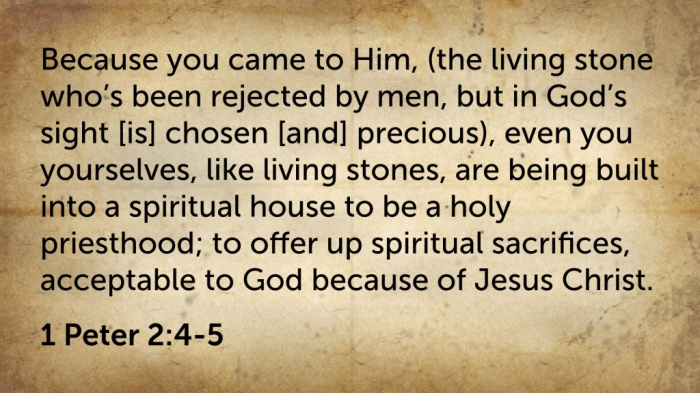
This passage today, 1 Peter 2:4-10, is all about mission and purpose. What on earth are Christians here to do? What is our mission? Peter tells us all about that today.

  • How should you think of a church? What is its mission?
  • How should you visualize the people who make up a church?
  • If you’re a Christian, why did God save you? For what purpose?
  • What does God think of you as?
  • What implications does all this have for your life, for your job, for the way you should view yourself?
  • What implications does this have for the way you should think about your position or station in life?

All this, and more, is what Peter’s message here is all about. Take a listen, and consider what all this means for your congregation, and your personal and unique role in the life of your church. More than that, consider what it means for who you are, and why God made you the person you are today.

The PDF notes for today’s lesson are here. As always, all audio files and PDF notes for all lessons are here. Unless I note otherwise, you can assume the translation from 1 Peter is mine.

Generic Parchment Reference (ES)

How to Study the Bible (Part 3)

books2Read the series so far.

I’m continuing my little series on Bible study, and I have something truly profound for you this evening. Yes, it’s true. I have something so unique, so original, so earth-shattering and so awesome that your mind may literally explode. Stop reading now, if you’re not 100% certain you’re ready . . .

I am going to tell you the true secret to Bible study. This is the most important step, but most people don’t touch it. They know about it, but they ignore it. They’d rather rely on work from other people, like pastors, theologians or Christian media personalities who generally know nothing.

What is this secret? I’ll tell you. Get ready . . .

Collect Information About the Subject You’re Studying

Yes. Amazing, isn’t it? If you want to know what the Bible really teaches about a particular topic, you collect all the information about that topic.

Say you want to learn all about what, exactly, a congregation ought to be doing. What constitutes a “church?” What building blocks need to be there for a church to actually be a church? I wrote about this briefly, in an introduction to my own study on this very topic. How do you even begin to study this?

You Start Small

The entire Bible is a bit daunting. So, start with a single author. Figure out, for example, what Luke had to say about a church. That’s much more manageable. Get a notepad, a pen, and your Bible. Start reading. Note every passage that speaks to your topic. Finish reading Luke. Rejoice.

Expand Your Scope

You finished Luke. Yay. You win a cookie.

After you finish the cookie, see what Peter had to say about a church. Then John. Then James. Then Jude. Then Paul.

At the end of the day, you have a whole mountain of data to work with. I’ll talk about how to do that in the next installment. For now, let me emphasize this – you’ll never be able to really study the Bible unless you collect and analyze the data yourself.

Don’t Assume Anything

We all have theological assumptions; a particular grid we interpret the Bible through. It’s very easy to ignore, overlook or misinterpret evidence that doesn’t fit neatly into our favored “system.”

I’m a dispensationalist. I don’t agree with a lot of the system, but I agree with the bare essentials of it. But, suppose I come across something that goes against dispensationalism. What should I do? Ignore it, because dispensationalism is always right? Or, make a note of it, because I (and the folks who taught me) could have got it wrong?

I hope you made the second choice.

Don’t be a mindless robot, blindly accepting a pre-packaged set of beliefs and interpretive grids. Most of the time, those grids are biblical, helpful and useful. But, in the finer points, there is always room for improvement and better understanding. There are different perspectives. You can be a mindless robot and ignore competing ideas, or you can keep an open mind and always be willing to let the text of Scripture correct your preconceived notions.

Do you want to believe something because you were told it’s true? Or, would you rather believe it because you looked at all the evidence yourself, and are actually convinced it’s true?

When a Biblical Author Talks About Your Topic, Pay Close Attention

Don’t build a mountain out of a passing comment or phrase that has nothing to do with the subject under discussion. In 1 John 2:2, the Apostle John mentioned that Jesus “is the expiation for our sins, and not for ours only but also for the sins of the whole world.”

Nice. That speaks to the extent of Christ’s atonement. Cool. Is that John’s point, in this book, though? Nope. It was a passing comment, a quick reference. Make a note of it, but give priority to passages that directly teach the subject you’re studying.

Which passage speaks about the church more directly; John 13:34-35 or 1 Peter 1:22 – 2:10? Yes, they both have insight about the topic, but which one speaks directly to the topic? That’s the one you should give more weight to.

What Does This Look Like?

Here is an example of some information I’ve gathered about the topic “what is a church.” I took all this from the Book of Acts, following the exact method I just explained to you. Here it is:

marks

This is just a sample; I have a LOT more information. But, you get the idea. This isn’t hard; but it takes time. It takes determination. It takes constructive thought.

Most people will never do this work. I’m not naïve. But, you can do this work. You have time. You need a pad of paper, your Bible, a pen, a few minutes a day, and some prayer. You can do this. It took me several weeks to gather all my data. It might take you less time, or more. It’ll be worth it.