Storing Up God’s Word

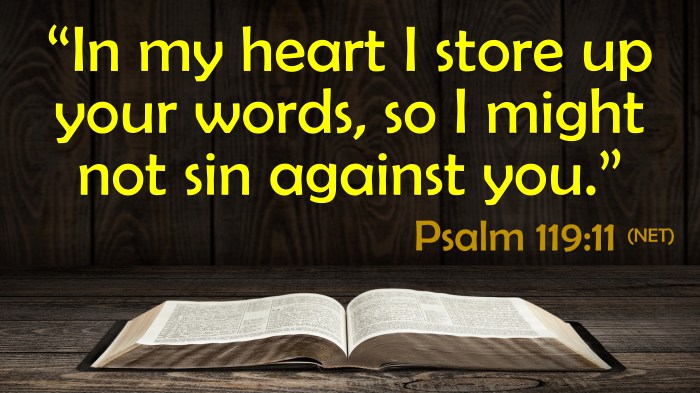
Ps 119(11)

If you don’t know what God’s word says, then you can’t use it to cleanse your life. If you can’t use God’s word to cleanse your life, then you will be unholy, impure, rebellious and disobedient to Him. The Word of God is the sword the Holy Spirit uses to fight against wickedness, evil, temptation and sin in your life (cf. Eph 6:17). If you do not read the Bible, then . . .

  • you will not grow,
  • you will not cleanse your life,
  • and you will be a disgrace to God

The psalmist is describing such a depth of familiarity with the Word of God that he can speak of it as being hidden or stored up in his heart, preventing him from sinning against God. Let me say this emphatically:

  • Many Christians have absolutely no idea what their Bibles say
  • Many Christian do not read their Bibles
  • Many Christians do not hide God’s word in their hearts
  • Many Christians live their Christian lives on the basis of a potpourri soup of sermons, anecdotes and traditions they’ve inherited – not on what the Bible actually says

All this means their conduct may or may not be governed by God’s word, and when God’s word is brought to bear clearly and accurately to settle an uncomfortable situation . . . they become upset, agitated, unsure of themselves, angry and defensive – because their potpourri soup of inherited tradition and half-remembered bad sermons is being directly challenged by God’s word – and that makes people angry!

If you don’t read God’s word and internalize it (all of His word, not just the convenient parts) . . .

  • then you won’t hide it in your heart,
  • then you won’t obey it because you don’t know what it is,
  • then you’re telling God you prefer your potpourri of tradition to His inspired word,
  • you won’t be cleansing your life,
  • you won’t be taking heed to His word,
  • and you’ll be a disgrace to Him

The psalmist understands all this – it’s why he’s saying what he’s saying. He doesn’t want to be like that. Do you?

Seeking God Day by Day

Ps 119

Many people assume that “seeking God” is something that only lost people do. That’s wrong.

Psalms 119:10 With my whole heart have I sought thee: O let me not wander from thy commandments.

Christians should always be seeking to know God better:

  • to love Him more,
  • to serve Him more faithfully,
  • to be a more willing and eager slave for His righteousness,
  • to be vessels that He can mold and shape for His own purposes

In short, it is a basic and fundamental duty for a Christian to be a slave for Christ.  This means a Christian should be continually seeking the Lord with everything he (or she) has. More than that, it means a Christian should be in prayer for the courage and conviction to not wander far from God’s word.

Do you seek God with everything you have? The psalmist isn’t interested in a passive, apathetic, convenient and lazy kind of faith – he loves the Lord and seeks Him with his whole heart. If you’re seeking Him with your whole heart, you’ll be willing to cleanse your life by taking heed according to God’s word – no matter how difficult it might be.

The excuses and lame justifications that might have held you back before should be meaningless to you now – if they’re not meaningless, your duty is to echo the psalmist’s prayer and ask God to make those excuses meaningless to you!

Obedience to the God’s word is more important than friendships, loyalties, warm fuzzy memories, and anything else in this world. If you’ve been a Christian for any length of time, you’ve come between a rock and a hard place before, and in that moment as you stood there at the fork in the road, you knew what the right thing was to do. That’s not the hard part – the hard part are the pathetic justifications and sinful “what if” scenarios that pop into your mind.

Let me urge you to adopt my patented three-step self-test questionnaire whenever you come to a fork in the road again, and you have to decide between the Bible and your own personal feelings and loyalties:

  1. Identify the problem
  2. Ask yourself – what does God’s word say to do about this problem?
  3. Ask yourself – why am I still even still conflicted about this?

You must be merciless about this, and that requires courage and determination. Some people would call this attitude “cold-blooded” and callous – I call it obedience, and so would the psalmist.

If you read God’s word, understand it, and deliberately decide to ignore it, then Christ is not Lord of your life, you are – there is no gentle way to put that!

Some Good Thoughts on English Bible Translations

NET_Banner_421x250_1395260640

Mark Ward (PhD, Bob Jones University) has some excellent thoughts on English Bible translations which go along with something I recently posted:

English speakers are looking for the wrong thing when we look for best. As I said, we need to look for useful. Does that sound too pragmatic? Let me clarify. We need to ask, “Which English Bible translation is most useful for preaching?” “Which is most useful for evangelism?” “Which is useful for reading through in a year?” “Which is conducive to close study?” How about for reading to kids? For memorization?

The average Christian has umpteen Bibles at home; we can afford, financially, to buy different editions for different purposes.

He is quite right. I love the KJV for preaching, because it is majestic, beautiful, and follows the original Greek text very closely. I am growing to love the NET for personal devotions, because it flows better in modern English, and is a bit more interpretive, especially in the Old Testament. (You can purchase the NET Bible here, or read it for free online here).

I’ll be posting more on the various English Bible translations in a few weeks. For now, feel free to read Mark Ward’s entire article here.

Cleansing Your Life

Ps 119

Psalms 119:9 Wherewithal shall a young man cleanse his way? by taking heed thereto according to thy word.

People can only be cleansed by doing what God’s word says – no matter how difficult, hard, painful or unpleasant it is. Cleansing is a perfect word to use here, because the Psalmist is asking how a believer can keep his life pure, holy, undefiled, uncorrupted and blameless before God and the other people in the congregation.

The phrase “young man” representatives the normal, average believer – it represents you, if you’re a Christian. The “cleansing” represents the activity and the work the average believer needs to be doing – identifying sin, confessing sin, forsaking sin, replacing that sin with godliness. This “cleansing” is present-tense;[1] it’s something that needs to be done continually, regularly, and often. 

You are never finished cleansing your life. Just as dirt begins to accumulate on the carpet as soon as you put your vacuum away, so sin begins to accumulate in your life the very moment you relax and let your internal guard down in your Christian life. You need to be on the lookout for sin, laziness, neglect and moral filth and corruption in your life on a regular, ongoing, present-tense and active basis.

In the first part of this verse, the psalmist asks a question (Wherewithal shall a young man cleanse his way?”), and now he gives us a very simple answer:“by taking heed thereto according to thy word.”

You keep your life morally pure by continually cleansing it according to God’s word. If you’re a Christian, then you belong to God and your life is not your own (cf. 1 Cor 6:19). This means that God cares what detergent you use, what vacuum you use, what kind of soap you use – in short, He cares about what method you use to cleanse your life. God says that you cleanse your life by doing what His word says.

If you don’t do what His word says . . .

  • then you don’t care about His word,
  • you don’t care about Him,
  • then you’d prefer to be disobedient,
  • and you’re in deliberate rebellion against Him

This is a very black and white statement. There are no shades of gray to be found (not even 50 of them . . .) There is a general trend in popular culture to avoid making absolute black and white statements, and many Christians have absorbed this Satanic tendency without even realizing it. We have become a culture of wimps, both inside the local church and outside. We like what God’s word says in the abstract, as long it doesn’t become personal – the same way we like the idea of exercise and good health, but shrink from ever actually doing anything to achieve it

However, when God’s word does become personal, when it stops being abstract and theoretical and becomes intimate and practical, this is when all the pious talk, the flowery prayers, and all the outward actions need to be translated into action.

Do you have the nerve, the courage and the commitment to actually cleanse yourself and your life by taking heed to God’s word day by day, week by week, month by month, and year by year – or is your faith nothing but hot air?

I’m deliberately calling this trend of Christian wimpiness “satanic,” because it is intentional disobedience wrapped up in a filthy cloak of pretend righteousness. It’s cowardice. It’s rebellion. It’s pathetic. It’s blasphemous. And we are all subject to this epidemic of wimpiness and fearful compromise, because we live every day in a wimpy, fearful and compromising culture!

The psalmist tells us that a Christian continually cleanses his life by doing what God’s word says. Period. This is a black and white statement, and there is nothing we can do to change this very simple precept:

  1. What’s the problem?
  2. What does God’s word say to do about this problem?
  3. Why are we still talking about this?

Anything else is nothing but excuses, self-deception, and self-delusion. If you want your personal life to be cleansed and be holy, you must take heed to do what God’s word says. The same is also true for the corporate life of a local congregation:

  1. What’s the problem?
  2. What does God’s word say to do about this problem?
  3. Why are we still talking about this?

If you love the Lord, you’ll want to honestly demonstrate that love by doing what He says. That’s not so hard to understand, is it!?

Luke 6:45-46 A good man out of the good treasure of his heart bringeth forth that which is good; and an evil man out of the evil treasure of his heart bringeth forth that which is evil: for of the abundance of the heart his mouth speaketh. And why call ye me, Lord, Lord, and do not the things which I say?


[1] At least, it’s present-tense in the LXX (κατορθώσει)!
A Better Devotional Life . . .

Let me suggest a few things to you that may bless your devotional life:

  1. Read large sections of text at one time (e.g. multiple chapters)
  2. Read through single books at a rapid pace until you finish them
  3. Read from both the Old and New Testaments
  4. Switch your Bible translation – and do it now!

Reading God’s word in a different, conservative translation opens your eyes to the text as though you’re reading it for the very first time. I recommend either NKJV, ESV, NASB, HCSB or NET.

For example, consider the difference between these two translations.

jn316

If all you’ve ever read is the KJV, then you’ve probably been conditioned by popular sentiment and well-meaning but wrong preaching to put stress on the English word “whosoever,” and think of this verse as an invitation to salvation. This is completely wrong – Jesus is simply stating a fact in this verse, not issuing an invitation to salvation[1].

The KJV rendering “whosoever” is a perfectly acceptable translation, as long as you understand what it means! William Tyndale, the great Bible translator of the 16th century, translated this as, “For God so loveth the world that he hath given his only son that none that believe in him should perish: but should have everlasting life.” The NET translation brings this out clearly, and opens your eyes to hidden treasures in God’s word that one single translation cannot possibly convey. Jesus is not issuing an invitation to salvation per se; He is stating a simple fact.

Think about switching up your Bible translation. Try out another good conservative translation and see if you are blessed by it.

[1] The phrase in question is ἵνα πᾶς ὁ πιστεύων εἰς αὐτὸν, which means “so that every person who believes in Him . . .”

Great Writing . . .

ischafp001p1I’ve been reading Philip Schaff’s 8 volume History of the Christian Church for a while now. I am constantly struck by just how good Schaff’s writing was. The words flow almost like poetry and the entire series is just a joy to read. Consider some excerpts from his section on William Farel, a pioneer of Protestantism in French Switzerland:

He hated the pope as the veritable Antichrist, the mass as idolatry, pictures and relics as heathen idols which must be destroyed like the idols of the Canaanites. Without a regular ordination, he felt himself divinely called, like a prophet of old, to break down idolatry and to clear the way for the spiritual worship of God according to his own revealed word. He was a born fighter; he came, not to bring peace, but the sword. He had to deal with priests who carried firearms and clubs under their frocks, and he fought them with the sword of the word and the spirit. Once he was fired at, but the gun burst, and, turning round, he said, “I am not afraid of your shots.” He never used violence himself, except in language. He had an indomitable will and power of endurance. Persecution and violence only stimulated him to greater exertions. His outward appearance was not prepossessing: he was small and feeble, with a pale but sunburnt face, narrow forehead, red and ill-combed beard, fiery eyes, and an expressive mouth.

Look at how Schaff introduces this remarkable man! I wish I could write like this. There is such a cadence and majesty to his words. Farel wasn’t described as a zealot; instead Schaff wrote that Ferel, “felt himself divinely called, like a prophet of old.”He was not described as fractious, but rather, “he was a born fighter; he came, not to bring peace, but the sword.” Does Schaff really have warrant to describe a man long dead as having a “red and ill-combed beard, fiery eyes and an expressive mouth!?” I’m not sure, but I love it anyway.

Farel’s work was destructive rather than constructive. He could pull down, but not build up. He was a conqueror, but not an organizer of his conquests; a man of action, not a man of letters; an intrepid preacher, not a theologian. He felt his defects, and handed his work over to the mighty genius of his younger friend Calvin. In the spirit of genuine humility and self-denial, he was willing to decrease that Calvin might increase. This is the finest trait in his character prophet of old.”

“A man of action, not a man of letters.” Indeed! Schaff says so much in such a short paragraph.

 He turned every stump and stone into a pulpit, every house, street, and market-place into a church; provoked the wrath of monks, priests, and bigoted women; was abused, called, “heretic” and, “devil,” insulted, spit upon, and more than once threatened with death. An attempt to poison him failed. Wherever he went he stirred up all the forces of the people, and made them take sides for or against the new gospel.

Ferel didn’t make people angry, Schaff wrote that he “provoked the wrath” of people! I wish history were still written this way.

He was also summoned to the Episcopal Council in the house of the Abbé de Beaumont, the vicar-general of the diocese. He was treated with insolence. “Come thou, filthy devil,” said one of the canons, “art thou baptized? Who invited you hither? Who gave you authority to preach?” Farel replied with dignity: “I have been baptized in the name of the Father, the Son, and the Holy Ghost, and am not a devil. I go about preaching Christ, who died for our sins and rose for our justification. Whoever believes in him will be saved; unbelievers will be lost. I am sent by God as a messenger of Christ, and am bound to preach him to all who will hear me. I am ready to dispute with you, and to give an account of my faith and ministry. Elijah said to King Ahab, ’It is thou, and not I, who disturbest Israel.’ So I say, it is you and yours, who trouble the world by your traditions, your human inventions, and your dissolute lives.” The priests had no intention to enter into a discussion; they knew and confessed, “If we argue, our trade is gone.” One of the canons exclaimed: “He has blasphemed; we need no further evidence; he deserves to die.” Farel replied: “Speak the words of God, and not of Caiaphas.” Hereupon the whole assembly shouted: “Away with him to the Rhone! Kill the Lutheran dog!” He was reviled, beaten, and shot at. One of the syndics interposed for his protection. He was ordered by the Episcopal Council to leave Geneva within three hours.

If you haven’t read some of Schaff’s History of the Christian Church, then you’re missing out on both some great history and great literature.

schaff books

A False Gospel?

I’ve been very busy lately, so I apologize for being scarce! I’ll be speaking about the Canon of the New Testament during the next apologetics class at my church. It is a common attack from unbelievers that many gospels were “left out” of the canon of the New Testament.orthodox_corruption

Walter Bauer’s theory was that there was no “orthodox” Christian doctrine. Rather, he argued, Christianity had no common core of beliefs, no body of faith that was passed down and eventually preserved in Scripture. Christianity was a hodgepodge of different beliefs, and what we now know as “orthodox” was merely the viewpoint which achieved dominance and crushed opposition.

In his scholarly book, The Orthodox Corruption of Scripture, Bart Ehrman applied Bauer’s theory to the discipline of textual criticism. Copies of Scripture exploded throughout the ancient world, and were copied and re-copied by these different groups, each with their own ideas of “orthodoxy.” Eventually, Ehrman argues, the very Scriptures themselves became hopelessly “corrupt” and began to reflect the various views and ideas of all the different groups.

If this is something that interests you, go to your local library and grab a copy of Ehrman’s book (or request one by Inter-Library-Loan). Read the introduction, where Ehrman lays out his thesis. It isn’t hard to understand. Anyone can read it. This is important, because Ehrman seems to be the face of liberal Christian scholarship these days. He has popularized his theories about the New Testament in a series of books, including Misquoting Jesus and Lost Christianities.

Why does this matter? Who cares? Here it is – Ehrman and other liberal scholars claim that various “heretical gospels” (he wouldn’t consider them heretical, of course – there is no Christian orthodoxy to his way of thinking, after all!) are just as valid as the canonical Gospels we see in our Bible’s today. You’ll hear references to The Gospel of Thomas, The Gospel of Peter, The Shepherd of Hermes, etc. Why were these so-called “Gospels” and other early Christian literature rejected by the corporate church as false, and Matthew, Mark, Luke and John accepted? This is what I’ll be talking about in my apologetics class.

Here is a fun little exercise. The four most important criteria for determining whether a Christian work was “canonical” or not were:

  1. The self-attestation of the Scripture to the believing reader. The reader, though the spiritual discernment given by the Holy Spirit, has a keen sense of what is Scripture and what isn’t
  2. Was the work written by an apostle, disciple or follower of Christ?
  3. Orthodoxy. Does the work conform to the corporate body of faith? Does it contradict known writings and the teaching handed down by the disciples?
  4. Catholicity. Is the work generally accepted by the Christian community at large? It can’t be accepted just in an obscure corner of the world. It must be generally recognized by Christians everywhere

Apply this test to the beginning portion of The Shepherd of Hermes. Please note – some early Christian did believe Hermes was canonical. In the end, however, it fell out of favor and was not accepted by the larger community. Leave a comment with any observations you have on why this work was not eventually accepted as canonical Scripture. Think about it. Jot a comment or two down and see what you find. Most people you’ll meet who challenge you with Hermes or other heretical documents have never actually read them. Read this excerpt from Hermes and judge for yourself . . .

Vision 1

1:1 The master, who reared me, had sold me to one Rhoda in Rome. After many years, I met her again, and began to love her as a sister.

1:2 After a certain time I saw her bathing in the river Tiber; and I gave her my hand, and led her out of the river. So, seeing her beauty, I reasoned in my heart, saying, “Happy were I, if I had such an one to wife both in beauty and in character.” I merely reflected on this and nothing more.

1:3 After a certain time, as I was journeying to Cumae, and glorifying God’s creatures for their greatness and splendor and power, as I walked I fell asleep. And a Spirit took me, and bore me away through a pathless tract, through which no man could pass: for the place was precipitous, and broken into clefts by reason of the waters. When then I had crossed the river, I came into the level country, and knelt down, and began to pray to the Lord and to confess my sins.

1:4 Now, while I prayed, the heaven was opened, and I see the lady, whom I had desired, greeting me from heaven, saying, “Good morrow, Hermas.”

1:5 And, looking at her, I said to her, “Lady, what doest thou here?” Then she answered me, “I was taken up, that I might convict thee of thy sins before the Lord.”

1:6 I said to her, “Dost thou now convict me?” “Nay, not so,” said she, “but hear the words, that I shall say to thee. God, Who dwelleth in the heavens, and created out of nothing the things which are, and increased and multiplied them for His holy Church’s sake, is wroth with thee, for that thou didst sin against me.”

1:7 I answered her and said, “Sin against thee? In what way? Did I ever speak an unseemly word unto thee? Did I not always regard thee as a goddess? Did I not always respect thee as a sister? How couldst thou falsely charge me, lady, with such villainy and uncleanness?

1:8 “Laughing she saith unto me, “The desire after evil entered into thine heart. Nay, thinkest thou not that it is an evil deed for a righteous man, if the evil desire should enter into his heart? It is indeed a sin and a great one too,” saith she; “for the righteous man entertaineth righteous purposes. While then his purposes are righteous, his repute stands steadfast in the heavens, and he finds the Lord easily propitiated in all that he does. But they that entertain evil purposes in their hearts, bring upon themselves death an captivity, especially they that claim for themselves this present work and boast in its riches, and cleave not to the good things that are to come.

1:9 Their souls shall rue it, seeing that they have no hope, but have abandoned themselves and their life. But do thou pray unto God and He shall heal thine own sins, and those of thy whole house, and of all the saints.”

What do you think?

The Birthplace of Christ

church of the nativity

Bethlehem. The bright cross shaped Church of the Nativity dominates Manger Square, the site of the birth of Jesus Christ. “The most sacred place on earth”, as St. Jerome wrote. On the right stands the Church of St. Catherine with its red-tiled roof.

– Hanan Isachar and Hedva Canetti, Images of the Holy Land (St Louis, MO: Concordia, 2004).

Something Completely Different . . .

Khobar_TowersJust because I thought a change of pace would be nice, I linked below to a peer-reviewed article I wrote for the DoD journal The Guardian back in my former life, when I was an anti-terrorism specialist in the Military Police.

The article discusses the Khobar Towers terrorist attack on an Air Force barracks in Saudi Arabia in 1996. It was a tragic event, and in many respects the birth of modern anti-terrorism (or “defensive”) standards for our armed forces.

My PDF article – Khobar Towers

If you are interested, the entire journal issue is here.