The modern city of Alasehir, where the ancient church at Philadelphia was located
This is my own translation of Revelation 3:8-12 from the Textus Receptus, plus a few changes from the UBS-5 text:
8I know your deeds. (Pay attention! I have put an opened door in front of you, and no one ever has [the] power to shut it.) I know you have a little strength, and yet you have obeyed my message and have not disowned my name.
9Pay attention! I will make those from the congregation of Satan who say they are Jews (yet they are not; rather, they are lying) . . . Pay attention! I will compel them, so that they will come and pay homage at your feet and realize that I have always loved you.
10Because you have obeyed my message about perseverance, I, in turn, will keep you from the time of the temptation which is about to come upon the whole inhabited world to put to the test those who are dwelling on the earth.
11I am going to come soon! You must keep on holding fast [to] what you have, so that no one will take your crown. 12The one who will be victorious, I will make him a pillar in the temple of my God and he will never go out again, and I will write on him the name of my God, and the name of my God’s city (that is, the New Jerusalem, which will come down from the heaven, from my God), and my new name.
My Pastor will be covering this text in his sermon this coming Sunday, so I thought I’d translate it myself for a bit of fun. My detailed translation is available here.
The NASB is famous for being very formal in it’s translation. The preface stated, “[w]hen it was felt that the word-for-word literalness was unacceptable to the modern eader, a change was made in the direction of a more current English idiom,” (iii). You can count in this translation to not be interpretive when it redners Koine Greek into English
Tyndale, KJV, ESV and the LEB are not quite as formal as the NASB, but they each stick very close to the original language. Tyndale was a linguistic genius who produced the first complete New Testament translation in English directly from Koine Greek in 1526 (revised for the last time in 1534). The KJV essentially followed Tyndale in many places. The ESV is a very popular, excellent new translation. The LEB, from Logos Bible Software, began it’s life as an interlinear.
The ISV and the NET are a bit more interpretive. The ISV’s New Testament was edited by David A. Black, a well-known teacher and author of several books on Koine Greek. The NET was produced largely by a team of scholars centered around Dallas Theological Seminary. Neither of these translations are particularly “well known,” but they’re excellent. I would put their translation philosophy in the same class as the NIV.
As far as Greek text goes, Tyndale and KJV used what would become known as the Textus Receptus. The ESV, NET, NASB and ISV used the current version of the United Bible Society critical text (UBS-4 for each, I believe). The LEB used the Society of Biblical Literature (SBL) Greek New Testament.
God Made You . . . What!?
The first issue I want to focus on is the words I translated as “made you acceptable,” (ἱκανώσαντι ὑμᾶς). What does it mean? The standard Koine Greek lexicon defines the word, in this context, as, “to cause to be adequate,” (BDAG, s.v. “3692 ἱκανόω”). Different English translations take this different ways:
“Acceptable” (Me, KJV, Tyndale)
“Qualified” (NASB, LEB, ESV, NET)
“Enabled” (ISV)
Now, the average reader has to admit that there isn’t a lot of difference between these three options. We read either one, and we get it. Paul’s point is that we are not acceptable to God. In order to give His elect eternal inheritance, salvation, redemption and forgiveness, He must first make us acceptable to Him. We cannot do this; God must do it to us. This verb is in the simple active voice, and God is performing the action. We have no part to play here. God’s chosen and called out people simply receive an action God does to them.
Each of these translations are glosses suggested by major lexicons (e.g. BDAG, Gingrich, Friberg, Danker, etc.). They each capture a different nuance or shade of meaning. They each convey subtly different meanings, but the same basic concept. When I translate from Koine Greek, I always have a Merriam-Webster dictionary and a good thesaurus at hand. I need to make sure I chose an English word which actually says what the Koine Greek meant, and I need a thesaurus to help me find synonyms to give the translation some stylistic flair, or else the whole thing will be as dry as a stale saltine cracker. Consider the nuance each translation option brings to the table:
“Acceptable/Meet”
This was my choice, and I obviously think it’s the best one. Merriam-Webster tells us that this means “capable or worthy.” This is good stuff. We’re not worthy, but God can make us worthy “according to the good pleasure of His will,” (Eph 1:5). We’re not capable of doing this; we have no capacity to right the hostility between ourselves and God, to earn His grace, mercy and forgiveness, or to stop our willful rebellion and hatred of Him. We will always be trying to “break their bands asunder, and cast away their cords from us,” (Ps 2:3). I like “acceptable.” I think it gets the point across very well.
However, the word “acceptable” can also conveys a sense of bare adequacy, not excellence. Like being told by your boss, “Well, your performance these past six months has been adequate, nothing more, nothing less.” It’s not a word that really conveys a sense of security. It’s like getting a “C-” on a final exam.
But, context is always key. The context is God making us competent and acceptable to share in the inheritance of the Kingdom of Light. God doesn’t do things half-way or merely adequately – He always does them well. He created creation and pronounced it “good!” Therefore, the word “acceptable” is an excellent choice. It gets the point across.
“Qualified”
Merriam-Webster says this means to be “fitted for a given purpose.” It’s clear that there really isn’t much difference between “acceptable” and “qualified.” In fact, I almost translated this as “made you fit.” We are not fit for salvation and we do not deserve mercy, love, grace or kindness. Yet, for a Christian, God has changed all that. He qualified us to share in the eternal inheritance in the Kingdom of Light! He made us fit, because we cannot make ourselves fit.
However, the word “qualify” can also open the door for a more synergistic view of salvation, whereby God and man cooperate in some form or fashion to achieve redemption. Somebody could interpret “qualify” to mean something like “eligible.” For example, “You’re qualified for a 30-year home mortgage with a low 25% interest rate!” Indeed, Merriam-Webster notes that a second definition for “qualified,” depending entirely on context, is, “having complied with the specific requirements or precedent conditions.” Therefore, God qualifies people to have eternal inheritance, but it is up to the individual to take advantage of God’s grace and repent and believe the Gospel. This is, in fact, what the concept of prevenient grace teaches – that as a result of Christ’s sacrificial and substitutionary death on the Cross, the Holy Spirit works on everybody’s heart, mind and will so they can either accept or reject the Gospel message.
Now, this is not what Colossians 1:12 teaches, and it is not the sense in which the word “qualified” ought to ever be taken here. After all, is it the translator’s fault if a preacher spends his time doing English word studies instead of opening his Greek New Testament!? Not at all! However, I think the potential theological landmine with the word “qualified” makes it an “acceptable” choice (see how much context matters!), but not necessarily the best choice.
“Enabled”
This is a very good word choice. After all, if somebody enables you to do something, it means that you are made able to accomplish what you could not formerly do. Merriam-Webster defines “enabled” as, “to make (someone or something) able to do or to be something.” We cannot ever gain or earn the privilege to share in the saints’ inheritance in the jurisdiction of light. We’re not acceptable to Him. We’re terrorists and criminals in God’s universe, naturally serving our father, the Devil. This is the message of the Bible. David wrote, “God looked down from heaven upon the children of men, to see if there were any that did understand, that did seek God. Every one of them is gone back: they are altogether become filthy; there is none that doeth good, no, not one,” (Ps 52:2-3). But, God has enabled Hs children to share in that inheritance.
However, the word “enabled” could also open the door for an un-Biblical and synergistic view of salvation. “God enabled us to choose, and now we decide to choose Him.” This could imply a two-step process in salvation where God and man work together. After all, God makes us able to choose Him, and the rest is up to us! This made me hesitate to use the word “enabled.”
Let me emphasize this very strongly – anybody with an agenda can take any English word or phrase and twist it completely out of context. That is not any translator’s fault. It is the reader’s fault. Most English-speaking Christians don’t know Koine Greek. They’re not going to consult BDAG, Danker, Gingrich or Friberg. Even if (heaven forbid!) an enterprising Christian has a copy of Strong’s Greek Dictionary handy, the information is next to useless if him if he does not understand how it works in the grammar and syntax of a particular sentence. This is where good English translations come in. Let me explain . . .
The Story of Diligent Christian
Pretend an average man, Diligent Christian, loves and likes the KJV. He reads Colossians 1:12 and is puzzled; God “hath made us meet to be partakers of the inheritance of the saints in light.” What on earth is “meet!?” Diligent Christian is an enterprising fellow, so he logs onto Biblegateway.comto compare different English Bible versions. He sees that many English versions use the word “qualified.” He immediately leaps to an erroneous conclusion about what the Apostle Paul meant by this statement. Diligent Christian is a member of an Arminian, independent, fundamental Baptist church with roots in the Sword of the Lord tradition. He has been conditioned by years of preaching and Bible study to interpret salvation synergistically. He sees no problem with “qualified.” By default, however, he interprets this “qualification” as prevenient grace.
But now, Diligent Christian is a bit confused. He looks at the ISV, and sees the translation “enabled.” This is a tad bit different, because it seems to have slightly more deterministic overtones. By some remarkable coincidence, he actually stumbles upon this pitiful little blog, and sees my own translation of “acceptable.” Diligent Christian is now having to grapple with the idea that God alone makes elect sinners “acceptable” to Him. We contribute nothing to this transaction.
He returns to the KJV, because that is his favored version, and decides to figure out what “meet” actually means once and for all. He reaches for his bookshelf, and pulls down Noah Webster’s 1828 American Dictionary of the English Language, which his Pastor recommended he use when he wants to figure out archaic words from the KJV. It defined “meet,” in this context, as “fit; suitable; proper; qualified; convenient; adapted, as to a use or purpose.” With this meaning firmly in mind, Diligent Christian now completely understands the sense in which “qualified” and “enabled” should be taken in these English translations. Indeed, he even browsed Merriam-Webster and found that this is still a valid use for the word “meet” (as an adjective) even today.
Now, Diligent Christian leans back in his chair, sips his coffee, and ponders the mercy and love of an infinite God who would qualify criminal sinners, enable them to be partakers of such a marvelous inheritance and make them acceptable and fit to be His servants. He is particularly happy to have so many good English translations to help him interpret the Scriptures!
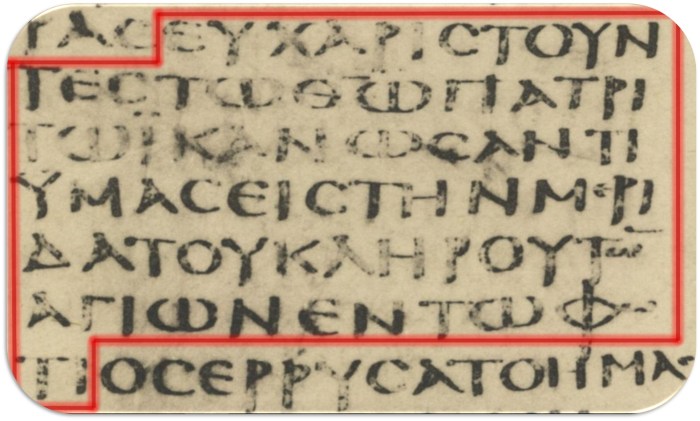
The portion of Codex Sinaiticus containing Colossians 1:12-20
The Book of Jude is taking far too long, so I took a bit of a break and translated Colossians 1:12-20. This precious passage includes a very early hymn about Jesus Christ (vv.15-20). This doesn’t mean the passage was literally sung aloud in worship services by early Christians; it just means that they put theological truth into lyrical prose as a memory aid.
I’m going to use this passage to demonstrate why Christians should consider switching their devotional translation every once in a while to get a different . . .flavor when they read their Bibles.
I’ll delve into the details next time, but for now, I’ll just give you my own translation. First, a disclaimer – I am not a Greek scholar. My Koine Greek is probably best described as “workman-like,” and representative of a Pastor who has had a few years of Seminary-level Greek training and uses Koine Greek on a regular basis.
Here is my translation:
12Giving thanks to the Father, who made you acceptable to share in the saints’ inheritance in the light, 13who rescued us from the jurisdiction of the darkness and transferred us to the kingdom of His beloved Son, 14in whom we now have the redemption, that is, the forgiveness of sins.
15He is the exact likeness of the invisible God, the favored heir over all creation, 16because by Him everything was created in the heavens and on the earth, visible and invisible, whether thrones, dominions, rulers or authorities. Everything has been created by Him and for Him, 17because He Himself is earlier than everything and everything always holds together because of Him.
18Also, He is the head of the body; that is, of the congregation. He is the Ruler, the first-born from the dead so that He alone will always have first place in everything, 19because the Father is always pleased for all the fullness to reside in Christ, 20and through Him to reconcile everything to Himself. Christ made peace by the blood of His cross, through Himself – whether on the earth or in the heavens.
My detailed translation, complete with information on how and why I classified and translated voice, tense, mood, prepositions, participles, infinitives, etc. the way I did is available here.
We’ll compare English Bible versions and make some observations next time!
The first chapter of the Book of Esther sets the stage for the rest of the account. It tells us why she even became the Queen of the Persian Empire in the first place. More specifically, it tells a bit about her charming husband, Ahasuerus (other translations usually call him Xerxes). He was not a good man! But first, the text:
Now it came to pass in the days of Ahasuerus, (this is Ahasuerus which reigned, from India even unto Ethiopia, over an hundred and seven and twenty provinces:) That in those days, when the king Ahasuerus sat on the throne of his kingdom, which was in Shushan the palace (Esther 1:1-2).
The Persian Empire which Ahasureus inherited from his father was very large. It stretched from India to the northern Sudan in Africa (e.g. “Ethiopia”).[1]
Map from: Jesse Hurlbut, Historical Geography of the Bible (Chicago, IL: Rand, McNalley & Co., 1887). It’s an old map, sure, but it’s in the public domain . . . !
King Ahasureus reigned from 486 – 485 B.C. Jews had been deported to Babylon in the early 590s, and in 586 B.C. This meant that Jews had been living in exile in Babylon for about 100 years by this point; 4-5 generations is a long time to develop deep roots!
In the third year of his reign, he made a feast unto all his princes and his servants; the power of Persia and Media, the nobles and princes of the provinces, being before him: When he shewed the riches of his glorious kingdom and the honour of his excellent majesty many days, even an hundred and fourscore days (Esther 1:3-4).
We just read that King Ahasuerus had a feast for six whole months! This event involved princes, servants,senior military officials (“the power of Media and Persia”) and civil administrators and leaders. What in the world was going on here?
Secular history tells us that this was a massive military planning session.[2] King Ahasuerus’ father had planned a military expedition against the Greeks, but died before he could pull it off – Ahasuerus wanted to finish what his father had started. This wasn’t a six-month long party – it was a strategy and planning session with his civil and military leaders from all over his massive empire.[3]
It was intentionally lavish (“he showed the riches . . .”) to impress the subordinates from all the far-flung corners of his empire. He needed their troops, their money, and their support to make his proposed military campaign happen.[4] The idea was to cumulatively overawe his subordinates with his riches, wealth and power as this planning session went on. They would be influenced to believe:
“The King is strong!”
“The empire is mighty!”
“This plan could work!”
“I’ll do my part to raise troops, provide funds, and support this endeavor!”
King Ahasuerus spent four years preparing for this campaign. He started immediately when he assumed the throne, three years before the events in the first chapter of Esther.[5] He had this massive planning session to declare his intentions and awe his military and civilian officials into supporting the plan. They actually set out about one year after this event. Esther didn’t become queen until he returned from the expedition – there is a large, multi-year gap between Esther 1 and 2.
Here was his military plan:
(1) Gather an army
(2) March overland to the Strait of Dardenelles (Hellespont)
Map showing approximate position of Ahasuerus and his first objective, the Strait of the Dardenelles
(3) Have his engineers erect a bridge across a suitable portion of the Strait
The approximate position where King Ahasuerus crossed the Strait with his army
(4) March his army across and attack and conquer Greece and burn Athens to the ground
My crude rendering of King Ahasuerus’ proposed route of advance into Greecian territory once he crossed the Strait
(6) Have his Navy protect the bridge from the Greek Navy during the campaign and destroy the Greek Navy, as well
So, what kind of guy was King Ahasuerus? He was a petty, cruel, altogether worthless man. Here are some examples:
His uncle advised against this adventure, reasoning that if the Greek Navy managed to destroy the bridge, Ahasuerus and his army would be cut off from home and destroyed piecemeal by the Greek army.[6] Ahasuerus called his uncle a “faint-hearted coward” and ordered him to stay home with the women while he marched forth to battle![7]
Engineers were sent ahead to build the bridge as the army marched onward. When his army finally reached the bridge, a great storm destroyed it! Ahasuerus was so furious, he ordered the water lashed in punishment, rebuking the waves for destroying the bridge![8] Even more disturbing, Ahasuerus had the construction supervisors decapitated[9]
A trusted elderly servant, accompanying the expedition, had second thoughts about going on. He asked Ahasuerus if he could take his eldest son and return home, leaving his four other sons to continue onward with the expedition.[10] Ahasuerus was furious, told the servant “no,” had the eldest son killed, cut in half, and placed on either side of the road for the army to march past.[11] He then made the servant continue on with the expedition, for good measure!
I say all that to say this – King Ahasuerus was not a kind, godly or nice man!
We’ll examine what happened one particular evening at this feast next time . . .
[1] “Xerxes was known for his consolidation of the Persian empire ‘from India to Cush,’ corresponding to the regions of modern Pakistan and northern Sudan, respectively,” (Karen H. Jobes, Esther, NIV Application Commentary [Grand Rapids, MI: Zondervan, 1998; reprint, Kindle ed., 2011], KL 960-961).
[2] Herodotus wrote, “After the conquest of Egypt, intending now to take in hand the expedition against Athens, Xerxes held a special assembly of the noblest among the Persians, so he could learn their opinions and declare his will before them all,” (The Histories 7.8, trans. A. D. Godley [Cambridge, MA: Harvard University Press, 1920]. Retrieved from http://goo.gl/eafshR).
[3] Joyce Baldwin suggests that the six-month length may be intentional irony on the part of the anonymous author of Esther: “The banquet then was the culmination of the festivities. Many would consider even seven days too long a time for such a carousal, but the intention is to conjure up an impression (not without irony) of the unlimited resources of the king . . .” (Esther, vol. 12, TOTC [Downers Grove, IL: InterVarsity Press, 1984], 57).
[4] Jobes commented, “Xerxes was mustering the nobles, officials, military leaders, princes, and governors of the provinces in Susa to rally support for his military campaign against the Greeks. The vast expanse of the Persian empire, from modern Pakistan in the east to modern Turkey in the west, encompassed many people groups with different languages, ethnic origins, and religions. Maintaining their support and loyalty over such a diverse and far-flung empire was no small feat. During the 180 days of the council, Xerxes displayed his wealth and glory to consolidate the leaders of the many provinces of the empire under his authority and to gain their loyalty to his cause,” (Esther, KL 990-995).
[5] “For full four years after the conquest of Egypt he was equipping his force and preparing all that was needed for it; before the fifth year was completed, he set forth on his march with the might of a great multitude.,” (Histories 7.20). The four-year preparation ran from 486-482 B.C. The planning session outlined in Esther 1 took place “in the third year of his reign” (Est 1:3) which was 483 B.C.
[6] “Suppose they do not succeed in both ways; but if they attack with their ships and prevail in a sea-fight, and then sail to the Hellespont and destroy your bridge, that, O king, is the hour of peril,” (Histories 7.10).
[7] “Thus spoke Artabanus. Xerxes answered angrily, ‘Artabanus, you are my father’s brother; that will save you from receiving the fitting reward of foolish words. But for your cowardly lack of spirit I lay upon you this disgrace, that you will not go with me and my army against Hellas, but will stay here with the women; I myself will accomplish all that I have said, with no help from you,” (Histories 7.11).
[8] “When Xerxes heard of this, he was very angry and commanded that the Hellespont be whipped with three hundred lashes, and a pair of fetters be thrown into the sea. I have even heard that he sent branders with them to brand the Hellespont. He commanded them while they whipped to utter words outlandish and presumptuous, ‘Bitter water, our master thus punishes you, because you did him wrong though he had done you none. Xerxes the king will pass over you, whether you want it or not; in accordance with justice no one offers you sacrifice, for you are a turbid and briny river,’” (Histories 7.35).
[9] “He commanded that the sea receive these punishments and that the overseers of the bridge over the Hellespont be beheaded. So this was done by those who were appointed to the thankless honor, and new engineers set about making the bridges,” (Histories 7.35-36).
[10] “‘Master, I have a favor to ask that I desire of you, easy for you to grant and precious for me to receive.’ Xerxes supposed that Pythius would demand anything rather than what he did ask and answered that he would grant the request, bidding him declare what he desired. When Pythius heard this, he took courage and said: ‘Master, I have five sons, and all of them are constrained to march with you against Hellas. I pray you, O king, take pity on me in my advanced age, and release one of my sons, the eldest, from service, so that he may take care of me and of my possessions; take the four others with you, and may you return back with all your plans accomplished,’” (Histories 7.38).
[11] “‘Villain, you see me marching against Hellas myself, and taking with me my sons and brothers and relations and friends; do you, my slave, who should have followed me with all your household and your very wife, speak to me of your son? Be well assured of this, that a man’s spirit dwells in his ears; when it hears good words it fills the whole body with delight, but when it hears the opposite it swells with anger. When you did me good service and promised more, you will never boast that you outdid your king in the matter of benefits; and now that you have turned aside to the way of shamelessness, you will receive a lesser requital than you merit. You and four of your sons are saved by your hospitality; but you shall be punished by the life of that one you most desire to keep.’ With that reply, he immediately ordered those who were assigned to do these things to find the eldest of Pythius sons and cut him in half, then to set one half of his body on the right side of the road and the other on the left, so that the army would pass between them,” (Histories 7.39).
A good friend of mine recently shared a Bible passage which encouraged him. It spoke about the deity of Christ. This is the passage in the KJV:
“And without controversy great is the mystery of godliness: God was manifest in the flesh, justified in the Spirit, seen of angels, preached unto the Gentiles, believed on in the world, received up into glory,” (1 Tim 3:16)
It is obvious that the text says that God was manifest in the flesh, and the context is clearly speaking about Jesus Christ. Good stuff. I like it. But, why does another version read completely differently? Here is the ESV:
“Great indeed, we confess, is the mystery of godliness: He was manifested in the flesh, vindicated by the Spirit, seen by angels, proclaimed among the nations, believed on in the world, taken up in glory,” (1 Tim 3:16)
You can see that, instead of God, we have the word He. In fact, every modern English translation reads He instead of God. Is this some kind of sinister plot? Not at all! It depends which Greek text your English translation is based on. The KJV and the NKJV are based on the Textus Receptus. Every single other major, modern English translation is based on the critical Greek text – the latest editions of which are the NA-28 and the UBS-5.
Regarding the mysterious case of God vs. He in 1 Timothy 3:16, it is obvious that “He” is the original reading. Let me show you an example from the earliest manuscript which contains both options – Codex Sinaiticus (ca. 4th century):
The portion of the text I highlighted reads who. This is obviously what the manuscript originally read, because it’s written in line with the rest of the text. In modern English translations, they clean this up a bit by supplying the implied antecedent “He.” But, did you notice what was scribbled in smaller print just above it?
The normal scribal abbreviation for Godis scribbled above the original who. It looks just like something we’ve all done when writing with pen – we scribble an addition to a previously written text above the original.
What’s truly fascinating is what people did to the other earliest manuscripts for 1 Timothy 3:16. In a manuscript from the 5th century (A), somebody did exactly the same thing – they scribbled “God” above the original “who.” In yet another manuscript from the 5th century (C), you see precisely the same thing again. In another 5th century manuscript (D), the text reads “which,” and a later hand scribbled in “God” above the line there, too.
It is very clear that the original reading of 1 Timothy 3:16 is “who” (i.e. “He”), and not “God.” Somebody scribbled “God” into the manuscript at a later date. Now, I agree that Jesus certainly is God, but the text doesn’t say that here.
I’m finished with my rough translation and about 50% of my detailed grammar work for my own translation of the Book of Jude. I still have to (1) classify all the accusatives and datives, (2) re-evaluate my translation of the tense, voice and mood, (3) look over pronouns again, and then (4) look at the textual critical issues. I’m using the TR for my base translation, and there are several areas where it differs from the UBS-5. This will make a difference if, for instance, you compare the NKJV to the ESV.
It is fascinating to see how the different conservative English translations offer different, but legitimate, takes on how to translate the text. This is precisely why the English reader would do well to switch his primary devotional translation for a change of pace. This is also precisely why I decided to translate the Book of Jude for myself, so I could point these issues out.
Here is a teaser issue . . . compare Jude 20-21a:
KJV: “But ye, beloved, building up yourselves on your most holy faith, praying in the Holy Ghost, Keep yourselves in the love of God . . .”
NASB: “But you, beloved, building yourselves up on your most holy faith, praying in the Holy Spirit, keep yourselves in the love of God . . .”
NET: “But you, dear friends, by building yourselves up in your most holy faith, by praying in the Holy Spirit, maintain yourselves in the love of God . . .”
Me: “But you, beloved, by building yourselves up in your most holy faith, by praying in the Holy Spirit, keep yourselves in the love of God . . .”
What is Jude communicating here? There are two clear options:
Is he telling them how to keep themselves in the love of God? Is he telling them what to be doing and also how to do it? Is he saying that we keep ourselves in the love of God (1) by building ourselves up in our faith and (2) by praying in the Spirit?
Or, is he simply describing two complementary actions they ought to be taking (i.e. building themselves up and praying) while they are keeping themselves in the love of God? Is this statement really just a descriptive aside before the command to “keep themselves” in Jude 21?
This whole issue hangs on the preposition ἐν. Most translations (e.g. KJV, NKJV, Tyndale, ISV and NASB) see this preposition expressing association, and just use the word “in,” as if the these are merely two complementary actions that accompany the command to “keep themselves.” The NET and the Lexham English Bible, however, understand the preposition to be describing the means by which the first action is achieved. Thus, Jude is telling them that they keep themselves in the love of God by means of (1) building themselves up in their faith and (2) praying in the Spirit.
What difference does this make? Here is a paraphrase of the two options:
Option #1: “But you, dear ones, as you build yourselves up in the most holy faith and pray in the Spirit, keep yourselves in the love of God . . .”
Option #2: “But you, dear ones, by building yourselves up in the most holy faith and by praying in the Spirit, keep yourselves in the love of God . . .”
I go with the second option, because I believe the context makes more sense that way. Otherwise, you just have a vague imperative command to do something, and no earthly idea how to achieve it.
But, what’s the “right” answer? How should it really be translated? The interesting thing is that there really isn’t a definitive answer. Both translations are plausible and even probable. In fact, only two English translations even agree with my own translation – most disagree. I could say more, but you get the point!
We are blessed in the English-speaking world with a wealth of wonderful translations. We should start making more use of them!
The Psalms are a collections of songs, written by different people over many, many years. The Psalms have always been treasured because they express the most basic and fundamental human emotions in poetic form – they give voice to what so many of us experience in our lives. If you’ve ever had a favorite song on the radio that expresses emotions, fears, anxieties and values that particularly resonate with you, then you’ll understand why the Book of Psalms is such an important part of the Bible. These psalms do the very same thing, but from a spiritual perspective – which makes them much more valuable than the catchy song on the radio!
Psalm 51 has always had a treasured place in Christian’s hearts, because every Christian can see himself in David’s words. We can transport ourselves into David’s world, understand his fears, feel his anxieties and experience the aching shame of regret for our sin. This is the value of the psalms – they express the timelessness of human emotions towards God. It doesn’t matter when the Psalm was written; it conveys feelings and attitudes that are universal. Time does not and cannot render these emotions obsolete.
In this Psalm, King David is begging God for mercy:
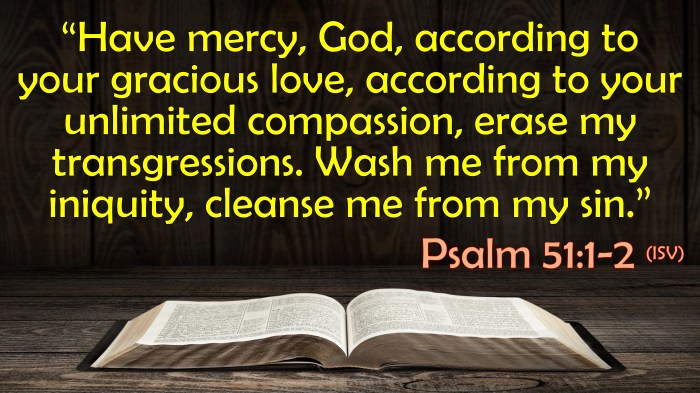
Have mercy upon me, O God, according to thy lovingkindness: according unto the multitude of thy tender mercies blot out my transgressions (Psalm 51:1)
Why is David asking for mercy?
He realizes that he has done something wrong, something wicked, something that God is not pleased with, something that is disgraceful to the Lord. Only somebody who belongs to the Lord by repentance and faith in Christ will actually feel ashamed of their conduct and beg for mercy.
There is none that understandeth, there is none that seeketh after God (Romans 3:11)
Now, this isn’t to say that unbelievers will never feel sorry for foolish and sinful things they do. What I mean is that it is impossible for unbelievers to feel a sense of accountability to the Lord, and a corresponding sense of shame and sorrow for their failure to serve Him. This is why the Apostle Paul warned us that, in our natural state as lost and rebellious sinners (cf. Romans 3:9-18):
There is nobody who is righteous
There is nobody who seeks God
Everybody is inherently worthless to God
There is no fear of God before anybody’s eyes
So, it’s important to realize that the only reason why David is even begging God for mercy in the first place is because he is a believer – and he therefore feels a profound and deep sense of sorrow and shame for his sins, so he begs God for mercy. Mercy is when God decides to withhold punishment that you deserve – this is what David is begging for.
What grounds does David have to ask God for mercy in the first place?
There two – (1) God’s lovingkindness and (2) the multitude of His tender mercies.
David can ask for mercy because he believes in God’s promise of the coming Savior – Jesus Christ. From our perspective, Jesus has already come, lived a perfect life for our sake, been tortured and executed for our sake, and rose miraculously from the dead to prove His jurisdiction, power and authority over Satan. From David’s perspective , this is all future – and he believes that God will do it. Know this – the only basis you have for begging God for mercy in the first place is if you have obeyed Jesus’ command to repent and believe the Gospel.
David is a believer in the future Messiah, Jesus Christ, and therefore has a right to lay claim to God’s lovingkindness and His tender mercy.
What does David ask God to do once mercy is granted?
He asks God to “blot out” out his transgressions because of the multitude of God’s “tender mercies.” If you belong to the Lord by repentance and faith in Jesus Christ, then you have a perfect forgiveness and perfect assurance of forgiveness. Only a saved person can pray this kind of prayer.
Wash me throughly from mine iniquity, and cleanse me from my sin (Psalm 51:2).
I can’t think of a more beautiful metaphor for the kind of forgiveness and mercy God shows to His adopted children. David speaks of a complete washing and cleansing from all sin, and the clear conscience that comes from knowing you’ve actually been forgiven.
If we confess our sins, he is faithful and just to forgive us our sins, and to cleanse us from all unrighteousness (1 John 1:9).
This is all present-tense, and this is the kind of forgiveness and mercy that David believes in and looks forward to – and asks God for. What Christian cannot read David’s words and reflect on his own life, his own moral failures, his own unworthiness and his own need for forgiveness, redemption, reconciliation and adoption into God’s family by Jesus Christ!?
What in the world does the Book of Esther have to teach the modern Christian? I believe there are three primary things we can learn from this wonderful book.
#1 – God uses imperfect people to do important things, even if they don’t realize it
He used the Assyrians to punish the Northern Kingdom. He used the Babylonians to punish the Southern Kingdom. He used a Medo-Persian King, Cyrus, to destroy the Babylonians, even going so far as to call Cyrus “his anointed” (Isa 45:1). He used Cyrus to send a huge wave of exiles back to Israel.
More specifically, He used secular, probably unbelieving Jews like Esther and Mordecai to save the Jewish people from genocide at Haman’s hands. They weren’t “good,” pious and faithful Jews like Daniel, Ezra or Nehemiah. The name of the one, true God isn’t even mentioned in the book by anyone, certainly not Esther or Mordecai – do you know why?
It’s because they were secularists who weren’t very worried about God, His covenant promises, or obedience to Him.[1] If they were, they’d be in Jerusalem helping to put the community back together with their fellow Jews! But . . . God used them anyway. God uses all kinds of people – even sinful and disobedient ones.
#2 – God keeps His promises
This book is about how God protected the Jewish people from certain destruction. Satan had been trying to destroy the Israelites, by any means necessary, for a very long time. If Satan had succeeded, Christ wouldn’t have come.[2] After all, Haman’s edict of genocide included all the Jews in Jerusalem, too!
#3 – God is in charge of this world
Behind all the free and admittedly un-Godly actions of Esther, Mordecai, King Ahasareus and Haman . . . God was working and was in charge of what was happening. I’ll elaborate on this more as we begin our study of the text itself next time!
[1] Whitcomb wrote, “Why, then, were God’s name and all the theocratic ideas obviously and meticulously avoided throughout the book? It was not because God’s presence was vague or uncertain. Nor was it because thousands of Gentiles died at the hands of Jews. Nor was it even because the Jewish hero and heroine of the book were probably unregenerate. The true reason is that Mordecai, Esther, and the Jews of Susa not only were outside of the promised land but, moreover, were not even concerned about God’s theocratic program centered in that land,” (Esther, 25-26).
[2] “It must not be forgotten that if Haman’s plot had succeeded, not only Jews in Susa but also the theocratic community in Jerusalem would have been wiped out. As Jacob Hoschander observed, no Purim would have meant no Israel, which would mean no Christianity,” (Whitcomb, Esther, 25).
William Tyndale hard at work on his English translation of the New Testament
I’ve begun translating the Book of Jude over the past week or so. I’m doing this for three reasons:
Jude is a really short and managable book,
I want an excuse to use and improve my Koine Greek, and
I want to use my study as an opportunity to discuss why Christians should switch their primary English Bible translation for something a bit different
I’ll be comparing my own translation with a couple of others, most likely William Tyndale’s 1526, the KJV, NASB, ESV, ISV and the NET. My translation won’t be very good, and certainly won’t be the best English in the world. I’m not doing this so I can win any Koine Greek awards or stylistic points. Instead, this is a great opportunity to point out why using different English translations can give you an extra glimpse or insight into the Biblical text that one single translation simply cannot do. For instance:
Is Jude the servant or slave of Jesus Christ?
Is he the brother of James or Jacob?
Did Jude write to Christians who are beloved by God, or to those who have been made holy and sanctified by Him?
Depending on which English translation you read, each of these questions will be answered completely differently – and that’s just from the first half of verse 1!
Looking forward to talking about this in the next few weeks . . . once I finish translating Jude!
If you don’t know what God’s word says, then you can’t use it to cleanse your life. If you can’t use God’s word to cleanse your life, then you will be unholy, impure, rebellious and disobedient to Him. The Word of God is the sword the Holy Spirit uses to fight against wickedness, evil, temptation and sin in your life (cf. Eph 6:17). If you do not read the Bible, then . . .
you will not grow,
you will not cleanse your life,
and you will be a disgrace to God
The psalmist is describing such a depth of familiarity with the Word of God that he can speak of it as being hidden or stored up in his heart, preventing him from sinning against God. Let me say this emphatically:
Many Christians have absolutely no idea what their Bibles say
Many Christian do not read their Bibles
Many Christians do not hide God’s word in their hearts
Many Christians live their Christian lives on the basis of a potpourri soup of sermons, anecdotes and traditions they’ve inherited – not on what the Bible actually says
All this means their conduct may or may not be governed by God’s word, and when God’s word is brought to bear clearly and accurately to settle an uncomfortable situation . . . they become upset, agitated, unsure of themselves, angry and defensive – because their potpourri soup of inherited tradition and half-remembered bad sermons is being directly challenged by God’s word – and that makes people angry!
If you don’t read God’s word and internalize it (all of His word, not just the convenient parts) . . .
then you won’t hide it in your heart,
then you won’t obey it because you don’t know what it is,
then you’re telling God you prefer your potpourri of tradition to His inspired word,
you won’t be cleansing your life,
you won’t be taking heed to His word,
and you’ll be a disgrace to Him
The psalmist understands all this – it’s why he’s saying what he’s saying. He doesn’t want to be like that. Do you?