The Septuagint (“LXX”) is the Greek translation of the Old Testament, dating to sometime in the mid to early 2nd century B.C. It came about because many Jews living abroad, particularly in Egypt, had lost much of their ability to read and speak Hebrew. They need a translation of the Tanakh (the Hebrew Scriptures) in their own language. The Mediterranean culture was heavily influenced by Hellenism at this time; a legacy of Alexander the Great’s conquests. So, the Hebrew Scriptures were translated into Greek.
This Greek version of the Tanakh was the version Jesus and the apostles used. The majority (but not all) of their Old Testament citations are from the Septuagint. This means the Septuagint is important.
I’m preaching from Zechariah 12:1 – 13:1 next week, as our congregation celebrates the Lord’s Supper. This passage contains the famous prophesy about the Israelites looking to Jesus, whom they pierced (Zech 12:10). This “piercing” clearly refers to Jesus’ death, and echoes an earlier prophet, Isaiah (“but He was pierced for our transgressions; He was crushed for our iniquities …” Isa 53:5).
But, there’s an interesting problem. The LXX is different from the Hebrew!
One of these is not like the other
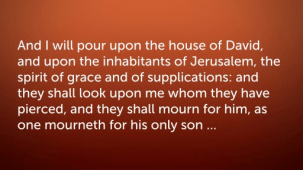
Here is the difference between the two:
To be sure, there are a lot of similarities. Both have a transition statement (“and”) to let the reader know a new, related subject is coming. Both have Yahweh declaring that He’ll “pour out” onto David’s house and those who are living in Jerusalem a spirit characterized by grace and mercy. These are things that describe this spirit; it’s merciful and full of grace.
But, here is the difference. The Hebrew clearly has a reference to someone whom the Israelites pierced. They’ll look at Yahweh, who they pierced, and they’ll be ashamed. This isn’t in dispute. Look at some other English translations:
KJV: “they shall look upon me whom they have pierced …”
RSV: “when they look on Him whom they have pierced …”
NASB: “they will look on me whom they have pierced …”
NET: “they will look to me, the one they have pierced …”
NIV: “they will look on me, the one they have pierced …”
NKJV: “they will look on me whom they have pierced …”
NLT: “they will look on me whom they have pierced …”
What does the LXX say? It says this:
Then they’ll stare fixedly at me, dumbfounded, because they treated me with hate.
The “look upon” part is still there; I just translated it in a more colloquial fashion (“stare fixedly at me, dumbfounded”). It’s the second part that’s different. The LXX says the Israelites will be astonished because they treated Yahweh with so much hate. How did they do this? Well, presumably, they treated Him with hate (or, despitefully) by rejecting Him for so long … until they didn’t.
The rest of the verse clarifies:
And they’ll grieve for Him, crying as for a loved one. And they’ll be in terrible, painful anguish, like for a firstborn son.
Because they treated Yahweh with so much hate, they’ll grieve for Him. You could translate the pronoun as it, but only if you believe the antecedent is an impersonal object, like the hateful treatment. But, if that were the case, the rest of the verse wouldn’t make too much sense. How can you mourn and grieve for an impersonal object like you would for a loved one, or even a firstborn son? The New English Translation of the Septuagint agrees, and so did Brenton’s translation. The Lexham English Septuagint, however, goes with “it,” but this deliberately a very literal translation.
The best way to understand this is as a third-person, personal pronoun (Him). But, who? Yahweh is talking in the first-person about Himself, but then shifts to third-person and says the Israelites will mourn for Him. This person is Jesus, who the Jews will turn to in the last days when the Spirit is poured out upon them, to convert them to the New Covenant.
Why the change?
The Greek text was clearly changed. The translators messed with it. The Hebrew reads “pierced,” and the Jews who did the translation altered it on purpose. They changed it to read “because they treated me with hate.” Why did they do it?
Maybe because they didn’t like what it said. How can someone “pierce” God? How does that even work? So, they changed it.
But do we know they being malicious? Not really! Perhaps it was more convenient to take this “piercing” in a more figurative sense. You know that feeling you get when someone you care about betrays you in an awful fashion? Isn’t it like having a stake driven right through your heart? Perhaps God felt that way when the Israelites hated Him, so this “piercing” was more metaphorical and poetic. In a colloquial way, the Israelites “cut God really deep” with their actions. Maybe that’s how they justified the change.
“Here, now,” they might have thought, “this is getting to the idea of being treated with malice and hate, so let’s just spell it out plainly, and drop the ‘piercing’ imagery!”
In a parallel way, the NET did a similar thing when it rendered Deuteronomy 10:16. See a comparison:
NET:Therefore, cleanse your heart and stop being so stubborn!
ESV:Circumcise therefore the foreskin of your heart, and be no longer stubborn.
The more literal rendering is to “circumcise” your heart. The NET decided that was too literal, and tried to get to the heart of the phrase by dropping the figurative imagery. That’s not necessarily a problem … unless you’re wrong about what that figurative imagery means!
In this case, assuming I’m right about why the LXX translators changed it, they were certainly wrong about what the imagery meant. It wasn’t imagery at all; Jesus literally was pierced (i.e. died).
Am I right about the reason for the change? I’ve no idea. Nobody knows why it was changed, so I might as well speculate right along with the commentators. Their guess is as good as mine. When a good textual critical commentary on the LXX of Zechariah comes out, then maybe we’ll have a more informed opinion! After all, there is no monolithic “one Septuagint.” There are many versions of the Septuagint floating around!
Bottom line
The LXX is neat. The LXX is helpful. The LXX is necessary. If you’re a pastor, and you took two years of Greek, you can muddle your way through the LXX. If you took more than the two years of Greek, you can stumble your way through it, like I do.
The LXX of Zechariah 12:10 is different, but it still conveys the same essential meaning. There are two people in the verse; Yahweh and the Person the Israelites will mourn for when they come to faith. This verse is a small snapshot of our triune God.
The sermon audio is below. Actually, this is a Sunday School lesson. But, the title has been published, so I can’t change it now!
The Book of Zechariah is a neglected book. At 14 chapters, it’s the longest of the so-called Minor Prophets. It’s an obscure book, tucked away in an even more obscure part of the Christian Bible – that wasteland after the Book of Daniel, before the New Testament.
And yet …
This book has perhaps more direct prophesies per column inch about the coming Messiah than any other book in the Bible. It promises a glorious future for the distressed Israelites, a new and better leader who’ll rule over the world in peace and righteousness, promises a new and better covenant, a new and better High Priest, and vows that Israel will be ashamed for betraying and rejecting her Savior. It’s a thrilling book, and a close reading (with a good commentary even closer at hand) will encourage even the most cynical Christian.
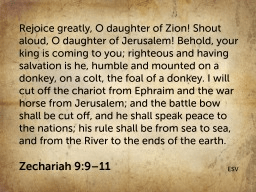
This is also the book which prophesies how the Messiah will reveal Himself to the world as King. That prophesy is found in Zechariah 9:9-11 (and following), and it’s what I taught about this morning. It’s a prophesy which bookmarks the start of God’s fulfillment of everything He’s promised to His people, ever since the Garden of Eden.
Is the prophet Micah referring to Mary (Jesus’ mother in the incarnation), or to Israel? Here is the text (Micah 5:1-4):
1 Now you are walled about with a wall;
siege is laid against us;
with a rod they strike upon the cheek
the ruler of Israel.
2 But you, O Bethlehem Ephrathah,
who are little to be among the clans of Judah,
from you shall come forth for me
one who is to be ruler in Israel,
whose origin is from of old,
from ancient days.
3 Therefore he shall give them up until the time when she who is in travail has brought forth;
then the rest of his brethren shall return
to the people of Israel.
4 And he shall stand and feed his flock in the strength of the LORD,
in the majesty of the name of the LORD his God.
And they shall dwell secure, for now he shall be great
to the ends of the earth.
A very brief survey of the text
Micah has circled back from encouragement to dire warnings. The time will come when Jerusalem will be surrounded, besieged, and its king abused. The bit about the “king” is likely a prophetic prediction of Zedekiah’s fate (2 Kings 25:1-7), although Christ could be in view, too. The perpetrators are the Babylonians.
But, in contrast to this gloomy future, the time will come when God will raise up a true king for Himself. This king will come from the little town of Bethlehem, a small city in Judah. The Jews understood this was a Messianic prophesy (see Matthew 2:1-6). This ruler will “come forth from me,” meaning He will be uniquely sent from God. This man’s origin is from the distant past, from ancient days. Whoever He is, He isn’t an ordinary ruler.
Therefore, God will give the Israelites up until this time comes. He’ll abandon them to their enemies, to suffer the covenant curses He warned them about in the wilderness (see Deuteronomy 28-29).
Who is it?
So . . . who is the woman who is in travail, who will bring forth this ruler? Is it a prophesy of Mary, the favored Jewish girl whom God chose to bear His incarnate Son? Or, is Micah referring to Israel as a woman who “brings forth” Jesus?
I originally wrote this article for SharperIron.org. Reprinted with permission.
This is a sad little story, because we see sad little men rejecting their great God and Savior, Jesus Christ. They have made void the word of God through their tradition (cf. Mk 7:13). In the Gospel of Mark, Jesus’ early confrontations with the Pharisees come quickly, one after the other. This particular account is where the water boils over.
Mounting Opposition
First, they questioned why Jesus shares a meal with such “worldly” and “disreputable” people (2:15-17). They don’t ask Jesus; they ask His disciples (Mk 2:16). We’re not sure why the Pharisees don’t approach Jesus directly. But we can guess, knowing ourselves, that they’re a bit tentative and unsure of themselves. Perhaps, they thought, it’ll be better to take the indirect route and cast doubt on His credentials to His followers.
Jesus, ever the polite diplomat, answers immediately with a burst of sarcasm. “Those who are well have no need of a physician, but those who are sick; I came not to call the righteous, but sinners,” (Mk 2:17). This is a warning shot across the bow, and it’s the first direct contact Jesus has with the Pharisees in Mark’s gospel. This is clearly an adversarial relationship from the very beginning. Jesus didn’t mince words when it came to self-righteous and blasphemous legalism. Matthew preserved another bit of the story, in which Christ verbally backhanded the Pharisees (“Go and learn what this means . . .” Mt 9:13) with a quote from Hosea 6:6.
The next episode follows right on the heels of this discussion (2:18-22). The Pharisees[1] demand to know why Jesus’ disciples don’t fast. Jesus responded and prophesied His own death (2:19-20). He then explained the Old Covenant (the old garment) cannot be patched up like an old sweater, or jerry-rigged to accommodate the New Covenant; “new wine is for fresh wineskins,” (2:22). We’re not sure how much of this the Pharisees understood, and Mark didn’t tell us. But, I doubt it was a pleasant conversation.
The final episode is the alleged Sabbath violation (2:23-28). Jesus cited a Scriptural precedent for violating the strict letter of the law under emergency circumstances (2:25-26). He then claimed a divine and Messianic title (“son of man”) and declared He was “lord even of the sabbath,” (2:28).
Mark gives us these incidents one after the other, and the reader is left almost reeling as this freight train of hostility and opposition springs forth from seemingly nowhere. This early enmity comes to a crescendo with the Pharisees storming out of the synagogue and colluding with their enemies to kill Jesus (3:6).
The Confrontation in the Synagogue
Again he entered the synagogue, and a man was there who had a withered hand. And they watched him, to see whether he would heal him on the sabbath, so that they might accuse him (Mk 3:1-2).
Again, Mark doesn’t tell us who “they” are, but the context assures us it is the Pharisees.[2] Why is the man there? Is this a coincidence? We know the Pharisees are watching all the time,[3] waiting, their little black notebooks at the ready, cellphone cameras on standby – anxious to gather evidence against Jesus. It is tempting to see the man as a prop, a poor sucker planted there as bait. We don’t know whether that is the case. But, we do know Jesus is being set up. If the Pharisees didn’t plant the poor man there, we can be sure they were at least “pleased” he was there.
Ironically, the Pharisees deny Jesus the right to do good on the Sabbath, while they actively plot to do evil![4]
This little episode is about more than proof for Jesus’ divinity. It is about this single miracle as one of a series of signs and wonders which announced the kingdom of God to those who had ears to hear. The prophets wrote that, when God returned for His people, the blind would receive sight, the deaf would hear, the lame will leap for joy and “the ransomed of the Lord shall return, and come to Zion with singing,” (Isa 35:5-6, 10). Christ appealed to these texts as proof that He was, indeed, the Messiah who had come to bring His people into the figurative promised land of eternal rest (Lk 4:16-21; 7:18-23; cf. Heb 4:1-11).
Rather than ponder the implications of Jesus’ teaching coupled with these signs and wonders, the Pharisees lie in wait in the synagogue like impotent little spiders, weaving a pathetic web of trickery. The man with the withered hand may have been a plant, or just somebody who happened to be there, but one thing is certain – the Pharisees didn’t care about him at all. He was a prop. He was nothing. They didn’t care if Jesus did heal him; they just wanted the evidence for a trial. Like serial killers who take genuine civic pride in obeying the speed limit, these legalists have it all backward.
And he said to the man who had the withered hand, “Come here.” And he said to them, “Is it lawful on the sabbath to do good or to do harm, to save life or to kill?” But they were silent (Mk 3:3-4).
Jesus knew everything (cf. Jn 2:24-25; Lk 5:6-7; Lk 6:8, etc.). He knew what the Pharisees were up to. He did not run away to fight another day. He felt discretion was no valor at all. He asked an open and rhetorical question designed to unmask their legalistic and blasphemous tradition about the Sabbath. This is the only time in Mark’s Gospel that Jesus initiates a healing without being approached. Clearly, He decided to make a decisive stand here.[5]
Nobody answered. Nobody said a word. Why not? Jesus had what we now call “command presence.” People listened to Him. He taught with authority (Mk 1:27). I suspect the Pharisees couldn’t have spoken even if they’d wanted to. Mark recorded another, similar incident later in his Gospel (Mk 12:34). They are speechless before this teacher who had such passion, such presence and such intrinsic authority.
What does Jesus mean by asking, “to save life or to kill?” Some commentators believe Jesus was referring to the Pharisees’ own intentions towards Him (cf. 3:6).[6] If that is so, no wonder they dared not answer. “While Jesus is preparing to do good, they are plotting his death! Which is the real Sabbath violation?”[7]
And he looked around at them with anger, grieved at their hardness of heart, and said to the man, “Stretch out your hand.” He stretched it out, and his hand was restored (Mk 3:5).
This is an instantaneous healing, and a true miracle. Jesus does not appeal to God for healing; He simply performs the action Himself. This is very, very different than what the OT prophets did (cf. 1 Kgs 13:6). Jesus is a prophet, but He is as qualitatively different from His Old Covenant counterparts as a glowworm is from a floodlight. He is divine. They were not.
What about the Pharisees’ hearts upset Jesus so much? Their inability to answer His question? Their callousness by using this poor man as a prop for their own wicked ends? Their inability and unwillingness to face the implications of His own teaching and the signs and wonders He performed? Perhaps it was all of this.
The word is usually rendered as “hardness” or “stubbornness” here. Hardness implies they are spiritually insensitive (e.g. Tyndale, “blindness”). Stubbornness gives the sense of stiff-necked inflexibility; they are wilfully rebellious. The NEB translates it as “obstinate stupidity,” which is a delightfully appropriate phrase!
Yes, this miracle is more proof for Jesus’ divinity. But, that is not why Mark wrote it. His didactic purpose is to highlight the scribes’ and Pharisees’ growing opposition in the face of Jesus’ explicit preaching, teaching and divine signs. These miracles are proof that “the kingdom of God is come unto you,” (Mt 12:28). People are healed. Demons are cast out. Jesus, by the Spirit of God, has bound Satan and is plundering his house (Mk 3:27). What must this mean!?
The Pharisees don’t care what it means. They have their evidence. The healed man is irrelevant. He’s served his purpose. Away with him! They ignore him, like some men would ignore a filthy dog (cf. Jn 9:34). Jesus is all that matters; not the implications of His teaching, but the evidence for His alleged “blasphemy.”
Throughout His ministry, Jesus shows a deliberate contempt for the oral tradition which “fenced” the Old Covenant law. The Pharisees feel this is a fundamental betrayal of orthodoxy, and act in fury out of righteous indignation. They are sincere, but they are sincerely wrong. Jesus, however, is not moved by pettiness or or self-righteousness. He is filled with righteous anger.
The Pharisees went out, and immediately held counsel with the Herodians against him, how to destroy him (Mk 3:6).
The “Herodians” were widely castigated as liberal compromisers.[8] They were not devout. It says something that the Pharisees sought to form an alliance with these men – all in order to kill the Lord of glory. This is their furious response to a whole host of escalating confrontations.[9] Their blood is up. Jesus is a blasphemer who despises the traditions of the fathers. He has now violated the Sabbath twice, and they have the evidence to prove it! Jesus must be destroyed – the law demands it (Ex 31:14-17)! Surely, they reason, God agrees with their zeal . . .
They Did Not Recognize Him . . .
So, off they go, in a huff. Jesus has righteous anger, these Pharisees have self-righteous resentment.[10] The Kingdom of God has broken into human history. The proof is here – behold the signs and wonders! The Messiah is here – behold His teaching! The legalistic externalism of the Pharisees is condemned. True worship flows from the heart and is proven by devoted action (cf. 1 Sam 15:22-23).
This little miracle proves Jesus’ deity, but it is a sad account. Confronted with their Savior, the Pharisees plot His death. The Apostle Paul was right:
For those who live in Jerusalem and their rulers, because they did not recognize him nor understand the utterances of the prophets which are read every sabbath, fulfilled these by condemning him (Acts 13:27).
Notes
[1] The Greek doesn’t specify who came to Jesus; it is simply a third-person plural verb (ἔρχονται). The closest antecedent are the scribes of the Pharisees (2:17). It is reasonable to conclude the Pharisees asked Jesus this question.
[2] See Walter W. Wessel (Mark, in EBC, vol. 8 [Grand Rapids, MI: Zondervan, 1984], 639) and Mark Strauss (Mark, in ZECNT [Grand Rapids, MI: Zondervan, 2014], 147).
[3] The verb here is imperfect (παρετήρουν αὐτὸν), which gives the general sense of an unfolding, continual action in the past. I think the NASB did well to render it as a descriptive imperfect (“they were watching Him . . .”).
[4] Mark Edwards, The Gospel According to Mark, in PNTC (Grand Rapids, MI: Eerdmans, 2002), 98.
[8] For more on the Herodians, see H. W. Hoehner, “Herodian Dynasty,” 5, in Dictionary of the New Testament: Backgrounds, ed. Craig Evans and Stanley Porter (Downers Grove, IL: IVP, 2000), 493-494.
[9] See William L. Lane, The Gospel of Mark, in NICNT (Grand Rapids, MI: Eerdmans, 1974), 121-122.
Why did the paralyzed man want to come to Jesus? This account is in each of the synoptic Gospels (Mt 9:1-8; Mk 2:1-12, Lk 5:17-26). It is a famous story. Many people assume the man came simply to be healed. This is what I believed, too. I remember preaching it this way in teen Sunday School, years ago. But, I was never very comfortable with this interpretation. Like Cinderella’s glass slipper on the ugly step-sister, it really didn’t fit.
I am working through the Gospel of Luke for our family devotions, and I came across this passage again last night. As I read it, the thought occurred to me. The man didn’t come to be healed per se – he came because he wanted to hear the Good News from the Messiah.
Matthew does not cover the passage in great detail, but Mark and Luke do. Here is the first portion of the passage:
Mark 2:1-5
Luke 5:17-20
And when he returned to Capernaum after some days, it was reported that he was at home. And many were gathered together, so that there was no longer room for them, not even about the door; and he was preaching the word to them.
And they came, bringing to him a paralytic carried by four men. And when they could not get near him because of the crowd, they removed the roof above him; and when they had made an opening, they let down the pallet on which the paralytic lay.
And when Jesus saw their faith, he said to the paralytic, “My son, your sins are forgiven.”
On one of those days, as he was teaching, there were Pharisees and teachers of the law sitting by, who had come from every village of Galilee and Judea and from Jerusalem; and the power of the Lord was with him to heal.
And behold, men were bringing on a bed a man who was paralyzed, and they sought to bring him in and lay him before Jesus; but finding no way to bring him in, because of the crowd, they went up on the roof and let him down with his bed through the tiles into the midst before Jesus.
And when he saw their faith he said, “Man, your sins are forgiven you.”
Notice what Jesus is doing in Capernaum. He “is teaching.” He is “preaching the word to them.” The article is important. Jesus didn’t preach “a word,” He preached “the word” (τὸν λόγον).
Jesus is preaching the word or message of the Good News of the coming Messianic Kingdom, and commanding people to repent and believe (cf. Mk 1:14-15 ). He is preaching about liberation from spiritual bondage, and recovery of sight to the spiritually blind through repentance and faith in Himself (cf. Lk 4:16-21; Isa 61:1-2). The immediate context in both Mark and Luke’s account is the coming Messianic Kingdom. In Luke, Jesus explicitly identified Himself as the agent who will accomplish this, in God’s stead.
If this is what Jesus is doing (and it is), and if this is the focus of both Gospel accounts (and it is), then perhaps we ought to re-consider why the paralytic asked his friends to bring him to see Christ.
Here are some observations:
There is no room to hear Jesus teach – not even at the door. Luke tells us why; “there were Pharisees and teachers of the law sitting by, who had come from every village of Galilee and Judea and from Jerusalem.” The focus is on the teaching, not the miracles.
People often assume the paralytic wanted to be near Jesus so he could be healed. Why not assume the man simply wanted to hear Jesus preach “the word?”
Jesus sees the corporate faith of all five men (τὴν πίστιν αὐτῶν), and tells the paralyzed fellow, “Man, your sins are forgiven you.” Mark records something a bit more personal (“Son”), which is likely an addition from Peter, who was there.
If the man simply came to be healed, then (1) what, exactly, was the content of the man’s faith, and (2) what about this faith warranted forgiveness of his sins?
Only Luke observes that “the power of the Lord was with him to heal.” This doesn’t mean the man wasn’t interested in healing, of course. But, it should give us a hint that he doesn’t see Jesus as simply a miracle-man. It is safe to assume the man had two motivations:
He wanted to hear the Good News of the coming Messianic Kingdom, and
He believed Jesus was the Messiah, and was thus capable of healing him, if He chose to do so
Therefore:
Jesus saw the man’s faith, and pronounced his sins forgiven on that basis
This suggests the man believed Jesus was the Messiah, and Jesus recognized his desperate struggle to come hear the message of the Messianic Kingdom
The entire focus of the rest of this story is on the charge of blasphemy against Christ, something which will become the key charge against Him throughout His ministry and at His trial. The focus was never on the healing. The healing was incidental, done to prove a point.
I think the man came for the message, not the healing.
We live in a created world. You can look at this world and see that it was planned, designed, created and is being sustained by an intelligent being. That Being has revealed Himself to us in the pages of the Old and New Testaments. He spoke to us by the prophets of old, like Moses, Isaiah, Jeremiah, Zechariah, David and Noah. In these last days, He has spoken to us through His Son, Jesus Christ (Hebrews 1:1).
That phrase, “Jesus Christ,” is both a name and a title. “Jesus” is the Greek rendering for the the Hebrew name translated as “Joshua,” which means “God is salvation.” That is His name – Jesus, Joshua, God is salvation. What a fitting name for the Son of God! The word “Christ” is a title, not a last name. It means “Messiah” or “Anointed One.” It means Jesus is the promised descendant from Eve who will crush Satan once and for all (Gen 3:15). He is the Suffering Servant whom Isaiah prophesied about (Isaiah 52:13-53:12). He is the true and great High Priest, clothed in fine garments (Zechariah 3). He is the Israelite prophet like Moses, whom all people are obligated to listen to (Deuteronomy 18:15ff). He is the One who King David prophesied about, whom the Lord will never allow to remain in the grave and see corruption (Psalm 16:10; Acts 2:27-31, 13:35-38). He is the one who is righteous and just, who came on the scene in a meek and lowly manner bearing the glorious message of salvation, reconciliation, forgiveness and adoption for all those who repent and believe His Good News (Zechariah 9:9).
This is who Jesus Christ is; the Anointed and Chosen One sent by God, who is God, who is salvation, who bears the message of salvation, who offers the refreshing and life-giving waters of eternal life (John 4:14) to sinners who are dead in their own trespasses and sins (Ephesians 2:1). He is the One who is co-equal and co-eternal with God the Father, who voluntarily and willingly left the Father’s throne room in heaven and came here to live a perfect and sinless life, and to die a sacrificial and substitutionary death for men, women, boys and girls from every tribe, language, people and nation on earth (cf. Revelation 5:9).
If you’re a Christian, it is He “who has qualified you to share in the saints’ inheritance in the light. He delivered us from the power of darkness and transferred us to the kingdom of the Son he loves, in whom we have redemption, the forgiveness of sins,” (Colossians 1:12b-14). If you’re not a Christian, then you have no cloak or pathetic pretense (cf. John 15:22ff) for your continued rebellion and insurgency against Him. The Apostle Peter said,
He commanded us to preach to the people and to warn them that he is the one appointed by God as judge of the living and the dead. About him all the prophets testify, that everyone who believes in him receives forgiveness of sins through his name (Acts 10:42-43).
Peter also warned,
But the things God foretold long ago through all the prophets – that his Christ would suffer – he has fulfilled in this way. Therefore repent and turn back so that your sins may be wiped out, so that times of refreshing may come from the presence of the Lord, and so that he may send the Messiah appointed for you – that is, Jesus. This one heaven must receive until the time all things are restored, which God declared from times long ago through his holy prophets.
Moses said, ‘The Lord your God will raise up for you a prophet like me from among your brothers. You must obey him in everything he tells you. Every person who does not obey that prophet will be destroyed and thus removed from the people.’
And all the prophets, from Samuel and those who followed him, have spoken about and announced these days. You are the sons of the prophets and of the covenant that God made with your ancestors, saying to Abraham, ‘And in your descendants all the nations of the earth will be blessed.’ God raised up his servant and sent him first to you, to bless you by turning each one of you from your iniquities (Acts 3:18-26).
You’re reading these words from a device which was deliberately engineered and designed by professionals to work just like it’s working right now. It is the same with this world we’re living in. The obvious intelligent design of the world around us tells us that God exists.
The heavens declare the glory of God; the sky displays his handiwork. Day after day it speaks out; night after night it reveals his greatness. There is no actual speech or word, nor is its voice literally heard. Yet its voice echoes throughout the earth; its words carry to the distant horizon. In the sky he has pitched a tent for the sun. Like a bridegroom it emerges from its chamber; like a strong man it enjoys running its course. It emerges from the distant horizon, and goes from one end of the sky to the other; nothing can escape its heat (Psalm 19:1-6)
Yet, all too often, we ignore the plain evidence of God in creation. We pass by the world around us without a second glance.
Bright, however, as is the manifestation which God gives both of himself and his immortal kingdom in the mirror of his works, so great is our stupidity, so dull are we in regard to these bright manifestations, that we derive no benefit from them. For in regard to the fabric and admirable arrangement of the universe, how few of us are there who, in lifting our eyes to the heavens, or looking abroad on the various regions of the earth, ever think of the Creator? Do we not rather overlook Him, and sluggishly content ourselves with a view of his works? And then in regard to supernatural events, though these are occurring every day, how few are there who ascribe them to the ruling providence of God—how many who imagine that they are casual results produced by the blind evolutions of the wheel of chance? Even when, under the guidance and direction of these events, we are in a manner forced to the contemplation of God, (a circumstance which all must occasionally experience,) and are thus led to form some impressions of Deity, we immediately fly off to carnal dreams and depraved fictions, and so by our vanity corrupt heavenly truth (John Calvin, Institutes of the Christian Religion, trans. Henry Beveridge [reprint; Peabody, MA: Hendrickson, 2008], 1.5.12).
This knowledge is meant to drive us to know more about God, and it is His dear Son, Jesus Christ, who reveals the Father to us, tells us who we are, where we stand with God, and what we must do to be reconciled, redeemed, forgiven, adopted into God’s family. It drives us to the Messiah, to the Christ, who in turn drives us to the Gospel.
To answer this question, we’ll have to start by discussing what the Trinity is. Here is a brief definition:
Within the one Being that is God, there exists three eternally co-equal and co-eternal persons, the Father, the Son and the Holy Spirit.
The Trinity!
We do not worship three Gods; we worship one God. Each Person of the Godhead is fully God, not ⅓ God. It is so important that we understand who the God we worship is. The Trinity is one of the more misunderstood doctrines of the Christian faith; all Christians would affirm it but not too many people would really understand what it means.
Notice how carefully worded the definition above is; every single word matters. There is a reason why I stress that (1) there is one Being, (2) existing in three Persons and that these Persons are each (3) co-equal and (4) co-eternal. This will become clear in the next blog article, where I briefly explain some of the heresies through the ages, particularly the various forms of monarchism and Arianism in the 2nd-3rd centuries. These are not just dusty, old “issues” fought over by a bunch of dead men – they go to the very heart of what it means to be a Christian.
Here is a short, orthodox definition of the Trinity:
One Being or Essence (Deut 6:4; Jas 2:19)
He is not three Gods – He is One God. We must be very careful to emphasize that we do not worship three separate Gods. The distinction between the one “being” or “essence” and the three “Persons” of this one Being are only our pitiful attempts to express the inexpressible. The term “essence” is not an explicitly Biblical term, but a secular phrase which attempts to capture the concept. It is not a sacred term, but as John Frame noted, it is doubtful a better term will be found.[1]
This is not merely a partnership, whereby each member of the Godhead can sign official paperwork in the name of the firm; there is one Being consisting of three distinct Persons – each one is fully divine.
The fundamental sticking point with men who hold heretical views is this; they rightly conclude the Old Testament teaches monotheism (Deut 6:4), but then therefore assume that the New Testament cannot teach that Christ is also God. Christological heresies begin with this basic presupposition. The distinction between (1) the one Being comprised of (2) three co-equal and co-eternal, separate Persons will be made clear in our look at the Gospel of John, below. The Trinity isn’t a doctrine that can be merely explained; it must be illustrated directly from Scripture to capture the full effect.
Three Persons
Each person has a very specific role in the unity of the Godhead, and is conscious of His specific role. For example, the Father sent Christ (Jn 5:22-24). Christ, as an independent Person of the Godhead, seeks only to do the will of His Father (Jn 6:35-40). The Holy Spirit comes from the Father and the Son (Jn 14:15-17; 15:26-27). Each Person of the Godhead is addressed as separate, specific Persons with distinct roles, which will be seen shortly.
Just as with the term “Being,” the word “Persons” is an attempt to express Scriptural truth. It defeats the notion of modalism, where Father, Son and Spirit are merely different manifestations or modes of the one God. The word “Person” immediately brings to mind a separate, individual identity. I am different than you; we are different people. Likewise, Father, Son and Spirit are completely different Persons who comprise the one Being that is God. They must not be conflated or mistaken for one another; they are different People.
There is no inferiority of status; the Father is not #1, the Son #2 and the Spirit #3. Each Person is co-equal and co-eternal; they are each equal in dignity and have each existed eternally – there was never a time when the three Persons of the Godhead did not exist.
Why Should You Care?
So, why should we care about this doctrine? Can’t we get along just fine without really grasping what the Trinity is all about? Consider this very brief statement by a Unitarian theologian; Unitarians deny the deity of Christ in a manner similiar to Arians. Theirs is a heretical, dangerous position:
Here are several reasons why an understanding of our God is so vital for our faith:
Because He is the God We Serve!
The God the Father always works through God the Son, and the Son does His work in human hearts only through the God the Holy Spirit.[2]Revelation cannot happen without the triune Godhead. For the prophecy came not in old time by the will of man: but holy men of God spake as they were moved by the Holy Ghost (2 Peter 1:21). We can see that men are saved only by Christ and recorded divine revelation from God through the working of the Holy Spirit.
It is How We’re Saved!
God the Father planned redemption in eternity past (Eph 1:3-5), God the Son is the means of that salvation (Eph 1:9-10) and the God the Holy Spirit effectually calls sinners to repentance. The Christian Savior simply must be Father, Son and Holy Spirit.
It Makes Us Christians!
The triune Godhead is the distinguishing characteristic of Christianity.[3] No false religion can compare to it; it is novel and absolutely unique. It is what makes a Christian a Christian! “To whom then will ye liken God? or what likeness will ye compare unto him?” (Isa 40:18).
It’s How We Worship!
Christian worship is inherently Trinitarian, whether one even realizes or acknowledges it. Paul opens his epistle to the Ephesians by acknowledging the triune Godhead; “Blessed be the God and Father of our Lord Jesus Christ, who hath blessed us with all spiritual blessings in heavenly places in Christ,” (Eph 1:3). Even in prayer, man “comes to God the Father, pleading the name of Christ, and is taught how to pray aright by the Holy Spirit.”[4]
Growth in Christ
God chose all who believe in Him from before the foundation of the world (Eph 1:4) to be saved by the work of Christ (Eph 1:7-10) and be sanctified by the Spirit (2 Cor 3:18). “But we all, with open face beholding as in a glass the glory of the Lord, are changed into the same image from glory to glory, even as by the Spirit of the Lord,” (2 Corinthians 3:18).
Unity
There is an unfathomable unity of purpose among the persons of the Godhead. Father, Son and Holy Spirit are never in conflict and each works with the other towards one unified, common purpose.
Walking Through the Gospel of John
For sake of time, we’ll take a brief walk (or perhaps sprint!) through key passages in the Gospel of John. I could spend much more time here, and John’s Gospel deserves more time. Do that extra study on your own and think deeply about the testimony of Scripture on this matter. Hopefully, the brief discussion here will make matters plain to you!
Prologue of John (1:1-18):
Christ and God are co-equal and co-eternal (v.1)
Christ and God are co-eternal (v.2)
Christ was the active Person of the Godhead in Creation (v.3)
Christ is our means of salvation, and this makes sense because He is God! Consider both the unity of purpose and the separate, distinct roles of each Person of the Godhead in effectually bringing about salvation of sinful men:
God the Father planned salvation in eternity past and predestinated those who believe for adoption as sons through Jesus Christ, according to the purpose of His will (Eph 1:4-5)
God the Son died in our place for our sins, as a substitutionary sacrifice. The Father laid on Him the iniquity of us all (Isa 53:6).
God the Spirit effectually applies the benefits of Christ’s death to us when we believe (Eze 36:25-27).
Christ, who is co-equal and co-eternal, was “made flesh and dwelt among us.” He wasn’t a created creature or a different “mode” of God.
Christ makes the Father known to us; he is the perfect revelation of the Father, the radiance of His glory and teh exact imprint of His nature (Heb 1:3). This is why Christ can tell the Jews, “If ye had known me, ye should have known my Father also: and from henceforth ye know him, and have seen him,” (Jn 14:7).
Christ’s Claims to Be God (Jn 5:1-18):
The Pharisees demanded to know why Christ was doing works on the Sabbath; as if a man carrying his bed was really a violation of the Sabbath according to the Old Testament!
“And therefore did the Jews persecute Jesus, and sought to slay him, because he had done these things on the sabbath day. But Jesus answered them, My Father worketh hitherto, and I work,” (John 5:16-17).
Christ’s message is very simple. God works on the Sabbath. Christ says God is His Father, therefore He too can work on the Sabbath!
The Jews, by their reaction to this saying, understood Christ was claiming to be co-equal with the Father:
Therefore the Jews sought the more to kill him, because he not only had broken the sabbath, but said also that God was his Father, making himself equal with God (John 5:18).
Christ is Separate from God:
John 5:19 Then answered Jesus and said unto them, Verily, verily, I say unto you, The Son can do nothing of himself, but what he seeth the Father do: for what things soever he doeth, these also doeth the Son likewise.
John 5:30 I can of mine own self do nothing: as I hear, I judge: and my judgment is just; because I seek not mine own will, but the will of the Father which hath sent me.
Christ is God’s Revelation to Men (Jn 6:22-29):
The Jews seek Christ after He feeds the 5,000 (v.22-25).
They sought Him for the wrong reasons (v.26)
They must not work for perishable bread, but for the Bread of Life – Christ (v.27)
Only He can give this bread to them
God has set His seal on the Son
The only “work” they must do to receive the Bread of Life is believe on Christ (v.28-29). He is the very revelation of God to men.
All Three Persons of Godhead Active in Salvation (Jn 6:35-51):
“No man can come to me, except the Father which hath sent me draw him: and I will raise him up at the last day,” (John 6:44). Consider this very important verse (I beg everybody to read the entire context, and consider the implications for election, effectual calling and preservation) and follow the train of thought here:
A man must receive Christ for salvation
No man can come to Christ on his own
The Father sent Christ
A man is drawn to Christ by the Holy Spirit (Eze 36:26-27; Jn 3:5; Tit 3:5)
The Holy Spirit does the will of the Father when He draws a sinner to Himself!
The Jews Accuse Christ of Blasphemy – Proving He Presented Himself as God:
Christ is separate from the Father, yet co-eternal with the Father
Jn 8:31-59
John 8:57-59 Then said the Jews unto him, Thou art not yet fifty years old, and hast thou seen Abraham? Jesus said unto them, Verily, verily, I say unto you, Before Abraham was, I am. Then took they up stones to cast at him: but Jesus hid himself, and went out of the temple, going through the midst of them, and so passed by.
Why did the Jews seek to kill Jesus? It was clearly because they understood Him to be claiming to be God. Whatever odd interpretation men might come up with today; Christ’s original audience understood Him perfectly well.
Jn 10:22-42
John 10:25-31 Jesus answered them, I told you, and ye believed not: the works that I do in my Father’s name, they bear witness of me. But ye believe not, because ye are not of my sheep, as I said unto you. My sheep hear my voice, and I know them, and they follow me: And I give unto them eternal life; and they shall never perish, neither shall any man pluck them out of my hand. My Father, which gave them me, is greater than all; and no man is able to pluck them out of my Father’s hand. I and my Father are one. Then the Jews took up stones again to stone him.
Once again, consider why the Jews sought to slay Jesus – He claimed to be God!
Christ executed because of alleged blasphemy
Jn 19:1-16
Jn 19:4-7 Pilate therefore went forth again, and saith unto them, Behold, I bring him forth to you, that ye may know that I find no fault in him. Then came Jesus forth, wearing the crown of thorns, and the purple robe. And Pilate saith unto them, Behold the man! When the chief priests therefore and officers saw him, they cried out, saying, Crucify him, crucify him. Pilate saith unto them, Take ye him, and crucify him: for I find no fault in him. The Jews answered him, We have a law, and by our law he ought to die, because he made himself the Son of God.
The very reason why Christ was executed was because He claimed to be God; this was the basis of the Jews’ complaint to Pilate.
Christ Accepts Worship – Which a Creature Cannot Do!
John 20:26-28 And after eight days again his disciples were within, and Thomas with them: then came Jesus, the doors being shut, and stood in the midst, and said, Peace be unto you. Then saith he to Thomas, Reach hither thy finger, and behold my hands; and reach hither thy hand, and thrust it into my side: and be not faithless, but believing. And Thomas answered and said unto him, My Lord and my God.
We’ll examine some 2nd and 3rd century heresies in the next post.
[1] John Frame, The Doctrine of God (Phillipsburg, NJ: P&R, 2002), 697.
[2] Augustus H. Strong, Systematic Theology (Old Tappan, NJ: Revell, 1979), 350.
It is a common challenge from unbelievers to demand a sign from God. People are so stubborn and rebellious in their sins, so determined to suppress their knowledge of His existence that the more bold among their number scoff, chortle and say something like, “If God is real, then why doesn’t He show Himself, here and now!”
This was the challenge atheist Edward Tabash gave to Greg Bahnsen during a long ago debate on the existence of God:
Greg Bahnsen’s response was classic:
Scripture tells us that even when He does show Himself by a divine sign, the people still demand more. God led the Israelites out of Egypt in a pillar of cloud by day, and a pillar of fire by night (Ex 13:21-22). Later, Moses led them out of Sinai, the Lord showed Himself by means of a pillar of cloud by day, whenever they set out from camp (Num 10:34). What more obvious of a sign of od’s presence and protection did the Israelites require!? If men were ever going to be satisfied with a visible sign from God, surely this would do. Alternating supernatural appearances of a pillar of fire and cloud would convince anybody, if men were willing to be convinced!
However, Scripture doesn’t give an account of covenant bliss on the march from Sinai. Instead of taking comfort from God’s presence and protection, the Israelites complained. Yes, that’s right – complained.
Now the rabble that was among them had a strong craving. And the people of Israel also wept again and said, “Oh that we had meat to eat! We remember the fish we ate in Egypt that cost nothing, the cucumbers, the melons, the leeks, the onions, and the garlic. But now our strength is dried up, and there is nothing at all but this manna to look at (Num 11:4-6).
This was wholesale rejection of God and a lack of faith in His provision. They regretted leaving Egypt (Num 11:20). Their regret meant they had rejected God Himself (Num 11:20). Later, in the New Testament, the Pharisees echoed Edward Tabash by demanding Christ give them a sign from heaven (Mk 8:11-13). This is not a new phenomenon. Likewise, we can rest assured that even if God did condescend to provide a visible sign, people would either not believe it or contemptuously dismiss it out of hand.
What is so tragic about all of this is that God’s handiwork can be seen everywhere, all around us. His design and continual care for His creation are obvious;
For his invisible attributes, namely, his eternal power and divine nature, have been clearly perceived, ever since the creation of the world, in the things that have been made. So they are without excuse (Rom 1:20).
People won’t come to saving knowledge of Jesus Christ by beholding some wondrous sign from God. He has given us His final revelation in Scripture. Saving faith will come only after people are convicted and convinced of their own sin, and the atoning work of Jesus Christ (Jn 14:6). This conviction will only come by the drawing of the Holy Spirit, by the eternal plan of God (Jn 6:65). Like the valley of dry bones from Ezekiel, we are unable to give ourselves life and stand on our own (Eze 37).
People don’t need signs, and wouldn’t believe them anyway. Christians should busy themselves with explaining the Gospel and trusting the Holy Spirit to do His work in people’s hearts.
How well do you know the doctrine of the Trinity? Could you explain, from the Scriptures, that Jesus was God? Could you explain how the Christian understanding of Christ as God doesn’t make us tri-thiests, or people who believe in three Gods?
Watch the video below, a short five minute clip from a Unitarian who believes Jesus was a created being, and not a person of the Godhead. This video is heresy!Could you answer his argument? After the video, see a short explanation on the historical development of the orthodox doctrine of the Trinity!
What you just watched was heresy. Now, I’ll give a short account of how the orthodox Trinitarian doctrine developed:
How the Doctrine of the Trinity Developed
When you consider “how the teaching of the Trinity developed,” it is important to understand that we are not talking about how men made up this doctrine. We’re talking about the struggle to precisely put into words the body of faith received from Christ and His disciples. This oral tradition, or body of faith, had acted as a conduit for correct doctrine and had eventually been set down in writing at the prompting of the Holy Spirit (1 Pet 1:21). So, we’re not discussing how men made this doctrine up, but how they struggled to precisely synthesize and define a doctrine clearly taught in the Scriptures.
There are five basic phases in the historical development of the Triune God, each often overlapping with one another; the economic concept, dynamic monarchism, modalism, Arianism and orthodoxy.[1] The very early church in general did not concern itself with deep theological reflection; therefore these various heretical doctrines generally emerged in conflict with orthodoxy in the mid to late 2nd century and early 3rd century. The church was chiefly concerned with basic survival amidst intense periods of persecution. “The process of organizing itself and propagating the faith and even the struggle for survival in a hostile world precluded much serious doctrinal reflection.”[2]
Economic Concept
This economic development dealt with the roles of the specific persons of the Godhead rather than the ontological development and its implications. Early church fathers who developed the economic concept include Hippolytus, Tertullian and Justin Martyr. Their conclusion was that God consists of one identical substance which is extended into three distinct manifestations.[3]
Justin Martyr, writing in the mid 2nd century likened this to one fire kindled from another; “which is not lessened when it has kindled [another], but remains the same; and that which has been kindled by it likewise appears to exist by itself, not diminishing that from which it was kindled.”[4]
Tertullian, writing sometime between 197-217 A.D., characterized this as a unity of substance and remarked,
Even when the ray is shot from the sun, it is still part of the parent mass; the sun will still be in the ray, because it is a ray of the sun—there is no division of substance, but merely an extension.[5]
Tertullian went on, “the material matrix remains entire and unimpaired, though you derive from it any number of shoots possessed of its qualities.”[6]
Tertullian actually formulated the concept of later orthodoxy, “one essence in three persons” in his attack on modalism. In his polemic on Praxeas, written no earlier than 208 A.D., he wrote again of a unity of substance which was distributed into a Trinity;
placing in their order the three Persons—the Father, the Son, and the Holy Ghost: three, however, not in condition, but in degree; not in substance, but in form; not in power, but in aspect; yet of one substance, and of one condition, and of one power, inasmuch as He is one God, from whom these degrees and forms and [l3] aspects are reckoned, under the name of the Father, and of the Son, and of the Holy Ghost.[7]
This economic concept of the Trinity is orthodox but incomplete. Erickson lamented about a “certain vagueness” in the economic concept of the Trinity. “Any effort to come up with a more exact understanding of just what it means will prove disappointing.”[8]
Dynamic Monarchism
This concept was an attempt by the early church to actually define the relationship between Christ and God. The main proponent of monarchism was Theodotus, who brought the doctrine to Rome about 190 A.D. He sought to preserve the supremacy of God the Father at the expense of God the Son.[9] Jesus was not really God; God was simply working through Him.
Theodotus “did not deny Christ’s birth from a virgin . . . but he did deny his divinity, teaching that he was a mere man upon whom the Holy Spirit descended at the time of his baptism, in consequence of which he became the Christ, received power to fulfill his special mission and by his righteousness was raised above all other men. The descent of the Holy Spirit, however, although raising him to a very exalted position, did not make him divine.”[10]
The concept was that Christ was elevated to an exalted position, a sort of “moral oneness” with God.[11]
A key proof-text for this concept was 1 Cor 5:19,[12] where Paul wrote “in Christ God was reconcilingthe world to himself.” Christ was not divine; God was simply using Christ as the means to achieve His ends. This view was condemned by the Christian community. Dionysius, the Bishop of Rome from approximately 259-263 A.D., held monarchist views. Eusebius recorded that Dionysius held, “contrary to the teaching of the Church, low and degraded views of Christ, namely, that in his nature he was a common man.” The catholic church (in the original sense of the term) moved energetically to combat this heresy, summoning Dionysius to a council to explain himself. Eusebius contemptuously referred to him as “a despoiler of the flock of Christ.”[13] Monarchism was never a widespread movement and was a relatively isolated phenomenon.[14]
Modalism
Erickson wrote that modalism was “a genuinely unique, original and creative conception . . . a brilliant breakthrough.”[15] It advocated the view that God was really just one person with three different names, roles or activities. Father, Son and the Holy Spirit are identical, successive revelations of the same person.[16] Like a skilled thespian, God simply plays different roles at different times.
Tertullian, writing his treatise against Praxeas sometime after 208 A.D., observed dryly, “Praxeas did a twofold service for the devil at Rome: he drove away prophecy, and he brought in heresy.”[17] Tertullian boldly claimed that Satan himself was working through Praxeas in his modalistic interpretation of the Trinity. “Out of this doctrine of the unity he may fabricate a heresy. He says that the Father Himself came down into the Virgin, was Himself born of her, Himself suffered, indeed was Himself Jesus Christ.”[18] He went on to state,
So it is either the Father or the Son, and the day is not the same as the night; nor is the Father the same as the Son, in such a way that Both of them should be One, and One or the Other should be Both.[19]
Employing a legal tactic of positing and answering modalistic objections, Tertullian continued,
Well, but “with God nothing is impossible.” True enough; who can be ignorant of it? Who also can be unaware that “the things which are impossible with men are possible with God?” The foolish things also of the world hath God chosen to confound the things which are wise.” We have read it all. Therefore, they argue, it was not difficult for God to make Himself both a Father and a Son, contrary to the condition of things among men. For a barren woman to have a child against nature was no difficulty with God; nor was it for a virgin to conceive. Of course nothing is “too hard for the Lord.
But if we choose to apply this principle so extravagantly and harshly in our capricious imaginations, we may then make out God to have done anything we please, on the ground that it was not impossible for Him to do it. We must not, however, because He is able to do all things suppose that He has actually done what He has not done.[20]
The modalistic conception of the Trinity was indeed novel. It solved any number of problems; both the unity of the Godhead and the full deity of all three persons are perfectly preserved by it. Ultimately, however, Scripture condemned this heresy to the flames. Too many texts spoke far too explicitly of the Trinity as distinct persons for the church to accept; such as Christ’s baptism, Christ speaking of the coming of the Spirit and His prayers that were specifically addressed to the Father.[21]
Arianism
The Arians, like the modern day Jehovah’s Witnesses, went a different route. Christ, they asserted, was not equal with God or even God at all – He was a creature brought into being by God. They felt that elevating Christ to the level of God the Father was, in effect, abandoning monotheism. They went further than the monarchists by emphatically declaring Christ was no more than a mere creature. However, from the beginning the church had worshipped Christ as God! The stage was set for a divisive battle. Athanasius considered Arianism to be a “harbinger of the Antichrist” and the daughter of Satan.[22] Summarizing their teaching, he wrote,
God was not always a Father; but once God was alone, and not yet a Father, but afterwards He became a Father. The Son was not always; for, whereas all things were made out of nothing, and all existing creatures and works were made, so the Word of God Himself was made out of nothing, and once He was not, and He was not before His origination, but He as others had an origin of creation.[23]
The church was quite rightly concerned with condoning the worship of a mere man. Athanasius wrote against the Arian heresy with great enthusiasm, judging it to be a theology which had been “vomited forth” and was at odds with Scripture and “alien to the divine oracle.”[24] Arians took Proverbs 8:22-23 as one of their primary proof-texts; “The Lord possessed me at the beginning of his work, the first of his acts of old.Ages ago I was set up, at the first, before the beginning of the earth.” The Arians examined texts such as this and others[25] and concluded it may be appropriate to call Christ a god, but he was certainly not the same as God the Father.[26] Arias himself explained,
God himself is inexpressible to all beings. He alone has none equal to him or like him, none of like glory. We call him unbegotten on account of the one who by nature is begotten; we sing his praises as without beginning because of the one who has a beginning. We worship him as eternal because of him who was born in the order of time. The one without beginning established the Son as the beginning of all creatures.[27]
Therefore, according to Arians, Christ Himself could not even fathom God’s essence. He was a mere creature; an exalted creature, to be sure – but a creature nonetheless. Church historian Justo Gonzalez summarized by observing, “if asked to draw a line between God and creation, Arians would draw that line so as to include the Word in creation.”[28]
Orthodoxy
The Arian heresy prompted the Council of Nicea in 325 A.D., the first ever ecumenical council of the early church. Prior to Nicea, church disputes had been settled over time with long debate culminating with an eventual consensus. After the conversion of Constantine, for the first time the authority of the state was invoked to settle a theological issue. Advocates of particular viewpoints could, for the very first time, forsake lengthy explanations of their positions in favor of simply convincing imperial authority. “Eventually, theological debate was eclipsed by political intrigue.”[29]
Arianism began as a local conflict in Alexandria, Egypt. The Bishop of Alexandria, Alexander, was in vehement disagreement with Arias, who was one of the most famous presbyters of the city. Alexander eventually condemned Arias and removed him from all official positions in Alexandrian church. Arias, refusing to meekly fade from the scene, appealed to the common people of Alexandria and other Bishops from throughout the East for support. Arias was quite successful; people marched in the streets chanting Arian dogma and various Bishops wrote letters in support. The Eastern church was in turmoil.
Constantine, who had recently established Christianity as the state religion, resolved that he must act. He decided to call a council of Bishops from the entire empire to settle this matter, among others. Arias, not being a Bishop himself, was forbidden to attend. He counted on Eusebius of Nocomedia to present his views. Eusebius (not to be confused with the historian) resolved to simply explain the matter, certain that all opposition would fade away in light of the remorseless logic of Arianism. Eusebius’ oration did not go well.
The assertion that the Word or Son was no more than a creature, no matter how high a creature, provoked angry reactions from many of the bishops: ‘You lie!’ ‘Blasphemy!’ ‘Heresy!’ Eusebius was shouted down, and we are told his speech was snatched from his hand, torn to shreds, and trampled underfoot.[30]
The result of this controversy, the Nicene Creed, is emphatically anti-Arian and takes great pains to emphasize the deity of Christ;[31]
I believe in one God, the Father Almighty, Maker of heaven and earth, and of all things visible and invisible.
And in one Lord Jesus Christ, the only-begotten Son of God, begotten of the Father before all worlds; God of God, Light of Light, very God of very God; begotten, not made, being of one substance with the Father, by whom all things were made.
Who, for us men for our salvation, came down from heaven, and was incarnate by the Holy Spirit of the virgin Mary, and was made man; and was crucified also for us under Pontius Pilate; He suffered and was buried; and the third day He rose again, according to the Scriptures; and ascended into heaven, and sits on the right hand of the Father; and He shall come again, with glory, to judge the quick and the dead; whose kingdom shall have no end.
And I believe in the Holy Ghost, the Lord and Giver of Life; who proceeds from the Father and the Son; who with the Father and the Son together is worshipped and glorified; who spoke by the prophets.
And I believe one holy catholic and apostolic Church. I acknowledge one baptism for the remission of sins; and I look for the resurrection of the dead.
In the Nicene Creed the early church provided a clear and unambiguous affirmation of the full deity of all three persons of the Godhead, while at the same time maintaining their distinct roles in the economic Trinity.
The doctrine received further refinement at the Council of Constantinople in 381 A.D. where the common phrase “three in one” was coined;[32] the very essence of the orthodox concept of the triunity of God. He is not triple, but three in one.
[1] Millard J. Erickson, Christian Theology, 2nd ed. (Grand Rapids, MI: Baker, 1998), 358-360. Erickson omits a discussion of Arianism.
This is part 3a of my series on the sufficiency of the Scriptures as the sole infallible authority for Christian faith and life. Part #1 set the stage. Part #2a and #2b examined what several New Testament books had to say on the matter. This post and the next will take a look at several critical passages in the New Testament on the subject.
Mark 7:1-13
Pharisees and scribes from Jerusalem have come down to see Jesus once more (Mk 7:1; see also Mk 3:22-30). It is doubtful they were merely curious about Christ; they likely came specifically to investigate and condemn Him. “The scribes and Pharisees, who had come from Jerusalem, were doubtless sent as spies, to watch and to report in no friendly spirit the proceedings of the great Prophet of Nazareth.”[1]
They soon find something to take issue with; “they saw that some of his disciples ate with hands that were defiled, that is, unwashed,” (Mk 7:2). The Pharisees had developed the custom of ritualistic washing before meals, along with many other inventions (Mk 7:3-4). Mark takes pains to mark these customs as the “tradition of the elders.” In their zeal to preserve their Jewishness in a distinctly un-Jewish world,[2] the Pharisees had elevated ritualistic tradition to the same level as the OT law.[3]Edwards remarks that “by Jesus’ day, adherence to the unwritten oral tradition was as important for the Pharisees as was adherence to the Torah itself.”[4]
Here Christ issues His decree on the sufficiency of the Scriptures. Would He approve of the elevation of human tradition? The accusation from the Pharisees is not long in coming; “Why do your disciples not walk according to the tradition of the elders, but eat with defiled hands?” (Mk 7:5). Christ does not mince words; he calls them hypocrites and draws from a prophesy of Isaiah to accuse them of false worship!
Well did Isaiah prophesy of you hypocrites, as it is written, ‘This people honors me with their lips, but their heart is far from me; in vain do they worship me, teaching as doctrines the commandments of men,’ (Mk 7:6b-7).
Our Savior follows up this frank condemnation with a summary statement; “You leave the commandment of God and hold to the tradition of men,” (Mk 7:8). What follows is a sad and despicable example of how the custom of Corban had been twisted and turned into a prohibition from honoring one’s parents (Mk 7:9-13). Jesus’ concluding remark on the matter is particularly damning; “thus making void the word of God by your tradition that you have handed down. And many such things you do,” (Mk 7:13).
The word is God is made void by man-made traditions. Scripture is indeed sufficient, and Christ upheld them as the sole authority for faith and life. As David King observed, “if, in their day [Christ and the apostles], there existed alongside Scripture, a legitimate God-given, objective standard of authority such as extra-biblical revelation, it has failed to surface.”[5]
2 Timothy 3:10-17
Paul wrote to his young disciple, Timothy, encouraging him to persevere in the midst of trials and hardships. Paul related that, though false teachers will come and persecute the brethren, “they will not get very far, for their folly will be plain to all,” (2 Tim 3:9). Paul reminds Timothy that he is very aware of how Paul has suffered for Christ’s sake during the course of his ministry (2 Tim 3:10-11).
“Indeed, all who desire to live a godly life in Christ Jesus will be persecuted, while evil people and impostors will go on from bad to worse, deceiving and being deceived,” (2 Tim 3:12-13).
Now, Paul turns to practical application for his apprentice. In the midst of this admittedly dark letter, after reminding Timothy of own trials and tribulations, Paul observes that anybody (including young Timothy) who seeks to live for God will face troubles. What practical advice will Paul give Timothy?
He tells Timothy to “continue in what you have learned and firmly believed, knowing from whom you learned it,” (2 Tim 3:14). Timothy was schooled in the Scriptures from his grandmother and mother (2 Tim 1:5). He was also instructed at length by Paul (2 Tim 1:13-14) in the Christian faith, which augmented his Jewish upbringing. Paul likewise also instructed Titus in the same manner (Tit 1:9). Therefore, when Paul reminds Timothy to “continue in what you have learned,” he was speaking of his childhood and young adult instruction in the faith.[6] This is a progressive revelation; a devout Jewish upbringing rounded out by instruction from Paul concerning new revelation of the gospel of Jesus Christ (Gal 1:12; Eph 3:1-13).
Paul continues, and reminds Timothy that he has been acquainted with the “sacred writings” since childhood, which make one wise for salvation through faith in Christ (2 Tim 3:15). These “sacred writings” are the Hebrew Scriptures,[7] but the remark about these Scriptures leading to explicit faith in Christ demonstrate that Paul also had the gospel message in view here as a complete revelation.[8] Thus the complete, divine revelation of the Hebrew Bible and the Gospel of Jesus Christ are “sacred.” This accords very well with Paul’s command for those who preach another Gospel to be “accursed” (Gal 1:8-9). Scripture contains absolute, propositional truth which is sacred. Paul commends these Scriptures to Timothy as an anchor in turbulent times.
The Holy Spirit guided Paul to choose his words very deliberately. “All Scripture is breathed out by God,” (2 Tim 3:16). The original Greek of theopneustos means “divinely inspired.”[9] This simple passage describes not only the nature of the inspiration of Scripture, but its source.[10]
The context of Paul’s statement (2 Tim 3:14-15) clearly include more than simply the OT Scriptures.[11] “Since the early church viewed the words of Jesus as fully authoritative, it would not have been a large step for Christians to accept the writings of His apostles as equally authoritative with the OT.”[12] Precisely because the Scriptures are divinely inspired, it is profitable to make the man of God complete, equipped for every good work (2 Tim 3:16-17). What more authority can Scripture ever claim, but that it was literally inspired by God Himself?
The next post will continue our look at some important New Testament passages on the sufficiency of the Scriptures.
[1] H. D. M. Spence-Jones, gen ed., The Pulpit Commentary, 23 vols. (London; New York: Funk & Wagnalls Company, 1909). St. Mark Vol. I, 291. See also John D. Grassmick, “Mark,” vol. 2, The Bible Knowledge Commentary: ed. J. F. Walvoord and R. B. Zuck (Wheaton, IL: Victor Books, 1985), 132. Grassmick is more charitable and merely stated they came to “investigate” Jesus.
[2] James R. Edwards, The Gospel According to Mark (Grand Rapids, MI: Kregel, 2002), 205. “Rituals concerning cleanness and uncleanness reflect rabbinic developments more than actual Torah prescriptions . . . As Judaism’s encounter with Gentile culture increased in the post-exilic period, however, the question of ritual cleanliness took on new significance as a way of maintaining Jewish purity over against Gentile culture.”
[3] Grassmick, “Mark,” 132-133. “These interpretations, designed to regulate every aspect of Jewish life, were considered as binding as the written Law and were passed on to each generation by faithful Law teachers (scribes).”
[4] Edwards, Mark, 208. See also Emil Shurer, A History of the Jewish People in the Time of Christ, 5 vols. (Peabody, MS: Hendrickson, 2012), 1:2.
“The predominance of Pharisaism is that which most distinctly characterized this period. The legalistic tendency inaugurated by Ezra had now assumed dimensions far beyond anything contemplated by its originator. No longer did it suffice to insist on obedience to the commandments of the Scripture Thora. These divine precepts were broken down into an innumerable series of minute and vexatious particulars, the observance of which was enforced as a sacred duty, and even made a condition of salvation. And this exaggeration even made a condition of salvation. And this exaggerated legalism had obtained such an absolute ascendency over the minds of the people, that all other tendencies were put entirely in the background.”
[6] William Mounce, Pastoral Epistles, vol. 46, Word Biblical Commentary, ed. Bruce Metzger (Nashville, TN; Thomas Nelson, 2000), 562-563.
[7] Thomas D. Lea, 1, 2 Timothy, vol. 34, The New American Commentary, ed. David Dockery (Nashville, TN: B&H, 1992), 234.
[8] Mounce, Pastoral Epistles, 563-564. “It seems doubtful that Paul would say that the OT by itself could instruct Timothy in a salvation that was by faith in Christ Jesus; this would be anachronistic. . . It may be concluded that the expression ‘sacred writings’ is drawn solely from the vocabulary describing the Hebrew Scripture, but since Paul is thinking about the culmination of the scriptural hope realized through faith in Christ Jesus, he chooses the anarthrous plural construction to develop his argument in the direction of joining the Hebrew Scripture and the gospel.” Emphasis mine.
[9] James Swanson, Dictionary of Biblical Languages with Semantic Domains: Greek (New Testament). (Oak Harbor: WA, Logos Research Systems, Inc., 1997).
 The Septuagint (“LXX”) is the Greek translation of the Old Testament, dating to sometime in the mid to early 2nd century B.C. It came about because many Jews living abroad, particularly in Egypt, had lost much of their ability to read and speak Hebrew. They need a translation of the Tanakh (the Hebrew Scriptures) in their own language. The Mediterranean culture was heavily influenced by Hellenism at this time; a legacy of Alexander the Great’s conquests. So, the Hebrew Scriptures were translated into Greek.

 The sermon audio is below. Actually, this is a Sunday School lesson. But, the title has been published, so I can’t change it now!
 Is the prophet Micah referring to Mary (Jesus’ mother in the incarnation), or to Israel? Here is the text (Micah 5:1-4):
 I originally wrote this article for
 Why did the paralyzed man want to come to Jesus? This account is in each of the synoptic Gospels (Mt 9:1-8; Mk 2:1-12, Lk 5:17-26). It is a famous story. Many people assume the man came simply to be healed. This is what I believed, too. I remember preaching it this way in teen Sunday School, years ago. But, I was never very comfortable with this interpretation. Like Cinderella’s glass slipper on the ugly step-sister, it really didn’t fit.