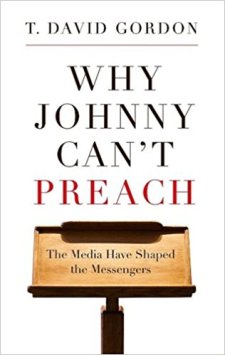
 In his wonderful little book, T. David Gordon seeks to answer Why Johnny Can’t Preach. He has a few answers, and one of them is fairly simple – Johnny can’t preach because Johnny can’t read.
And, Johnny can’t read because he never rarely reads anything. He watches TV, he surfs the internet, he binge-watches Netflix on his tablet. But, he doesn’t read. He has little to no exposure to classic English and American literature. His literary instincts are infantile, because he rarely reads anything.
Text is passe. Now, images are key. Twitter, with its 140 characters, rules the world. Facebook memes influence millions. Every day, some new video goes “viral.” Now, the cultural conversation isn’t advanced by clear, reasoned and impassioned written or even spoken debate (ala Lincoln v. Douglas). Now, people prop their smartphones on dashboards and record rambling, often incoherent rants inside their cars, post them to Facebook, and watch the “likes” roll in.
Gordon rightly described the impact this shift has had on how we read:
Electronic media flash sounds and images at us at a remarkable rate of speed; and each image or sound leaves some impact on us, but greater than the impact of any individual image or sound is the entire pace of the life it creates. We become acclimated to distraction, to multitasking, to giving part of our attention to many things at once, while almost never devoting the entire attention of the entire soul to anything.
T. David Gordon, Why Johnny Can’t Preach: The Media Have Shaped the Messengers (Philipsburg, NJ: P&R, 2009; Kindle ed.), KL 448-450.
You see, if you haven’t made it a habit to read texts closely; to appreciate the beauty of a well-constructed sentence and/or to critically follow an argument from a more scholarly tome, then you won’t be prepared to notice these in Scripture . . . and that means you won’t be able to bring this out when you preach. Your preaching will have as much pizzazz as a flat diet coke.
Gordon explains:
Culturally, then, we are no longer careful, close readers of texts, sacred or secular. We scan for information, but we do not appreciate literary craftsmanship. Exposition is therefore virtually a lost art. We don’t really read texts to enter the world of the author and perceive reality through his vantage point; we read texts to see how they confirm what we already believe about reality. Texts are mirrors that reflect ourselves; they are not pictures that are appreciated in themselves. This explains, in part, the phenomenon that many Christians will read their Bibles daily for fifty years, and not have one opinion that changes in the entire fifty-year span.
Texts do not change or alter or skew their perspective; texts do not move them or shape them; they merely use them as mnemonic devices to recall what they already know. They have no capacity to expound a text, or to describe what another has said and how he has said it; and they retain only the capacity to notice when something in the language of another appears to concur with their own opinions. To employ C. S. Lewis’s way of stating the matter, they ‘use’ texts but do not ‘receive’ them.
Why Johnny Can’t Preach (KL 437 – 446).
This is interesting stuff. There is an inevitable, compounding effect at work here:
- Many Americans don’t read,
- Pastors in America are usually, well . . . Americans,
- Therefore many Pastors don’t read, either
- Therefore they don’t practice critical reading and comprehension
- Therefore they also cannot appreciate good literature (which the Bible certainly is)
- Therefore, what they preach is often a more diluted product of their own already anemic literary skills
I read a lot. I read fiction, history, and theology books. Right now, I’m reading an apologetics book by Athanasius (ca. 4th century) about the Christian faith. But, one thing I don’t do is read poetry – except for the Psalms. I’ve never been “into” it. I do remember reading a lot of Walt Whitman for American literature, back in my university days. Maybe, if I tip-toed back to poetry one day, I’ll be able to appreciate it better now. Perhaps I’ll pick up a poetry anthology the next time I’m at the used book store . . .
One thing is clear – if a Pastor doesn’t read much, he won’t get much out of the Bible, and the congregation will suffer. I think, from a technical standpoint, seminaries that are committed to expository preaching (and make no mistake, many are not!) are doing an outstanding job. Textbooks abound, and there are resources are aplenty. But, you can’t make a man read. And, if he doesn’t read, then he won’t preach well.

 You can find more of my pitiful translations from the New Testament, the Septuagint and an ancient creed or two
 The Textus Receptus is a printed Greek text. It’s a product of textual criticism, and (depending on which version you prefer) generally dates from the early 16th – mid 17th century. It is based on a very small number of late Greek manuscripts. It’s the printed Greek text which (in various forms) underlies William Tyndale’s translation, the KJV, NKJV and the newer MEV.
 Life is messy. The Apostle Peter understood that. And, because he wrote what God wanted him to write, that means God understands it, too.
 There are a lot of dying churches out there. Some of them deserve to die, because their pastors are charlatans, or inept, or incompetent, or unregenerate, or hateful – maybe all of the above. But, some of these churches are dying because they’re living in the past.


 Is the prophet Micah referring to Mary (Jesus’ mother in the incarnation), or to Israel? Here is the text (Micah 5:1-4):
 T. David Gordon doesn’t think so:
 Most Christians don’t ever share the Gospel. If you’re a Christian, you should start planning to stop this failure. You should decide to do something about that, to change it. But, I really mean that you should plan to stop. Don’t plan for this the same way you “plan” to start a new workout program. We all know how that last time went, don’t we?
 In 1969, the band Led Zeppelin released its first album. On that album, there was a little song entitled “Communication Breakdown.” It’s about a man who likes a girl, but can’t bring himself to actually speak to her. Now, as every married man knows, if you’re too terrified to ever speak to a pretty girl, then you have a potentially fatal problem . . .

