Paul and the Pagan – The Lost Dialogue

paul

Most people in America are aware some Christian bakers prefer to not bake cakes for homosexual “weddings.” These “here I stand” moments often repeat in a similar way each time, as the cultural foes on both sides of this ideological divide rush to their phones, eager to summon their media allies to hear their tales of woe.

In conservative Christian circles, many people say this is all a terrible thing. You’ve heard it before. The government is evil. The government is trying to persecute Christians. The government is a tool of Satan. Pack your bags, stock the bunker, prepare for The End. Things ain’t like they used to be. Etc, etc, etc.

If you were a Christian baker, would you bake a cake for what you know is a homosexual “wedding? Some Christians wouldn’t do it, as we can tell from recent media coverage. Some Christians would do it, what they consider to be biblical reasons, too. So, let me ask a simple question. The Apostle Paul was a tentmaker (Acts 18:1-3). Do you think he only made tents for Christians?

Paul was not a wealthy man, and most people in this period only earned enough to survive. Artisans made money by developing a reputation for producing better quality work than the other guy in the same town, or the next. This means you had to build your business locally – and this could only happen if you stayed in one place for a while, to develop a name for yourself.

Paul traveled all over for years, so it must have been extraordinarily difficult to get work – especially because the locals already had their own guys they went to for tent making. In this context, do you actually believe Paul would have survived if he’d only made tents for Christians?

Thankfully, biblical archaeologists have recently uncovered a perfectly preserved mp3 recording of an actual conversation between the blessed Apostle and a pagan customer. I’ve transcribed it, and you can read it all for yourself . . .

The Lost Dialogue

Paul sits on his stool, sharpening his tools, wondering how on earth he’ll find enough money for his planned trip to Corinth. He hasn’t eaten for almost a day and a half. A man wanders by and stops to chat . . .

Pagan: “Hey, dude! I’d like you to make me a tent.”

Paul: “Are you a Christian?”

Pagan: “What’s that got to do with you making me a tent?”

Paul: “Nothing, really.”

Pagan: “Ok . . . so, I’d like you to make me a tent.”

Paul: “I can do that.”

Pagan: “Ok, so how much?”

Paul: “I’ll tell you in a minute. First, do you want to know how to become a Christian? In four easy steps, you can invite Jesus into your heart. I have an old-fashioned altar nearby, too. I’ll even walk you down the aisle myself, with every head bowed, and every eye closed, nobody looking around . . .”

Pagan (looks nervous, wonders if he’s made a terrible mistake): Uh . . . look, I’m not interested. Wasn’t your leader was a criminal? And, didn’t he tell you guys you had to, like, eat his flesh and drink his blood, too . . . ?”

Paul: “Nah, man – that’s not true. In fact —–”

Pagan (interrupts Paul): “Look, I just want to buy a tent.”

Paul: “What do you plan to use the tent for?”

Pagan: “I plan to use it when I make my pilgrimage to Ephesus, to worship the fertility goddess Diana. During my stay, I plan to bring many cultic prostitutes back to my tent, where we will enjoy ourselves, and I pray our energetic activities will entice the honored goddess Diana to bless me with a wife, and many sons!”

Paul (taken aback, clearly troubled): “I . . . see . . .”

Pagan: “What’s wrong?”

Paul: “Oh, nothing.”

Pagan: “Are you sure, man? You look upset . . .”

Paul: “Well . . . actually, I don’t think I can make you this tent, after all.”

Pagan (visibly upset, confused): “Why not!?”

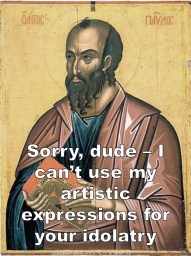
Paul: “I’m sorry, but I just can’t allow my artistic talents to be used for something my religion tells me is morally wrong.”

Pagan: “What!?”

Paul: “Yes, it’s true. I can only use my artistic expressions to promote messages that align with my religious beliefs.”

Pagan: “What have I said that’s against your “religious beliefs?’”

Paul: “I think sexual activity should only be between a married man and woman. I wrote about this in a little book. Let me get it for you —-”

Pagan (interrupts Paul): “I don’t want to see your silly book!”

Paul: “Ok, no problem. If you change your mind, just Google “Nashville Statement,” and it’s all there.”

Pagan: “I don’t believe this . . .”

Paul: “I don’t mean to offend you. It’s just that I think every Roman should be free to choose which art he will create, and which art he won’t create.”

Pagan: “Art? We’re talking about a tent.”

Paul: “My work is my art. It’s who I am. My artistic expressions are a part of me. They complete me.”

Pagan: Your . . . artistic expressions? What on earth are those?”

Paul: “I’m glad you asked. You see, I believe God has gifted me with a very particular set of skills; skills I’ve acquired over a very long career . . .”

Pagan: “Go on.”

Paul: “Well . . . I earn my living by using these very particular skills. They’re how I express my artistic talent. If I use those talents to make your tent, which you’ll take to Ephesus and use to copulate with cultic prostitutes, then I’ll be participating in your wickedness.”

Pagan: “How do you figure?”

Paul: “Because, man.”

Pagan: “Because, why?”

Paul: “Because if I make you an awesome tent with these skills, which I’ve acquired over a very long career, then I’ll be condoning your sin. I’ll actually be helping you sin! Don’t you see?”

Pagan: “No. Are you actually saying you can only make tents for people who think exactly the same way you do about marriage?”

Paul: “Uh . . . no . . .”

Pagan: “It sounds like that’s what you’re saying.”

Paul: “It isn’t.”

Pagan: “Would you make a tent for somebody who has been divorced?”

Paul: “Umm . . . I’m not sure . . .”

Pagan: “What about Alexander, the tanner? You got your leather from him last week, and he’s the one who recommended you! He’s had four wives!”

Paul: “Well, I didn’t know that.”

Pagan: “Did you ask him about it?”

Paul: “No.”

Pagan: “So, you get to pick and choose who you’ll use your ‘skills’ for, is that it?”

Paul: “Well . . .”

Pagan: “I think I’ll file a complaint with the local EEO office. I’m also recording this.”

Paul: “Let’s not be too hasty, here!”

Pagan: “So, if I hadn’t told you what I’d be using the tent for, you would have made it?”

Paul: “Of course.”

Pagan: “But now, you won’t make it. Is that right?”

Paul: “Right! My conscience won’t allow me to do this. I must use my gifts for the Lord, in a way that honors and glorifies Him!”

Pagan: “Whatever. I’m leaving.”

Paul: “I suggest you try Fred, just down the road. Cheers!”

Paul settles back down, goes back to sharpening his tools, and wonders how he’ll find food to eat tomorrow.


The Man from Uz (Part 2)

job2
“God Speaks to Job,” from an illuminated Byzantine manuscript (ca. 12th century)

Read more from the series on the Book of Job here.

In the space of one day, in the space of perhaps less than one terrible hour, Job’s entire life has fallen apart. This good man, “the greatest of all the people of the east” (Job 1:3), has been brought low by God. To be sure, it is Satan (whose name actually means accuser or adversary) who has done this, but only because God gave him permission (Job 1:12).

This conundrum raises all sorts of disturbing questions for the thinking Christian, and every serious Christian must deal with this text. Life is hard, and bad things do happen to Christians. Why? That is the question this wonderful book addresses. This is the reason God gave us this book.

In the second chapter, the author brings us back to God’s throne room, in the heavens above. Satan has returned, and Yahweh cannot help but reminded him about Job’s steadfastness, “He still holds fast his integrity, although you moved me against him, to destroy him without cause,” (Job 2:3).

  • Is God being flippant about a truly tragic situation?
  • Does God consider us to be disposable pawns, fit to be used for silly demonstrations, then tossed aside like soiled Kleenex?
  • Does God’s way of speaking to Satan reflect badly upon Him in any way?
  • When Christians are suffering through some terrible ordeal, and bearing the strain without cursing God (just as Job has done thus far; cf. Job 1:20-22), is God speaking this way about us?
  • Is it inappropriate to even ask these questions about God? Is it somehow more pious to pretend we have no questions about the justice and rightness of His actions, here?

Satan responds with a pretty shrewd insight,

All that a man has he will give for his life. But put forth thy hand now, and touch his bone and his flesh, and he will curse thee to thy face (Job 1:4-5).

Satan has failed to get Job to curse God so far. But, he’s convinced that a deliberate attack on Job’s physical health will achieve the desired result. God had previously denied this to Satan (Job 1:12), but now He’s lifted that restriction. “And the LORD said to Satan, ‘Behold, he is in your power; only spare his life,’” (Job 2:6).

  • Do you agree with Satan, here? Do you think most professing believers would give anything in exchange for their lives?
  • What does the Bible teach us about suffering for the Lord’s sake? What are some good passages to consider, here?
  • Again, Satan can only harm Job with God’s permission. What does this tell us about the ultimate cause of physical ailments in human beings? Can we extrapolate out from this account, and directly attribute all physical sufferings to the deliberate intention of God? Why, or why not?

The text tells us,

So Satan went forth from the presence of the LORD, and afflicted Job with loathsome sores from the sole of his foot to the crown of his head. And he took a potsherd with which to scrape himself, and sat among the ashes. Then his wife said to him, “Do you still hold fast your integrity? Curse God, and die,” (Job 1:7-10).

Here are some things to consider:

  • Why does the text say Job was “among the ashes?” Does this mean he’s just sitting among the ashes he’s heaped upon his own head in mourning? Or, because of his skin disease, has Job been cast outside the city to the “dump” to be quarantined. This is the place where, among other things, dung is taken by the population to be burnt. If this is indeed the place Job has been cast out to, then perhaps we can understand his wife’s despair even more keenly.
  • Do you think Job’s wife deserves a bad reputation? Why, or why not? We understand, from a cold and intellectual perspective, that her reaction is “wrong.” But, can you understand why she would respond the way she did? Can you put yourself in her context, suffering the sudden death of 10 children and loss of all earthly possessions, watching her husband crippled from a debilitating sickness, and sympathize with her?
  • Have you ever swore at your spouse in a moment of extreme anger, frustration or sorrow, and regretted it? As you later apologized, did you say something like, “I didn’t mean it! I was just so angry . . . I’m sorry!”
  • Is the wife’s reaction something Satan would have liked? Why or why not? What does this tell us about how Satan feels about our own inappropriate reactions to trials and hardships?

Job’s response is interesting:

But he said to her, “You speak as one of the foolish women would speak. Shall we receive good at the hand of God, and shall we not receive evil?” In all this Job did not sin with his lips (Job 2:10).

He refuses to curse God, or blame Him. As we’ll see, Job never curses God, but he accuses God of injustice in a roundabout way. But, his response is intriguing:

  • Is Job right? Does God have the right, as the creator of earth, the heavens, and every single man, woman, boy and girl on earth (whether they acknowledge it or not), to dispense good and evil to His people?
  • Why would God dispense evil to His covenant people? What insight does this give us about our own problems?

The core of the book begins next. Job’s three friends arrive, and the real conversation begins (Job 2:11-13). They have many things to say, and not all of it is bad. Some of it is bad because it’s just, well . . . bad. Other times, they say things that are right sometimes, but wrong for Job’s situation. God in His providence, chose to preserve the book in this format so we can see real people, asking real questions, and struggling to find real answers to real problems in the real world.

Why do the righteous suffer? Why does God permit this? What does He want from His people as He allows them to suffer, through no fault of their own?

The book of Job is one place to go for some answers.

Real Christian Life . . . and the Government (Part 2)

are here

1 Peter 2 (13-17)What do you think of your political leaders? To be honest, many Christians would have to admit they don’t think much of politicians!

What do you think of the government? What do you think about the institutions, the agencies and bureaucracies at the local, state and federal level? Many people wish some of them would go away. In the recent election, “drain the swamp!” was one of now-President Trump’s rallying cries.

The concept is timeless; the political class is corrupt, underhanded and looking out for itself. There is an implicit assumption that all bureaucrats, at all levels of government, are inept and incompetent at best, and nefarious at worst. Even in the Apostle Peter’s day, one pagan writer referred to Rome as the city “where all things hideous and shameful from every part of the world meet and become popular.”[1]

It’s almost expected that we should despise politicians, government and those who work for “the state.” In America, we need only look to this recent political season to see the hateful rhetoric and vitriol we often show to politicians from “the other side.” Too often, Christians let their secular political passions get the best of them, and join in on this feeding frenzy of scorn and ridicule. That is wrong.

The Apostle Peter wrote his first letter in a very different context. Christians were under pressure from a pagan society to conform, or at least round some of the “rough edges” off their faith. Former pagans had been ostracized from their communities, cut off from all the support structure they had. Former Jews, who believed Jesus was the fulfillment of their Scriptures, likely had it even worse. The storm clouds of persecution had not yet broken open upon the Christians, but they were about to.

In Jerusalem, James the Just had recently been killed by a Jewish mob, thrown from the top of a building in the temple complex, stoned as he lay injured and crippled, then his head had been beaten in by a club [2]. In Rome, the Emperor Nero would soon conveniently blame Christians for starting a massive fire which had destroyed a good portion of the city. He would use this marginalized “Jewish sect” as a scapegoat, and kill many believers in awful ways. [3]

When Peter commanded Christians to “submit yourselves to every human authority because of the Lord,” he didn’t have our quaint American context in mind. He wrote for a darker time, for a more serious context. In the West, we are blessed beyond all imagination. When we Christians consider “persecution” here, we talk about losing our 501(c)(3) status and cry about bakers being forced to make cakes. In Peter’s day, people died horribly for their faith.

Yet, Peter still wrote those words, and God wanted him to write them. You see, God isn’t concerned with our comfort in the here and now; this is what Peter warned us about elsewhere (1 Peter 1:1-6; 4:12-19). The early Christians rejoiced in persecution, because they knew they were a testimony for Christ (see Acts 4; especially 4:23-31). Instead, we’re commanded to make our entire way of life holy, so we might have opportunity to help draw people to Christ by our own example in the midst of terrible trials. One of those contexts was in dealing with the government.

So to return to modern politics, it’s clear there’s a lot for Christians to disagree with. But, the Apostle Peter tells us we should always submit ourselves to every human authority, anyway. Of course, the Bible qualifies this blanket statement elsewhere (see, for example Acts 4-5).  But, in general terms, we should respect human authority “because of the Lord.”

But, we often don’t do that, do we? This isn’t the way our culture operates today; our culture encourages people to act petulant, childish, angry and crazed when they do not like a politician or agree with his politics or policies.

Last week, we spent some time in Sunday School talking about this. How we speak and think about government institutions and officials, at all levels (local, state and federal) is important. The Christian message is offensive enough; we shouldn’t compound this by crazed activism, un-Christlike rhetoric or insurrection.

Take a listen to the audio (below), and let’s see what Peter has to say about all this. It will take us several weeks to discuss this passage, and some of its implications. The teaching notes for the passage are here. All audio and teaching notes for the 1 & 2 Peter series so far are here. Feel free to contact me with any questions, or to comment below.

Notes

[1] From Tacitus, “Annals 15.44.2-8.” This excerpt is from J. Stevenson (ed.), A New Eusebius, revised by. W.H.C. Frend (London, UK: SPCK, 1987), 2-3.

[2] I follow Eusebius’ account, who quotes from a near-contemporary source (Ecclesiastical History, 2.23). Josephus makes no mention of James being clubbed to death (Antiquities, 20.9.1).

[3] From Tacitus, “Annals 15.44.2-8.” This excerpt is from J. Stevenson (ed.), A New Eusebius, revised by. W.H.C. Frend (London, UK: SPCK, 1987), 2-3.

A Word from David

jerusalem

How does God expect His people to live? This is an old question, but the answer isn’t any less relevant. King David asked the same thing, a long time ago, in a galaxy far, far away:

Psalm 15:1 O LORD, who shall sojourn in thy tent?
Who shall dwell on thy holy hill?

His opening line is rhetorical. David knows the answer. But, the question itself is worth mulling over for a moment or two. Who can live in God’s tent? Who has a place in His house? Who has, as it were, a seat at His family dinner table? As Israelites and the Gentile proselytes came to Jerusalem three times per year, and began the climb up the “holy hill” to God’s city, who among them had an eternal home with the Lord?

David is not asking for the identity of all the people who belong to God; he wants to know what kind of people belong to God. What do God’s people act like? What motivates their heart and infuses their soul? To quote the great philosopher Jerry McGuire, what “completes” them?

At this point, the reader has to make a decision – is David explaining how a man becomes a child of God, or is he describing how a child of God will want to live? That is, is his answer prescriptive (e.g. do this, and become a child of God) or descriptive (e.g. a child of God will want to do this)?

The Scripture teaches us David is being descriptive. Man cannot earn his way to salvation, or else Christ wouldn’t have had to come in the first place (Galatians 2:21).

Psalm 15:2 He who walks blamelessly, and does what is right,
and speaks truth from his heart;

David locates the desire for righteous and holy behavior in the heart. Outward conformity is meaningless and cheap. We all know people who are frauds. They speak and act one way, but we know it’s an act – because we’ve seen the mask slip.

No; a man who belongs to God will want to walk blamelessly, and he’ll honestly try to do it. He won’t do it to earn salvation or buy favor from God; he’ll do it because he loves the Lord and wants to do what He says (Deuteronomy 6:4; Mark 12:28-30). This last bit is critical – an ungodly man can be morally upright. There are plenty of decent, “moral people” who have good manners. David isn’t talking about this.

To borrow a legal phrase, God doesn’t recognize behavior that is the fruit of a poisonous tree. A child of God will love God, and this love produces a real desire for loving obedience. A child of Satan (i.e. somebody who is not a Christian; see Ephesians 2:1-4) has no love for God, and therefore his actions don’t flow from that love. The motivations are different, therefore the moral weights of each action are different, too.

Consider this:

  • A co-worker named Cynthia knows you like Lee Child’s novels featuring Jack Reacher, so she snags an old paperback from a used bookstore and gives it to you for a birthday present.
  • Your wife gives you the same birthday present later that day, when you return home

You received presents from both women; identical presents. Which one carries more weight? The one from your wife, of course. Why? Because the relationship is clearly different. You’re in a covenant relationship with your wife; whereas Cynthia is the nice 65-yr old grandmother from work.

In a similar way, God weighs the believer’s actions differently than the unbeliever’ actions. In fact, in God’s case, the unbeliever’s actions have no moral value whatsoever, because they’re not being done out of loving obedience.

Psalm 15:3 who does not slander with his tongue,
and does no evil to his friend,
nor takes up a reproach against his neighbor;

It’s fascinating how David’s descriptive proofs for a child of God focus so much on action. There is much to be commended about a focus on internal motivation as a check against rote legalism. After all, we don’t want to be hypocrites, going through the external motions while our hearts are harder than stone.

But, David (and God!) don’t let us off so easy. The other side of the ditch is just as treacherous. It’s so easy to excuse external conformity with pious appeals to “the heart,” isn’t it? A man claims to be a Christian, but has lived like a reprobate for years. “Oh,” he says, “I love God! I want to serve Him, honest!” At some point, every Christian needs to be honest with himself – where is the fruit?

David expects there to be fruit. Period. A godly man doesn’t slander, doesn’t betray his friend and doesn’t slander and reproach his neighbor. In other words, he seeks to be holy, because God is holy (Leviticus 19:2; 1 Peter 1:14-15).

Psalm 15:4 in whose eyes a reprobate is despised,
but who honors those who fear the LORD;
who swears to his own hurt and does not change;

This bit is particularly interesting. A godly man will despise a reprobate (i.e. a vile person, a flagrant sinner). This is somebody who is nominally part of the Old Covenant community, but lives in complete rebellion against God. David says Israelites should despise this person; have contempt for him. In contrast, a godly woman will honor those who reverently fear the Lord.

What’s the purpose? It’s likely about shame. There is something to be said for peer pressure. But, doesn’t this concept go completely against our modern church culture? We prefer to love people to death, even when they deserve contempt, rebuke, or censure. In short, we’re wimps.

To be sure, David isn’t saying we should hate everybody who sins; we’re not on witch hunts for non-conformists. But, if you have somebody who (1) is a professing believer, (2) who is a reprobate; a vile and habitual rebel, and (3) he refuses to try to conform to God’s word, (4) then you need to take action – once all lesser means have failed. The man is hardened in his perversity and his rebellion is deliberate and calculated.

Part of this action is for the rest of the covenant community to have open contempt for the offender, and shower honor on those who honestly love the Lord.

Psalm 15:5 who does not put out his money at interest,
and does not take a bribe against the innocent.

He who does these things shall never be moved.

Isn’t is fascinating how sin so often revolves around money? In my experience in law enforcement and regulatory investigations, people do wrong for three reasons – money, sex and power. It doesn’t matter whether you’re a Christian; these three temptations are universal. Godly people will fight against these urges; thus we have David’s warnings against shady business practices. To be sure, sometimes we’ll lose against these urges. But, the general trajectory of our personal lives should be trending towards more Christlikeness, not less.

This is a short little psalm; five whole verses. Yet, it sums up an entire theology of the Christian life. Who will dwell with the Lord, and dwell in His tent? The one who proves his love for God by concrete action. What kind of action? All kinds; but this psalm gives us a good start.

This isn’t an ethic that an unbeliever can have, because only a believer’s actions flow from his love for the Lord. This was one of Jesus’ points in the Sermon on the Mount. It’s David’s point here, too.

Real Advice for a Messy Life

messyLife is messy. The Apostle Peter understood that. And, because he wrote what God wanted him to write, that means God understands it, too.

In theory, a Christian shouldn’t marry a non-Christian. Doesn’t always work out that way. Never mind why it doesn’t – we can all agree that, sometimes, it doesn’t happen that way. What if one person becomes a Christian when she’s already married? Should she pack up and hit the road? Not at all.

These are the gritty questions of real life. Life is messy. Life is hard. Life isn’t neat and tidy. As I said, Peter understands that. He has some practical advice for us on that score (1 Peter 3:1-6; from my own translation):

In the same way, you wives must submit yourselves to your own husbands, so that even if some are being disobedient to the word, they might be won over without a word by your way of life when they see your holy conduct, along with your respect towards God.

Don’t let your beauty be simply external, like the braiding of hair and wearing of gold, or putting on [fancy] clothes. Instead, let your beauty be [from] the inner person, from the heart, through the immortal [character] of a gentle and peaceful spirit, which is very precious in God’s eyes. Because this is also how the holy women from the past who hoped in God made themselves beautiful – by submitting themselves to their own husbands. That’s what Sarah did; she obeyed Abraham by calling him, “Sir.”

You’ve now become her daughters! So, do what’s right and don’t fear any husband who is intimidating.

Why does Peter call the Christian spouse to stay in the relationship? So that the believer might win the unbeliever to Christ. He tells the Christian not to lord it over the spouse, not to be filled with self-righteousness. He tells the believer to be patient and, if necessary, not say anything at all – to let her Christ-like way of life and holy conduct speak for itself.

There’s much more to be said. I’ll get there in Sunday School . . . in about two months or so!

Glory Days

autopsyThere are a lot of dying churches out there. Some of them deserve to die, because their pastors are charlatans, or inept, or incompetent, or unregenerate, or hateful – maybe all of the above. But, some of these churches are dying because they’re living in the past.

These churches are filled with older members (the younger ones fled long ago). These good folks remember the glory days, usually back when Nixon, Ford or Reagan (or perhaps Bush #1) was in office. The pews were filled, children ran in the aisles, Vacation Bible School was a big event, and things were happening!

Now . . . well, things are different.

Everybody in the congregation has white or gray hair. Many of those children are gone. Some have remained, now in their fifties and above – forlorn and melancholy about what once was. The pews are empty. The sermons grow more and more pitiful and desperate with each passing Sunday. Everybody knows the church is dying. An air of sadness pervades the congregation, an aura of inevitable doom. Rooms are closed off; nobody has used them in years. The last time you had a visitor was that one Thanksgiving . . . was it last year, or the year before?

These churches often live in the past. They revel in it. If only they could recapture those glory days. Springsteen could have been singing about them. Maybe he was.

Churches like this will probably die. It’s common in churchy circles to double down on failure, to spiritualize it and claim you’re “suffering for the Lord.” But of course you are. Nobody can whitewash failure quite like a Christian.

Thom Rainer, in his outstanding book Autopsy of a Deceased Church, wrote about this kind of dying church:

The most pervasive and common thread of our autopsies was that the deceased churches lived for a long time with the past as hero. They held on more tightly with each progressive year. They often clung to things of the past with desperation and fear. And when any internal or external force tried to change the past, they responded with anger and resolution: “We will die before we change.” And they did.

Thom S. Rainer, Autopsy of a Deceased Church: 12 Ways to Keep Yours Alive (Nashville, TN: B&H, 2014; Kindle ed. ), KL 161-164.

Real Christian Life . . . and the Government (Part 1)

It’s easy to lose your perspective. We live in a very self-absorbed, historically ignorant culture. We know, intellectually at least, that we can learn from people who have come before us. We get it. But, functionally, we don’t get it. We often act as though what’s happening right now is momentous, unprecedented, and unparalleled. That’s often not the case at all.

We live in a very politically charged atmosphere. Old mores are being toppled, the “shackles” of a Puritan-esque Christian ethic (though, to be sure, our society left Puritanism behind a long time ago, but never mind the facts) and are being cast off with glee. Our society has formerly transformed from a false “Christian Americana,” to outright secularism. To be sure, America has been secular for quite a while, but now she feels free to revel in it, without the rusty, embarrassing remnants of a Christian ethical compass to hold her back.

The historian George Marsden wrote about this bygone age in American culture, which he believes was at its height in the later quarter of the 19th century. He described it well; very well. Those who grew up in the old “Bible Belt” will understand exactly what Marsden was getting at. He wrote:

A veneer of evangelical Sunday-school piety covered almost everything in the culture, but no longer did the rhetoric of idealism and virtue seem to touch the core of the materialism of the political and business interests. It was a dime store millennium.[1]

This dimestore millennium endured for a while. I believe we saw its last gasp this past decade. Now, it’s gone. Russell Moore, a Southern Baptist leader and minister a generation older than me, wrote this about his Boy Scout troop and the cultural Christianity of his childhood in the South:

The “God and Country” badge wasn’t really about conforming us to the gospel, or to the Bible, to any confessional Christian tradition, or even, for that matter, to the “mere Christianity” of the ancient creeds and councils. This project didn’t want to immerse us (or even sprinkle us) into the strange world of the Bible, with its fiery spirits and burning bushes and empty tombs. We were here for the right kind of Christianity, the sort that was a means to an end. We were to have enough Christianity to fight the Communists and save the Republic, as long as we didn’t take it all too seriously.[2]

That version of America is gone, and it’ll never come back.

So, Christians in America are in a quandary. How should we live, work and minister in a culture which is so adamantly pagan and secular? The Apostle Peter tells us how. And (to return to my point about perspective), Peter is a guy who wrote and ministered in a much more secular time than we live in today, in the West.

Not long after Peter died for his faith (likely on the orders of the Roman Emperor, Nero), Christians were periodically ordered to declare their allegiance to the Emperor by offering incense to him, and worshipping him. Now, that’s a quandary. Do you think our political climate is unprecedented? Peter faced Nero. You face MSNBC. Children, please . . .

Our text for next few week is very practical; it speaks to real life, in the real world, and how Christians should think about and deal with the government (really, all people in authority).

1 Peter 2 (13-17)

  • Who are you supposed to submit yourself to?
  • What does it mean to “submit yourself?”
  • How should this inform how you interact with government officials, or refer to them in private conversations, public conversations, and your posts on social media?

Take a listen to the audio (below), and let’s see what Peter has to say about all this. It will take us several weeks to discuss this passage, and some of its implications. The teaching notes for the passage are here. All audio and teaching notes for the 1 & 2 Peter series so far are here. Feel free to contact me with any questions, or to comment below.

Notes

[1] George Marsden, Understanding Fundamentalism and Evangelicalism (Grand Rapids, MI: Eerdmans, 1991), 10.

[2]  Russell D. Moore, Onward: Engaging the Culture without Losing the Gospel (Nashville, TN: B&H, 2015), 11-12.

Dereliction of Duty?

deverMost Christians don’t ever share the Gospel. If you’re a Christian, you should start planning to stop this failure. You should decide to do something about that, to change it. But, I really mean that you should plan to stop. Don’t plan for this the same way you “plan” to start a new workout program. We all know how that last time went, don’t we?

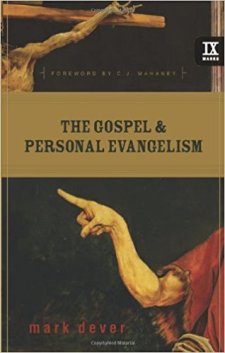
Mark Dever, in his wonderful little book The Gospel and Personal Evangelism, offers some advice on how to plan to start doing evangelism in your daily life:

Pray. I think many times we don’t evangelize because we undertake everything in our own power. We attempt to leave God out of it. We forget that it is His will and pleasure for His gospel to be known. He wants sinners to be saved. Simply put, we don’t pray for opportunities to share the gospel, so how surprised should we be when they don’t come? If you’re not evangelizing because you think you lack opportunities, pray and be amazed as God answers your prayers.

Mark Dever, The Gospel and Personal Evangelism (Wheaton, IL: Crossway, 2007), 24.


Communication Breakdown?

unchurched next doorIn 1969, the band Led Zeppelin released its first album. On that album, there was a little song entitled “Communication Breakdown.” It’s about a man who likes a girl, but can’t bring himself to actually speak to her. Now, as every married man knows, if you’re too terrified to ever speak to a pretty girl, then you have a potentially fatal problem . . .

For Christians, there is another kind of communication breakdown happening. Most Christians have never done anything concrete to give somebody the Gospel, at all. Now, I don’t intend to shame you into anything – there’s been enough of that over the years. Instead, I want to encourage you.

Thom Rainer is a Southern Baptist minister currently President of LifeWay Christian Resources. Not long ago, he did a remarkable amount of research and published a book entitled The Unchurched Next Door: Understanding Faith Stages as Keys to Sharing Your Faith. Consider this, from the book:

82 percent of the unchurched are at least “somewhat likely” to attend church if they are invited. Perhaps we need to pause on this response. Perhaps we need to restate it: More than eight out of ten of the unchurched said they would come to church if they were invited. If you take anything from this book, please remember this point.

What constitutes an invitation? For many of the unchurched, it was a simple statement of invitation to come to one’s church. For others, it was an invitation that included the offer to meet someone at church to show them around. In either case, the process was pretty basic. If we invite them, they will come.

The next obvious question is: Are Christians inviting non-Christians to church? The heartbreaking answer is no. Only 21 percent of active churchgoers invite anyone to church in the course of a year. But only 2 percent of church members invite an unchurched person to church.

Thom S. Rainer, The Unchurched Next Door: Understanding Faith Stages as Keys to Sharing Your Faith (Grand Rapids, MI: Zondervan, 2008; Kindle ed.). KL 298 – 301.

Why don’t you invite a friend, family member or co-worker to church this Sunday? Give it a shot.

Farmers, Not Salesmen

workplace graceIf you’re a Christian, I predict one of these two scenarios probably describes your experience with evangelism:

Scenario #1: You’ve never been taught evangelism at all. Your Pastor talks about it sometimes, you know it’s important, but nobody in church leadership has ever taught you how to do it, what it’s about, what it entails, what it means, and what “success” actually is.

Scenario #2: You’ve been taught a pre-scripted, rote, memorized way to share the Gospel. You know, deep down, that you sound like a cheesy salesman, so you don’t usually bother to do it.

Scenario #1 is unacceptable, and your church leadership should put some energy and effort into fixing this – now. Scenario #2 is unhelpful, and very bad. Pre-scripted approaches are unhelpful because you cannot script a conversation. It’s more important you actually understand doctrine, so you can better explain it to people with the time you have. For more on this, see my lesson entitled “Teaching the Gospel to Kids” (audio and handout are at the link).

The truth is, Christians are not salesmen – we’re farmers. I’ll let a good book explain the rest:

Many Christians learned a mechanical, aggressive approach to evangelism. We attended workshops and read books based on techniques developed by people who have the gift of evangelism. That is the problem. When those of us who are not gifted evangelists muster up the courage to try these techniques, the results are usually disappointing— which makes us feel guilty and often offends others. We begin to think of ourselves as substandard disciples who are simply not able to share our faith. Although we want to see friends and colleagues come to Christ, we stop trying out of fear and frustration.

According to a 2009 Barna Group survey, since 1995, the proportion of born again adults claiming the gift of evangelism dropped from four percent to one percent. The problem is one of perspective, not inability. We tend to think of evangelism as an event, a point in time when we explain the gospel message and individuals put their faith in Jesus on the spot. Done!

However, according to the Bible, evangelism is an organic process, more like farming than selling. A person’s decision to trust Christ is the climactic step, following a series of smaller steps God orchestrates to draw a person to Himself. He typically enlists a number of people with a variety of gifts. Each person plays a different but vital role to help a nonbeliever take one step closer to Jesus.

Bill Kraftson of Search Ministries observes that each Christian in a nonbeliever’s journey to faith is like a link in a chain. “It’s great to be the last link in the chain,” Kraftson says, “but it’s not more important than any other link. We just need to make sure we’re not the missing link.”

Walt Larimore and Bill Peel, Workplace Grace: Becoming a Spiritual Influence at Work (Longview, TX: LeTourneau Press, 2014; Kindle ed.), KL 203 – 224.