A Bit About Esther’s Charming Husband

The first chapter of the Book of Esther sets the stage for the rest of the account. It tells us why she even became the Queen of the Persian Empire in the first place. More specifically, it tells a bit about her charming husband, Ahasuerus (other translations usually call him Xerxes). He was not a good man! But first, the text:

Now it came to pass in the days of Ahasuerus, (this is Ahasuerus which reigned, from India even unto Ethiopia, over an hundred and seven and twenty provinces:) That in those days, when the king Ahasuerus sat on the throne of his kingdom, which was in Shushan the palace (Esther 1:1-2).

The Persian Empire which Ahasureus inherited from his father was very large. It stretched from India to the northern Sudan in Africa (e.g. “Ethiopia”).[1]

Persian Empire
Map from: Jesse Hurlbut, Historical Geography of the Bible (Chicago, IL: Rand, McNalley & Co., 1887). It’s an old map, sure, but it’s in the public domain . . . !

King Ahasureus reigned from 486 – 485 B.C. Jews had been deported to Babylon in the early 590s, and in 586 B.C. This meant that Jews had been living in exile in Babylon for about 100 years by this point; 4-5 generations is a long time to develop deep roots!

In the third year of his reign, he made a feast unto all his princes and his servants; the power of Persia and Media, the nobles and princes of the provinces, being before him: When he shewed the riches of his glorious kingdom and the honour of his excellent majesty many days, even an hundred and fourscore days (Esther 1:3-4).

We just read that King Ahasuerus had a feast for six whole months! This event involved princes, servants,senior military officials (“the power of Media and Persia”) and civil administrators and leaders. What in the world was going on here?

Secular history tells us that this was a massive military planning session.[2] King Ahasuerus’ father had planned a military expedition against the Greeks, but died before he could pull it off – Ahasuerus wanted to finish what his father had started. This wasn’t a six-month long party – it was a strategy and planning session with his civil and military leaders from all over his massive empire.[3]

It was intentionally lavish (“he showed the riches . . .”) to impress the subordinates from all the far-flung corners of his empire. He needed their troops, their money, and their support to make his proposed military campaign happen.[4] The idea was to cumulatively overawe his subordinates with his riches, wealth and power as this planning session went on. They would be influenced to believe:

  • “The King is strong!”
  • “The empire is mighty!”
  • “This plan could work!”
  • “I’ll do my part to raise troops, provide funds, and support this endeavor!”

King Ahasuerus spent four years preparing for this campaign. He started immediately when he assumed the throne, three years before the events in the first chapter of Esther.[5] He had this massive planning session to declare his intentions and awe his military and civilian officials into supporting the plan. They actually set out about one year after this event. Esther didn’t become queen until he returned from the expedition – there is a large, multi-year gap between Esther 1 and 2.

Here was his military plan:

  • (1) Gather an army
  • (2) March overland to the Strait of Dardenelles (Hellespont)
esther1
Map showing approximate position of Ahasuerus and his first objective, the Strait of the Dardenelles
  • (3) Have his engineers erect a bridge across a suitable portion of the Strait
esther2
The approximate position where King Ahasuerus crossed the Strait with his army
  • (4) March his army across and attack and conquer Greece and burn Athens to the ground
esther3
My crude rendering of King Ahasuerus’ proposed route of advance into Greecian territory once he crossed the Strait
  • (6) Have his Navy protect the bridge from the Greek Navy during the campaign and destroy the Greek Navy, as well

So, what kind of guy was King Ahasuerus? He was a petty, cruel, altogether worthless man. Here are some examples:

  • His uncle advised against this adventure, reasoning that if the Greek Navy managed to destroy the bridge, Ahasuerus and his army would be cut off from home and destroyed piecemeal by the Greek army.[6] Ahasuerus called his uncle a “faint-hearted coward” and ordered him to stay home with the women while he marched forth to battle![7]
  • Engineers were sent ahead to build the bridge as the army marched onward. When his army finally reached the bridge, a great storm destroyed it! Ahasuerus was so furious, he ordered the water lashed in punishment, rebuking the waves for destroying the bridge![8] Even more disturbing, Ahasuerus had the construction supervisors decapitated[9]
  • A trusted elderly servant, accompanying the expedition, had second thoughts about going on. He asked Ahasuerus if he could take his eldest son and return home, leaving his four other sons to continue onward with the expedition.[10] Ahasuerus was furious, told the servant “no,” had the eldest son killed, cut in half, and placed on either side of the road for the army to march past.[11] He then made the servant continue on with the expedition, for good measure!

I say all that to say this – King Ahasuerus was not a kind, godly or nice man!

We’ll examine what happened one particular evening at this feast next time . . .


[1] “Xerxes was known for his consolidation of the Persian empire ‘from India to Cush,’ corresponding to the regions of modern Pakistan and northern Sudan, respectively,” (Karen H. Jobes, Esther, NIV Application Commentary [Grand Rapids, MI: Zondervan, 1998; reprint, Kindle ed., 2011], KL 960-961).

[2] Herodotus wrote, “After the conquest of Egypt, intending now to take in hand the expedition against Athens, Xerxes held a special assembly of the noblest among the Persians, so he could learn their opinions and declare his will before them all,” (The Histories 7.8, trans. A. D. Godley [Cambridge, MA: Harvard University Press, 1920]. Retrieved from http://goo.gl/eafshR).

[3] Joyce Baldwin suggests that the six-month length may be intentional irony on the part of the anonymous author of Esther: “The banquet then was the culmination of the festivities. Many would consider even seven days too long a time for such a carousal, but the intention is to conjure up an impression (not without irony) of the unlimited resources of the king . . .” (Esther, vol. 12, TOTC [Downers Grove, IL: InterVarsity Press, 1984], 57).

[4] Jobes commented, “Xerxes was mustering the nobles, officials, military leaders, princes, and governors of the provinces in Susa to rally support for his military campaign against the Greeks. The vast expanse of the Persian empire, from modern Pakistan in the east to modern Turkey in the west, encompassed many people groups with different languages, ethnic origins, and religions. Maintaining their support and loyalty over such a diverse and far-flung empire was no small feat. During the 180 days of the council, Xerxes displayed his wealth and glory to consolidate the leaders of the many provinces of the empire under his authority and to gain their loyalty to his cause,” (Esther, KL 990-995).

[5] “For full four years after the conquest of Egypt he was equipping his force and preparing all that was needed for it; before the fifth year was completed, he set forth on his march with the might of a great multitude.,” (Histories 7.20). The four-year preparation ran from 486-482 B.C. The planning session outlined in Esther 1 took place “in the third year of his reign” (Est 1:3) which was 483 B.C.

[6] “Suppose they do not succeed in both ways; but if they attack with their ships and prevail in a sea-fight, and then sail to the Hellespont and destroy your bridge, that, O king, is the hour of peril,” (Histories 7.10).

[7] “Thus spoke Artabanus. Xerxes answered angrily, ‘Artabanus, you are my father’s brother; that will save you from receiving the fitting reward of foolish words. But for your cowardly lack of spirit I lay upon you this disgrace, that you will not go with me and my army against Hellas, but will stay here with the women; I myself will accomplish all that I have said, with no help from you,” (Histories 7.11).

[8] “When Xerxes heard of this, he was very angry and commanded that the Hellespont be whipped with three hundred lashes, and a pair of fetters be thrown into the sea. I have even heard that he sent branders with them to brand the Hellespont. He commanded them while they whipped to utter words outlandish and presumptuous, ‘Bitter water, our master thus punishes you, because you did him wrong though he had done you none. Xerxes the king will pass over you, whether you want it or not; in accordance with justice no one offers you sacrifice, for you are a turbid and briny river,’” (Histories 7.35).

[9] “He commanded that the sea receive these punishments and that the overseers of the bridge over the Hellespont be beheaded. So this was done by those who were appointed to the thankless honor, and new engineers set about making the bridges,” (Histories 7.35-36).

[10] “‘Master, I have a favor to ask that I desire of you, easy for you to grant and precious for me to receive.’ Xerxes supposed that Pythius would demand anything rather than what he did ask and answered that he would grant the request, bidding him declare what he desired. When Pythius heard this, he took courage and said: ‘Master, I have five sons, and all of them are constrained to march with you against Hellas. I pray you, O king, take pity on me in my advanced age, and release one of my sons, the eldest, from service, so that he may take care of me and of my possessions; take the four others with you, and may you return back with all your plans accomplished,’” (Histories 7.38).

[11] “‘Villain, you see me marching against Hellas myself, and taking with me my sons and brothers and relations and friends; do you, my slave, who should have followed me with all your household and your very wife, speak to me of your son? Be well assured of this, that a man’s spirit dwells in his ears; when it hears good words it fills the whole body with delight, but when it hears the opposite it swells with anger. When you did me good service and promised more, you will never boast that you outdid your king in the matter of benefits; and now that you have turned aside to the way of shamelessness, you will receive a lesser requital than you merit. You and four of your sons are saved by your hospitality; but you shall be punished by the life of that one you most desire to keep.’ With that reply, he immediately ordered those who were assigned to do these things to find the eldest of Pythius sons and cut him in half, then to set one half of his body on the right side of the road and the other on the left, so that the army would pass between them,” (Histories 7.39).

1 Timothy 3:16 – Who Was Manifest in the Flesh!?

inspector_gadget
Inspector Gadget will figure this out . . .

A good friend of mine recently shared a Bible passage which encouraged him. It spoke about the deity of Christ. This is the passage in the KJV:

And without controversy great is the mystery of godliness: God was manifest in the flesh, justified in the Spirit, seen of angels, preached unto the Gentiles, believed on in the world, received up into glory,” (1 Tim 3:16)

It is obvious that the text says that God was manifest in the flesh, and the context is clearly speaking about Jesus Christ. Good stuff. I like it. But, why does another version read completely differently? Here is the ESV:

“Great indeed, we confess, is the mystery of godliness: He was manifested in the flesh, vindicated by the Spirit, seen by angels, proclaimed among the nations, believed on in the world, taken up in glory,” (1 Tim 3:16)

You can see that, instead of God, we have the word He. In fact, every modern English translation reads He instead of God. Is this some kind of sinister plot? Not at all! It depends which Greek text your English translation is based on. The KJV and the NKJV are based on the Textus Receptus. Every single other major, modern English translation is based on the critical Greek text – the latest editions of which are the NA-28 and the UBS-5.

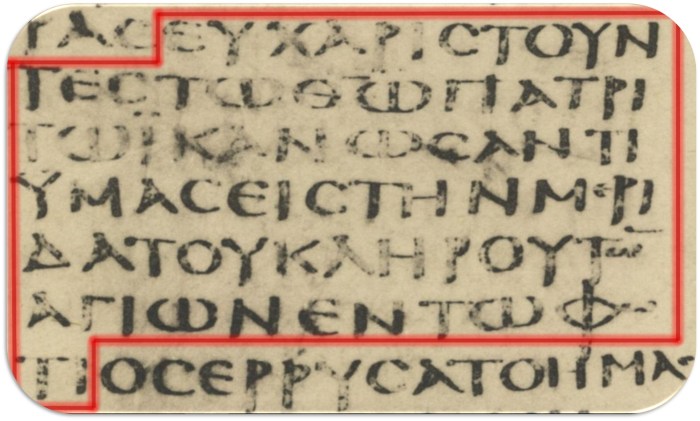
Regarding the mysterious case of God vs. He in 1 Timothy 3:16, it is obvious that “He” is the original reading. Let me show you an example from the earliest manuscript which contains both options – Codex Sinaiticus (ca. 4th century):

sinai3

The portion of the text I highlighted reads who. This is obviously what the manuscript originally read, because it’s written in line with the rest of the text. In modern English translations, they clean this up a bit by supplying the implied antecedent “He.” But, did you notice what was scribbled in smaller print just above it?

sinai4

The normal scribal abbreviation for God is scribbled above the original who. It looks just like something we’ve all done when writing with pen – we scribble an addition to a previously written text above the original.

What’s truly fascinating is what people did to the other earliest manuscripts for 1 Timothy 3:16. In a manuscript from the 5th century (A), somebody did exactly the same thing – they scribbled “God” above the original “who.” In yet another manuscript from the 5th century (C), you see precisely the same thing again. In another 5th century manuscript (D), the text reads “which,” and a later hand scribbled in “God” above the line there, too.

It is very clear that the original reading of 1 Timothy 3:16 is “who” (i.e. “He”), and not “God.” Somebody scribbled “God” into the manuscript at a later date. Now, I agree that Jesus certainly is God, but the text doesn’t say that here.

The Book of Jude and English Bible Translations

erasmus
Desiderius Erasmus by Albrecht Durer (1526)

I’m finished with my rough translation and about 50% of my detailed grammar work for my own translation of the Book of Jude. I still have to (1) classify all the accusatives and datives, (2) re-evaluate my translation of the tense, voice and mood, (3) look over pronouns again, and then (4) look at the textual critical issues. I’m using the TR for my base translation, and there are several areas where it differs from the UBS-5. This will make a difference if, for instance, you compare the NKJV to the ESV.

It is fascinating to see how the different conservative English translations offer different, but legitimate, takes on how to translate the text. This is precisely why the English reader would do well to switch his primary devotional translation for a change of pace. This is also precisely why I decided to translate the Book of Jude for myself, so I could point these issues out.

Here is a teaser issue . . . compare Jude 20-21a:

  • KJV:  “But ye, beloved, building up yourselves on your most holy faith, praying in the Holy Ghost, Keep yourselves in the love of God . . .”
  • NASB: “But you, beloved, building yourselves up on your most holy faith, praying in the Holy Spirit, keep yourselves in the love of God . . .”
  • NET: “But you, dear friends, by building yourselves up in your most holy faith, by praying in the Holy Spirit, maintain yourselves in the love of God . . .”
  • Me: “But you, beloved, by building yourselves up in your most holy faith, by praying in the Holy Spirit, keep yourselves in the love of God . . .”

What is Jude communicating here? There are two clear options:

  1. Is he telling them how to keep themselves in the love of God? Is he telling them what to be doing and also how to do it? Is he saying that we keep ourselves in the love of God (1) by building ourselves up in our faith and (2) by praying in the Spirit?
  2. Or, is he simply describing two complementary actions they ought to be taking (i.e. building themselves up and praying) while they are keeping themselves in the love of God? Is this statement really just a descriptive aside before the command to “keep themselves” in Jude 21?

Here is the Greek text in question:

  • ὑμεῖς δέ, ἀγαπητοί, τῇ ἁγιωτάτῃ ὑμῶν πίστει ἐποικοδομοῦντες ἑαυτούς, ἐν Πνεύματι Ἁγίῳ προσευχόμενοι

This whole issue hangs on the preposition ἐνMost translations (e.g. KJV, NKJV, Tyndale, ISV and NASB) see this preposition expressing association, and just use the word “in,” as if the these are merely two complementary actions that accompany the command to “keep themselves.” The NET and the Lexham English Bible, however, understand the preposition to be describing the means by which the first action is achieved. Thus, Jude is telling them that they keep themselves in the love of God by means of (1) building themselves up in their faith and (2) praying in the Spirit.

What difference does this make? Here is a paraphrase of the two options:

  • Option #1: “But you, dear ones, as you build yourselves up in the most holy faith and pray in the Spirit, keep yourselves in the love of God . . .”
  • Option #2: “But you, dear ones, by building yourselves up in the most holy faith and by praying in the Spirit, keep yourselves in the love of God . . .”

I go with the second option, because I believe the context makes more sense that way. Otherwise, you just have a vague imperative command to do something, and no earthly idea how to achieve it.

But, what’s the “right” answer? How should it really be translated? The interesting thing is that there really isn’t a definitive answer. Both translations are plausible and even probable. In fact, only two English translations even agree with my own translation – most disagree. I could say more, but you get the point!

We are blessed in the English-speaking world with a wealth of wonderful translations. We should start making more use of them!


When is God Merciful?

Ps 51 (1-2)

The Psalms are a collections of songs, written by different people over many, many years. The Psalms have always been treasured because they express the most basic and fundamental human emotions in poetic form – they give voice to what so many of us experience in our lives. If you’ve ever had a favorite song on the radio that expresses emotions, fears, anxieties and values that particularly resonate with you, then you’ll understand why the Book of Psalms is such an important part of the Bible. These psalms do the very same thing, but from a spiritual perspective – which makes them much more valuable than the catchy song on the radio!

Psalm 51 has always had a treasured place in Christian’s hearts, because every Christian can see himself in David’s words. We can transport ourselves into David’s world, understand his fears, feel his anxieties and experience the aching shame of regret for our sin. This is the value of the psalms – they express the timelessness of human emotions towards God. It doesn’t matter when the Psalm was written; it conveys feelings and attitudes that are universal. Time does not and cannot render these emotions obsolete.

In this Psalm, King David is begging God for mercy:

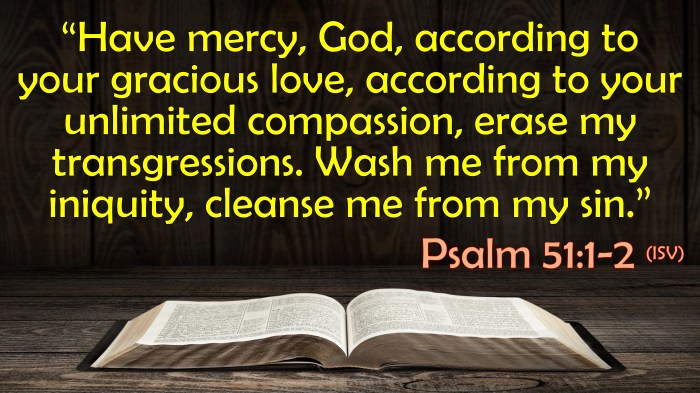
Have mercy upon me, O God, according to thy lovingkindness: according unto the multitude of thy tender mercies blot out my transgressions (Psalm 51:1)

  • Why is David asking for mercy?

He realizes that he has done something wrong, something wicked, something that God is not pleased with, something that is disgraceful to the Lord. Only somebody who belongs to the Lord by repentance and faith in Christ will actually feel ashamed of their conduct and beg for mercy.

There is none that understandeth, there is none that seeketh after God (Romans 3:11)

Now, this isn’t to say that unbelievers will never feel sorry for foolish and sinful things they do. What I mean is that it is impossible for unbelievers to feel a sense of accountability to the Lord, and a corresponding sense of shame and sorrow for their failure to serve Him. This is why the Apostle Paul warned us that, in our natural state as lost and rebellious sinners (cf. Romans 3:9-18):

  • There is nobody who is righteous
  • There is nobody who seeks God
  • Everybody is inherently worthless to God
  • There is no fear of God before anybody’s eyes

So, it’s important to realize that the only reason why David is even begging God for mercy in the first place is because he is a believer – and he therefore feels a profound and deep sense of sorrow and shame for his sins, so he begs God for mercy. Mercy is when God decides to withhold punishment that you deserve – this is what David is begging for.

  • What grounds does David have to ask God for mercy in the first place?

There two – (1) God’s lovingkindness and (2) the multitude of His tender mercies.

David can ask for mercy because he believes in God’s promise of the coming Savior – Jesus Christ. From our perspective, Jesus has already come, lived a perfect life for our sake, been tortured and executed for our sake, and rose miraculously from the dead to prove His jurisdiction, power and authority over Satan. From David’s perspective , this is all future – and he believes that God will do it. Know this – the only basis you have for begging God for mercy in the first place is if you have obeyed Jesus’ command to repent and believe the Gospel.

David is a believer in the future Messiah, Jesus Christ, and therefore has a right to lay claim to God’s lovingkindness and His tender mercy.

  • What does David ask God to do once mercy is granted?

He asks God to “blot out” out his transgressions because of the multitude of God’s “tender mercies.” If you belong to the Lord by repentance and faith in Jesus Christ, then you have a perfect forgiveness and perfect assurance of forgiveness. Only a saved person can pray this kind of prayer.

Wash me throughly from mine iniquity, and cleanse me from my sin (Psalm 51:2).


I can’t think of a more beautiful metaphor for the kind of forgiveness and mercy God shows to His adopted children. David speaks of a complete washing and cleansing from all sin, and the clear conscience that comes from knowing you’ve actually been forgiven.

If we confess our sins, he is faithful and just to forgive us our sins, and to cleanse us from all unrighteousness (1 John 1:9).

This is all present-tense, and this is the kind of forgiveness and mercy that David believes in and looks forward to – and asks God for. What Christian cannot read David’s words and reflect on his own life, his own moral failures, his own unworthiness and his own need for forgiveness, redemption, reconciliation and adoption into God’s family by Jesus Christ!?

More on Psalm 51 next time . . .

Why the Book of Esther Matters Today

Esther

What in the world does the Book of Esther have to teach the modern Christian? I believe there are three primary things we can learn from this wonderful book.

  • #1 – God uses imperfect people to do important things, even if they don’t realize it

He used the Assyrians to punish the Northern Kingdom. He used the Babylonians to punish the Southern Kingdom. He used a Medo-Persian King, Cyrus, to destroy the Babylonians, even going so far as to call Cyrus “his anointed” (Isa 45:1). He used Cyrus to send a huge wave of exiles back to Israel.

More specifically, He used secular, probably unbelieving Jews like Esther and Mordecai to save the Jewish people from genocide at Haman’s hands. They weren’t “good,” pious and faithful Jews like Daniel, Ezra or Nehemiah. The name of the one, true God isn’t even mentioned in the book by anyone, certainly not Esther or Mordecai – do you know why?

It’s because they were secularists who weren’t very worried about God, His covenant promises, or obedience to Him.[1] If they were, they’d be in Jerusalem helping to put the community back together with their fellow Jews! But . . . God used them anyway. God uses all kinds of people – even sinful and disobedient ones.

  • #2 – God keeps His promises

This book is about how God protected the Jewish people from certain destruction. Satan had been trying to destroy the Israelites, by any means necessary, for a very long time. If Satan had succeeded, Christ wouldn’t have come.[2] After all, Haman’s edict of genocide included all the Jews in Jerusalem, too!

  • #3 – God is in charge of this world

Behind all the free and admittedly un-Godly actions of Esther, Mordecai, King Ahasareus and Haman . . . God was working and was in charge of what was happening. I’ll elaborate on this more as we begin our study of the text itself next time!


[1] Whitcomb wrote, “Why, then, were God’s name and all the theocratic ideas obviously and meticulously avoided throughout the book? It was not because God’s presence was vague or uncertain. Nor was it because thousands of Gentiles died at the hands of Jews. Nor was it even because the Jewish hero and heroine of the book were probably unregenerate. The true reason is that Mordecai, Esther, and the Jews of Susa not only were outside of the promised land but, moreover, were not even concerned about God’s theocratic program centered in that land,” (Esther, 25-26).

[2] “It must not be forgotten that if Haman’s plot had succeeded, not only Jews in Susa but also the theocratic community in Jerusalem would have been wiped out. As Jacob Hoschander observed, no Purim would have meant no Israel, which would mean no Christianity,” (Whitcomb, Esther, 25).

More on English Bible Versions

tyndale
William Tyndale hard at work on his English translation of the New Testament

I’ve begun translating the Book of Jude over the past week or so. I’m doing this for three reasons:

  1. Jude is a really short and managable book,
  2. I want an excuse to use and improve my Koine Greek, and
  3. I want to use my study as an opportunity to discuss why Christians should switch their primary English Bible translation for something a bit different

I’ll be comparing my own translation with a couple of others, most likely William Tyndale’s 1526, the KJV, NASB, ESV, ISV and the NET. My translation won’t be very good, and certainly won’t be the best English in the world. I’m not doing this so I can win any Koine Greek awards or stylistic points. Instead, this is a great opportunity to point out why using different English translations can give you an extra glimpse or insight into the Biblical text that one single translation simply cannot do. For instance:

  • Is Jude the servant or slave of Jesus Christ?
  • Is he the brother of James or Jacob?
  • Did Jude write to Christians who are beloved by God, or to those who have been made holy and sanctified by Him?

Depending on which English translation you read, each of these questions will be answered completely differently – and that’s just from the first half of verse 1!

Looking forward to talking about this in the next few weeks . . . once I finish translating Jude!

Storing Up God’s Word

Ps 119(11)

If you don’t know what God’s word says, then you can’t use it to cleanse your life. If you can’t use God’s word to cleanse your life, then you will be unholy, impure, rebellious and disobedient to Him. The Word of God is the sword the Holy Spirit uses to fight against wickedness, evil, temptation and sin in your life (cf. Eph 6:17). If you do not read the Bible, then . . .

  • you will not grow,
  • you will not cleanse your life,
  • and you will be a disgrace to God

The psalmist is describing such a depth of familiarity with the Word of God that he can speak of it as being hidden or stored up in his heart, preventing him from sinning against God. Let me say this emphatically:

  • Many Christians have absolutely no idea what their Bibles say
  • Many Christian do not read their Bibles
  • Many Christians do not hide God’s word in their hearts
  • Many Christians live their Christian lives on the basis of a potpourri soup of sermons, anecdotes and traditions they’ve inherited – not on what the Bible actually says

All this means their conduct may or may not be governed by God’s word, and when God’s word is brought to bear clearly and accurately to settle an uncomfortable situation . . . they become upset, agitated, unsure of themselves, angry and defensive – because their potpourri soup of inherited tradition and half-remembered bad sermons is being directly challenged by God’s word – and that makes people angry!

If you don’t read God’s word and internalize it (all of His word, not just the convenient parts) . . .

  • then you won’t hide it in your heart,
  • then you won’t obey it because you don’t know what it is,
  • then you’re telling God you prefer your potpourri of tradition to His inspired word,
  • you won’t be cleansing your life,
  • you won’t be taking heed to His word,
  • and you’ll be a disgrace to Him

The psalmist understands all this – it’s why he’s saying what he’s saying. He doesn’t want to be like that. Do you?

All About the Book of Esther (Pt. 2)

Esther

We stopped last time just as I was about to introduce the two most important charactersa in the Book of Esther – Mordecai and Esther herself. Let’s do that now

Esther:

Esther was a secular Jew who was not a passionate follow of God. She doesn’t have many positive lessons to teach us. Instead, we’d be better off learning how not to act from her! Please take time to re-read those last three sentences again! Many people have a warm, friendly view of Esther. Some Bible study books even trumpet Esther as a role model for young women. That is a terrible thing. If you want your little daughter to be like Esther, then you haven’t read Esther very closely! Here is why, and this will be explained more as we go through the book:

  • #1 – She actually wanted to be the wife of a pagan king

We now this because she made sure she pleased the man who took care of the young virgins who were gathered for the king:[1]

Esther 2:8-9a So it came to pass, when the king’s commandment and his decree was heard, and when many maidens were gathered together unto Shushan the palace, to the custody of Hegai, that Esther was brought also unto the king’s house, to the custody of Hegai, keeper of the women. And the maiden pleased him, and she obtained kindness of him . . .

  • #2 – She didn’t eat kosher food when she entered the king’s harem, like Daniel did
  • #3 – She hid the fact that she was a Jew, because the king allowed Haman to issue a decree that all Jews in the kingdom should be killed!

If she concealed the fact she was a Jew for so long, it must mean that she didn’t live her life like a Jew. She may have even worshipped pagan gods along with her husband; if she hadn’t, it would have at least raised a few eyebrows. Contrast this with the faithfulness of Daniel. Contrast this with the faithfulness of Ezra.

Ezra 7:6 This Ezra went up from Babylon; and he was a ready scribe in the law of Moses, which the LORD God of Israel had given: and the king granted him all his request, according to the hand of the LORD his God upon him.

Don’t believe that Esther had to hide her Jewish faith upon fear of death – that’s not true and the exilic returns prove it. It’s not as though Jews would be killed if they lived their lives as Jews – after all, Ezra did was a renouned scribe raised in the Jewish community in Babylon. Jews had their own little communities all over the Persian Empire – that’s why Haman was able to issue his decree to kill them all, because they knew where to find them.

The very best that could be said about Esther is that she was a secular Jew.[2] She was born as a Jew, she knew about God and the various covenant promises. She was a brave woman, no doubt – and good for her. But, her faith was lukewarm – if it even existed at all. Her piety and devotion was practically non-existent. She probably worshipped pagan gods, or at the very least pretended to.

Mordecai:

Mordecai was Esther’s older cousin (Est 2:7). He was a secular Jew who was not a passionate follower of God. He doesn’t have many positive lessons to teach us. Instead, we’d be better off learning how not to act from him! Here is why:

  • #1 – A godly Jew wouldn’t tell Esther to keep conceal her Jewish identity

Esther 2:10 Esther had not shewed her people nor her kindred: for Mordecai had charged her that she should not shew it.

Christians who read Esther usually assume that her life would be in danger if she lived like a Jew. This is nonsense. As I mentioned above, Ezra was trained as a scribe in the Jewish community in Babylon, and earned the king’s favor. Cyrus had instituted a policy of kindness and tolerance towards Jews about 100 years earlier. Nehemiah lived as an open Jew and was the cupbearer to this king’s son.

Nobody really knows why Mordecai told her to keep it a secret. We do know that her life wasn’t in danger. We also know that it might have been a political calculation on Mordecai’s part – i.e. she’d have a better shot at being the new Queen if she concealed her Jewish identity and simply assimilated.

  • #2 – Mordecai started the feud with Haman:[3]

Esther 3:1-4 After these things did king Ahasuerus promote Haman the son of Hammedatha the Agagite, and advanced him, and set his seat above all the princes that were with him. And all the king’s servants, that were in the king’s gate, bowed, and reverenced Haman: for the king had so commanded concerning him. But Mordecai bowed not, nor did him reverence. Then the king’s servants, which were in the king’s gate, said unto Mordecai, Why transgressest thou the king’s commandment? Now it came to pass, when they spake daily unto him, and he hearkened not unto them, that they told Haman, to see whether Mordecai’s matters would stand: for he had told them that he was a Jew.

Don’t get the idea that Mordecai was a pious man because he refused to bow and “worship” Haman. Bowing wasn’t a form of worship; it was a mandated sign of simple respect for their culture. Mordecai simply didn’t like the man.

  • #3 – Mordecai kept his Jewish heritage a complete secret until the feud with Haman started (Est 3:4)[4]

He only told them he was a Jew when his co-workers asked him why he wouldn’t bow to Haman. He was likely just using his Jewishness as an excuse[5] – compare that to Daniel’s real piety!

The best you could say about Haman is that he was a secular Jew. He raised Esther as a secularist. He was a secularist. He knew about God and the various covenant promises. He had a high sense of national, Jewish pride. He may not have even been a saved man – only God knows.

More on why the Book of Esther should matter to you next time . . .


[1] Ronald Pierce wrote, “. . . one finds here a diaspora Jewess who desires a chance at the throne so greatly that she is willing to betray her heritage at the advice of her cousin without a hint of resistance. Moreover, she participates in the contest with no evident reluctance, resulting in the king being pleased with her more than all the other women and thus giving her the crown (2:16),” (“The Politics Of Esther And Mordecai: Courage Or Compromise?” Bulletin for Biblical Research 02:1 [1992], 85).

[2]  “If it seems incredible that the Jews who remained in exile should have so utterly lost all knowledge of God and all religious habits and instincts, as the book of Esther indicates, we have only to recur to the testimony of the prophet Jeremiah and Ezekiel to have all doubt removed. Esther becomes only the natural and necessary sequel to the appalling apostasy and depravity to which both these prophets testify,” (Smith, “Esther,” 399).

[3] Joyce Baldwin observed, “It is still part of eastern courtesy to bow in recognition of age and honour, and there is evidence that Israelite culture was no exception. While obeisance was given supremely to God and the king, suppliants bowed when seeking favour (so Jacob to Esau, Gn. 33:3) or when expressing indebtedness (e.g. David to Jonathan, 1 Sa. 20:41). Mordecai stubbornly refused to submit for any reason to Haman; indeed there seems to have been a general lack of respect for this man, otherwise there should have been no need for a royal command that people should bow down to him,” (Esther, vol. 12, TOTC [Downers Grove, IL: InterVarsity Press, 1984], 72). See also Whitcomb (Esther, 63-64).

[4] See Whitcomb (Esther, 64-65).

[5] “Probably this persistent (day after day) refusal stemmed more from pride than from religious scruples. For several years Mordecai had not let Esther tell the king she was a Jewess (2:10, 20), but now Mordecai was using their national heritage as an excuse for not giving honor to a high Persian official,” (John A. Martin, Esther, Bible Knowledge Commentary, ed. J. F. Walvoord and R. B. Zuck, vol. 1 [Wheaton, IL: Victor Books, 1985], 705).

Seeking God Day by Day

Ps 119

Many people assume that “seeking God” is something that only lost people do. That’s wrong.

Psalms 119:10 With my whole heart have I sought thee: O let me not wander from thy commandments.

Christians should always be seeking to know God better:

  • to love Him more,
  • to serve Him more faithfully,
  • to be a more willing and eager slave for His righteousness,
  • to be vessels that He can mold and shape for His own purposes

In short, it is a basic and fundamental duty for a Christian to be a slave for Christ.  This means a Christian should be continually seeking the Lord with everything he (or she) has. More than that, it means a Christian should be in prayer for the courage and conviction to not wander far from God’s word.

Do you seek God with everything you have? The psalmist isn’t interested in a passive, apathetic, convenient and lazy kind of faith – he loves the Lord and seeks Him with his whole heart. If you’re seeking Him with your whole heart, you’ll be willing to cleanse your life by taking heed according to God’s word – no matter how difficult it might be.

The excuses and lame justifications that might have held you back before should be meaningless to you now – if they’re not meaningless, your duty is to echo the psalmist’s prayer and ask God to make those excuses meaningless to you!

Obedience to the God’s word is more important than friendships, loyalties, warm fuzzy memories, and anything else in this world. If you’ve been a Christian for any length of time, you’ve come between a rock and a hard place before, and in that moment as you stood there at the fork in the road, you knew what the right thing was to do. That’s not the hard part – the hard part are the pathetic justifications and sinful “what if” scenarios that pop into your mind.

Let me urge you to adopt my patented three-step self-test questionnaire whenever you come to a fork in the road again, and you have to decide between the Bible and your own personal feelings and loyalties:

  1. Identify the problem
  2. Ask yourself – what does God’s word say to do about this problem?
  3. Ask yourself – why am I still even still conflicted about this?

You must be merciless about this, and that requires courage and determination. Some people would call this attitude “cold-blooded” and callous – I call it obedience, and so would the psalmist.

If you read God’s word, understand it, and deliberately decide to ignore it, then Christ is not Lord of your life, you are – there is no gentle way to put that!

Some Good Thoughts on English Bible Translations

NET_Banner_421x250_1395260640

Mark Ward (PhD, Bob Jones University) has some excellent thoughts on English Bible translations which go along with something I recently posted:

English speakers are looking for the wrong thing when we look for best. As I said, we need to look for useful. Does that sound too pragmatic? Let me clarify. We need to ask, “Which English Bible translation is most useful for preaching?” “Which is most useful for evangelism?” “Which is useful for reading through in a year?” “Which is conducive to close study?” How about for reading to kids? For memorization?

The average Christian has umpteen Bibles at home; we can afford, financially, to buy different editions for different purposes.

He is quite right. I love the KJV for preaching, because it is majestic, beautiful, and follows the original Greek text very closely. I am growing to love the NET for personal devotions, because it flows better in modern English, and is a bit more interpretive, especially in the Old Testament. (You can purchase the NET Bible here, or read it for free online here).

I’ll be posting more on the various English Bible translations in a few weeks. For now, feel free to read Mark Ward’s entire article here.