Different Strokes . . . for Different Churches?


Evangelist
Don’t be like this guy . . .

When it comes to how a congregation does corporate evangelism, there are four basic approaches or philosophies a church will take. I’m confident nearly every church will fit one of these four categories. I understand why different church leaders take each approach, but I believe only one of them is gutsy enough to be faithful to Christ. I think the other three are negligent, cowardly, and foolish, in that order.


Here they are – and I’ve even given them names to be extra offensive:

The church that doesn’t evangelize at all

This is the church that does nothing. Yes, you heard me – nothing. This church has no tracts for members. No literature. No training. No programs. No planned events. No mention of the Gospel on its website. No encouragement and exhortation to evangelize.

Nothing.

The pastor might mention evangelism every once and a while, in passing. But, it’s always vague and rather meaningless.

Pastors are pulled in many different directions, and its impossible for one guy to do everything well. I get that. But, still . . . nothing? Really?

The church that’s ashamed of the gospel

This church really, really wants to be your friend. It wants you to know it’s not like that other church; you know the one. These folks are different – they just wanna love on you and show you how nice Christians are. They’ll have public events, but somehow never mention Jesus or His Good News at all. Don’t want to offend, you know!

They’ll likely not distribute evangelistic literature at all. If they do, it’ll be so sanitized and purged of all possible offense so as to be meaningless. The “Gospel” in these presentations is typically more airbrushed than an aging starlet on Instagram.

The unbelievers who do come to these events will leave thinking these Christians are nice people. That’s sweet. The lady at the donut shop is nice, too. So is my cat. These churches have their hearts in the right place, but they’ll likely accomplish nothing positive. Their entire approach is to tiptoe softly, tenderly, and ever so apologetically towards some vague, generic conversation about Jesus.

Though it’s leaders wouldn’t put it quite this way, one must conclude they believe a sinner will come to faith in Jesus through a combination of vague “love,” lots of free food, and by never mentioning the Gospel at all.

The angry church

This church wants you to know you’re goin’ straight to hell. Don’t pass go. Don’t collect $200. Go straight to hell. The flames await, so enjoy your time burning, sucka.

These people are so passionate about the Gospel, they’ll tell you:

  1. You’re a sinner, and goin’ right to the flames of hell
  2. God loves you, and Jesus came to save you
  3. He died for you
  4. Pray this prayer, and you’ll be saved
  5. Praise God! You’re saved!
  6. Bye, now.

As Daniel Strange has observed:

Here there is a tendency when questioned simply to trot out verses like Acts 4: 12 and John 14: 6 with little explanation or apologetic defence (because we don’t have one), or to give the impression of ‘self-righteousness’, implying we have achieved total enlightenment on these issues and that there are simple and easy answers when it comes to this topic. We use a machete to bludgeon when what is needed is a scalpel to subvert. While these approaches may be doctrinally orthodox, none are winsome or persuasive.

Daniel Strange, Their Rock Is Not Like Our Rock: A Theology of Religions (Grand Rapids, MI: Zondervan, 2014; Kindle ed.), KL 431-434.

Like deranged Neanderthals, they bludgeon with gusto and frighten everyone away. These are the guys the first group doesn’t ever want to be confused with.

The nice church that isn’t afraid

This church does something really, really crazy. It cares enough to understand the world it operates in, understand the mindset and culture of the people it seeks to reach, tries to show Christian love, and yet still boldly proclaims the Gospel. This approach combines the best intentions of the last two flawed approaches (above), but doesn’t drive off the cliff into madness in the process.

Perhaps a better approach, and one in keeping with the tenor of much apologetic teaching in the New Testament, is one that both defends and proclaims Christian exclusivity with what might be called a ‘bold humility’, a stance that seeks first to understand the world of religion and religions through a biblical worldview before then applying unique and satisfying gospel truth to a world of pseudo-gospels that promise much but can never ultimately deliver. We are to give a reason for the hope that we have, but to do so with gentleness and respect (1 Pet. 3: 15). In other words, fortiter in re, suaviter in modo (boldly in action, gently in manner).

Strange, Their Rock is Not Like Our Rock, KL 434-439.

This kind of church plans and executes corporate evangelistic events, and boldly but lovingly proclaims the whole Gospel without caring who is offended. But, it also trains its members to understand theology, understand God, understand the Bible in a deep, meaningful and comprehensive way.

It teaches its people to show real Christian love to unbelievers, so they, too, might come to faith in Christ. But, this love never comes at the expense of a clear and unapologetic proclamation of Gospel truth.

It teaches its people how to share the Gospel. It explains what sin is, what repentance is, who Jesus is, what the building blocks of the Gospel are, and aggressively engages with its community in corporate evangelism. It’s out there, in the marketplace of ideas, pushing Jesus in a winsome way.

Which are you?

I could flesh out more, but I’m not trying to write a biblical theology for corporate evangelism. I’m simply making this point – your church will have to choose which approach it will take:

  1. It can never do evangelism at all. Eventually, the church will die – and it will be all your fault;
  2. It can be have benign events, never mention the Gospel at all, and pray that (magically) the person will hear it by accident one day;
  3. It can be an angry Neanderthal, and bludgeon people with the Gospel without any intellectual reflection or interaction with the people it’s speaking to;
  4. Or, it can simply tell people the whole Gospel in an unapologetic fashion, while showing Christian love and understanding to people at the same time

In my experience, churches will usually take options #1 – #3. Let’s stop being afraid. Let’s stop being brute Neanderthals. Let’s take option #4 for our churches.

The Man from Uz (Part 2)

job2
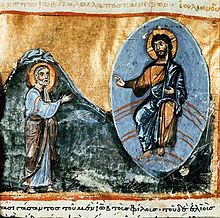
“God Speaks to Job,” from an illuminated Byzantine manuscript (ca. 12th century)

Read more from the series on the Book of Job here.

In the space of one day, in the space of perhaps less than one terrible hour, Job’s entire life has fallen apart. This good man, “the greatest of all the people of the east” (Job 1:3), has been brought low by God. To be sure, it is Satan (whose name actually means accuser or adversary) who has done this, but only because God gave him permission (Job 1:12).

This conundrum raises all sorts of disturbing questions for the thinking Christian, and every serious Christian must deal with this text. Life is hard, and bad things do happen to Christians. Why? That is the question this wonderful book addresses. This is the reason God gave us this book.

In the second chapter, the author brings us back to God’s throne room, in the heavens above. Satan has returned, and Yahweh cannot help but reminded him about Job’s steadfastness, “He still holds fast his integrity, although you moved me against him, to destroy him without cause,” (Job 2:3).

  • Is God being flippant about a truly tragic situation?
  • Does God consider us to be disposable pawns, fit to be used for silly demonstrations, then tossed aside like soiled Kleenex?
  • Does God’s way of speaking to Satan reflect badly upon Him in any way?
  • When Christians are suffering through some terrible ordeal, and bearing the strain without cursing God (just as Job has done thus far; cf. Job 1:20-22), is God speaking this way about us?
  • Is it inappropriate to even ask these questions about God? Is it somehow more pious to pretend we have no questions about the justice and rightness of His actions, here?

Satan responds with a pretty shrewd insight,

All that a man has he will give for his life. But put forth thy hand now, and touch his bone and his flesh, and he will curse thee to thy face (Job 1:4-5).

Satan has failed to get Job to curse God so far. But, he’s convinced that a deliberate attack on Job’s physical health will achieve the desired result. God had previously denied this to Satan (Job 1:12), but now He’s lifted that restriction. “And the LORD said to Satan, ‘Behold, he is in your power; only spare his life,’” (Job 2:6).

  • Do you agree with Satan, here? Do you think most professing believers would give anything in exchange for their lives?
  • What does the Bible teach us about suffering for the Lord’s sake? What are some good passages to consider, here?
  • Again, Satan can only harm Job with God’s permission. What does this tell us about the ultimate cause of physical ailments in human beings? Can we extrapolate out from this account, and directly attribute all physical sufferings to the deliberate intention of God? Why, or why not?

The text tells us,

So Satan went forth from the presence of the LORD, and afflicted Job with loathsome sores from the sole of his foot to the crown of his head. And he took a potsherd with which to scrape himself, and sat among the ashes. Then his wife said to him, “Do you still hold fast your integrity? Curse God, and die,” (Job 1:7-10).

Here are some things to consider:

  • Why does the text say Job was “among the ashes?” Does this mean he’s just sitting among the ashes he’s heaped upon his own head in mourning? Or, because of his skin disease, has Job been cast outside the city to the “dump” to be quarantined. This is the place where, among other things, dung is taken by the population to be burnt. If this is indeed the place Job has been cast out to, then perhaps we can understand his wife’s despair even more keenly.
  • Do you think Job’s wife deserves a bad reputation? Why, or why not? We understand, from a cold and intellectual perspective, that her reaction is “wrong.” But, can you understand why she would respond the way she did? Can you put yourself in her context, suffering the sudden death of 10 children and loss of all earthly possessions, watching her husband crippled from a debilitating sickness, and sympathize with her?
  • Have you ever swore at your spouse in a moment of extreme anger, frustration or sorrow, and regretted it? As you later apologized, did you say something like, “I didn’t mean it! I was just so angry . . . I’m sorry!”
  • Is the wife’s reaction something Satan would have liked? Why or why not? What does this tell us about how Satan feels about our own inappropriate reactions to trials and hardships?

Job’s response is interesting:

But he said to her, “You speak as one of the foolish women would speak. Shall we receive good at the hand of God, and shall we not receive evil?” In all this Job did not sin with his lips (Job 2:10).

He refuses to curse God, or blame Him. As we’ll see, Job never curses God, but he accuses God of injustice in a roundabout way. But, his response is intriguing:

  • Is Job right? Does God have the right, as the creator of earth, the heavens, and every single man, woman, boy and girl on earth (whether they acknowledge it or not), to dispense good and evil to His people?
  • Why would God dispense evil to His covenant people? What insight does this give us about our own problems?

The core of the book begins next. Job’s three friends arrive, and the real conversation begins (Job 2:11-13). They have many things to say, and not all of it is bad. Some of it is bad because it’s just, well . . . bad. Other times, they say things that are right sometimes, but wrong for Job’s situation. God in His providence, chose to preserve the book in this format so we can see real people, asking real questions, and struggling to find real answers to real problems in the real world.

Why do the righteous suffer? Why does God permit this? What does He want from His people as He allows them to suffer, through no fault of their own?

The book of Job is one place to go for some answers.

Against Cardboard Shepherds

5000Trinitarian heresies usually stumble over who Christ is. Without fail, these heretical groups, sects and movements brand themselves as “renewal movements.” God gave us the Scriptures but, alas, things went haywire after the apostles died. The church lurched into heresy bit by bit. These groups warn us that the Greeks influenced Christian thinking, and eventually this pagan philosophy corrupted our doctrine of God, and the church was in darkness. Until . . . (cue theme music) . . . someone read the Bible for himself and discovered The Truth (insert heresy now).

For example, Anthony Buzzard, a conservative Unitarian, writes,

Though I believe with a passion the extraordinary and yet eminently sane claims of the New Testament writers, I have the strongest reservation about what the Church, claiming to be followers of Jesus, later did with the faith of those original Christians. I believe that history shows an enormous difference between what has through the centuries come to be known as the Christian faith and what we find reported as first-century Christianity.[1]

The truth is that these cults are reading the Bible in a very flat, sterile way. The Gospels are thoroughly Trinitarian, and the cults cannot find their doctrine through a systematic exposition of Scripture. Here, in our text this morning, we see Jesus as the shepherd over Israel:

The apostles returned to Jesus, and told him all that they had done and taught. And he said to them, “Come away by yourselves to a lonely place, and rest a while.” For many were coming and going, and they had no leisure even to eat.

And they went away in the boat to a lonely place by themselves. Now many saw them going, and knew them, and they ran there on foot from all the towns, and got there ahead of them. As he went ashore he saw a great throng, and he had compassion on them, because they were like sheep without a shepherd; and he began to teach them many things (Mk 6:30-34)

Mark is the only Gospel writer who specifically explains why Jesus “had compassion on them.” It was “because they were like sheep without a shepherd.” Why were they seeking Him? It wasn’t for the free food; that would come later (Jn 6:26)! It was probably a combination of excitement because of His status as a miracle worker (cf. Mt 14:34-36), and also His unique teaching on the Kingdom of God, which everyone acknowledged carried enormous authority (cf. Mk 1:22).

Mark tells us Jesus “began to teach them many things.” Matthew adds He “healed their sick,” (Mt 14:14) and Luke explains “he welcomed them and spoke to them of the kingdom of God, and cured those who had need of healing,” (Lk 9:11).

Who is this shepherd?

It’s easy to pass by this reference to Jesus as the shepherd without comment. That would be a mistake. Jesus has already identified Himself as Messiah, and commanded everyone to repent because the Kingdom of God was at hand (Mk 1:14-15). His entire ministry identifies Him to not be an ordinary prophet or messenger. He is altogether extraordinary:

  • He’s the one John the Baptist preached about, who would baptize the faithful with the Holy Spirit (Mk 1:7-8).
  • God ripped the heavens open to proclaim Jesus as “my beloved Son” at His baptism (Mk 1:10-11).
  • He’s the One who withstood all Satan’s temptation for forty days (Mk 1:12-13); the Last Adam triumphed where the first failed so miserably.
  • He’s the one who gathered disciples to “become fishers of men,” (Mk 1:17), to call people to repent and believe in Christ and His coming Kingdom.
  • The demons are terrified of Christ, identify Him as God’s Holy one, and beg Him for mercy (Mk 1:23-24). The congregations in the synagogues are astonished, “What is this? A new teaching! With authority he commands even the unclean spirits, and they obey him,” (Mk 1:27).
  • He heals the sick, conducts exorcisms with ease, commands the demons to be silent – and they obey (Mk 1:32-34, 39)

I don’t mean this to be a tedious recitation of Jesus’ deeds. I believe Christians are so familiar with the Gospel accounts that we often forget how extraordinary they are. Jesus has proved His credentials by the end of Mark’s first chapter, and there are 15 more to go! Remember that, when Jesus was plainly asked if He was the Messiah, He pointed to His deeds as proof the Kingdom of God had broken into this present, evil world (Lk 7:18-23).

So, realize that Jesus’ actions and words already tell us He isn’t only a king. He’s divine and equal to the Father, yet distinct. This context is important when you consider Mark’s comment; “he had compassion on them, because they were like sheep without a shepherd; and he began to teach them many things,” (Mk 6:34). This is a very important phrase throughout the Old Testament.

To modern ears, the notion of Jesus as “the shepherd” evokes pastoral images. However, in Scripture, the “shepherd” is the leader and ruler of Israel. These are echoes of military victory and royal government, not pastoral sensibilities.[2] Though, to be sure, in Jesus both these themes merge together.

Moses’ True Successor

Moses asked God to appoint a successor for him, “that the congregation of the LORD may not be as sheep which have no shepherd,” (Num 27:17). He worried the Israelites would falter if they didn’t have a strong and godly leader to show them the way. In our text, Jesus sees His countrymen who had followed Him so far; some desperate with disease, others desperate for news about the promised Kingdom. He had compassion on them because they were lost. They had no guidance. They had no leader. Remember, immediately before this account, Mark just finished recounting Herod Antipas’ debauchery and his murder of John the Baptist (Mk 6:14-29). Antipas is the nominal Jewish leader of Galilee and Perea in Jesus’ day, and what a contrast!

So, God chose Joshua, “a man in whom is the spirit,” (Num 27:18). Interestingly, Moses prophesied about a man who would be raised up from among the Israelites, who would be like him, and to whom all Israel would be obligated to listen. This man is Jesus (Acts 3:22-23), who certainly had the Spirit, too (Mk 1:8,10)! Mark is identifying Jesus as the true leader of Israel, the successor par excellence to Moses.

The Bold Prophet

In another passage, King Ahab of Israel and King Jehoshaphat of Judah form an alliance against Syria. They seek a rubber-stamped blessing form the Lord, and their hirelings oblige with flattering words. Jehoshaphat asks if Ahab has another prophet handy. Ahab admits that, yes, there is another prophet, “but I hate him, for he never prophesies good concerning me, but evil,” (1 Kings 22:8).

This prophet, Micaiah, initially offers a rote prediction of smashing success. When pressed, he gives the real message: “I saw all Israel scattered upon the mountains, as sheep that have no shepherd’ and the Lord said, ‘These have no master; let each return to his home in peace,’” (1 Kings 22:17).

Micaiah’s point is clear – Ahab is such a worthless and pagan leader that the Israelites, in effect, have no shepherd at all. The prophet exited with this warning to Ahab, “If you return in peace, the Lord has not spoken by me!” (1 Kings 22:28). In contrast, Jesus is the promised Messiah, the true shepherd of God’s people.

The Coming King

In Zechariah, the prophet tells us the coming King will come on the scene in a meek and lowly manner. Yet, this king “shall command peace to the nations; his dominion shall be from sea to sea,” (Zech 9:9-10). Because of the blood of this king’s covenant with them, He’ll set the Israelites free (Zech 9:11). He will lead them into battle and crush all Israel’s enemies; they’ll trample their foes so terribly the blood will flow like wine (Zech 9:12-15).

Why is this conquering king necessary? Because, in Zechariah’s present day, “the teraphim utter nonsense, and the diviners see lies; the dreamers tell false dreams, and give empty consolation. Therefore the people wander like sheep; they are afflicted for want of a shepherd,” (Zech 10:2).

The theme is the same. The current leadership in Israel was apostate and worthless, even in the early years of the return from exile! But, take heart – a new king would come! That king is Jesus, who came to shepherd His people.

Yahweh the Shepherd

In the Book of Jeremiah, the Lord promised the Israelites that, one day, He’d destroy the Babylonians, the very nation which was gathering to destroy Israel in their day. When Babylon eventually fell, God promised, something marvelous would happen:

In those days and in that time, says the LORD, the people of Israel and the people of Judah shall come together, weeping as they come; and they shall seek the LORD their God. They shall ask the way to Zion, with faces turned toward it, saying, ‘Come, let us join ourselves to the LORD in an everlasting covenant which will never be forgotten.’

My people have been lost sheep; their shepherds have led them astray, turning them away on the mountains; from mountain to hill they have gone, they have forgotten their fold (Jeremiah 50:4-6).

Their leaders have led them to disaster; they wander about like lost sheep who can’t find their way home. Interestingly, Jeremiah tells us that Yahweh is the shepherd who will re-gather Israel and tend to them (Jer 50:19-20). Yahweh is the true shepherd; yet, Mark tells us it is Jesus.

The psalmist also tells us, “Know that the LORD is God! It is he that made us, and we are his; we are his people, and the sheep of his pasture,” (Ps 100:3). David confessed Yahweh is his shepherd (Ps 23:1).

Jesus the Shepherd

This context helps us understand Mark’s comment better. Jesus felt this compassion for the people because He was their true and promised leader; the Anointed One. His words and actions (briefly summarized from Mark’s first chapter, above) prove He is not merely a man, but the Father’s unique Son, distinct from Him, with equal power and glory. He was their “shepherd” because He was the promised leader; the one who would succeed where Moses, Ahab, and the leaders in Jeremiah and Zechariah’s day failed so terribly. In that capacity, He “taught them many things” about the Kingdom, and about what it means to truly love God (Mk 12:28-32; cf. Deut 6). Zechariah tells us Yahweh is their shepherd, yet Jesus is the One who came. What does this tell us?

The Scripture is soaked in the Trinity; in the distinction and unity of Father, Son and Holy Spirit. Those who deny the Trinity often protest they’re simply following the monotheistic faith of Abraham, and reinterpret the New Testament through this grid. “There is not a word in the New Testament about any such revolutionary changes in the definition of God.”[3]

These men and women would likely find nothing noteworthy in Mark’s comment about Jesus as the shepherd who had compassion on his lost people. This is a flat, sterile, cardboard way to read Scripture. Jesus’ deeds, words, and the Old Testament teaching about the coming shepherd and Messiah prove otherwise.

Notes

[1] Anthony Buzzard, Jesus Was Not a Trinitarian: A Call to Return to the Creed of Jesus (Morrow, GA: Restoration Fellowship, 2007; Kindle ed.), KL 296-300.

[2] James R. Edwards, The Gospel According to Mark, in PNTC (Grand Rapids, MI: Eerdmans, 2002), 191.

[3] Buzzard (Jesus Was Not a Trinitarian, KL 215).
The Man from Uz – Thoughts on Job (Part 1)

jobMy family and I are working through the Book of Job together, several nights per week. I’ll be posting some questions, thoughts and reflections on the text as we go through the book. I’ll briefly address some of the questions, and I’ll leave others alone. Perhaps they’ll encourage you to think about this wonderful book, and the timeless questions it raises about God’s eternal purposes in our lives!

The opening sentences establish Job as a good and godly man. He “was blameless and upright, one who feared God, and turned away from evil,” (Job 1:1). This doesn’t mean he was perfect, of course – just that he was a godly man. In an economy based largely on agriculture, he was clearly a very wealthy man (Job 1:3). His wealth and character marked him out as “the greatest of all the people of the east,” (Job 1:3). He was the proud father of ten adult children.

This book is likely set before the Old Covenant era,[1] perhaps in the aftermath of the Tower of Babel incident. Job acts as the priest for his family, and routinely brings burnt offerings to the Lord on his children’s behalf; “for Job said, ‘It may be that my sons have sinned, and cursed God in their hearts.’ Thus Job did continually,” (Job 1:5).

Why does Satan have direct access to Yahweh’s throne room, in heaven (Job 1:6)? What does this tell us about fallen angels? Is this still normative today? It at least tells us Satan had access during this particular time. We have no idea if this is normative, or if all fallen angels have this privilege. The author of Job isn’t interested in this detail, so I’m not too interested in it, either.

Why does Yahweh even mention Job to Satan (Job 1:8)? His tone sounds sarcastic and taunting – what’s His point? Satan responds with a bit of commonsense logic:

Does Job fear God for nought? Hast thou not put a hedge about him and his house and all that he has, on every side? Thou hast blessed the work of his hands, and his possessions have increased in the land. But put forth thy hand now, and touch all that he has, and he will curse thee to thy face (Job 1:9-11).

How many alleged “Christians” today only claim to love and worship God because their lives are comfortable? If circumstances change, what will happen to their “love” and “devotion” for the Lord? I think, for many professing Christians, Satan’s words are perfectly applicable.

Satan acknowledges Yahweh has “put a hedge about him and his house,” (Job 1:10). Is this normative? Can Christians expect God has done the very same thing to them? What does this “hedge” consist of? An angelic host of bouncers? Restraining the evil impulses of those who would do us harm? All of the above? Or, is this not a normative thing? How does the notion of “common grace” fit in, here? Does it?

The text tells us Satan can only attack Job because God permits it:

And the LORD said to Satan, ‘Behold, all that he has is in your power; only upon himself do not put forth your hand.’ So Satan went forth from the presence of the LORD (Job 1:12).

What does this tell us about God’s power, in relation to Satan’s – who is in charge? What are the implications for our lives? Does anything happen unless God specifically permits it? So, why do bad things happen to Christians? What does this say about God? What does this say about our perspective, that we would ask this question and implicitly doubt God’s holiness and goodness? Are we offended by the idea that God might intend that His people suffer through difficult times?

Is God’s goal to make our lives comfortable; or, are we supposed to serve Him in whatever way He wants us to serve? The Book of Job is one long treatise about God’s sovereignty and human suffering; this means it’s probably the most extended teaching God has given us on this subject. How should this inform how we read and understand the rest of the Bible, particularly when it comes to the issue if God’s sovereignty and the nature of evil?

In rapid succession, on the same day, all Job’s children die and all his world possessions are stolen or destroyed (Job 1:13-19). Take a moment and think about this. Think about your life, and your possessions. Really think about it, and imagine this happened to you. Then, imagine you’re Job – how would you feel? What would you be tempted to say? What would you be thinking about God? About His goodness, holiness, and righteousness? About fairness? Is He cruel for allowing you to raise ten children, only to snatch them away in an instant?

Job responds with mourning, which is to be expected (Job 1:20). However, what he says is not expected:

And he said, “Naked I came from my mother’s womb, and naked shall I return; the LORD gave, and the LORD has taken away; blessed be the name of the LORD.” In all this Job did not sin or charge God with wrong (Job 1:21-22).

What is his point? What does Job seem to think about God’s goodness, holiness and fairness? What does he think about God’s sovereignty, and His providence?

Notes

[1] The date for Job is widely discussed, and I have no interest on weighing in on this. I believe Job lived sometime during the era of the patriarchs.

“Scholars have traditionally placed the events of this book in the patriarchal period, citing the absence of any reference to covenant or law. Two facts join to support the conclusion that the book is set before the time of Moses: Job’s service as the family priest and the lack of reference to a sanctuary. Against such an inference, we need only note that Job is not an Israelite (he is from the land of Uz, 1:1). We would therefore not expect any reference to covenant or law, priest, or temple,” (John H. Walton and Kelly Lemon Vizcaino, Job, in NIV Application Commentary [Grand Rapids, MI: Zondervan, 2012], 23).

Likewise, Elmer Smick concluded, “It seems likely that Job himself lived in the second millennium B.C. (2000 – 1000 B.C.) and shared a tradition not far removed from that of the Hebrew patriarchs,” (Job, in EBC, vol. 4 [Grand Rapids, MI: Zondervan, 1988], 853).

Robert Alden summarized, “The facts about him, which are mainly in the first two chapters, suggest that he lived around the time of the patriarchs. His wealth was measured in cattle rather than in the precious metals of the time of Solomon. He reflected no knowledge of organized religion, Mosaic, Levitical, or otherwise. Like the patriarchs he was a priest to his own household (1:5). The only other explanation for this absence of anything from the Pentateuch in Job is that he lived outside the promised land and beyond the influence of the law of Moses. Probably both explanations are correct; that is, Job was very early and he lived in a region well outside Canaan,” (Job, in NAC, vol. 11 [Nashville, TN: B&H, 1993], 26).

The Trinity in the Old Testament

beckwithCarl Beckwith, a Lutheran theologian, explains a little bit about how God revealed His triune nature in the Old Testament scriptures:
What are we to make of Scripture variously identifying the sole creator of the heavens and the earth as YHWH, Elohim, Word, Spirit, Wisdom, and Father? The answer must be that the scriptural understanding of monotheism encompasses both Is 44: 24 (“ Thus says YHWH, your Redeemer, who formed you from the womb: I am YHWH, who made all things, who alone stretched out the heavens, who spread out the earth by myself”) and Gn 1: 1, Dt 32: 6, and Ps 33: 6.

Scripture declares that YHWH by Himself made all things, stretched out the heavens, and made us from the womb. According to Scripture, however, the same may be said of the Father, the Word/ Wisdom, and the Spirit. Further, Scripture insists that we have one creation, not three, and that these three created, not that they contributed a part here and a part there. Their work of creation is one.

The only responsible conclusion according to the Scriptures is to confess the correlative and coequal working of Father, Word/ Wisdom, and Spirit, and to locate all three— equally and eternally— within the unique identity of YHWH, our Elohim.

Carl L. Beckwith, The Holy Trinity, in Confessional Lutheran Dogmatics, vol. 3 (Fort Wayne, IN: Luther Academy, 2016; Kindle ed.), KL 4538-4547.

Real Christian Life . . . and the Government (Part 2)

are here

1 Peter 2 (13-17)What do you think of your political leaders? To be honest, many Christians would have to admit they don’t think much of politicians!

What do you think of the government? What do you think about the institutions, the agencies and bureaucracies at the local, state and federal level? Many people wish some of them would go away. In the recent election, “drain the swamp!” was one of now-President Trump’s rallying cries.

The concept is timeless; the political class is corrupt, underhanded and looking out for itself. There is an implicit assumption that all bureaucrats, at all levels of government, are inept and incompetent at best, and nefarious at worst. Even in the Apostle Peter’s day, one pagan writer referred to Rome as the city “where all things hideous and shameful from every part of the world meet and become popular.”[1]

It’s almost expected that we should despise politicians, government and those who work for “the state.” In America, we need only look to this recent political season to see the hateful rhetoric and vitriol we often show to politicians from “the other side.” Too often, Christians let their secular political passions get the best of them, and join in on this feeding frenzy of scorn and ridicule. That is wrong.

The Apostle Peter wrote his first letter in a very different context. Christians were under pressure from a pagan society to conform, or at least round some of the “rough edges” off their faith. Former pagans had been ostracized from their communities, cut off from all the support structure they had. Former Jews, who believed Jesus was the fulfillment of their Scriptures, likely had it even worse. The storm clouds of persecution had not yet broken open upon the Christians, but they were about to.

In Jerusalem, James the Just had recently been killed by a Jewish mob, thrown from the top of a building in the temple complex, stoned as he lay injured and crippled, then his head had been beaten in by a club [2]. In Rome, the Emperor Nero would soon conveniently blame Christians for starting a massive fire which had destroyed a good portion of the city. He would use this marginalized “Jewish sect” as a scapegoat, and kill many believers in awful ways. [3]

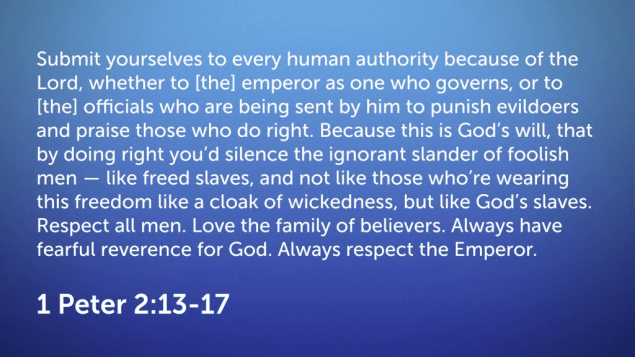
When Peter commanded Christians to “submit yourselves to every human authority because of the Lord,” he didn’t have our quaint American context in mind. He wrote for a darker time, for a more serious context. In the West, we are blessed beyond all imagination. When we Christians consider “persecution” here, we talk about losing our 501(c)(3) status and cry about bakers being forced to make cakes. In Peter’s day, people died horribly for their faith.

Yet, Peter still wrote those words, and God wanted him to write them. You see, God isn’t concerned with our comfort in the here and now; this is what Peter warned us about elsewhere (1 Peter 1:1-6; 4:12-19). The early Christians rejoiced in persecution, because they knew they were a testimony for Christ (see Acts 4; especially 4:23-31). Instead, we’re commanded to make our entire way of life holy, so we might have opportunity to help draw people to Christ by our own example in the midst of terrible trials. One of those contexts was in dealing with the government.

So to return to modern politics, it’s clear there’s a lot for Christians to disagree with. But, the Apostle Peter tells us we should always submit ourselves to every human authority, anyway. Of course, the Bible qualifies this blanket statement elsewhere (see, for example Acts 4-5).  But, in general terms, we should respect human authority “because of the Lord.”

But, we often don’t do that, do we? This isn’t the way our culture operates today; our culture encourages people to act petulant, childish, angry and crazed when they do not like a politician or agree with his politics or policies.

Last week, we spent some time in Sunday School talking about this. How we speak and think about government institutions and officials, at all levels (local, state and federal) is important. The Christian message is offensive enough; we shouldn’t compound this by crazed activism, un-Christlike rhetoric or insurrection.

Take a listen to the audio (below), and let’s see what Peter has to say about all this. It will take us several weeks to discuss this passage, and some of its implications. The teaching notes for the passage are here. All audio and teaching notes for the 1 & 2 Peter series so far are here. Feel free to contact me with any questions, or to comment below.

Notes

[1] From Tacitus, “Annals 15.44.2-8.” This excerpt is from J. Stevenson (ed.), A New Eusebius, revised by. W.H.C. Frend (London, UK: SPCK, 1987), 2-3.

[2] I follow Eusebius’ account, who quotes from a near-contemporary source (Ecclesiastical History, 2.23). Josephus makes no mention of James being clubbed to death (Antiquities, 20.9.1).

[3] From Tacitus, “Annals 15.44.2-8.” This excerpt is from J. Stevenson (ed.), A New Eusebius, revised by. W.H.C. Frend (London, UK: SPCK, 1987), 2-3.

A Word from David

jerusalem

How does God expect His people to live? This is an old question, but the answer isn’t any less relevant. King David asked the same thing, a long time ago, in a galaxy far, far away:

Psalm 15:1 O LORD, who shall sojourn in thy tent?
Who shall dwell on thy holy hill?

His opening line is rhetorical. David knows the answer. But, the question itself is worth mulling over for a moment or two. Who can live in God’s tent? Who has a place in His house? Who has, as it were, a seat at His family dinner table? As Israelites and the Gentile proselytes came to Jerusalem three times per year, and began the climb up the “holy hill” to God’s city, who among them had an eternal home with the Lord?

David is not asking for the identity of all the people who belong to God; he wants to know what kind of people belong to God. What do God’s people act like? What motivates their heart and infuses their soul? To quote the great philosopher Jerry McGuire, what “completes” them?

At this point, the reader has to make a decision – is David explaining how a man becomes a child of God, or is he describing how a child of God will want to live? That is, is his answer prescriptive (e.g. do this, and become a child of God) or descriptive (e.g. a child of God will want to do this)?

The Scripture teaches us David is being descriptive. Man cannot earn his way to salvation, or else Christ wouldn’t have had to come in the first place (Galatians 2:21).

Psalm 15:2 He who walks blamelessly, and does what is right,
and speaks truth from his heart;

David locates the desire for righteous and holy behavior in the heart. Outward conformity is meaningless and cheap. We all know people who are frauds. They speak and act one way, but we know it’s an act – because we’ve seen the mask slip.

No; a man who belongs to God will want to walk blamelessly, and he’ll honestly try to do it. He won’t do it to earn salvation or buy favor from God; he’ll do it because he loves the Lord and wants to do what He says (Deuteronomy 6:4; Mark 12:28-30). This last bit is critical – an ungodly man can be morally upright. There are plenty of decent, “moral people” who have good manners. David isn’t talking about this.

To borrow a legal phrase, God doesn’t recognize behavior that is the fruit of a poisonous tree. A child of God will love God, and this love produces a real desire for loving obedience. A child of Satan (i.e. somebody who is not a Christian; see Ephesians 2:1-4) has no love for God, and therefore his actions don’t flow from that love. The motivations are different, therefore the moral weights of each action are different, too.

Consider this:

  • A co-worker named Cynthia knows you like Lee Child’s novels featuring Jack Reacher, so she snags an old paperback from a used bookstore and gives it to you for a birthday present.
  • Your wife gives you the same birthday present later that day, when you return home

You received presents from both women; identical presents. Which one carries more weight? The one from your wife, of course. Why? Because the relationship is clearly different. You’re in a covenant relationship with your wife; whereas Cynthia is the nice 65-yr old grandmother from work.

In a similar way, God weighs the believer’s actions differently than the unbeliever’ actions. In fact, in God’s case, the unbeliever’s actions have no moral value whatsoever, because they’re not being done out of loving obedience.

Psalm 15:3 who does not slander with his tongue,
and does no evil to his friend,
nor takes up a reproach against his neighbor;

It’s fascinating how David’s descriptive proofs for a child of God focus so much on action. There is much to be commended about a focus on internal motivation as a check against rote legalism. After all, we don’t want to be hypocrites, going through the external motions while our hearts are harder than stone.

But, David (and God!) don’t let us off so easy. The other side of the ditch is just as treacherous. It’s so easy to excuse external conformity with pious appeals to “the heart,” isn’t it? A man claims to be a Christian, but has lived like a reprobate for years. “Oh,” he says, “I love God! I want to serve Him, honest!” At some point, every Christian needs to be honest with himself – where is the fruit?

David expects there to be fruit. Period. A godly man doesn’t slander, doesn’t betray his friend and doesn’t slander and reproach his neighbor. In other words, he seeks to be holy, because God is holy (Leviticus 19:2; 1 Peter 1:14-15).

Psalm 15:4 in whose eyes a reprobate is despised,
but who honors those who fear the LORD;
who swears to his own hurt and does not change;

This bit is particularly interesting. A godly man will despise a reprobate (i.e. a vile person, a flagrant sinner). This is somebody who is nominally part of the Old Covenant community, but lives in complete rebellion against God. David says Israelites should despise this person; have contempt for him. In contrast, a godly woman will honor those who reverently fear the Lord.

What’s the purpose? It’s likely about shame. There is something to be said for peer pressure. But, doesn’t this concept go completely against our modern church culture? We prefer to love people to death, even when they deserve contempt, rebuke, or censure. In short, we’re wimps.

To be sure, David isn’t saying we should hate everybody who sins; we’re not on witch hunts for non-conformists. But, if you have somebody who (1) is a professing believer, (2) who is a reprobate; a vile and habitual rebel, and (3) he refuses to try to conform to God’s word, (4) then you need to take action – once all lesser means have failed. The man is hardened in his perversity and his rebellion is deliberate and calculated.

Part of this action is for the rest of the covenant community to have open contempt for the offender, and shower honor on those who honestly love the Lord.

Psalm 15:5 who does not put out his money at interest,
and does not take a bribe against the innocent.

He who does these things shall never be moved.

Isn’t is fascinating how sin so often revolves around money? In my experience in law enforcement and regulatory investigations, people do wrong for three reasons – money, sex and power. It doesn’t matter whether you’re a Christian; these three temptations are universal. Godly people will fight against these urges; thus we have David’s warnings against shady business practices. To be sure, sometimes we’ll lose against these urges. But, the general trajectory of our personal lives should be trending towards more Christlikeness, not less.

This is a short little psalm; five whole verses. Yet, it sums up an entire theology of the Christian life. Who will dwell with the Lord, and dwell in His tent? The one who proves his love for God by concrete action. What kind of action? All kinds; but this psalm gives us a good start.

This isn’t an ethic that an unbeliever can have, because only a believer’s actions flow from his love for the Lord. This was one of Jesus’ points in the Sermon on the Mount. It’s David’s point here, too.

Johnny Can’t Read?

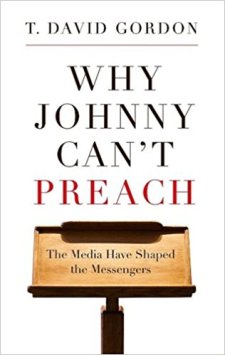
johnnyIn his wonderful little book, T. David Gordon seeks to answer Why Johnny Can’t Preach. He has a few answers, and one of them is fairly simple – Johnny can’t preach because Johnny can’t read.

And, Johnny can’t read because he never rarely reads anything. He watches TV, he surfs the internet, he binge-watches Netflix on his tablet. But, he doesn’t read. He has little to no exposure to classic English and American literature. His literary instincts are infantile, because he rarely reads anything.

Text is passe. Now, images are key. Twitter, with its 140 characters, rules the world. Facebook memes influence millions. Every day, some new video goes “viral.” Now, the cultural conversation isn’t advanced by clear, reasoned and impassioned written or even spoken debate (ala Lincoln v. Douglas). Now, people prop their smartphones on dashboards and record rambling, often incoherent rants inside their cars, post them to Facebook, and watch the “likes” roll in.

Gordon rightly described the impact this shift has had on how we read:

Electronic media flash sounds and images at us at a remarkable rate of speed; and each image or sound leaves some impact on us, but greater than the impact of any individual image or sound is the entire pace of the life it creates. We become acclimated to distraction, to multitasking, to giving part of our attention to many things at once, while almost never devoting the entire attention of the entire soul to anything.

T. David Gordon, Why Johnny Can’t Preach: The Media Have Shaped the Messengers (Philipsburg, NJ: P&R, 2009; Kindle ed.), KL 448-450.

You see, if you haven’t made it a habit to read texts closely; to appreciate the beauty of a well-constructed sentence and/or to critically follow an argument from a more scholarly tome, then you won’t be prepared to notice these in Scripture . . . and that means you won’t be able to bring this out when you preach. Your preaching will have as much pizzazz as a flat diet coke.

Gordon explains:

Culturally, then, we are no longer careful, close readers of texts, sacred or secular. We scan for information, but we do not appreciate literary craftsmanship. Exposition is therefore virtually a lost art. We don’t really read texts to enter the world of the author and perceive reality through his vantage point; we read texts to see how they confirm what we already believe about reality. Texts are mirrors that reflect ourselves; they are not pictures that are appreciated in themselves. This explains, in part, the phenomenon that many Christians will read their Bibles daily for fifty years, and not have one opinion that changes in the entire fifty-year span.

Texts do not change or alter or skew their perspective; texts do not move them or shape them; they merely use them as mnemonic devices to recall what they already know. They have no capacity to expound a text, or to describe what another has said and how he has said it; and they retain only the capacity to notice when something in the language of another appears to concur with their own opinions. To employ C. S. Lewis’s way of stating the matter, they ‘use’ texts but do not ‘receive’ them.

Why Johnny Can’t Preach (KL 437 – 446).

This is interesting stuff. There is an inevitable, compounding effect at work here:

  1. Many Americans don’t read,
  2. Pastors in America are usually, well . . . Americans,
  3. Therefore many Pastors don’t read, either
  4. Therefore they don’t practice critical reading and comprehension
  5. Therefore they also cannot appreciate good literature (which the Bible certainly is)
  6. Therefore, what they preach is often a more diluted product of their own already anemic literary skills

I read a lot. I read fiction, history, and theology books. Right now, I’m reading an apologetics book by Athanasius (ca. 4th century) about the Christian faith. But, one thing I don’t do is read poetry – except for the Psalms. I’ve never been “into” it. I do remember reading a lot of Walt Whitman for American literature, back in my university days. Maybe, if I tip-toed back to poetry one day, I’ll be able to appreciate it better now. Perhaps I’ll pick up a poetry anthology the next time I’m at the used book store . . .

One thing is clear – if a Pastor doesn’t read much, he won’t get much out of the Bible, and the congregation will suffer. I think, from a technical standpoint, seminaries that are committed to expository preaching (and make no mistake, many are not!) are doing an outstanding job. Textbooks abound, and there are resources are aplenty. But, you can’t make a man read. And, if he doesn’t read, then he won’t preach well.

My Translation of Micah 5:1-3

The prophet Micah wrote a wonderful prophesy about Jesus Christ, the One who would come forth for God to be the ruler par excellence in Israel. I’ve spent some time translating the passage from the Septuagint; the Greek translation of the Hebrew Scriptures which Jesus and the early Christian used. I plan to write a bit about this passage soon. For now, I’ll just leave you with the translation.

There are some differences from the English translation in your Bibles, because they’re translated from Hebrew, not Greek. The verse numbers from the Septuagint are also different, sometimes. This is one of those times. In your English Bibles, this passage will be Micah 5:2-4. Here, it’s Micah 5:1-3:

Micah 5(1-3)You can find more of my pitiful translations from the New Testament, the Septuagint and an ancient creed or two here.

Textus Obsoletus

elzevir-textus-receptusThe Textus Receptus is a printed Greek text. It’s a product of textual criticism, and (depending on which version you prefer) generally dates from the early 16th – mid 17th century. It is based on a very small number of late Greek manuscripts. It’s the printed Greek text which (in various forms) underlies William Tyndale’s translation, the KJV, NKJV and the newer MEV.

Because the Textus Receptus is based on such a small number of manuscripts, it has some unique readings that the other, more modern printed texts (which are based on many, many more manuscripts) don’t have. For example, I was translating 1 Peter 3:1-6 recently. I wondered why the Textus Receptus (F.H.A. Scrivener’s 1894 version, to be exact) had a subjunctive verb at a certain point, which no other printed text had. It was such an obscure reading that none of my standard textual critical resources even mentioned this variant. I looked at a more detailed database (CNTTS), and found this strange reading came from a single Greek manuscript from the 15th century. It hadn’t been found anywhere else. No. Where. Else.

Many people realize there are problems with the Textus Receptus. It’s like preferring an old tricycle when you have a Ferrari in the driveway. The tricycle works, no doubt about it. The Ferrari just works a lot better . . .

I’ll let a good book explain a bit more:

While the TR has been the dominant New Testament text for the past centuries, those who espouse this tradition today must squarely meet four challenges.

First, there has not been a plain consensus as to which TR text is best. For example, while England followed Stephanus’ 3rd edition (1550), and it eventually became the source for the Geneva Bible (1557), the European continent followed Elzever’s 2nd edition (1633) which more closely aligned with Stephanus’ 4th edition (1551). Therefore, however small the deviations, neither TR text is identical. Surely, both cannot be the pure representative of the autographa.

Second, when Theodore de Beza edited Stephanus’ fourth edition in two separate editions (1588/ 89 and 1598), he did so making some changes to each text. It is very difficult to see how one writer could dogmatically conclude, “This author believes that Beza’s 1598 Greek Edition of the New Testament is essentially equivalent to the very words of the NT autographa.” This is especially thorny when one considers that the 1611 KJV translators made extensive use of both the 1588/ 9 and 1598 editions of Beza.

Third, John Mills (1645-1707), a Greek scholar from Oxford, spent thirty years of his life studying thirty-two printed Greek New Testaments, nearly 100 manuscripts, and voluminous patristic citations of the New Testament. His work was published two weeks before his death at age sixty-two (June 23, 1707). Using Stephanus’ 3rd edition as his base he collected and calculated some 30,000 differences among the Greek texts and references. His work is a critical blow to the entire TR tradition which seeks to find a consensus in some single text that fully and accurately reflects the autographa. Mills’ research affirms that such a text did not exist in his day (almost 200 years after Erasmus’ first edition).

Finally, with such observable data, TR supporters like Hills relegate the “changes” and “emendations” to Erasmus’ 5th edition by Stephanus, Calvin, and Beza as either “humanistic tendency” or the overruling of the “common faith,” which ultimately protected the TR text from their variant readings. In their terminology, the TR has been supernaturally sheltered by God, and any textual changes (or protection from change) has been God-directed.

James B. Williams (ed.), God’s Word in Our Hands: The Bible Preserved for Us (Greenville, SC: Ambassador International, 2003; Kindle ed.), KL 4553-4573.

There are good and godly folks who prefer the KJV (for example) because they prefer the Textus Receptus. Some of these people genuinely trust that printed Greek text. However, in other cases, this position is just a smokescreen for King James Only-ism.

A very helpful book to read which defends the Textus Receptus position and takes a hostile approach towards modern printed Greek texts (e.g. UBS-5, NA28, SBLGNT) is here. I don’t agree with much of the book, but it’s an excellent and passionate representation of the position.